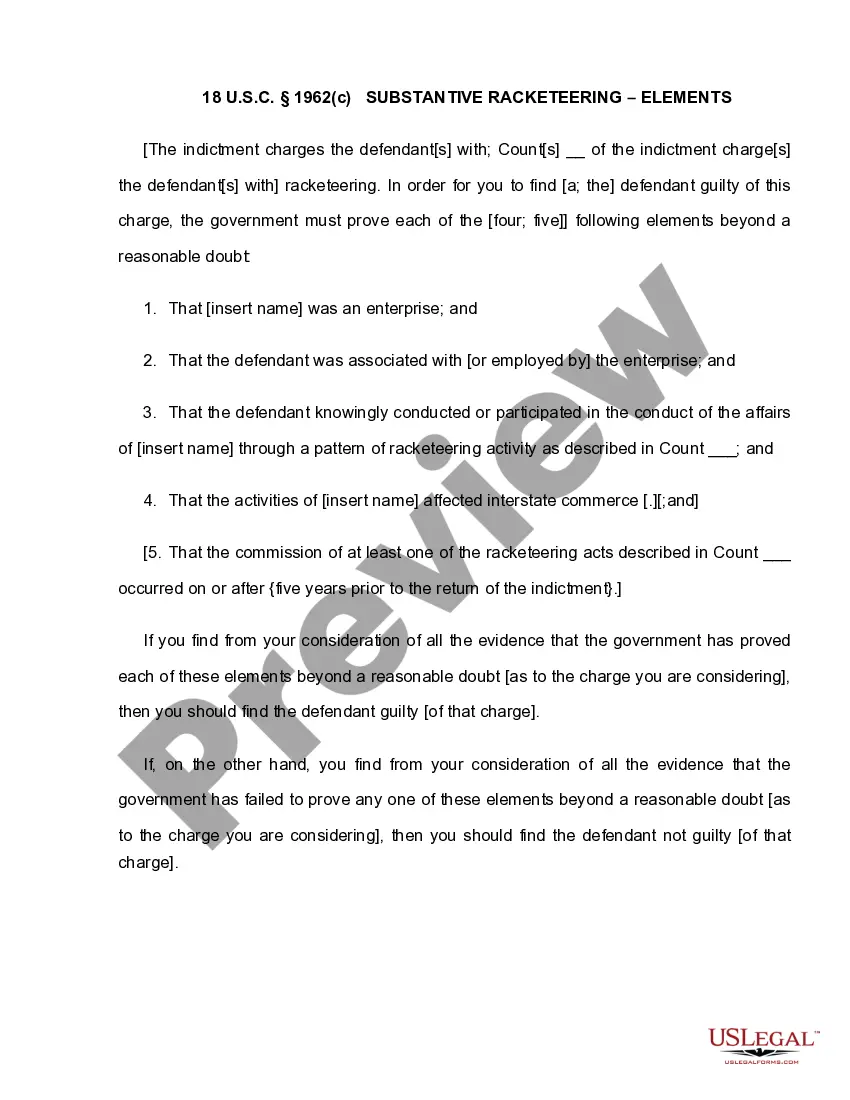
Minnesota Order for Judgment of Attorney's Fees
Overview of this form
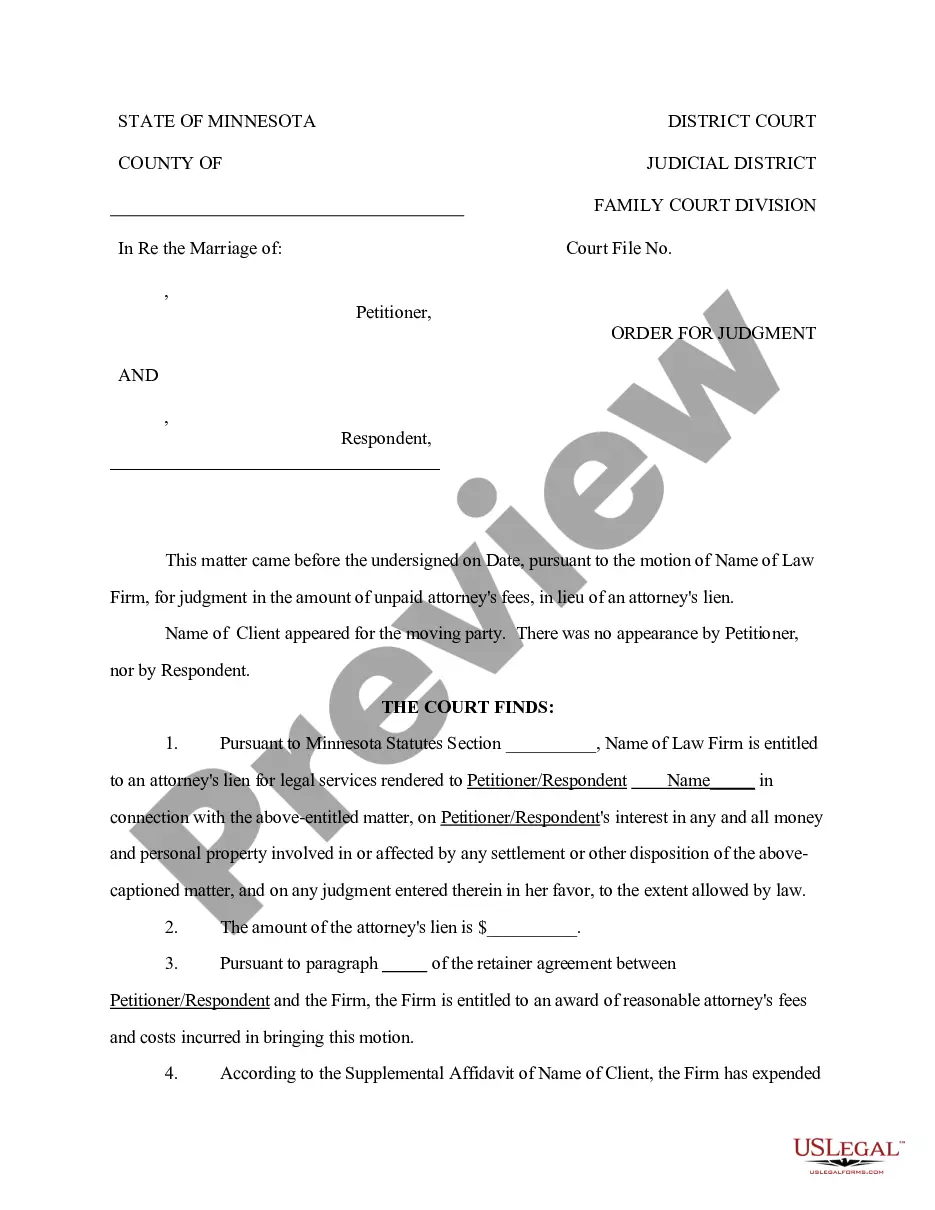
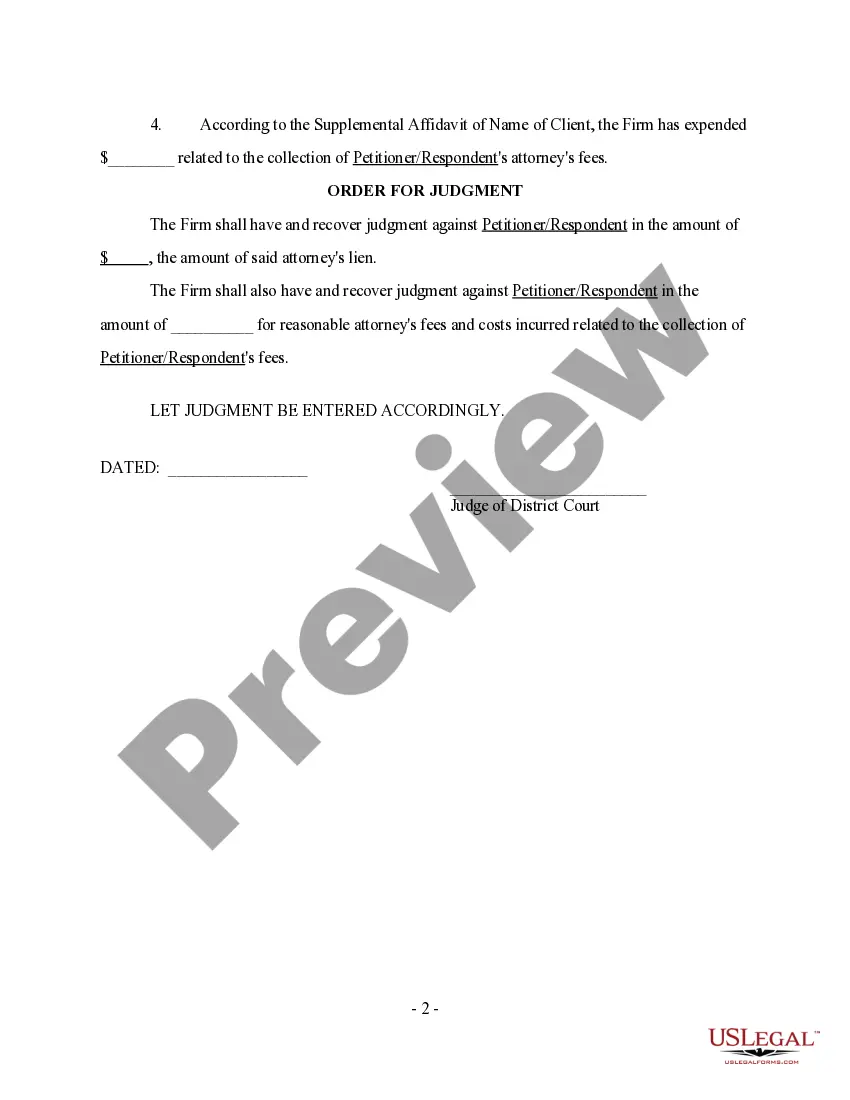
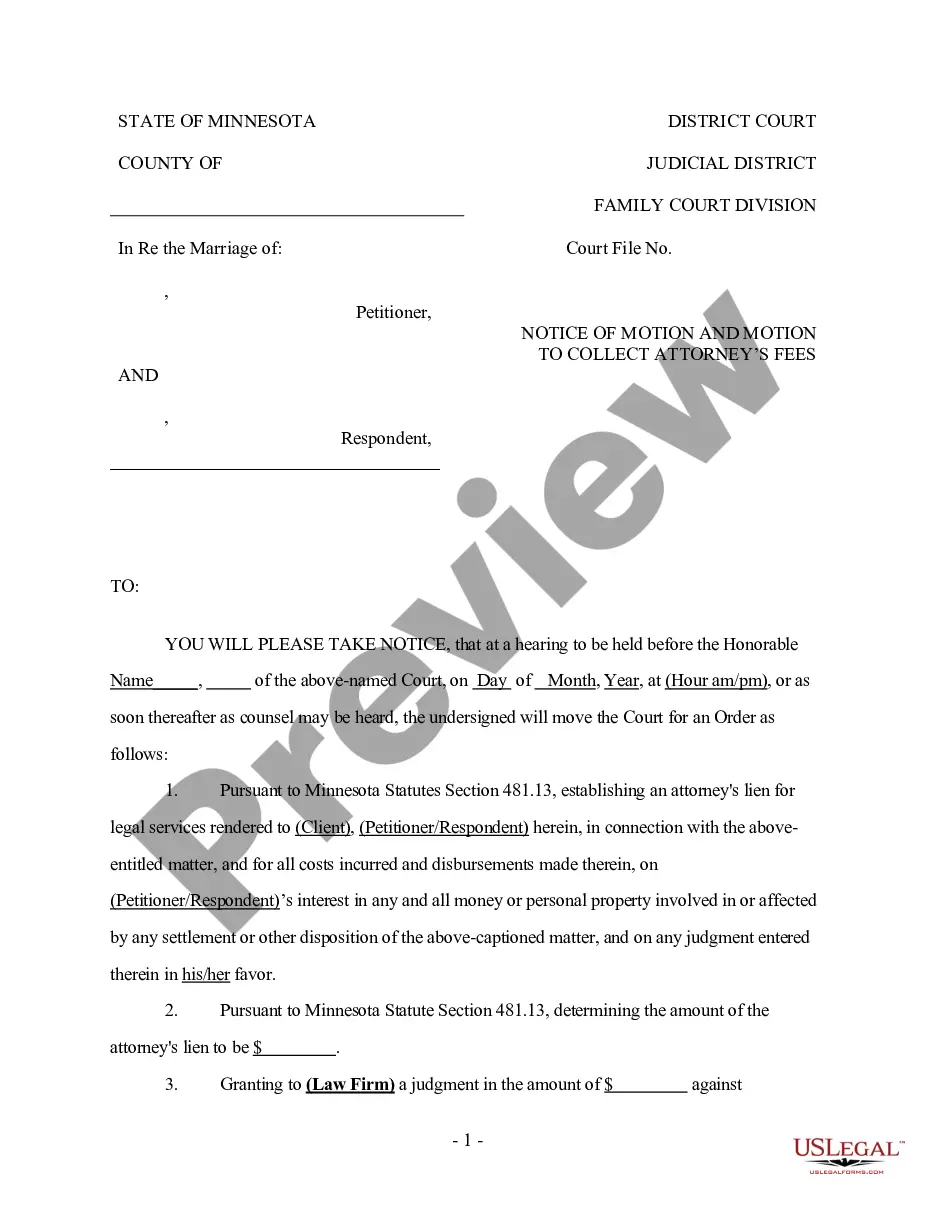
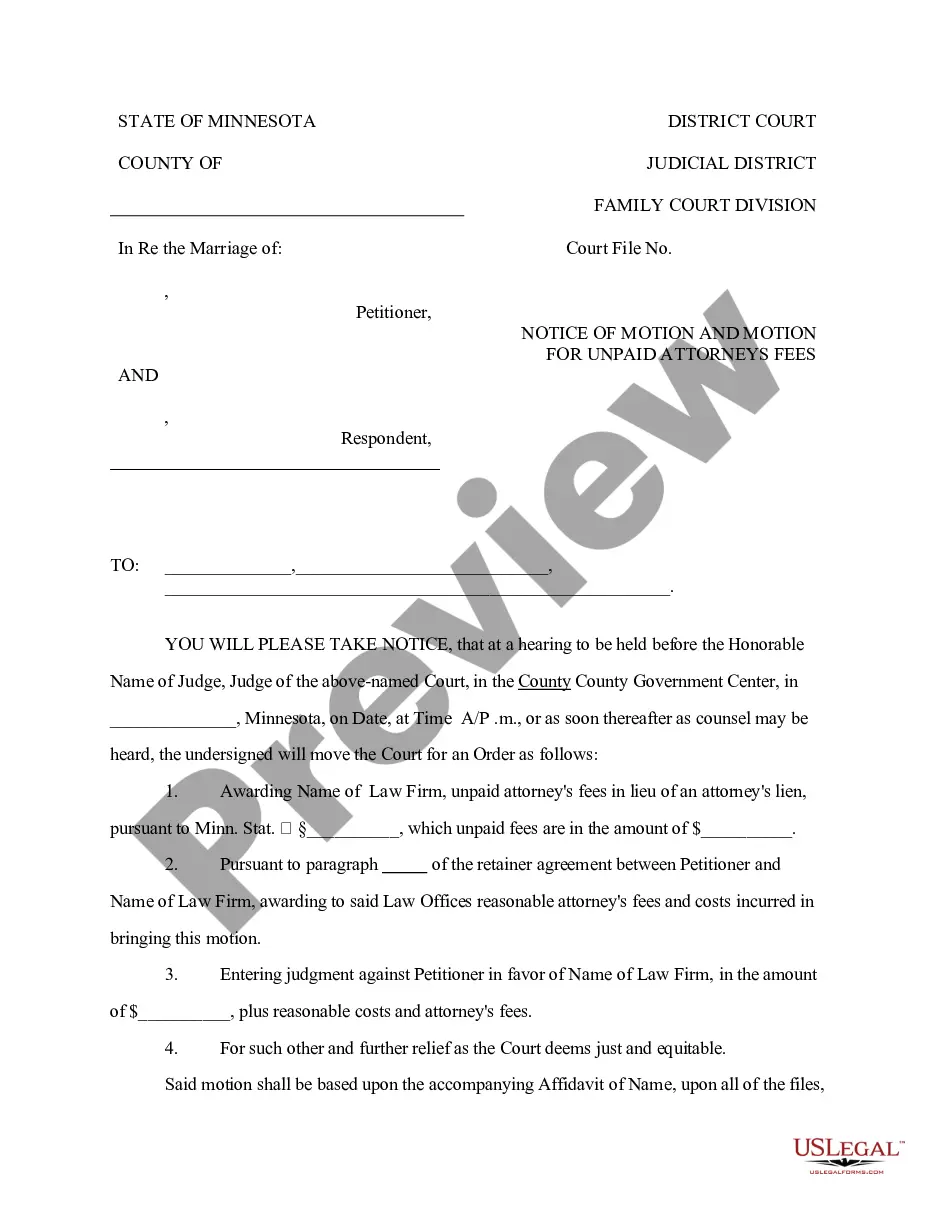
The Order for Judgment of Attorney's Fees is a legal document used to secure a judgment in favor of a law firm regarding unpaid fees. This form is specifically designed for situations where a client has not paid for legal services rendered. Unlike other forms that simply outline service agreements, this document formalizes the attorney's lien and the amount owed, making it a critical tool for law firms seeking compensation from clients who have failed to fulfill their payment obligations.
Key parts of this document
- Name of the law firm: Identifies the legal entity seeking judgment.
- Name of the client: Specifies the individual or entity that owes attorney fees.
- Amount of attorney's lien: The sum for which the law firm is seeking judgment.
- Judgment order: Formal declaration granting the law firm the right to recover the specified amount.
- Date of judgment: The date when the judgment is entered into the court record.
When this form is needed
This form is used when a law firm has provided legal services and is seeking to enforce payment through a court judgment. It is particularly relevant when a client has stopped communication or has failed to pay fees as agreed in their attorney-client contract. Typical scenarios for using this form include collection actions filing after unsuccessful attempts to collect the owed fees directly from the client.
Who should use this form
- Lawyers and law firms needing to collect unpaid attorney fees.
- Clients who are involved in disputes related to attorney fees.
- Legal professionals seeking to formalize claims against clients for unpaid services.
Instructions for completing this form
- Identify the parties involved by entering the names of the client and the law firm.
- Fill in the statutory reference to the applicable Minnesota Statutes Section.
- Specify the amount of the attorney's lien in the designated field.
- Enter the total judgment amount being sought against the client for unpaid fees.
- Date the form and include the signature of the presiding judge.
Notarization guidance
This form does not typically require notarization unless specified by local law. It is essential to check local regulations to ensure compliance with any notarization requirements that may apply.
Get your form ready online
Our built-in tools help you complete, sign, share, and store your documents in one place.
Make edits, fill in missing information, and update formatting in US Legal Forms—just like you would in MS Word.
Download a copy, print it, send it by email, or mail it via USPS—whatever works best for your next step.
Sign and collect signatures with our SignNow integration. Send to multiple recipients, set reminders, and more. Go Premium to unlock E-Sign.
If this form requires notarization, complete it online through a secure video call—no need to meet a notary in person or wait for an appointment.
We protect your documents and personal data by following strict security and privacy standards.

Make edits, fill in missing information, and update formatting in US Legal Forms—just like you would in MS Word.

Download a copy, print it, send it by email, or mail it via USPS—whatever works best for your next step.

Sign and collect signatures with our SignNow integration. Send to multiple recipients, set reminders, and more. Go Premium to unlock E-Sign.

If this form requires notarization, complete it online through a secure video call—no need to meet a notary in person or wait for an appointment.

We protect your documents and personal data by following strict security and privacy standards.
Mistakes to watch out for
- Failing to include the correct legal citation for the attorney's lien.
- Leaving fields blank, especially the amounts owed.
- Not signing or dating the judgment, which invalidates the document.
Benefits of using this form online
- Convenience of immediate download, allowing for quick action against unpaid fees.
- Editability to tailor the form to specific case details easily.
- Access to templates drafted by licensed attorneys, ensuring legal compliance.
Legal use & context
- This form is enforceable when properly filled out and filed with the court.
- Failure to follow procedural rules could limit the ability to collect the owed fees.
- It is vital to retain records of communication with the client regarding fees.
Summary of main points
- The Order for Judgment of Attorney's Fees secures a law firm's right to collect unpaid fees through a court judgment.
- Accuracy in filling out this form is crucial to its enforceability.
- Consult local statutes to comply with specific state requirements about attorney liens.
Looking for another form?
Form popularity
FAQ
If you have found the judgment debtor's assets such as an active bank account or employment, collection can be made by a levy on the bank account or garnishment of wages. This is done by obtaining a Writ of Execution from the Court for a fee of $55.00.
The American Rule states that each party pays its own attorneys' fees, regardless of who is the prevailing party.There are thus conditions to recover your attorneys' fees in a legal matter, and attorneys' fees are never recovered in California unless a lawsuit has been filed.
In order to obtain an attorney's fee award, the litigant seeking such an award must prove both that the fees in question have, in fact, been incurred and that they are reasonable.
How long does a judgment last? A creditor has ten (10) years from the date the judgment was entered to collect the money owed to them by the debtor. A judgment can be "renewed" by the creditor if it is not satisfied (paid) within the 10 years.
Attorney's fee awards refer to the order of the payment of the attorney fees of one party by another party. In the U.S., each party in a legal case typically pays for his/her own attorney fees, under a principle known as the American rule.
How long does a judgment last? A creditor has ten (10) years from the date the judgment was entered to collect the money owed to them by the debtor. A judgment can be "renewed" by the creditor if it is not satisfied (paid) within the 10 years.
Collecting a judgment can be just as challenging as winning the lawsuit in some cases. If the defendant has stable finances, they should pay the judgment uneventfully.Most often, the judgment debtor will need to pay the judgment as a lump sum, but sometimes a debtor will ask to pay it in installments.
In many situations, one of the best ways to collect a judgment after winning a case is to put a lien on the debtor's property. This gives you a claim to the property and, in some cases, the property will be sold at public auction in order to satisfy the debt that is owed.
Give your sheriff or other local official (known as a levying officer) information about the judgment and where the debtor works. This officer will collect the money and give it to you.