Minnesota Domestic Relations Order - template
Understanding this form
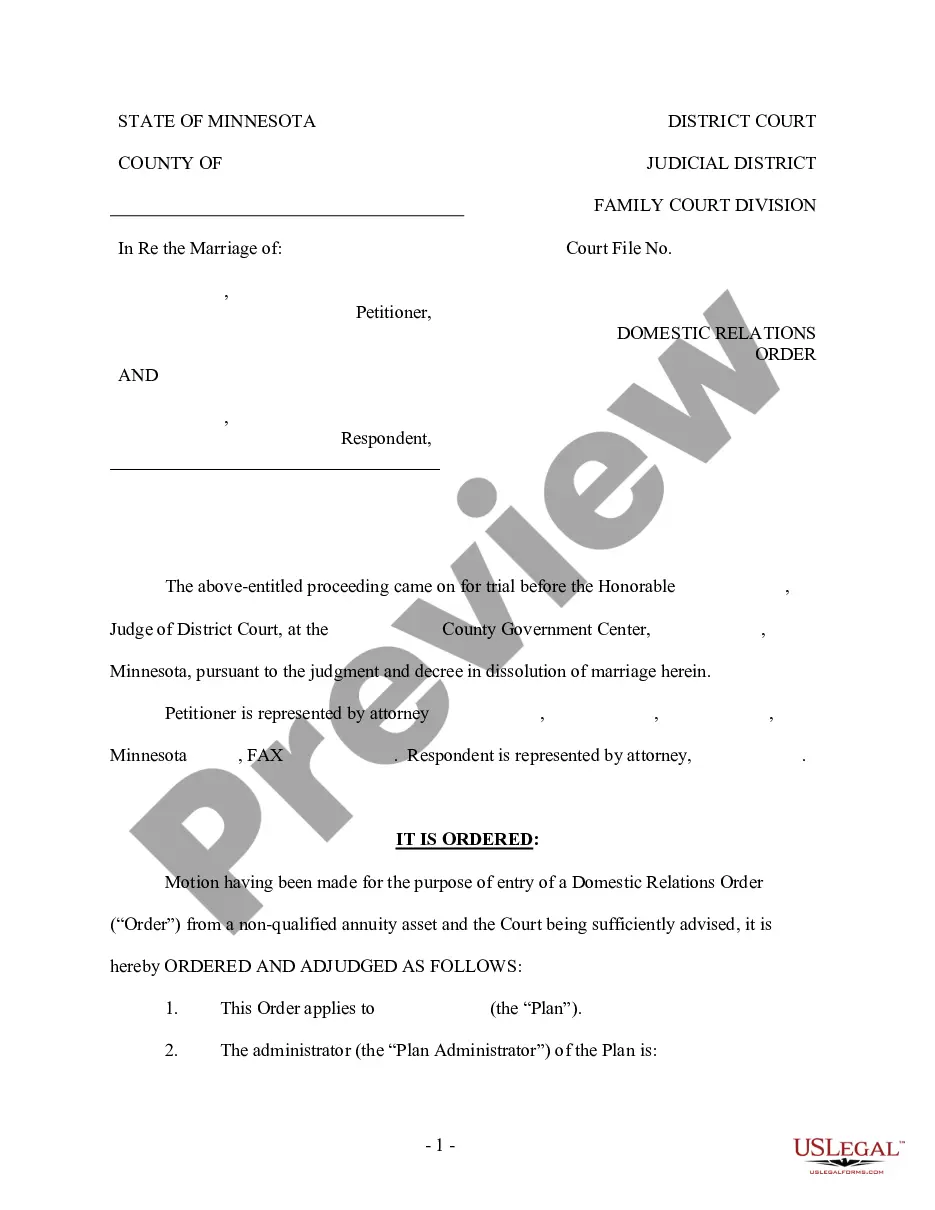
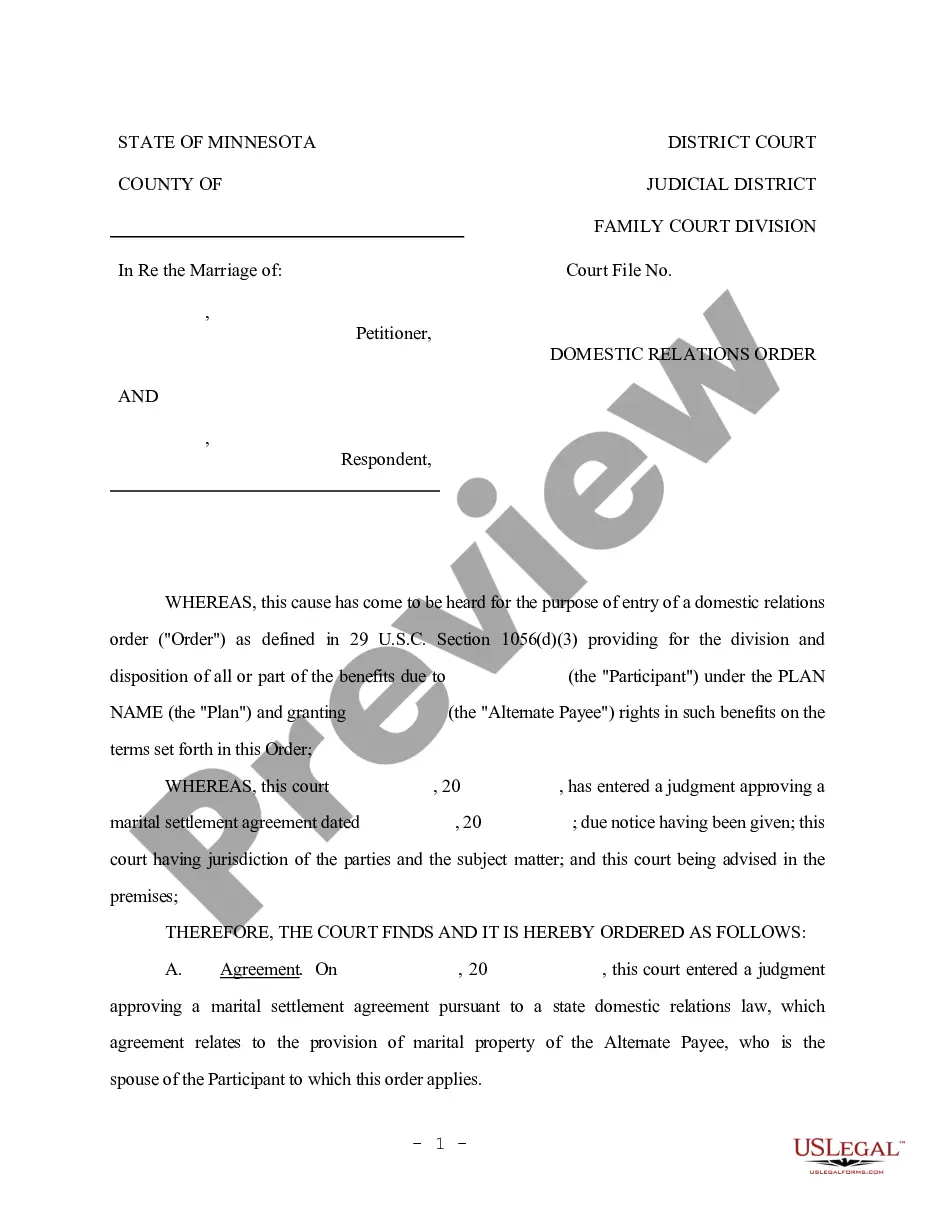
A Domestic Relations Order (DRO) is a legal order that allows a former spouse or other designated individual (the alternate payee) to receive a portion of the benefits from a retirement plan belonging to an employee (the plan participant). This template is important for addressing marital property rights in divorce proceedings, ensuring that the alternate payee can access their awarded benefits according to the terms outlined in the order. Unlike general divorce agreements, a DRO specifically facilitates the division of retirement assets while protecting all parties involved from liabilities related to the enforcement of the order.
Form components explained
- Identification of the plan and its administrator.
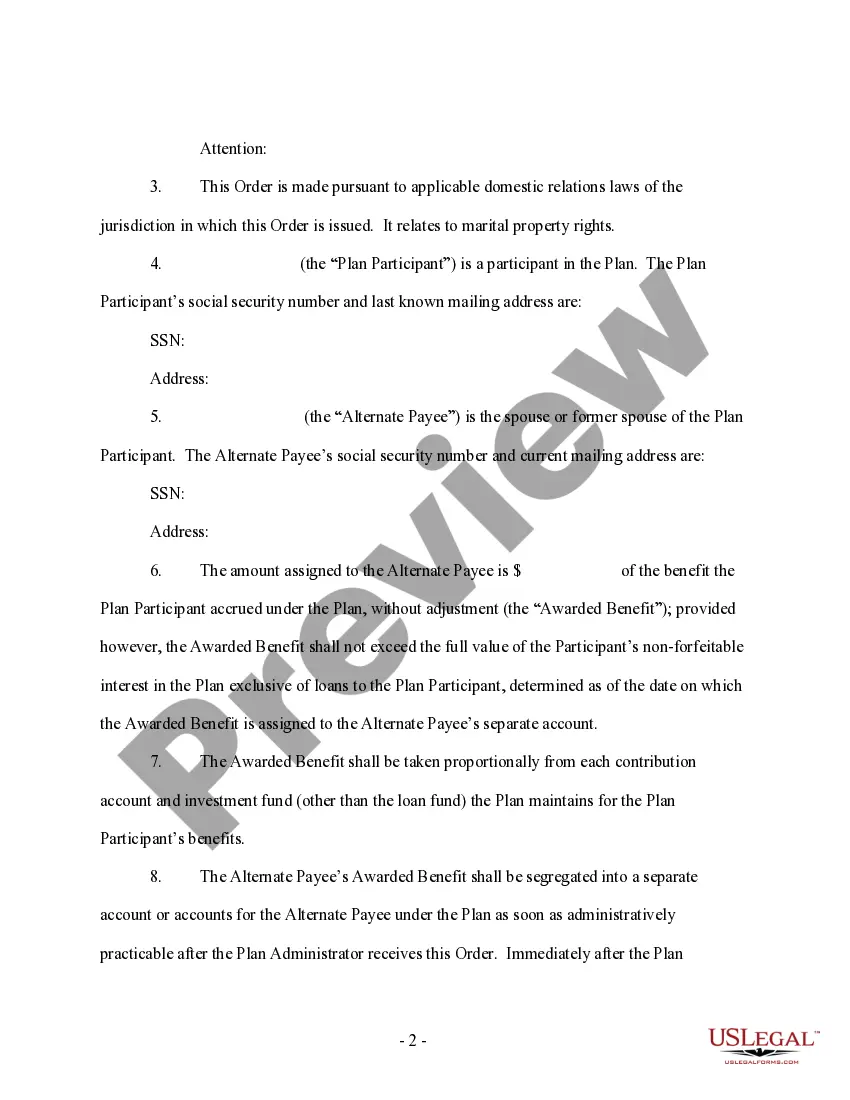
- Details of the plan participant and alternate payee, including social security numbers and addresses.
- Specification of the awarded benefit amount designated for the alternate payee.
- Instructions for the segregation of the awarded benefit into a separate account.
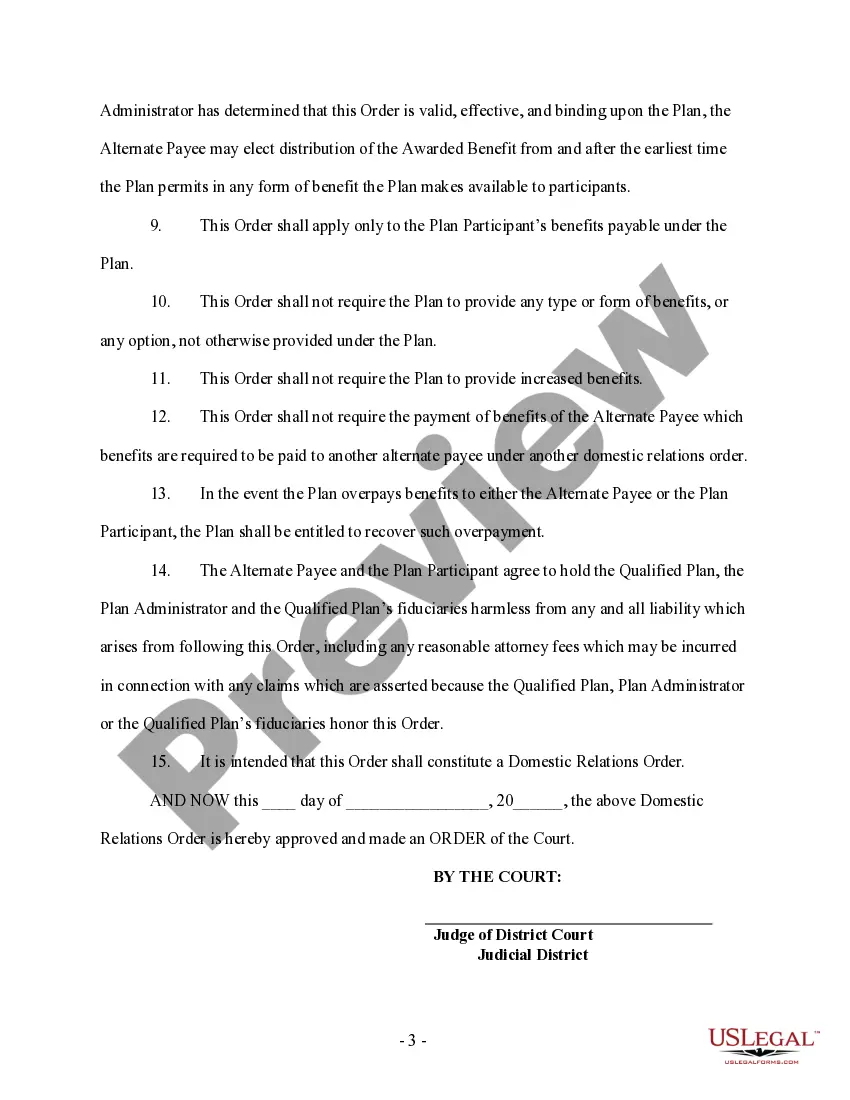
- Terms that clarify the limits of the order, including its enforceability and the rights of the plan.
- Legal protections for the plan, plan administrator, and fiduciaries against claims arising from the order.
When to use this document
You should use a Domestic Relations Order whenever a couple is going through a divorce, and there are retirement benefits that need to be split or assigned. This form is particularly essential when one spouse has a retirement plan governed by federal law, such as a qualified pension plan, and it is necessary to formally document the division of these benefits as part of the divorce settlement. Using a DRO ensures that the proper procedures are followed for the alternate payee to receive their entitled share of the retirement assets.
Intended users of this form
This form is intended for:
- Individuals involved in marital dissolution who have retirement plans to divide.
- Attorneys representing clients in divorce cases where retirement benefits are a concern.
- Plan administrators who require a legal directive to follow in allocating benefits to alternate payees.
Instructions for completing this form
- Identify the retirement plan and its administrator, filling in their names and contact details.
- Enter the names, social security numbers, and addresses of both the plan participant and alternate payee.
- Specify the exact percentage or amount of the retirement benefit to be assigned to the alternate payee.
- Include relevant dates and details regarding the conditions of the awarded benefits.
- Ensure all parties sign the document in the presence of a notary if required by state law.
- File the completed order with the court and provide copies to the plan administrator.
Does this form need to be notarized?
Notarization is generally not required for this form. However, certain states or situations might demand it. You can complete notarization online through US Legal Forms, powered by Notarize, using a verified video call available anytime.
Get your form ready online
Our built-in tools help you complete, sign, share, and store your documents in one place.
Make edits, fill in missing information, and update formatting in US Legal Forms—just like you would in MS Word.
Download a copy, print it, send it by email, or mail it via USPS—whatever works best for your next step.
Sign and collect signatures with our SignNow integration. Send to multiple recipients, set reminders, and more. Go Premium to unlock E-Sign.
If this form requires notarization, complete it online through a secure video call—no need to meet a notary in person or wait for an appointment.
We protect your documents and personal data by following strict security and privacy standards.

Make edits, fill in missing information, and update formatting in US Legal Forms—just like you would in MS Word.

Download a copy, print it, send it by email, or mail it via USPS—whatever works best for your next step.

Sign and collect signatures with our SignNow integration. Send to multiple recipients, set reminders, and more. Go Premium to unlock E-Sign.

If this form requires notarization, complete it online through a secure video call—no need to meet a notary in person or wait for an appointment.

We protect your documents and personal data by following strict security and privacy standards.
Avoid these common issues
- Failing to include all necessary contact information for the plan and parties involved.
- Not specifying the exact percentage of the benefit awarded to the alternate payee.
- Overlooking the need for notarization or proper signatures.
- Forgetting to file the order with the court after completion.
Why use this form online
- The template is easily accessible and can be downloaded immediately.
- Information can be filled out and edited at your convenience, minimizing errors.
- The legal validity is ensured through a format that meets requirements across multiple jurisdictions.
- Time-efficient, as it allows for quick preparation and processing.
Legal use & context
- A Domestic Relations Order is legally enforceable when executed correctly and filed with the appropriate court.
- This form provides clear documentation for the division of retirement benefits, following state and federal regulations.
- It protects all parties from future claims related to the division of these benefits when properly implemented.
What to keep in mind
- A Domestic Relations Order is crucial for dividing retirement assets in a divorce.
- It should be customized to fit specific state requirements regarding the division of benefits.
- Completing the form accurately is vital to avoid disputes and ensure legality.
Looking for another form?

Form popularity
FAQ
Drafting a Qualified Domestic Relations Order (QDRO) requires careful attention to detail, as it divides retirement benefits during a divorce. To create an effective Minnesota Domestic Relations Order - template, you must include specific information about the retirement plan and the parties involved. Our platform offers templates and guidance to help you draft a QDRO that meets legal requirements and protects your interests.
Yes, you can file for divorce in Minnesota without a lawyer, but it can be challenging to navigate the legal system alone. You will need to complete specific forms, including a Minnesota Domestic Relations Order - template if applicable. Our resources can guide you through the process, making it easier to understand what documents you need and how to file them correctly.
A domestic relations court order is a legal document issued by a court that outlines the rights and responsibilities of parties involved in family matters, such as divorce or child custody. This order often includes details about property division, spousal support, and child support. Understanding how to create a Minnesota Domestic Relations Order - template can help ensure that your legal rights are protected. Utilizing our platform can simplify this process.
Filling out a qualified domestic relations order involves several key steps. Start by obtaining a Minnesota Domestic Relations Order - template, which will guide you through the necessary sections. Clearly indicate the names of the parties, the retirement accounts affected, and how the benefits will be divided. After completing the form, review it for accuracy, and consider seeking legal advice to ensure it meets all legal requirements.
To complete a QDRO, you need to gather the required information, including the names of the parties, the retirement plans involved, and the specific distribution terms. Utilizing a Minnesota Domestic Relations Order - template can help you structure this information correctly. Follow the template's layout, fill in the details carefully, and ensure all relevant parties receive copies for review. Once completed, file the QDRO with the appropriate court for approval.
Yes, you can fill out a Qualified Domestic Relations Order (QDRO) yourself, but it requires careful attention to detail. Using a Minnesota Domestic Relations Order - template can simplify this process significantly. This template provides guidance on the necessary sections and legal language needed to ensure your order meets court requirements. However, consulting with a legal expert is advisable to avoid costly mistakes.
A QDRO does not directly affect Social Security benefits, as Social Security operates independently from retirement plans. However, it can impact the division of other retirement benefits that may influence your financial situation. It is essential to understand how these orders interact with your overall retirement strategy. For clear guidance, consider utilizing a Minnesota Domestic Relations Order - template to navigate these complexities.
In Minnesota, a qualified domestic relations order (QDRO) is a legal document that divides retirement plan benefits between divorcing spouses. It allows one spouse to receive a portion of the other spouse's retirement benefits without tax penalties. This process ensures fair distribution of assets during divorce proceedings. Using a Minnesota Domestic Relations Order - template can simplify this complex process.