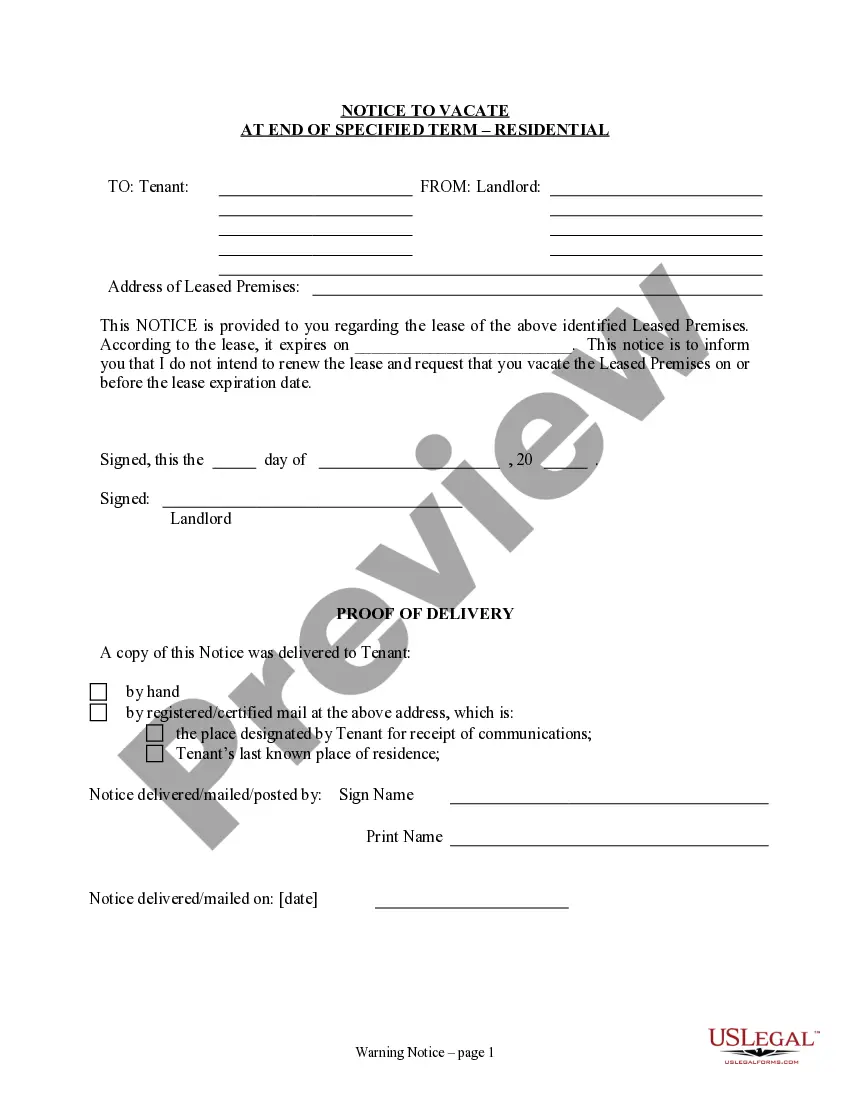
Minnesota Notice of Intent Not to Renew at End of Specified Term from Landlord to Tenant for Residential Property
Description


How to fill out Minnesota Notice Of Intent Not To Renew At End Of Specified Term From Landlord To Tenant For Residential Property?
Obtain any template from 85,000 legal documents including Minnesota Notice of Intent Not to Renew at End of Specified Term from Landlord to Tenant online with US Legal Forms. Each template is created and updated by state-certified legal experts.
If you possess a subscription, Log In. When you’re on the form’s page, click on the Download button and navigate to My documents to retrieve it.
If you haven’t subscribed yet, follow the instructions listed below.
After your reusable template is downloaded, print it out or save it to your device. With US Legal Forms, you will always have immediate access to the appropriate downloadable sample. The service grants you access to forms and categorizes them to ease your search. Use US Legal Forms to obtain your Minnesota Notice of Intent Not to Renew at End of Specified Term from Landlord to Tenant for Residential Property swiftly and simply.
- Verify the state-specific criteria for the Minnesota Notice of Intent Not to Renew at End of Specified Term from Landlord to Tenant for Residential Property you wish to utilize.
- Review the description and examine the sample.
- Once you’re assured the sample is what you require, click Buy Now.
- Choose a subscription plan that fits your financial plan.
- Establish a personal account.
- Make a payment in one of two available methods: by credit card or through PayPal.
- Choose a format to download the file in; two options are available (PDF or Word).
- Download the document to the My documents tab.
Form popularity
FAQ
Yes, a tenant must provide notice if they decide not to renew their lease. In Minnesota, the Notice of Intent Not to Renew at End of Specified Term from Landlord to Tenant for Residential Property is essential for clear communication. This notice ensures that both parties understand the lease's expiration and can prepare accordingly. By using the US Legal Forms platform, you can easily find and customize the necessary forms to properly notify your landlord.
In Minnesota, if a landlord is not renewing a lease, they are typically required to give at least one full rental period's notice. This requirement is essential in the context of the Minnesota Notice of Intent Not to Renew at End of Specified Term from Landlord to Tenant for Residential Property. Following this guideline helps ensure that tenants have adequate time to find new accommodation.
The notice period for non-renewal by a landlord in Minnesota generally corresponds to the length of the rental period. A landlord must provide at least one full rental period's notice, allowing tenants sufficient time to adjust their living arrangements. It is advisable to check your lease agreement for any specific requirements related to non-renewal.
Landlords in Minnesota must provide adequate notice when they choose not to renew a lease. Typically, this means giving notice equal to at least one full rental period. This requirement is part of the Minnesota Notice of Intent Not to Renew at End of Specified Term from Landlord to Tenant for Residential Property, and it ensures tenants have enough time to prepare for their next steps.
Writing a non-renewal notice involves creating a clear and concise document. Start with your name and contact information, followed by the landlord's details, the property address, and the date. Clearly state your intention not to renew the lease, and include any relevant lease details to ensure clarity. Templates available on platforms like US Legal Forms can help simplify this process.
In Minnesota, the amount of notice a landlord must provide for not renewing a lease typically depends on the length of the lease term. Generally, landlords are required to give at least one full rental period's notice. This helps ensure that tenants have sufficient time to find alternative housing and facilitates a smoother transition.
Notifying your landlord of your decision not to renew a lease requires clear communication. Draft a written notice that specifies your intention not to renew, and include relevant details such as your name, address, and the date. Deliver the notice according to the terms outlined in your lease agreement to ensure compliance with the Minnesota Notice of Intent Not to Renew at End of Specified Term from Landlord to Tenant for Residential Property.
To notify your landlord of your decision not to renew your lease, you should provide a written notice that clearly states your intentions. This document should include your name, the property address, and the date of the notice. It is important to adhere to the terms of your lease regarding the notice period to ensure a smooth transition.
A notice of non-renewal of lease or termination of tenancy is a formal document that informs the tenant that the landlord does not intend to renew the lease agreement at the end of its specified term. This notice is essential for both parties as it outlines the end of their rental relationship. In Minnesota, this notice is known as the Minnesota Notice of Intent Not to Renew at End of Specified Term from Landlord to Tenant for Residential Property.
A landlord in Minnesota is required to give tenants written notice at least 30 days before the lease expires if they do not plan to renew the lease. This notice is a key component of the Minnesota Notice of Intent Not to Renew at End of Specified Term from Landlord to Tenant for Residential Property. Providing this notice helps tenants prepare for their next steps, whether that means finding a new place or negotiating a new lease. Effective communication is vital in maintaining a positive rental relationship.