Minnesota Quitclaim Deed - Trust to an Individual

Overview of this form
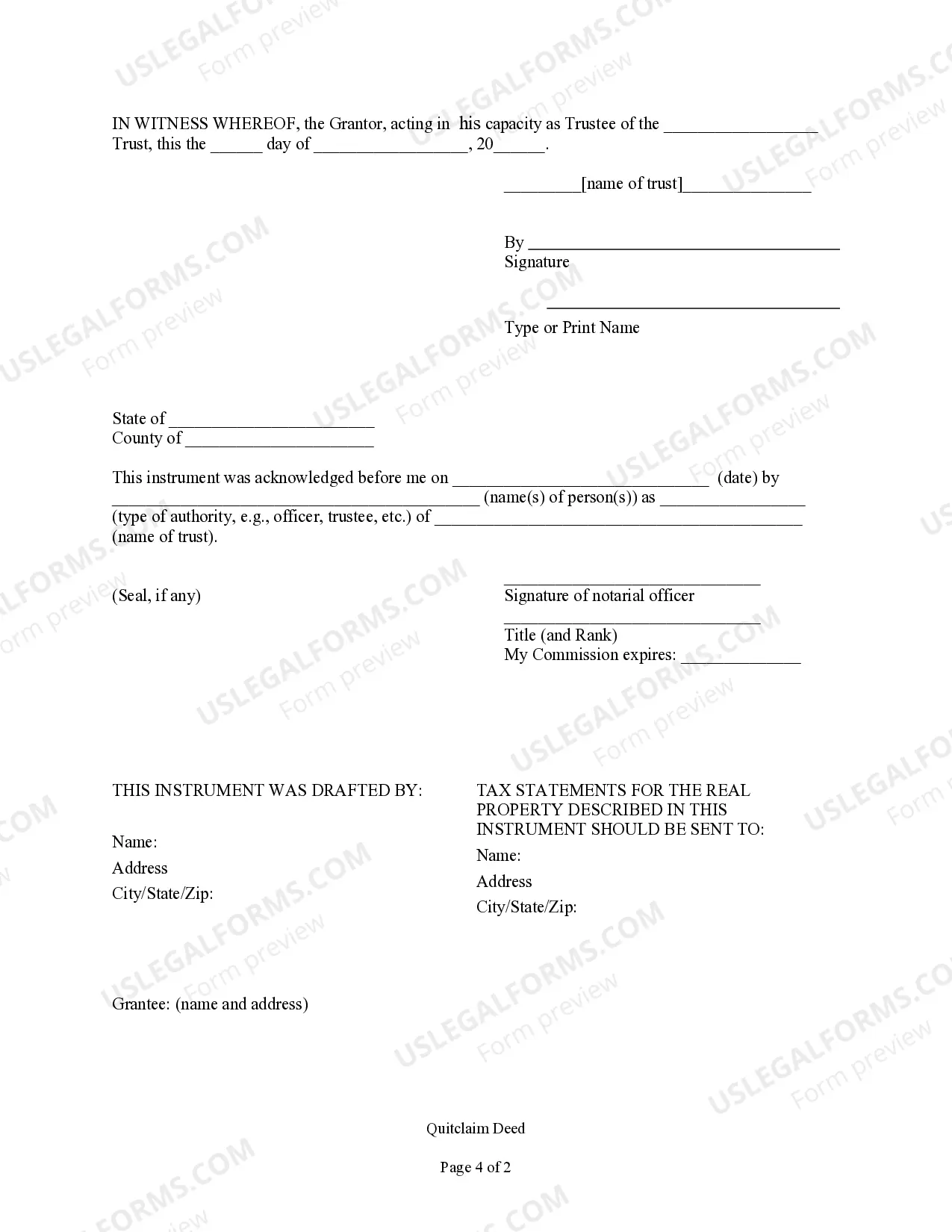
This Quitclaim Deed is a legal document in which a trustee of a trust conveys property to an individual. Unlike a warranty deed, a quitclaim deed does not guarantee the title of the property against claims by others. This form is commonly used to transfer property within families, particularly in estate planning scenarios where a trust is involved.
What’s included in this form
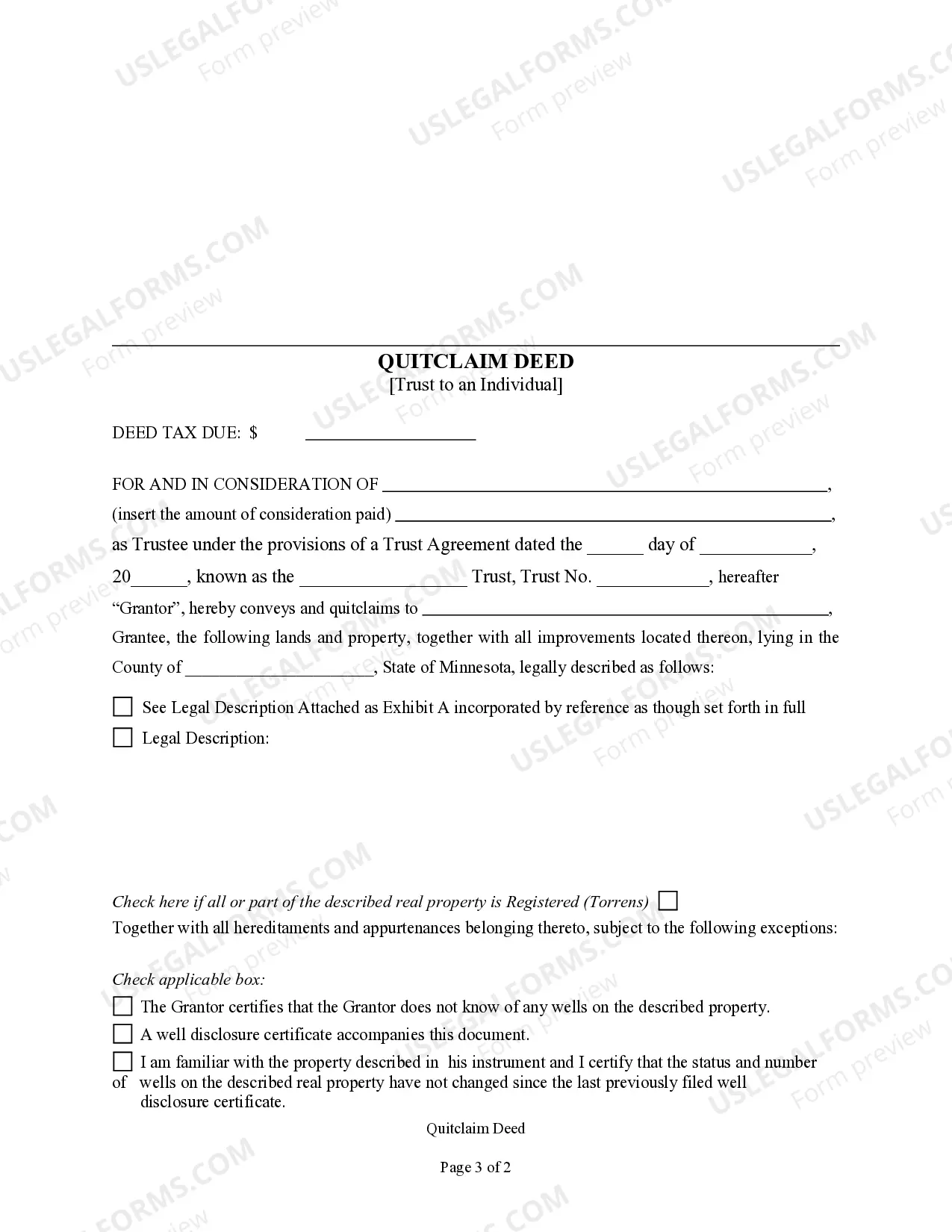
- Grantor information: Details about the trustee acting on behalf of the trust.
- Grantee information: Identification of the individual receiving the property.
- Property description: A detailed description of the property being conveyed.
- Legal acknowledgment: Statement confirming the execution of the deed under lawful conditions.
- Notary section: Space for notarization to validate the document.






When to use this form
This form should be used when a property held in a trust is being transferred to an individual. This often occurs during situations such as dissolving a trust, estate planning, or when beneficiaries inherit property from the trust. It is a straightforward way to facilitate property transfers without the associated liability of a warranty deed.
Who should use this form
The following individuals should consider using this form:
- Trustees looking to transfer property from a trust to an individual.
- Individuals involved in estate planning who wish to simplify property transfers.
- Beneficiaries receiving property from a trust.
Completing this form step by step
- Identify the parties: List the name of the trustee (grantor) and the individual (grantee).
- Specify the property: Provide a clear description of the property being transferred.
- Enter dates: Fill in the date of the execution of the deed.
- Complete the acknowledgment: Ensure the necessary lines for notarization are prepared for signing.
- Sign the document: Have the grantor sign the deed in the presence of a notary.
Does this document require notarization?
To make this form legally binding, it must be notarized. Our online notarization service, powered by Notarize, lets you verify and sign documents remotely through an encrypted video session.
Get your form ready online
Our built-in tools help you complete, sign, share, and store your documents in one place.
Make edits, fill in missing information, and update formatting in US Legal Forms—just like you would in MS Word.
Download a copy, print it, send it by email, or mail it via USPS—whatever works best for your next step.
Sign and collect signatures with our SignNow integration. Send to multiple recipients, set reminders, and more. Go Premium to unlock E-Sign.
If this form requires notarization, complete it online through a secure video call—no need to meet a notary in person or wait for an appointment.
We protect your documents and personal data by following strict security and privacy standards.

Make edits, fill in missing information, and update formatting in US Legal Forms—just like you would in MS Word.

Download a copy, print it, send it by email, or mail it via USPS—whatever works best for your next step.

Sign and collect signatures with our SignNow integration. Send to multiple recipients, set reminders, and more. Go Premium to unlock E-Sign.

If this form requires notarization, complete it online through a secure video call—no need to meet a notary in person or wait for an appointment.

We protect your documents and personal data by following strict security and privacy standards.
Typical mistakes to avoid
- Failing to provide an accurate legal description of the property.
- Not having the form notarized when required.
- Omitting necessary details about the grantor or grantee.
- Not checking the execution requirements for their specific state.
Why complete this form online
- Convenience: Access and complete the form from anywhere without the need for in-person appointments.
- Editability: Easily modify the form to fit specific details and preferences.
- Reliability: Forms are drafted by licensed attorneys, ensuring compliance with legal standards.
Main things to remember
- This Quitclaim Deed allows a trustee to transfer property to an individual.
- It is crucial to provide accurate details about the property and the parties involved.
- Notarization is required for the deed to be considered legally binding.
Looking for another form?
Form popularity
FAQ
Choosing between a Minnesota Quitclaim Deed - Trust to an Individual and a trust depends on your specific needs. A quitclaim deed is straightforward for transferring property but offers no protection against claims or debts. On the other hand, a trust can provide better asset protection and control over how your property is managed after your passing. Evaluate your situation carefully, and consider consulting resources like USLegalForms to guide your decision.
In Minnesota, a quitclaim deed transfers ownership of property without any warranties about the title. This means that the grantor simply conveys whatever interest they have, if any, to the grantee. The process typically requires the deed to be signed, notarized, and recorded with the county. Using a Minnesota Quitclaim Deed - Trust to an Individual can simplify property transfers, especially among family members or close associates.
When using a Minnesota Quitclaim Deed - Trust to an Individual, you may encounter issues such as unclear title history or existing liens on the property. Unlike other deed types, a quitclaim deed does not guarantee clear ownership, which can lead to disputes. Additionally, if not properly executed, it might create complications in future transactions. To avoid these problems, consider using a trusted platform like USLegalForms to ensure your deed is correctly prepared.
To file a Minnesota Quitclaim Deed - Trust to an Individual, begin by obtaining the correct form, which you can find through various legal resources online. After completing the form with accurate information, sign it in front of a notary public. Then, you will need to file the deed with the county recorder's office where the property is located. Utilizing user-friendly platforms like US Legal Forms can streamline this process, providing guidance and templates to ensure compliance.
Yes, you can execute a Minnesota Quitclaim Deed - Trust to an Individual. This process allows you to transfer property into a trust, which can provide benefits like asset protection and estate planning advantages. When drafting the deed, it is essential to include the trust's name and the trustee's details. You may consider using platforms like US Legal Forms to access reliable templates tailored for this specific purpose.
You do not need a lawyer to file a Minnesota Quitclaim Deed - Trust to an Individual, but having one can simplify the process. A lawyer can help you understand the implications of transferring property through a quitclaim deed. Additionally, they can ensure that all necessary documentation is correctly completed. However, if you feel confident, you can use online resources and forms to file the deed yourself.
Yes, you can transfer property through a Minnesota Quitclaim Deed - Trust to an Individual into a trust. This method allows for a smooth transition of ownership while maintaining the benefits of the trust. It is advisable to ensure that the trust is properly established and that the quitclaim deed is correctly filled out and filed. Platforms like US Legal Forms can assist you in preparing the necessary documents for this process.
You do not necessarily need a lawyer to obtain a Minnesota Quitclaim Deed - Trust to an Individual. Many individuals successfully complete this process on their own by using online resources. However, consulting a lawyer can provide additional assurance and clarity, especially if you have specific concerns about your property or the deed's implications.
Filing a Minnesota Quitclaim Deed - Trust to an Individual involves several steps. First, you must complete the quitclaim deed form, ensuring all required information is accurate. Next, you need to sign and notarize the document, then file it with the county recorder's office where the property is located. Utilizing tools from US Legal Forms can simplify this process and provide you with the correct forms.
Yes, you can complete a Minnesota Quitclaim Deed - Trust to an Individual without a lawyer. However, it is crucial to understand the legal implications and requirements. You might consider using online resources or platforms like US Legal Forms to guide you through the process. This can help ensure that you meet all necessary documentation and filing requirements.