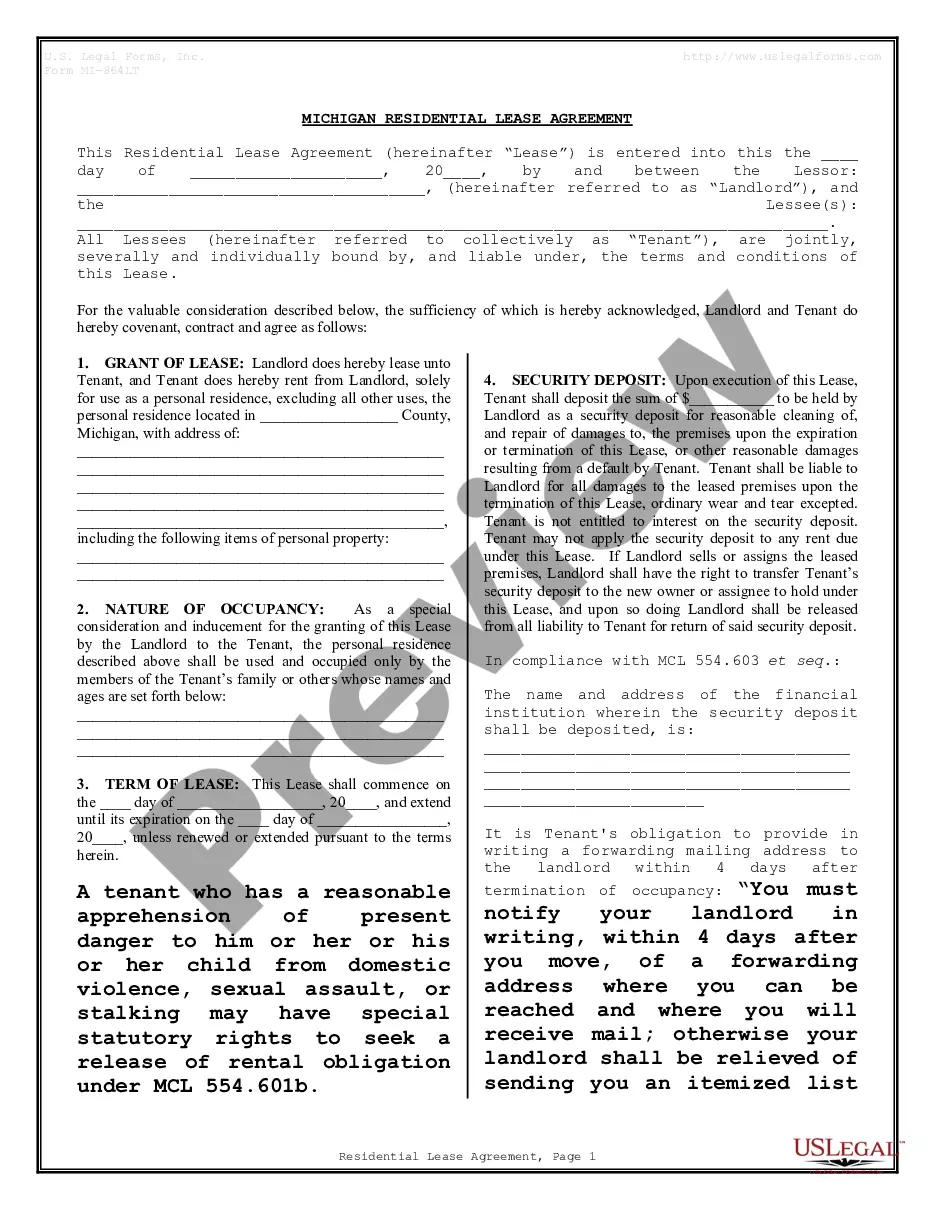
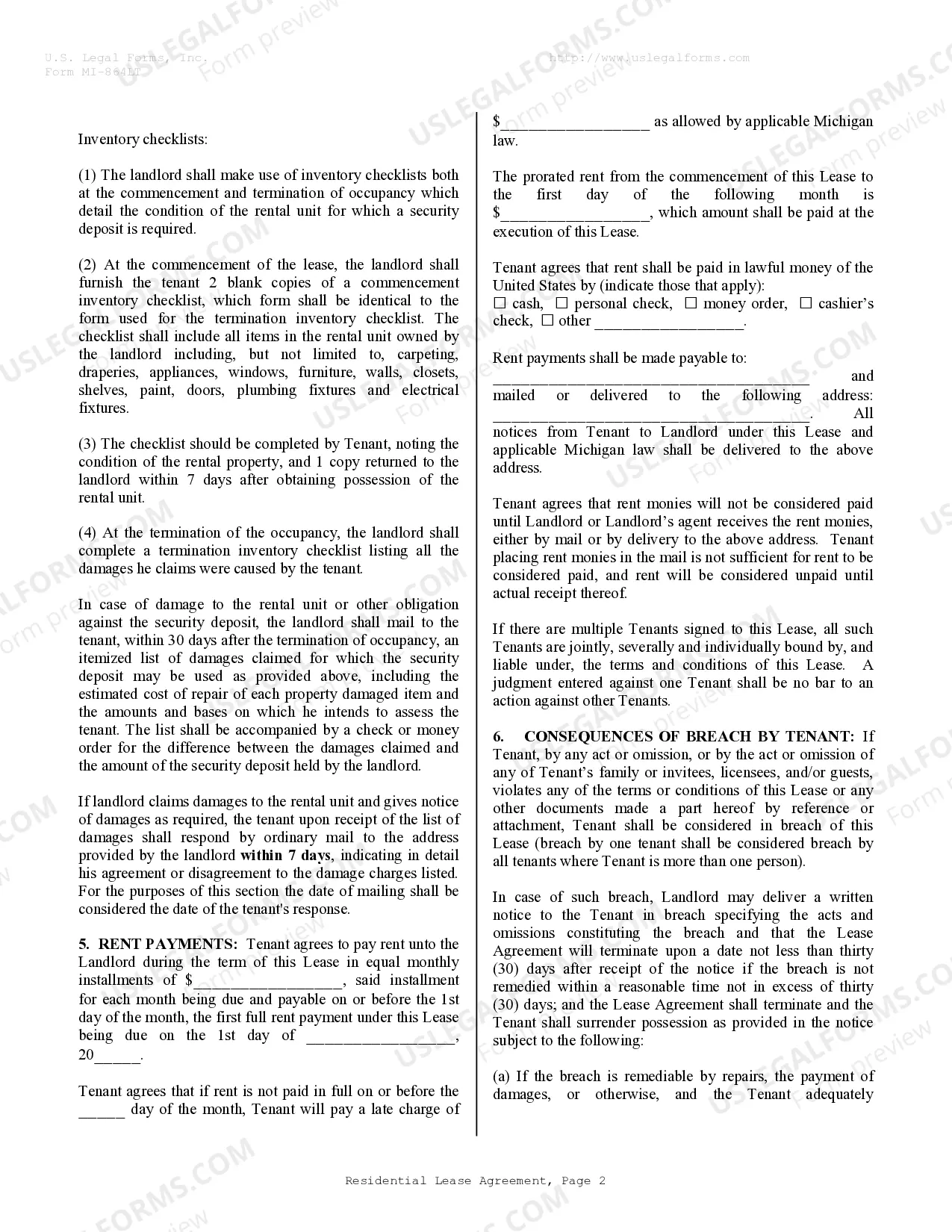
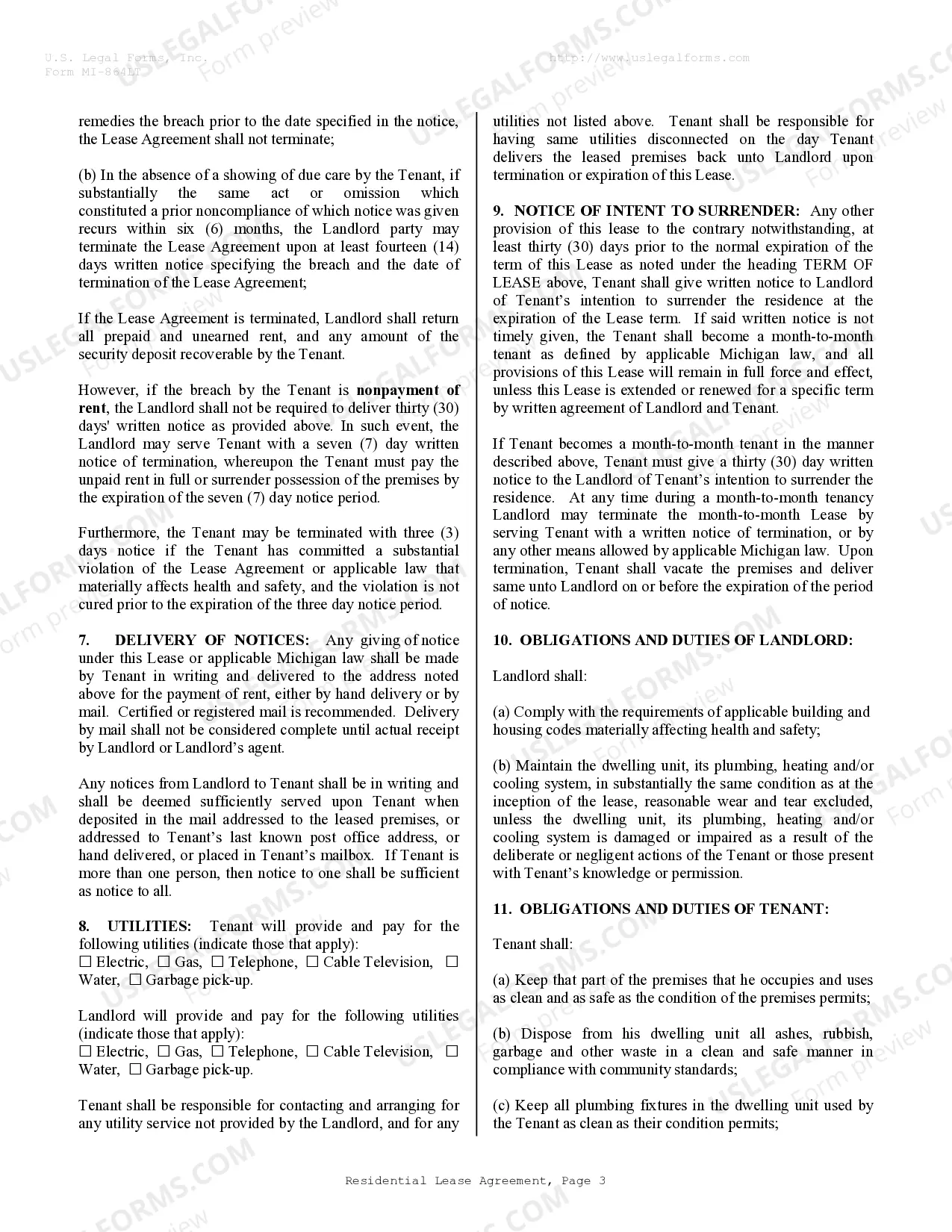
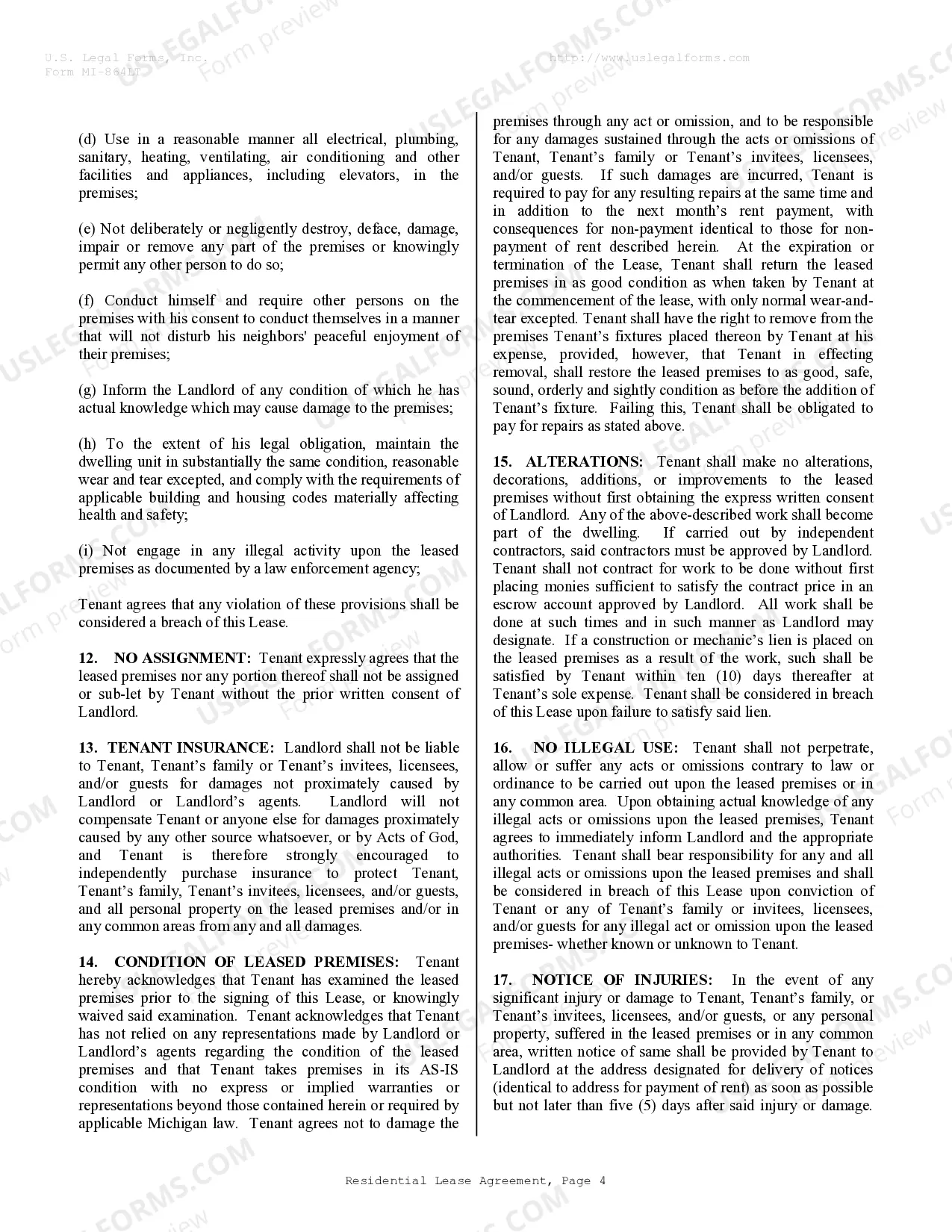
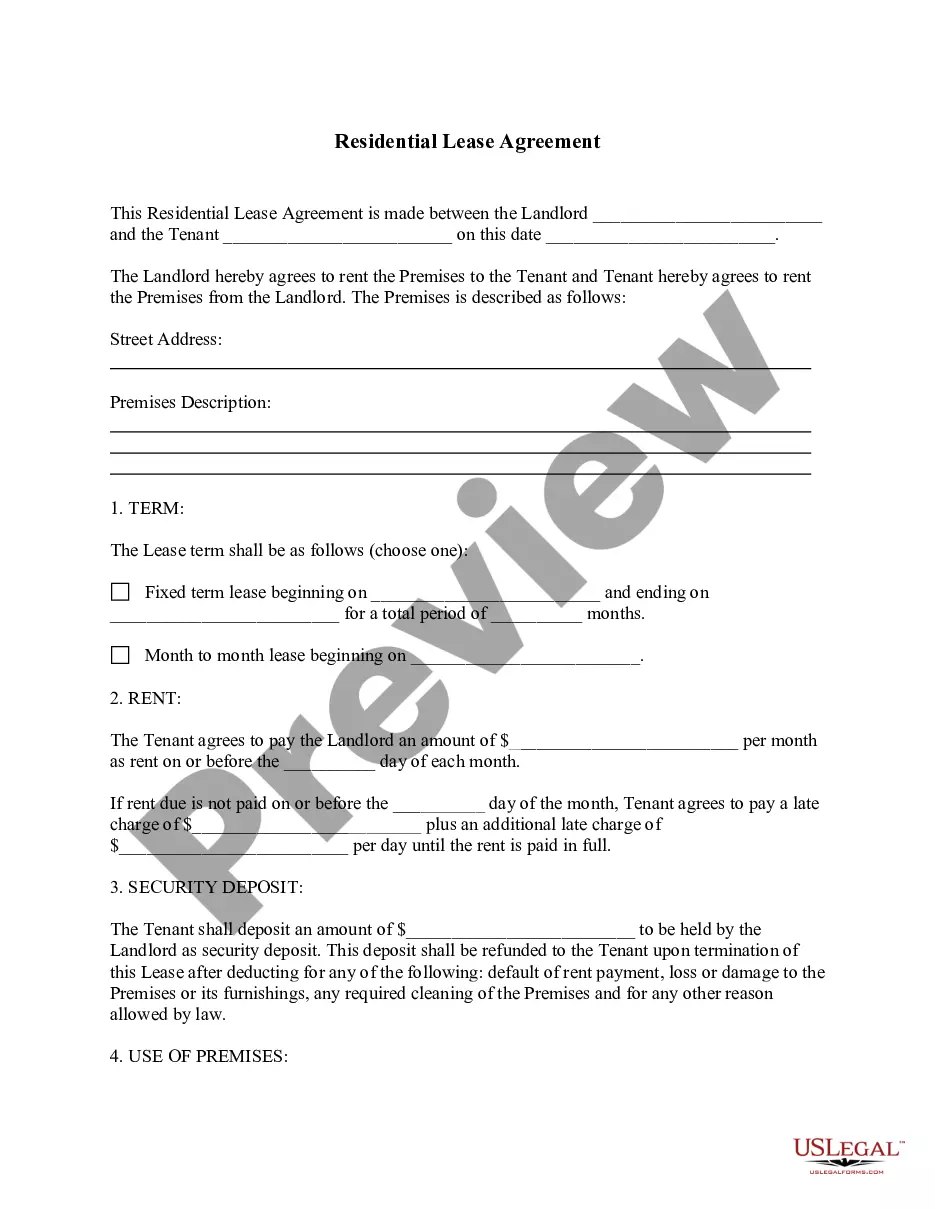
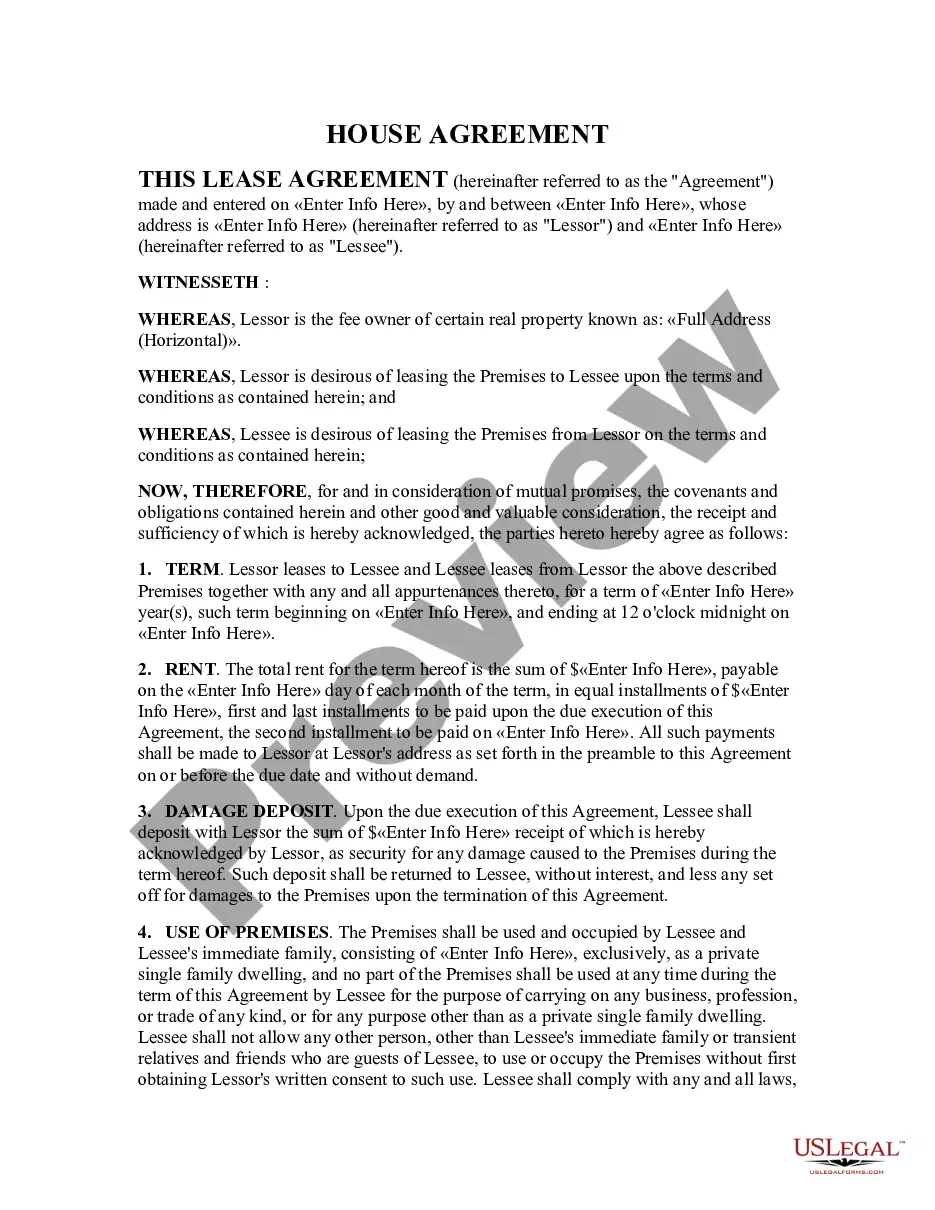
Residential Rental Lease Agreement
LANDLORD AND TENANT
RELATIONSHIPS
Act 348 of 1972
AN ACT to regulate relationships between landlords
and tenants relative to rental agreements for rental units; to regulate
the payment, repayment, use and investment of security deposits; to provide
for commencement and termination inventories of rental units; to provide
for termination arrangements relative to rental units; to provide for legal
remedies; and to provide penalties.
Definitions. [M.S.A. 26.1138(1) ]
Sec. 1. As used in this act:
(a) "Rental unit" means a structure or part of a structure used
as a home, residence, or sleeping unit by a single person or household
unit, or any grounds, or other facilities or area promised for the use
of a residential tenant and includes, but without limitation, apartment
units, boarding houses, rooming houses, mobile home spaces, and single
and 2-family dwellings.
(b) "Rental agreement" means an agreement that establishes or modifies
the terms, conditions, rules, regulations, or any other provisions concerning
the use and occupancy of a rental unit.
(c) "Landlord" means the owner, lessor, or sublessor of the rental
unit or the property of which it is a part and, in addition, means a person
authorized to exercise any aspect of the management of the premises, including
a person who, directly or indirectly, acts as a rental agent, receives
rent, other than as a bona fide purchaser, and who has no obligation to
deliver the receipts to another person.
(d) "Tenant" means a person who occupies a rental unit for residential
purposes with the landlord's consent for an agreed upon consideration.
(e) "Security deposit" means a deposit, in any amount, paid
by the tenant to the landlord or his or her agent to be held for the term
of the rental agreement, or any part of the term, and includes any
required prepayment of rent other than the first full rental period of
the lease agreement; any sum required to be paid as rent in any rental
period in excess of the average rent for the term; and any other
amount of money or property returnable to the tenant on condition of return
of the rental unit by the tenant in condition as required by the rental
agreement. Security deposit does not include either of the following: (i)
An amount paid for an option to purchase, pursuant to a lease with option
to purchase, unless it is shown the intent was to evade this act.
(ii) An amount paid as a subscription for or purchase of a membership
in a cooperative housing association incorporated under the laws of this
state. As used in this subparagraph, "cooperative housing association"
means a consumer cooperative that provides dwelling units to its members.
(f) "Senior citizen housing" means housing for individuals 62 years
of age or older that is subsidized in whole or in part under any local,
state, or federal program. Act, 348, §554.601
Termination of lease; conditions; applicability of section to
leases entered into, renewed, or renegotiated after effective date. [M.S.A.
26.1138(1a) ]
Sec. 1a.
(1) A rental agreement shall provide that a tenant who has occupied
a rental unit for more than 13 months may terminate a lease a 60-day written
notice to the landlord if 1 of the following occurs:
(a) The tenant becomes eligible during the lease term to take possession
of
a subsidized rental unit in senior citizen housing and provides the landlord
with written proof of that eligibility.
(b) The tenant becomes incapable during the lease term of living
independently, as certified by a physician in a notarized statement.
(2) This section applies only to leases entered into, renewed, or
renegotiated after the effective date of this section, in accordance with
the constitutional prohibition against impairment of contracts provided
by section 10 of article I of the state constitution of 1963 . Act 348,
§554.601a
Security deposit; amount. [M.S.A. 26.1138(2) ]
Sec. 2.
A landlord may require a security deposit for
each rental unit.
A security deposit shall be required and maintained in accordance
with the terms of this act and shall not exceed 1 1/2 months' rent. Act
348, §554.602
Security deposit; notice. [M.S.A. 26.1138(3) ]
Sec. 3.
A landlord shall not require a security deposit
unless he notifies the tenant no later than 14 days from the date a tenant
assumes possession in a written instrument of the landlord's name and address
for receipt of communications under this act, the name and address of the
financial institution or surety required by section 4 and the tenant's
obligation to provide in writing a forwarding mailing address to the landlord
within 4 days after termination of occupancy. The notice shall include
the following statement in 12 point boldface type which is at least 4 points
larger than the body of the notice or lease agreement: "You must notify
your landlord in writing within 4 days after you move of a forwarding address
where you can be reached and where you will receive mail; otherwise your
landlord shall be relieved of sending you an itemized list of damages and
the penalties adherent to that failure." Failure to provide the information
relieves the tenant of his obligation relative to notification of the landlord
of his forwarding mailing address. Act 348, §554.603
Security deposit, disposition; bond. [M.S.A. 26.1138(4)]
Sec. 4.
(1) The security deposit shall be deposited in a regulated financial
institution. A landlord may use the moneys so deposited for any purposes
he desires if he deposits with the secretary of state a cash bond or surety
bond written by a surety company licensed to do business in this state
and acceptable to the attorney general to secure the entire deposits up
to $50,000.00 and 25% of any amount exceeding $50,000.00. The attorney
general may find a bond unacceptable based only upon reasonable criteria
relating to the sufficiency of the bond, and shall notify the landlord
in writing of his reasons for the unacceptability of the bond.
(2) The bond shall be for the benefit of persons making security
deposits with the landlord. A person for whose benefit the bond is
written or his legal representative may bring an action in the district,
common pleas or municipal court where the landlord resides or does business
for collection on the bond. Act 348, §554.604
Security deposit as property of tenant. [M.S.A. 26.1138(5) ]
Sec. 5.
For the purposes of this act and any litigation
arising thereunder, the security deposit is considered the lawful property
of the tenant until the landlord establishes a right to the deposit
or portions thereof as long as the bond provision is fulfilled, the landlord
may use this fund for any purposes he desires. Act 348, §554.605
Waiving requirements of act. [M.S.A. 26.1138(6) ]
Sec. 6.
The requirements of this act may not be waived
by the parties to a rental agreement except as specifically provided herein.
Act 348, §554.606
Security deposit; permissible uses. [M.S.A. 26.1138(7) ]
Sec. 7.
A security deposit may be used only for the
following purposes:
(a) Reimburse the landlord for actual damages to the rental unit
or any ancillary facility that are the direct result of conduct not reasonably
expected in the normal course of habitation of a dwelling.
(b) Pay the landlord for all rent in arrearage under the rental
agreement, rent due for premature termination of the rental agreement by
the tenant and for utility bills not paid by the tenant. Act 348,
§554.607
Inventory checklists. [M.S.A. 26.1138(8) ]
Sec. 8.
(1) The landlord shall make use of inventory checklists both at
the commencement and termination of occupancy for each rental unit which
detail the condition of the rental unit for which a security deposit is
required.
(2) At the commencement of the lease, the landlord shall furnish
the tenant 2 blank copies of a commencement inventory checklist,
which form shall be identical to the form used for the termination
inventory checklist. The checklist shall include all items in the
rental unit owned by the landlord including, but not limited to,
carpeting, draperies, appliances, windows, furniture, walls, closets,
shelves, paint, doors, plumbing fixtures and electrical fixtures.
(3) Unless the landlord and tenant agree to complete their inventory
checklist within a shorter period, the tenant shall review the checklist,
note the condition of the property and return 1 copy of the checklist to
the landlord within 7 days after receiving possession of the premises.
(4) The checklist shall contain the following notice in 12 point
boldface type at the top of the first page: "You should complete
this checklist, noting the condition of the rental property, and return
it to the landlord within 7 days after obtaining possession of the
rental unit. You are also entitled to request and receive a copy
of the last termination inventory checklist which shows what claims were
chargeable to the last prior tenants.".
(5) At the termination of the occupancy, the landlord shall complete
a termination inventory checklist listing all the damages he claims
were caused by the tenant. Act 348, §554.608
Itemized list of damages; check or money order; contents
of notice of damages. [M.S.A. 26.1138(9) ]
Sec. 9.
In case of damage to the rental unit or other
obligation against the security deposit, the landlord shall mail to the
tenant, within 30 days after the termination of occupancy, an itemized
list of damages claimed for which the security deposit may be used as provided
in section 7, including the estimated cost of repair of each property
damaged item and the amounts and bases on which he intends to assess the
tenant. The list shall be accompanied by a check or money order for the
difference between the damages claimed and the amount of the security deposit
held by the landlord and shall not include any damages that were claimed
on a previous termination inventory checklist prior to the tenant's occupancy
of the rental unit. The notice of damages shall include the following statement
in 12 point boldface type which shall be at least 4 points larger than
the body of the notice:
"You must respond to this notice by mail within 7 days after
receipt of same, otherwise you will forfeit the amount claimed for
damages.". Act 348, §554.609
Effect of noncompliance with notice of damages requirement.
[M.S.A. 26.1138(10) ]
Sec. 10.
Failure by the landlord to comply with the notice
of damages requirement within the 30 days after the termination of occupancy,
constitutes agreement by the landlord that no damages are due and he shall
remit to the tenant immediately the full security deposit. Act 348,
§554.610
Notice of forwarding address; effect of noncompliance. [M.S.A.
26.1138(11) ]
Sec. 11.
The tenant shall notify the landlord in writing
at the address given under section 4 within 4 days after termination of
his occupancy of an address at which communications pursuant to this act
may be received. Failure to comply with this requirement relieves
the landlord of the requirement of notice of damages but does not
prejudice a tenant's subsequent claim for the security deposit. Act
348, §554.611
Response to notice of damages. [M.S.A. 26.1138(12) ]
Sec. 12.
If a landlord claims damages to a rental unit
and gives notice of damages as required, the tenant upon receipt of the
list of damages shall respond by ordinary mail to the address provided
by the landlord as required by section 3 within 7 days, indicating
in detail his agreement or disagreement to the damage charges listed. For
the purposes of this section the date of mailing shall be considered the
date of the tenant's response. Act 348, §554.612
Action for damages; retention of security deposit; waiver.
[M.S.A. 26.1138(13) ]
Sec. 13.
(1) Within 45 days after termination of the occupancy and
not thereafter the landlord may commence an action in a court of competent
jurisdiction for a money judgment for damages which he has claimed or in
lieu thereof return the balance of the security deposit held by him
to the tenant or any amount mutually agreed upon in writing by the parties.
A landlord shall not be entitled to retain any portion of a security deposit
for damages claimed unless he has first obtained a money judgment for the
disputed amount or filed with the court satisfactory proof of an inability
to obtain service on the tenant or unless:
(a) The tenant has failed to provide a forwarding address as required
by section 11.
(b) The tenant has failed to respond to the notice of damages as
required by section 12.
(c) The parties have agreed in writing to the disposition of the
balance of the deposit claimed by the landlord.
(d) The amount claimed is entirely based upon accrued and unpaid
rent equal to the actual rent for any full rental period or portion thereof
during which the tenant has had actual or constructive possession of
the premises.
(2) This section does not prejudice a landlord's right to retain
any security deposit funds as satisfaction or partial satisfaction of a
money judgment obtained pursuant to summary proceedings filed pursuant
to chapter 57 of Act No. 236 of the Public Acts of 1961, as amended,
being sections 600.5701 to 600.5759 of the Compiled Laws of 1948 or other
proceedings at law. Failure of the landlord to comply fully with
this section constitutes waiver of all claimed damages and makes
him liable to the tenant for double the amount of the security deposit
retained. Act 348, §554.613
Termination of landlord's interest; liability for security deposit.
[M.S.A. 26.1138(14) ]
Sec. 14.
Upon termination of a landlord's interest in
a rental unit whether by sale, assignment, death, appointment of receiver
or otherwise, the landlord or his agent is liable with respect to
the security deposit, until the occurrence of any of the following:
(a) Transfer of the deposit to the landlord's successor in interest
and written notification to the tenant by ordinary mail of the transfer
and of the successor's name and address.
(b) Compliance with section 4 by the successor in interest.
(c) Return of the security deposit to the tenant. Act 348,
§554.614
Action to enforce act. [M.S.A. 26.1138(15) ]
Sec. 15.
The attorney general or any affected individual
may bring an action to enforce this act in a court of competent jurisdiction
in the county where the defendant resides or does business. Act 348,
§554.615
Effective date and applicability of act. [M.S.A. 26.1138(16)
]
Sec. 16.
This act takes effect April 1, 1973 and applies
only to security deposits held pursuant to leases entered into, renewed
or renegotiated after April 1, 1973. Act 348, §554.616
Short title. [M.S.A. 26.1138(31) ]
Sec. 1.
This act shall be known and may be cited as
the "truth in renting act". Act 348, §554.631
Definitions. [M.S.A. 26.1138(32) ]
Sec. 2.
As used in this act:
(a) "Rental agreement" means a written agreement embodying
the terms and conditions concerning the use and occupancy of residential
premises, but does not include an agreement the terms of which are limited
to 1 or more of the following: the identity of the parties, a description
of the premises, the rental period, the total rental amount due,
the amount of rental payments, and the times at which payments are due.
(b) "Residential premises" means a house, building, structure, shelter,
or mobile home, or portion thereof, used as a dwelling, home, residence,
or living place by 1 or more human beings. "Residential premises"
includes an apartment unit, a boardinghouse, a rooming house, a mobile
home, a mobile home space, and a single or multiple family dwelling, but
does not include a hotel, a motel, motor home, or other tourist accommodation,
when used as a temporary accommodation for guests or tourists, or
premises used as the principal place of residence of the owner and rented
occasionally during temporary absences including vacation or sabbatical
leave. Act 348, §554.632
Rental agreement; prohibited provisions or clauses; violation.
Sec. 3.
(1) A rental agreement shall not include a provision that does
1 or more of the following:
(a) Waives or alters a remedy available to the parties when the
premises are in a condition that violates the covenants of fitness and
habitability required pursuant to section 39 of 1846 RS 84, MCL 554.139.
(b) Provides that the parties waive a right established by 1972
PA 348, MCL 554.601 to 554.616, which regulates security deposits.
(c) Excludes or discriminates against a person in violation of the
Elliott-Larsen civil rights act, 1976 PA 453, MCL 37.2101 to 37.2804, or
the persons with disabilities civil rights act, 1976 PA 220, MCL
37.1101 to 37.1607.
(d) Provides for a confession of judgment by a party.
(e) Exculpates the lessor from liability for the lessor's failure
to perform, or negligent performance of, a duty imposed by law. This
subdivision does not apply to a provision that releases a party from
liability arising from loss, damage, or injury caused by fire or other
casualty for which insurance is carried by the other party, under a
policy that permits waiver of liability and waives the insurer's rights
of subrogation, to the extent of any recovery by the insured party under
the policy.
(f) Waives or alters a party's right to demand a trial by jury or
any other right of notice or procedure required by law in a judicial
proceeding arising under the rental agreement.
(g) Provides that a party is liable for legal costs or attorney's
fees incurred by another party, in connection with a dispute arising
under the rental agreement, in excess of costs or fees specifically permitted
by statute.
(h) Provides for the acquisition by the lessor of a security interest
in any personal property of the tenant to assure payment of rent or other
charges arising under the rental agreement, except as specifically allowed
by law.
(i) Provides that rental payments may be accelerated if the rental
agreement is breached by the tenant, unless the provision also includes
a statement that the tenant may not be liable for the total accelerated
amount because of the landlord's obligation to minimize damages, and that
either party may have a court determine the actual amount owed, if
any.
(j) Waives or alters a party's rights with respect to possession
or eviction proceedings provided in section 2918 of the revised judicature
act of 1961, 1961 PA 236, MCL 600.2918, or with respect to summary
proceedings to recover possession as provided in chapter 57 of the
revised judicature act of 1961, 1961 PA 236, MCL 600.5701 to 600.5759.
(k) Releases a party from a duty to mitigate damages.
(l) Provides that a lessor may alter a provision of the rental agreement
after its commencement without the written consent of the tenant, or, in
the case of a rental agreement between a consumer cooperative that
provides housing and a member of the consumer cooperative, without
the approval of the board of directors of the cooperative or other
appropriate body elected by members who are also tenants of the cooperative,
except that an agreement may provide for the following types of adjustments
to be made upon written notice of not less than 30 days: (i) Changes required
by federal, state, or local law or rule or regulation.
(ii) Changes in rules relating to the property that are required
to protect the physical health, safety, or peaceful enjoyment of
tenants and guests.
(iii) Changes in the amount of rental payments to cover additional
costs in operating the rental premises incurred by the lessor because
of increases in ad valorem property taxes, charges for the electricity,
heating fuel, water, or sanitary sewer services consumed at the property,
or increases in premiums paid for liability, fire, or worker compensation
insurance.
(m) Violates the Michigan consumer protection act, 1976 PA 331,
MCL 445.901 to 445.922.
(n) Requires the tenant to give the lessor a power of attorney.
(2) A rental agreement shall not include a clause or provision that,
not less than 90 days before the execution of the rental agreement,
has been prohibited by statute or declared unenforceable by a published
decision of the supreme court of this state or the United States supreme
court relating to the law of this state.
(3) A provision or clause of a rental agreement that violates this
section is void. Act 348, §554.633
Rental agreement; mandatory statements. [M.S.A. 26.1138(34)
]
Sec. 4.
(1) A rental agreement shall state the name and address at
which notice required under this act shall be given to the lessor.
(2) A rental agreement shall state in a prominent place in type
not smaller than the size of 12-point type, or in legible print with
letters not smaller than 1/8 inch, a notice in substantially the
following form:
"NOTICE: Michigan law establishes rights and obligations for parties
to rental agreements. This agreement is required to comply with the Truth
in Renting Act. If you have a question about the interpretation or legality
of a provision of this agreement, you may want to seek assistance from
a lawyer or other qualified person." Act 348, §554.634
Notices. [M.S.A. 26.1138(35) ]
Sec. 5.
(1) A lessor may cure a violation of section 3 by giving written
notice to all tenants who are currently parties, with the lessor, to a
rental agreement which contains a prohibited provision. The notice shall
state that the provision is void and unenforceable or alter the provision
to bring it into compliance with this act.
(2) A lessor may cure a violation of section 4 by giving written
notice to all tenants who are currently parties, with the lessor, to a
rental agreement which does not include a required statement. The
notice shall set forth the statement as provided in section 4.
(3) Notices under this section may be given personally or sent by
first class or certified mail to the tenant at the address of the leased
premises.
Act 348, §554.635
Actions; court costs and attorney fees; joinder; actual damages;
effect of judicial construction; "tenant" defined. [M.S.A. 26.1138(36)
]
Sec. 6.
(1) If a rental agreement contains a provision which violates section
3, and if the landlord fails to cure the violation by exercising the notice
provisions of section 5 within 20 days after the tenant gives written
notice to the landlord of the provision believed to be in violation and
the reason therefor, a tenant may bring an action for any of the following
relief: (a) To void the rental agreement and terminate the tenancy.
(b) To enjoin the lessor from including the provision in any rental
agreement subsequently entered into and to require the lessor to exercise
the notice procedure provided in section 5 to cure the violation
in all rental agreements in which the provision occurs and to which the
lessor is currently a party.
(c) To recover damages in the amount of $250.00 per action, or actual
damages, whichever is greater.
(2) If a rental agreement fails to contain a provision as required
by section 4 or contains a provision which is explicitly and unambiguously
prohibited by section 3, and if the landlord fails to cure the violation
by exercising the notice provisions of section 5 within 20 days after
the tenant, or, where there is more than one plaintiff, each tenant,
gives written notice to the landlord of the provision required by
section 4 or absence of a provision believed to be in violation and
the reason therefor, a tenant may bring an action for any of the following
relief: (a) To avoid the rental agreement and terminate the tenancy.
(b) To enjoin the lessor from including the provision which violates
section 3 in any rental agreement subsequently entered into and to require
the lessor to exercise the notice procedure provided in section 5 to cure
the violation in all rental agreements in which the provision occurs and
to which the lessor is currently a party.
(c) To enjoin the lessor from failing to comply with section 4 in
any rental agreement subsequently entered into and to require the lessor
to exercise the notice procedure provided in section 5 to cure the
violation.
(d) To recover damages in the amount of $500.00, or actual damages,
whichever is greater.
(3) A tenant may exercise the remedies of this section without the
prior notice to the landlord required by subsections (1) and (2)
under any of the following circumstances:
(a) If a rental agreement contains a provision which has previously
been determined by a court of record to be in violation of section 3 in
an action to which the lessor was a party.
(b) If a rental agreement contains a provision which the lessor
actually knew was in violation of section 3 at the time the rental
agreement was entered into.
(c) If a rental agreement does not include a provision as required
by section 4 and the lessor actually knew that the provision was not
included as required at the time the rental agreement was entered into.
As used in subdivisions (b) and (c), "actual knowledge" shall be established
by written documentation, evidencing the actual knowledge, written
or issued by the lessor or an agent of the lessor who is authorized
to execute rental agreements or by an admission, evidencing the actual
knowledge, made by the lessor or an agent of the lessor who is authorized
to execute rental agreements or by showing the lessor has previously
given notice under section 5 relating to the same provision which is the
subject of the current action.
(4) A party who prevails in an action under this section is entitled
to recover court costs plus statutory attorney fees.
(5) All actions brought under subsection (1) with respect to a
particular provision of a rental agreement shall be joined, and only 1
judgment for damages of $250.00 shall be awarded with respect to a particular
provision even if there are multiple actions or multiple plaintiffs if,
before judgment in the initial action and before the passage of 30 days
after service of process in any second action, the lessor gives written
notice to all tenants who are currently subject to that provision, stating
that the enforceability of the provision is under dispute and may be determined
by a court of law. However, this subsection does not prohibit a tenant
from recovering actual damages, if any, with respect to an unlawful
provision of a rental agreement. As used in this subsection, "action" means
a court action instituted by a single plaintiff, a representative plaintiff,
or multiple plaintiffs.
(6) If a rental agreement contains the provisions as required by
section 4 but contains a provision which violates this act, solely
because of a judicial construction by a court of record of a provision
of a statute cited in section 3 in an action to which the lessor was a
party, the lessor shall not be subject to the penalties of this act unless
the lessor fails to cure the violation by exercising the notice provisions
of section 5 within 30 days following the final determination by the court.
For purposes of this subsection, section 39(2) of chapter 66 of the Revised
Statutes of 1846, being section 554.139 of the Michigan Compiled Laws,
shall not be considered to have been judicially construed as of the effective
date of this act.
(7) For purposes of this section, "tenant" means a person who is
currently a party to a rental agreement with the lessor. Act 348,
§554.636
Remedies cumulative. [M.S.A. 26.1138(37) ]
Sec. 7.
The remedies provided by this act shall be in
addition to any other remedies provided by law, and the provisions of this
act shall not limit a person's right to use any other cause of action available
under law. Act 348, §554.637
Printed rental agreement form; sale; violation; damages.
[M.S.A. 26.1138(38) ]
Sec. 8.
A printed rental agreement form which fails
to include a provision required by section 4, which contains a provision
which expressly and unambiguously violates section 3, or which contains
a provision which, not less than 90 days before the sale, has been prohibited
by statute or declared unenforceable by a published decision of the supreme
court of this state or the United States supreme court relating to the
law of this state shall not be offered for sale in this state by a commercial
seller. A commercial seller who violates this section shall be liable for
damages suffered by a purchaser of such a form in an action brought against
the purchaser by a tenant under this act. Act 348, §554.638
Waiver prohibited. [M.S.A. 26.1138(39) ]
Sec. 9.
The requirements of this act may not be waived.
Act 348, §554.639
Exception. [M.S.A. 26.1138(40) ]
Sec. 10.
This act shall not apply to a rental agreement
entered into before the effective date of this act. Act 348, §554.640
Effective date. [M.S.A. 26.1138(41) ]
Sec. 11.
This act shall not take effect until July 1,
1979. Act 348, §554.641