Michigan Notice of Pro Confesso Hearing
Overview of this form
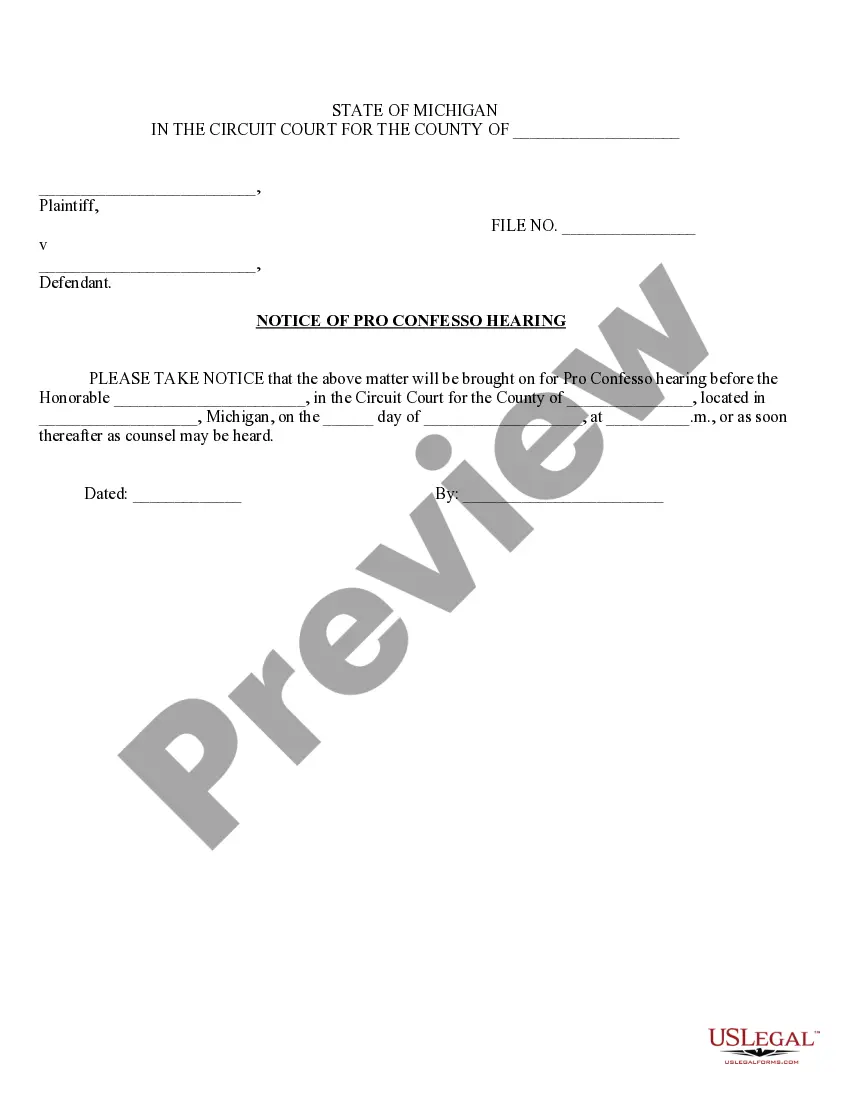
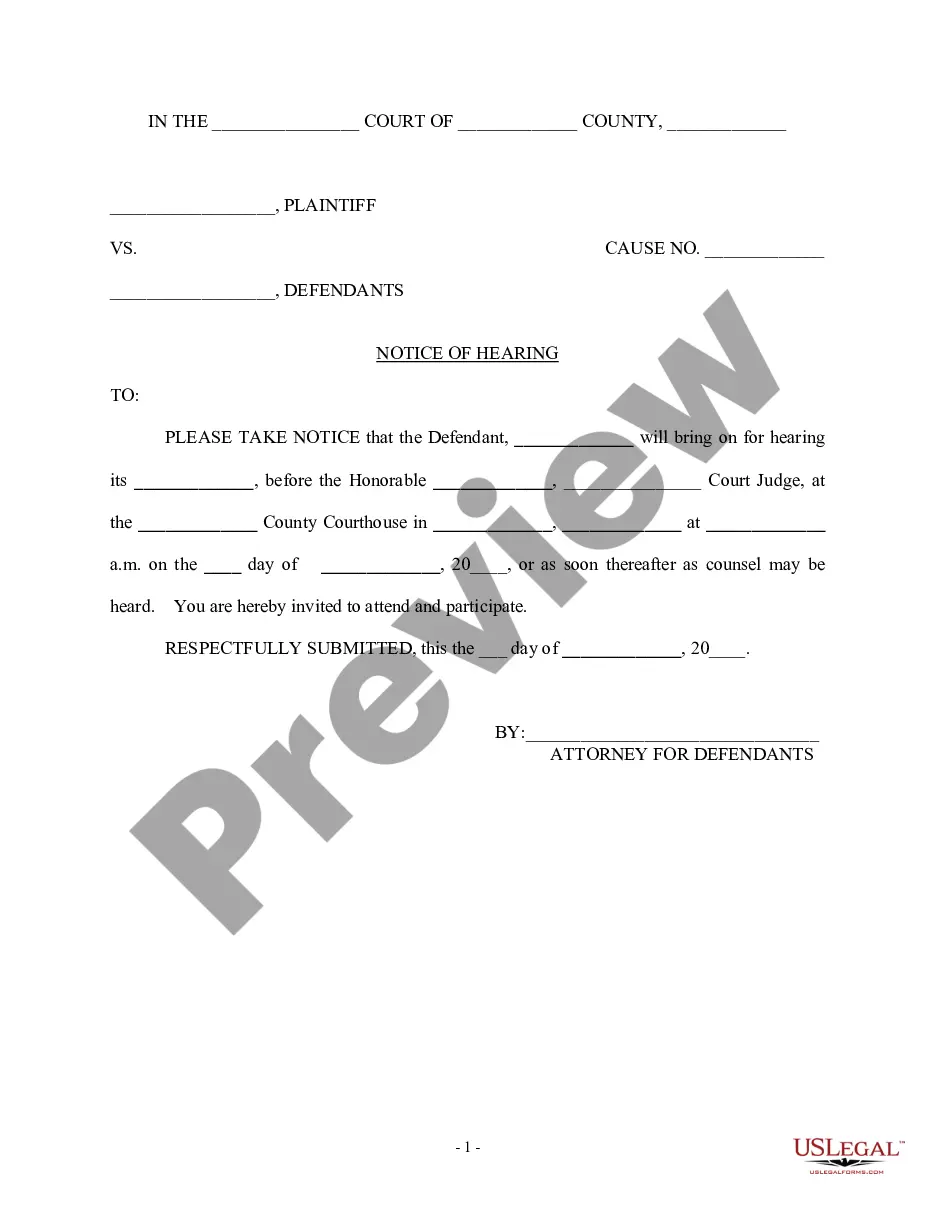
The Notice of Pro Confesso Hearing is a legal document that informs a party about an upcoming hearing in a court case. This notice is crucial for ensuring that all parties are aware of legal proceedings and can prepare accordingly. Unlike other notice forms, this one specifically addresses hearings that may lead to a judgment in favor of the party who initiates the hearing, often in cases where the other party may not respond to a legal complaint.
What’s included in this form
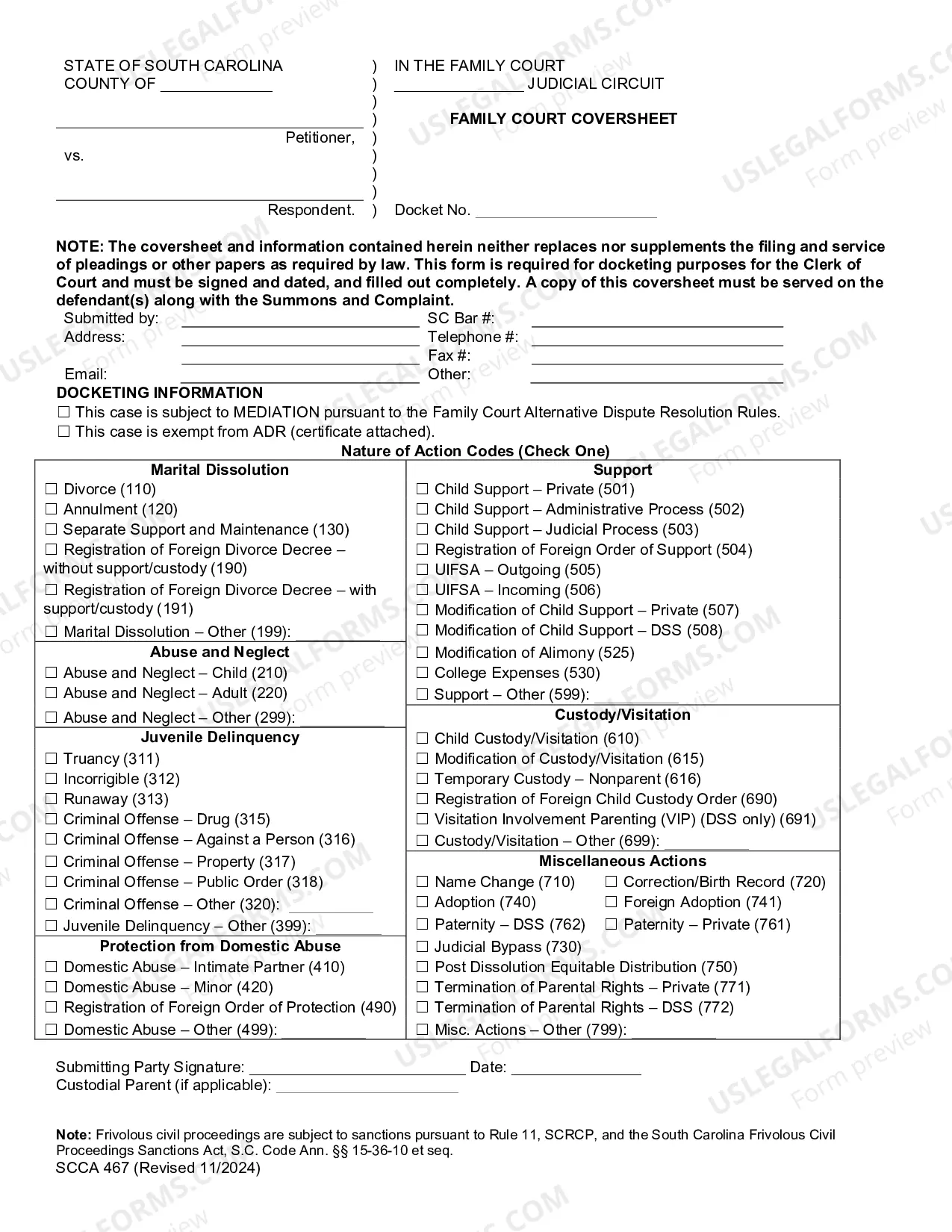
- Caption of the case, including the Plaintiff and Defendant's names.
- File number of the case for reference.
- Date and time of the Pro Confesso hearing.
- Name of the presiding judge.
- Location of the court where the hearing will take place.
- Signature line for the attorney or party sending the notice.
When to use this form
This form should be used when a party to a legal action has failed to respond or appear in court as required. It serves to notify them that a Pro Confesso hearing will be held, potentially resulting in a default judgment against them. This form could be necessary in cases related to civil disputes, family law matters, or other civil litigation where the defendant does not engage in the legal process.
Who needs this form
This form is intended for:
- Attorneys representing a party in a legal case.
- Individuals involved in a civil lawsuit who need to notify the other party of a hearing.
- Parties seeking to move forward with a case when the opponent has not responded.
Completing this form step by step
- Identify the parties involved in the case by filling in the Plaintiff and Defendant names.
- Enter the file number associated with your case.
- Specify the date and time for the hearing, ensuring it is accurate and allows for proper notification.
- Fill in the name of the judge who will preside over the hearing.
- Indicate the location of the court where the proceeding will occur.
- Sign and date the form to validate its contents and indicate who is sending the notice.
Does this document require notarization?
Notarization is generally not required for this form. However, certain states or situations might demand it. You can complete notarization online through US Legal Forms, powered by Notarize, using a verified video call available anytime.
Get your form ready online
Our built-in tools help you complete, sign, share, and store your documents in one place.
Make edits, fill in missing information, and update formatting in US Legal Forms—just like you would in MS Word.
Download a copy, print it, send it by email, or mail it via USPS—whatever works best for your next step.
Sign and collect signatures with our SignNow integration. Send to multiple recipients, set reminders, and more. Go Premium to unlock E-Sign.
If this form requires notarization, complete it online through a secure video call—no need to meet a notary in person or wait for an appointment.
We protect your documents and personal data by following strict security and privacy standards.

Make edits, fill in missing information, and update formatting in US Legal Forms—just like you would in MS Word.

Download a copy, print it, send it by email, or mail it via USPS—whatever works best for your next step.

Sign and collect signatures with our SignNow integration. Send to multiple recipients, set reminders, and more. Go Premium to unlock E-Sign.

If this form requires notarization, complete it online through a secure video call—no need to meet a notary in person or wait for an appointment.

We protect your documents and personal data by following strict security and privacy standards.
Common mistakes to avoid
- Failing to include the correct case number, which can cause confusion.
- Neglecting to specify the hearing date and time clearly.
- Not signing the document, rendering it ineffective.
- Omitting the judge's name, which may lead to procedural issues.
Why use this form online
- Convenient access to downloadable legal templates that you can customize as needed.
- Editable format allows for easy adjustments to fit specific cases.
- Developed by licensed attorneys, ensuring legal reliability.
What to keep in mind
- The Notice of Pro Confesso Hearing is crucial for notifying defendants of scheduled hearings.
- Ensure accuracy when filling out the form to avoid delays in your case.
- This form is tailored for use in Michigan and should be adjusted according to local legal requirements.
Looking for another form?
Form popularity
FAQ
Rule 2.313 in Michigan pertains to the process of discovery and ensures that both parties can obtain necessary information and documents from each other. This rule plays a vital role in cases leading up to a Michigan Notice of Pro Confesso Hearing, as it helps establish a clear understanding of the facts and arguments. By facilitating effective communication between parties, Rule 2.313 promotes fairness in judicial proceedings. For guidance on navigating these processes, consider using the uslegalforms platform, which offers comprehensive resources tailored to Michigan court procedures.
Pro con is short for pro confesso, a Latin term which means as though confessed. In a divorce case, once a complete agreement has been reached a pro confesso or pro con hearing is scheduled. At that hearing, testimony (also known as proofs) must be placed on the record before the Judge can grant the divorce.
Pro Confesso. At the hearing, a party, usually the plaintiff, appears in court to confirm the facts giving rise to the jurisdiction, the marriage remains broken, there is no reasonable chance of reconciliation, and other matters. Once the party gives the required testimony, the court enters the judgment of divorce.
File your Motion and the copies with the court clerk's office in the court where your case was heard. File a copy of the proposed order with your Motion. You can file your forms in person or by mailing your Motion and the copies to the court. The clerk will give you a hearing date and time when you file your Motion.
You don't need an attorney to file a Motion for Contempt, but it is a good idea to have one. If you decide to represent yourself, you can go to the courthouse that made the order and ask for help at the Court Service Center.
With a hearing, the judge will consider evidence and testimony on one or more aspects of your divorce, perhaps child custody or visitation or temporary alimony, for example. The judge will render a decision on those issues only, removing some of the roadblocks and answering some questions about your divorce.
A divorce settlement conference is a meeting where the spouses and attorneys work on the terms and conditions of property division, alimony, child support, and custody and visitation. They negotiate and find compromises on these issues because through compromise and negotiation the parties attempt to avoid a trial.
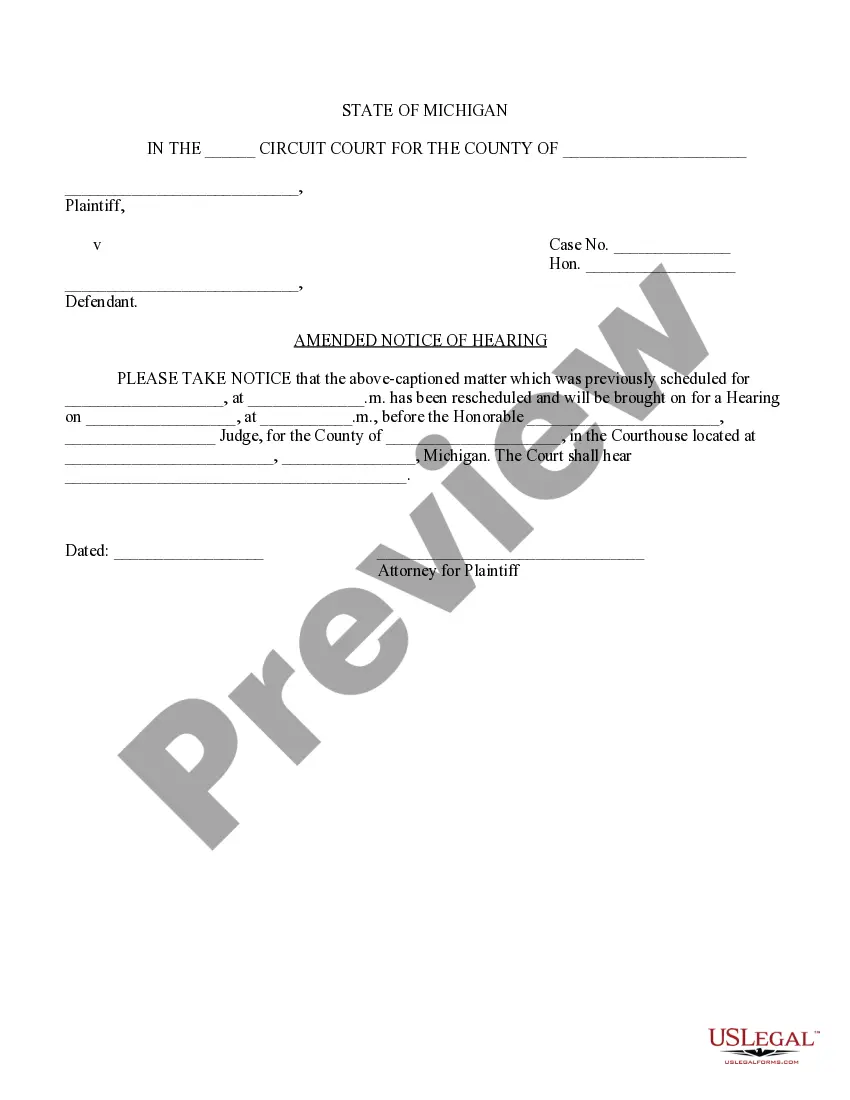
Requests to reschedule hearings that were administratively initiated by the Friend of the Court must be done by contacting the Referee's Support Staff by telephone (see Referee Support Telephone List) or faxing a written request to (313) 237-9268.
Ask the court for a motion date. Identify and fill out your motion forms. Serve and file your motion forms. Confirm that you will attend the motion. Go to your motion hearing. Receive the judge's decision.
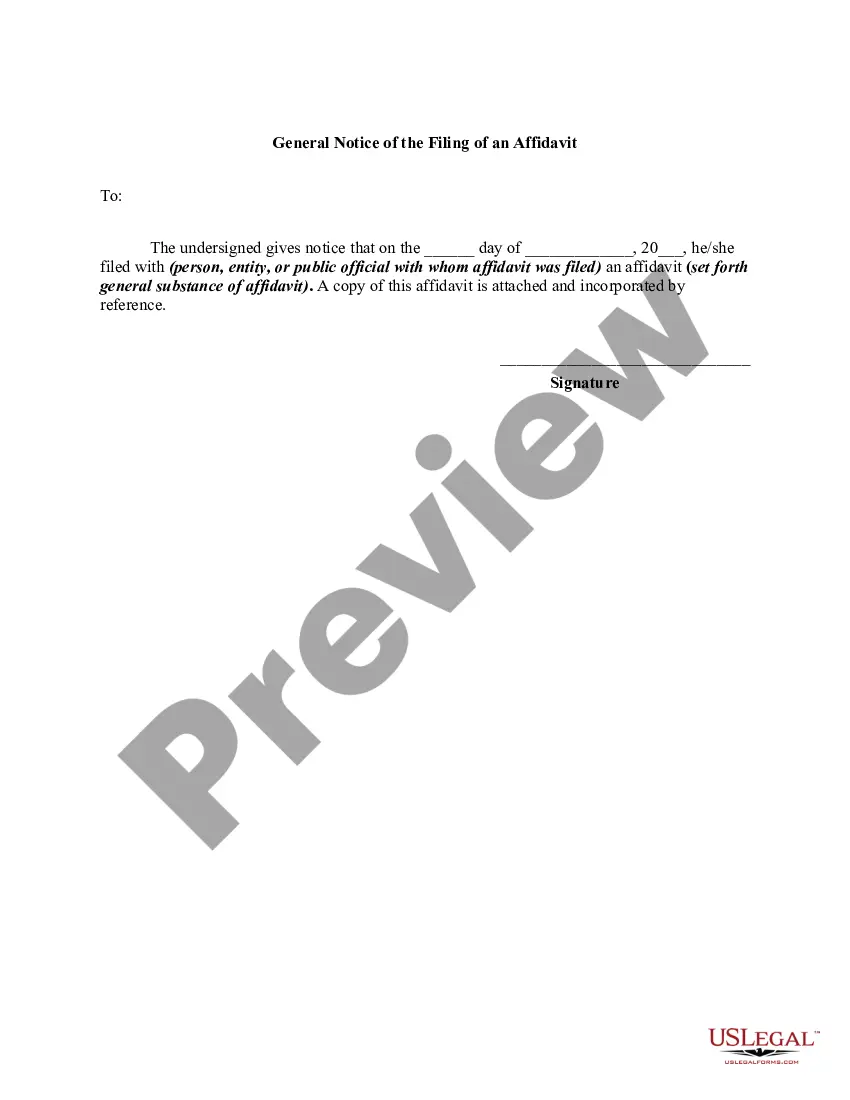
Summons. Complaint for Custody, Parenting Time, and Child Support. Uniform Child Custody Jurisdiction Enforcement Act Affidavit. Verified Statement. Application for IV-D Child Support Services (form DHS-1201D)