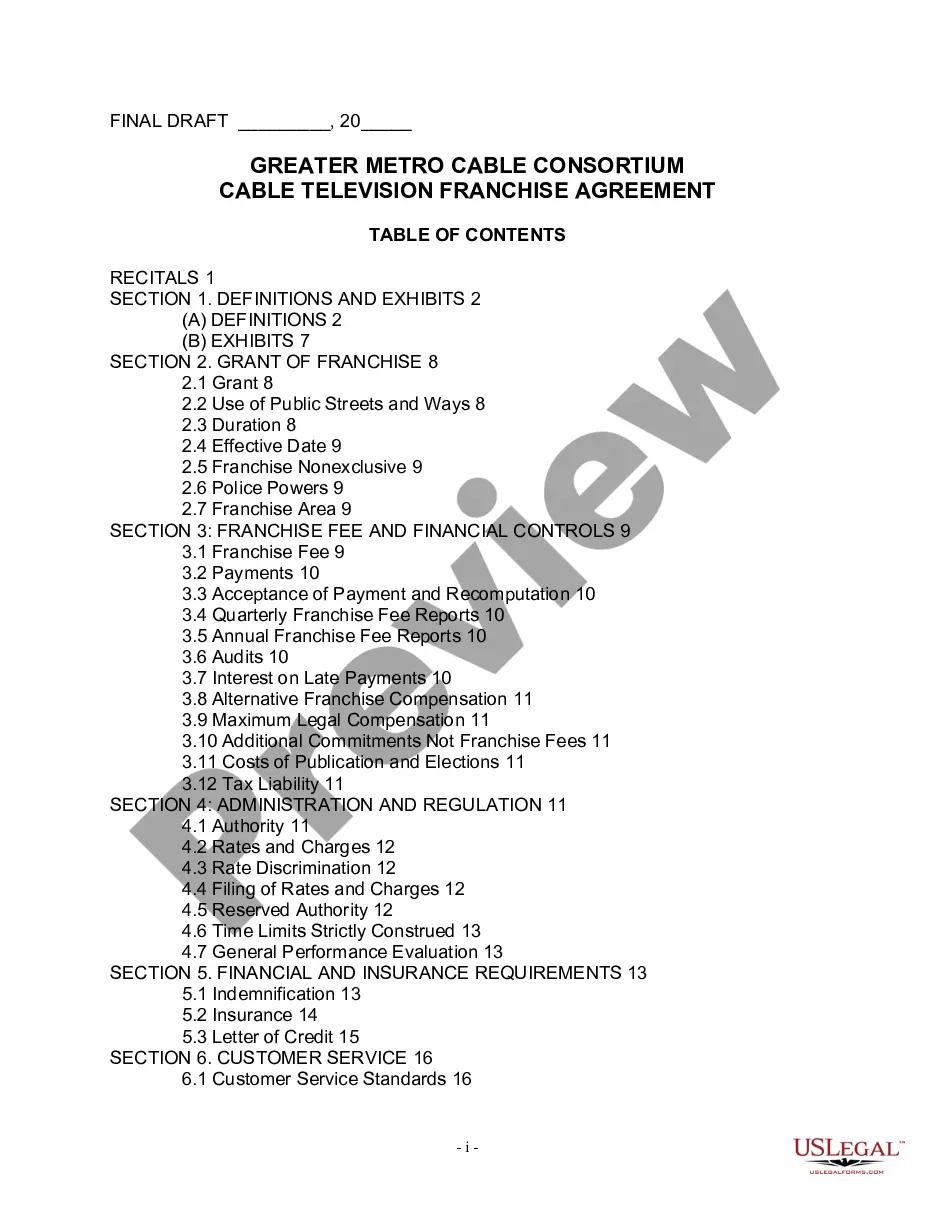
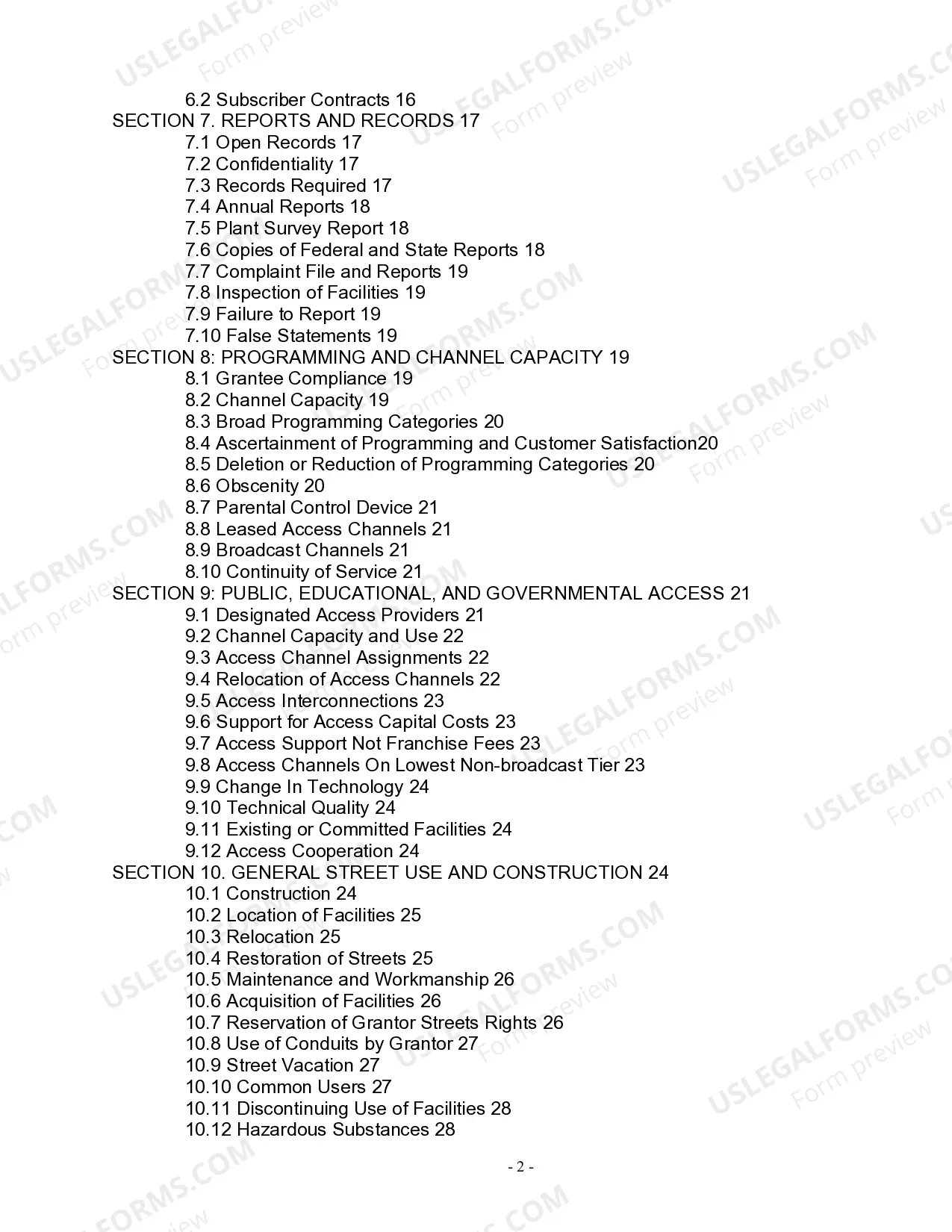
Maine Cable Consortium Cable Television Franchise Agreement
Description


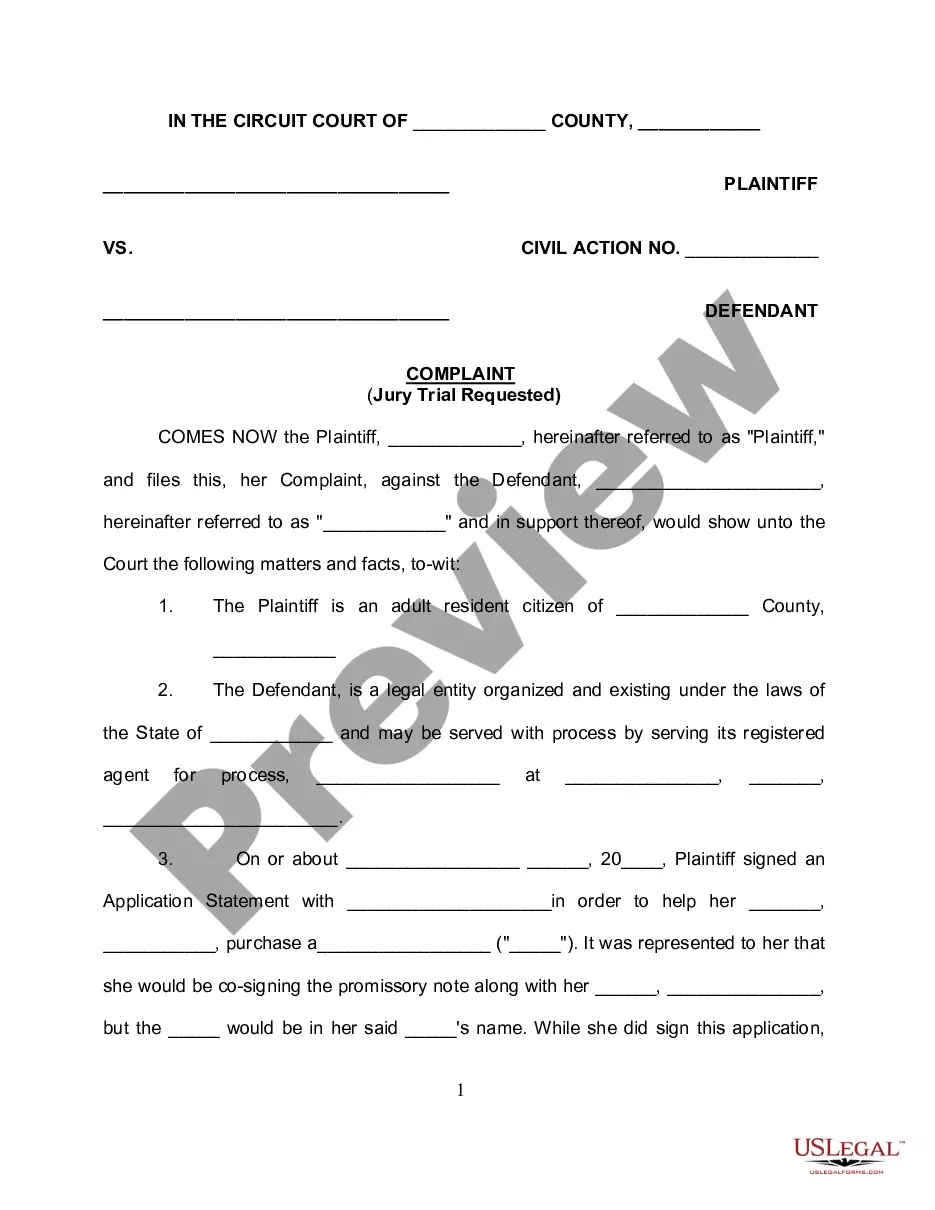
How to fill out Cable Consortium Cable Television Franchise Agreement?
If you require extensive, acquire, or create legal document templates, utilize US Legal Forms, the largest collection of legal forms available online.
Employ the site’s straightforward and user-friendly search to find the documents you need.
Numerous templates for business and personal purposes are categorized by types and jurisdictions, or keywords.
Step 4. Once you have located the form you need, click the Acquire now button. Choose the pricing plan you prefer and provide your information to register for an account.
Step 5. Complete the transaction. You can use your credit card or PayPal account to finalize the purchase.
- Use US Legal Forms to obtain the Maine Cable Consortium Cable Television Franchise Agreement in just a few clicks.
- If you are already a US Legal Forms customer, Log In to your account and click on the Obtain button to retrieve the Maine Cable Consortium Cable Television Franchise Agreement.
- You can also access forms you previously downloaded in the My documents section of your account.
- If you are using US Legal Forms for the first time, follow the instructions below.
- Step 1. Ensure you have chosen the form for the correct city/state.
- Step 2. Use the Preview feature to review the form’s content. Don’t forget to check the details.
- Step 3. If you are not satisfied with the form, use the Search bar at the top of the screen to find alternative versions of the legal form template.
Form popularity
FAQ
Cable franchises, including the Maine Cable Consortium Cable Television Franchise Agreement, are typically awarded for a term of 10 to 15 years. This duration allows cable companies to invest in infrastructure and provide reliable services to their customers. It also ensures that local governments have the opportunity to review and renew the agreements based on performance and community needs. If you're seeking guidance on navigating these agreements, consider using the resources available through USLegalForms to simplify the process.
Cable franchise fees can be utilized for various public purposes, including funding local infrastructure projects, enhancing community services, and supporting public access television. These fees, often a percentage of the revenue generated by the cable provider, contribute to the local economy and improve the quality of life for residents. By understanding the Maine Cable Consortium Cable Television Franchise Agreement, you can see how these fees help maintain and improve community resources, ensuring that everyone benefits from quality cable services.
A cable franchise agreement is a contract that allows a cable company to provide service within a certain area. It is a crucial part of the regulatory process and requires the cable provider to meet local standards and community needs. This agreement typically includes terms regarding service quality, fees, and the provision of public access channels. By examining the Maine Cable Consortium Cable Television Franchise Agreement, you can gain insights into how these agreements function and their impact on your local cable services.
The purpose of a franchise agreement is to establish a legal framework between a cable provider and a local government. This agreement outlines the rights and responsibilities of both parties, ensuring that the cable provider can operate within the community while adhering to specific regulations. It also protects the interests of consumers by mandating service standards and promoting fair competition. By understanding the Maine Cable Consortium Cable Television Franchise Agreement, you can appreciate how it benefits both service providers and residents.
The three types of franchise agreements include cable television franchise agreements, which specifically govern the operation of cable services in designated areas; telecommunications franchise agreements, which cover broader communication services; and video service franchise agreements, which focus on video programming delivery. The Maine Cable Consortium Cable Television Franchise Agreement falls under the first category, providing local governments with the authority to regulate cable services. Each type of agreement serves unique purposes and involves distinct regulatory requirements, ensuring that operators meet community needs effectively.
In the United States cable television industry, a cable television franchise fee is an annual fee charged by a local government to a private cable television company as compensation for using public property it owns as right-of-way for its cable lines.
Most rates charged by cable television companies are not regulated by the FCC.
About the FCC. The Federal Communications Commission regulates interstate and international communications by radio, television, wire, satellite and cable in all 50 states, the District of Columbia and U.S. territories.
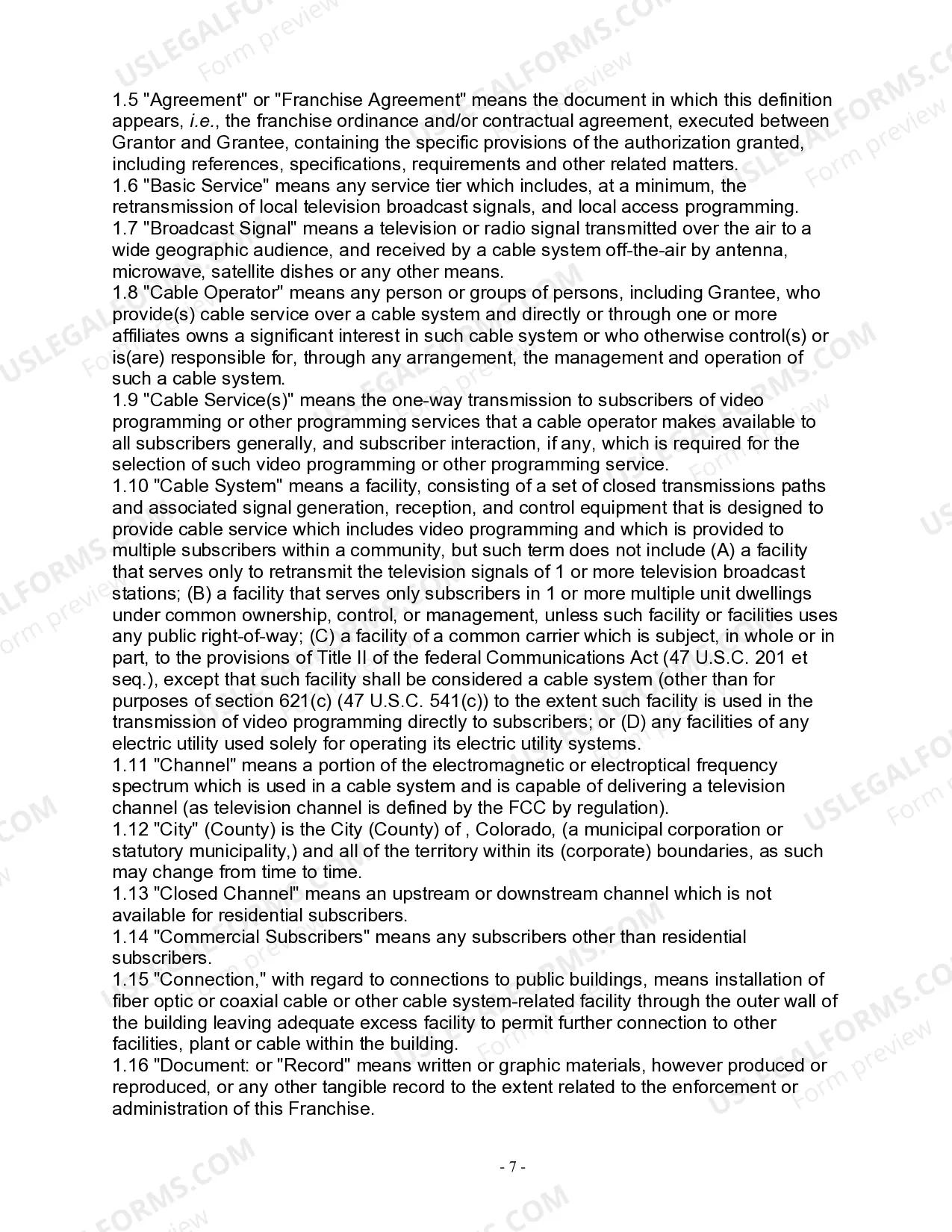
Cable franchise agreements provide the franchisee the right to construct, install, maintain and operate a cable system on County Public Rights-of-Way in exchange for the franchisee's promise to provide cable service to residents of the County.
Under that provision, franchising authorities may not "grant an exclusive franchise" or "unreasonably refuse to award an additional competitive franchise."