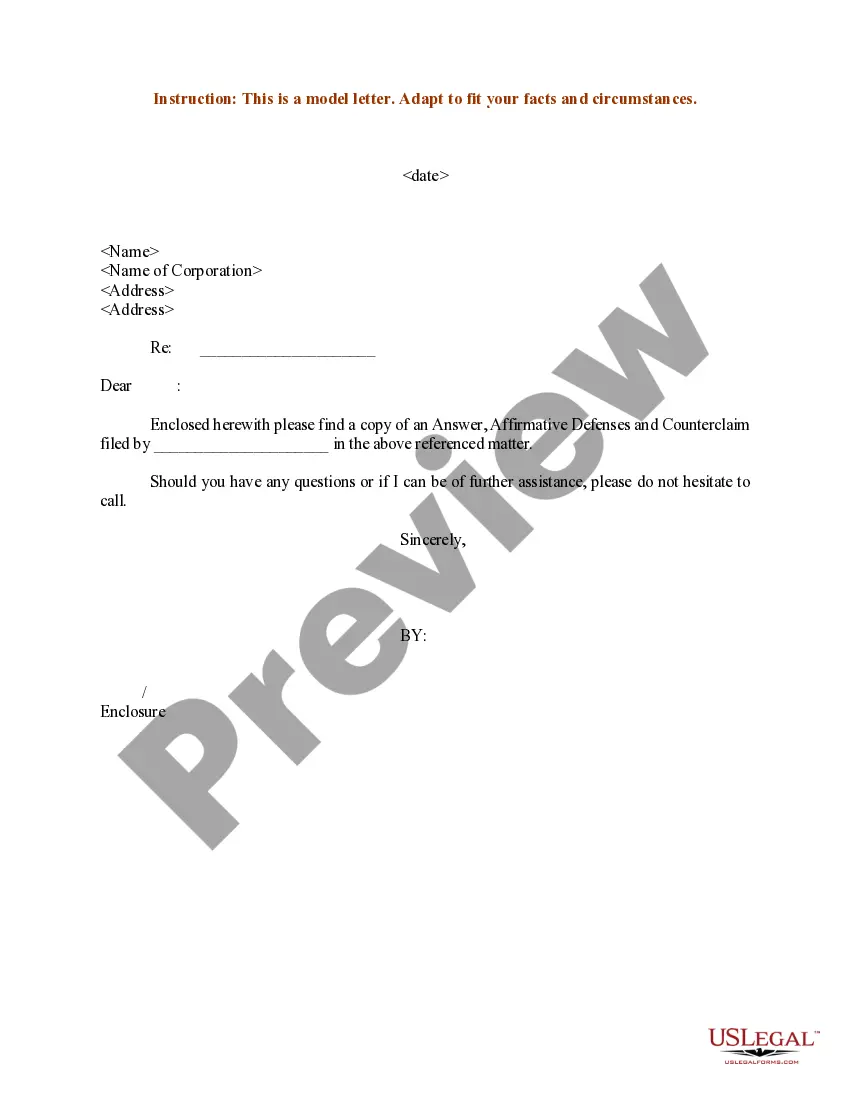
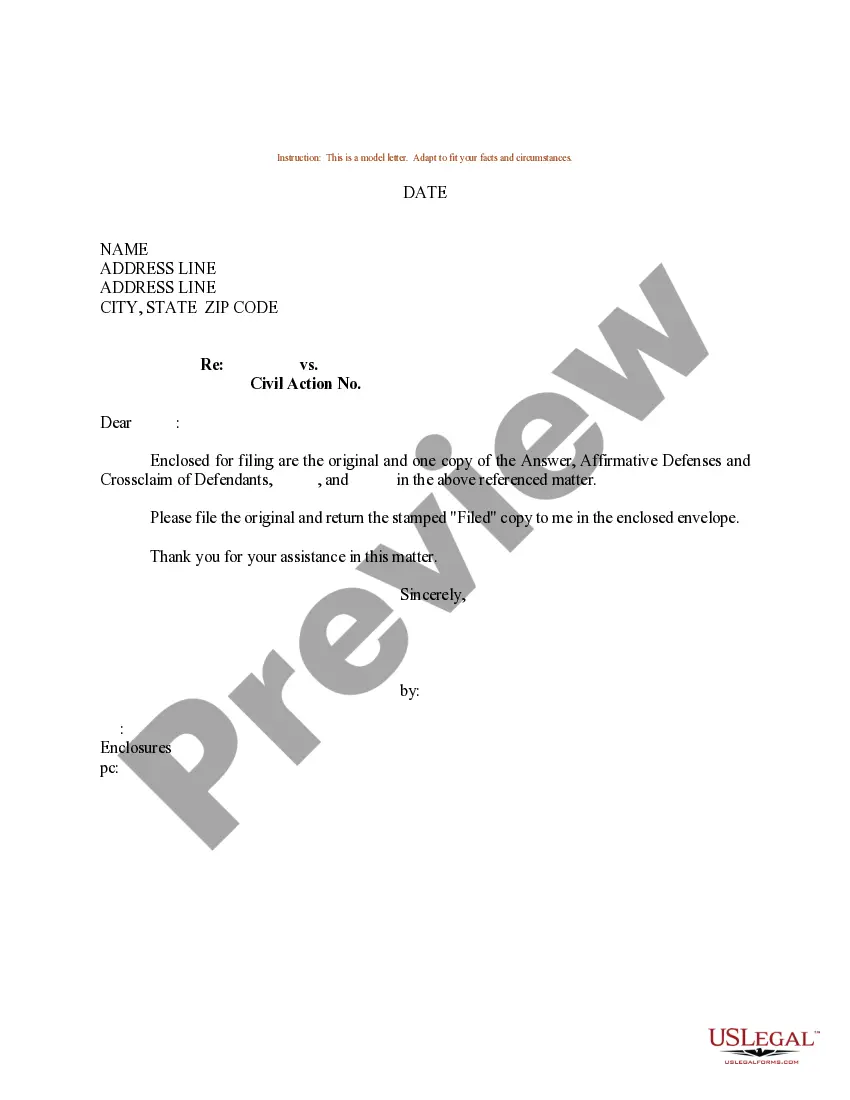
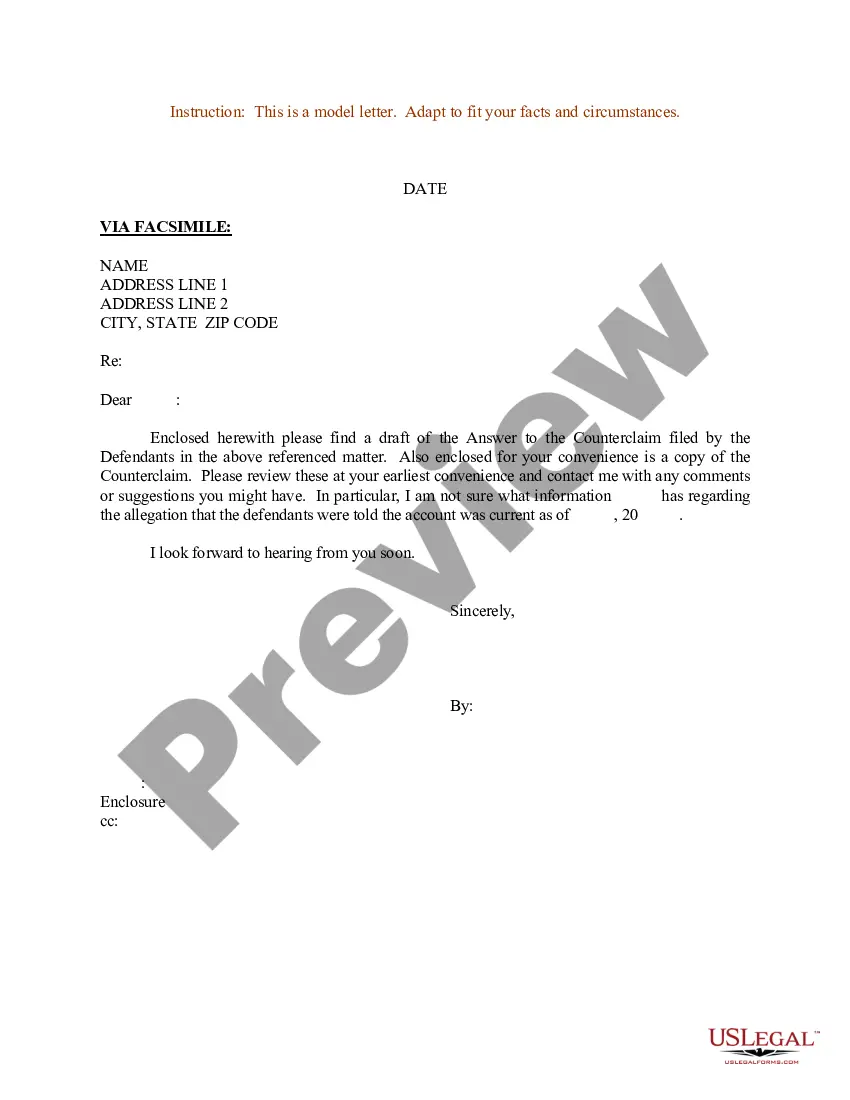
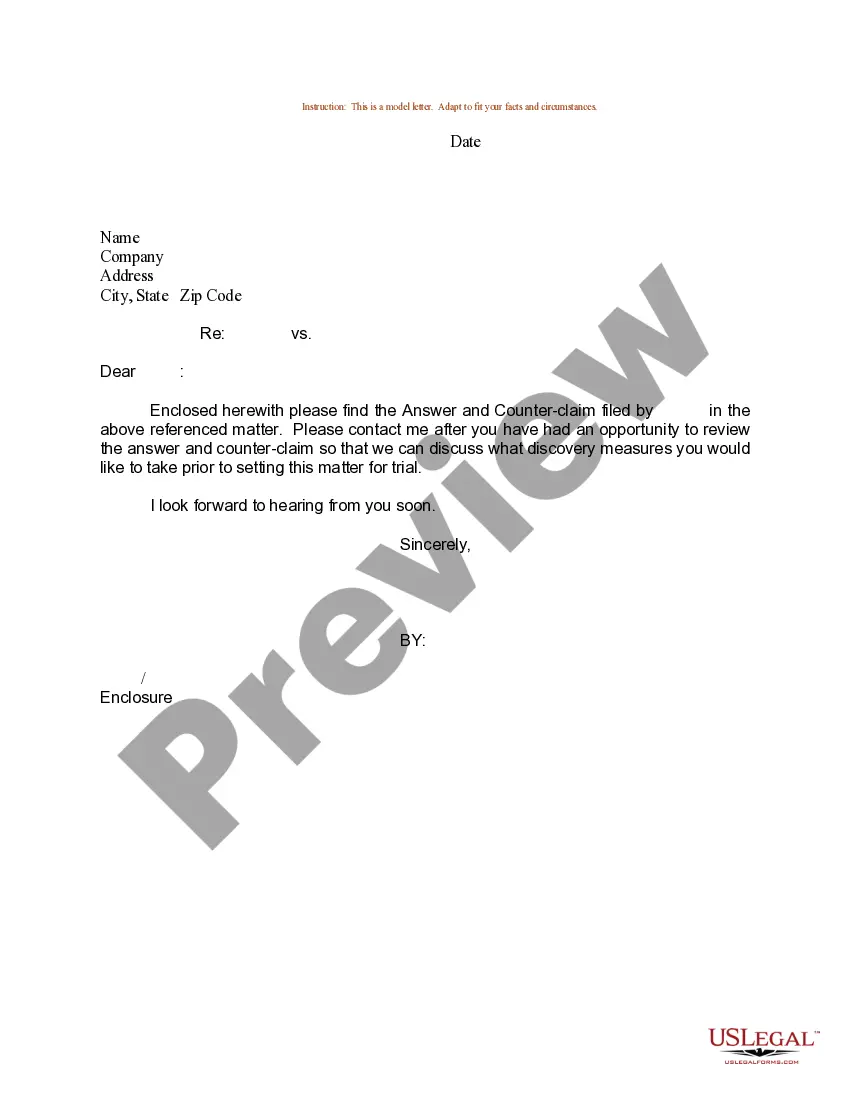
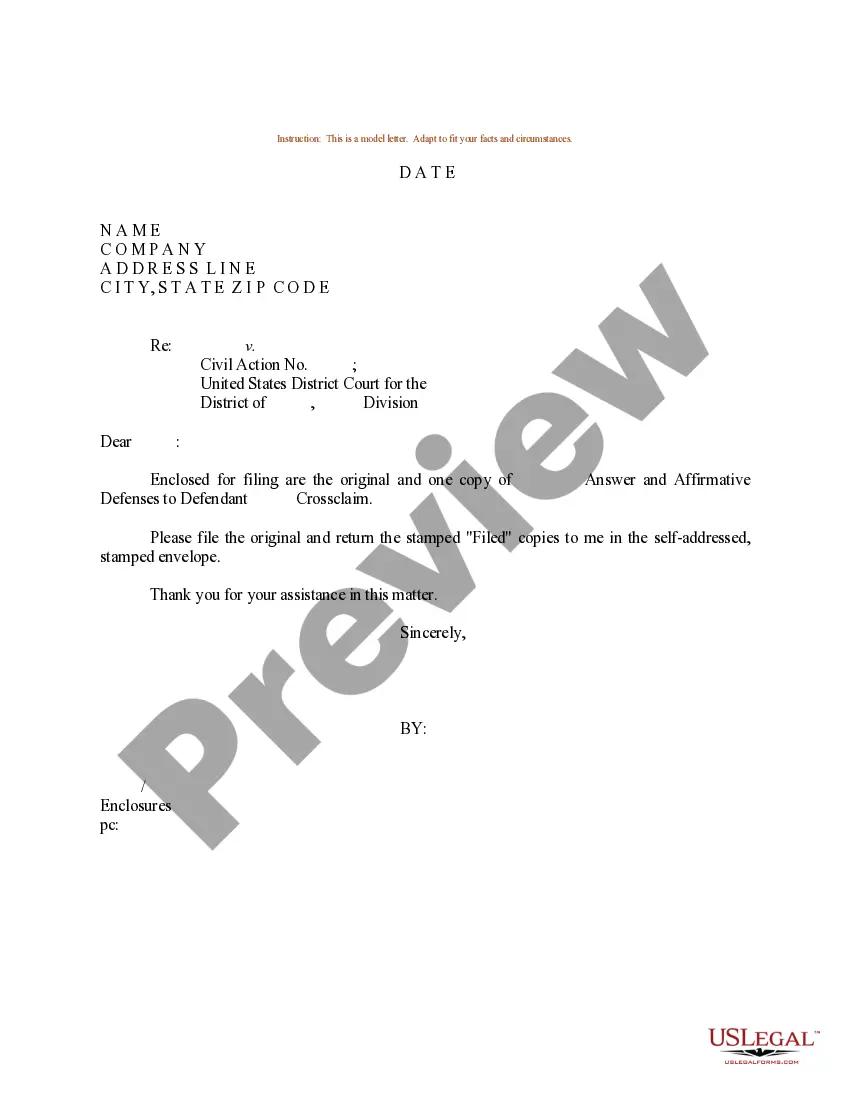
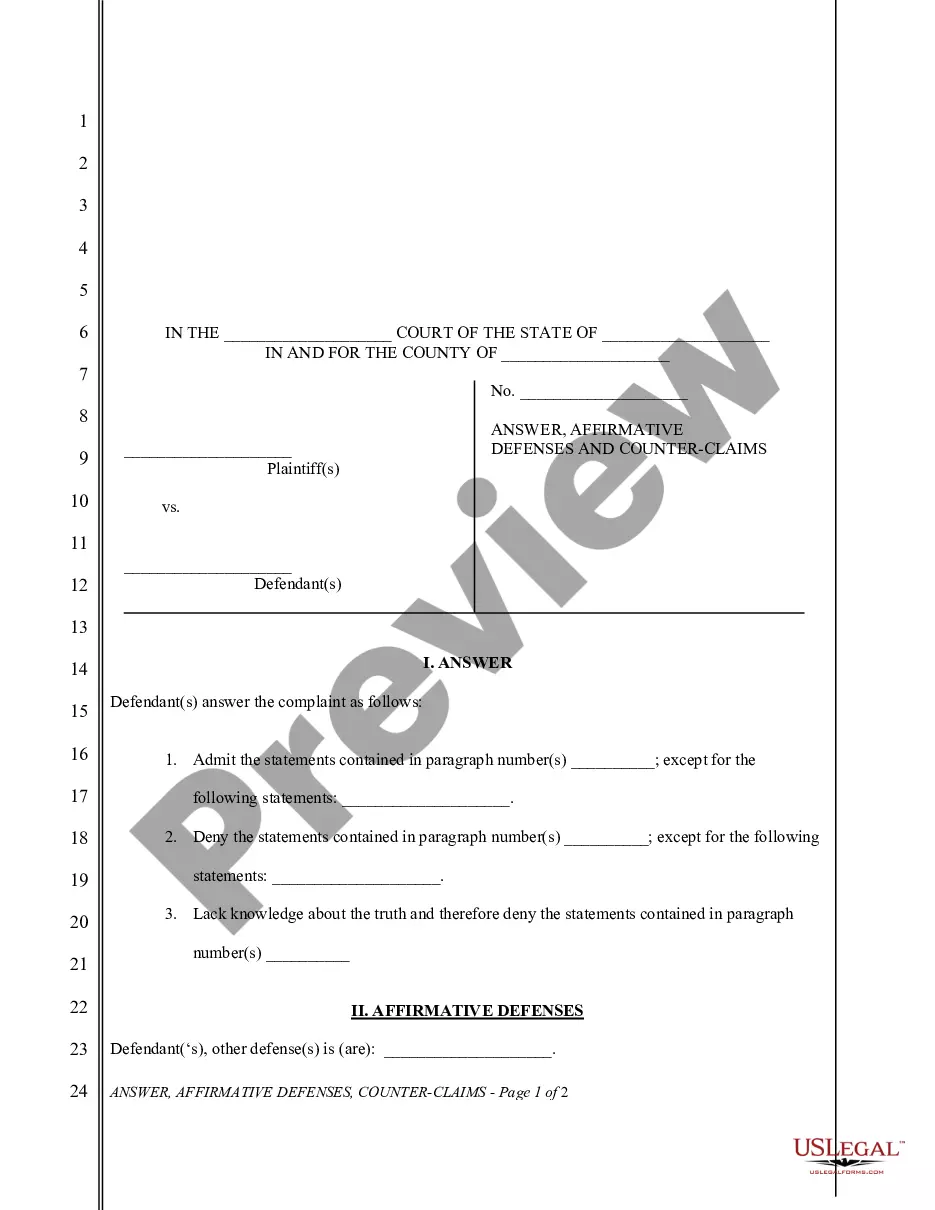
Maine Sample Letter regarding Answer, Affirmative Defenses, and Counterclaim
Description
Get your form ready online
Our built-in tools help you complete, sign, share, and store your documents in one place.
Make edits, fill in missing information, and update formatting in US Legal Forms—just like you would in MS Word.
Download a copy, print it, send it by email, or mail it via USPS—whatever works best for your next step.
Sign and collect signatures with our SignNow integration. Send to multiple recipients, set reminders, and more. Go Premium to unlock E-Sign.
If this form requires notarization, complete it online through a secure video call—no need to meet a notary in person or wait for an appointment.
We protect your documents and personal data by following strict security and privacy standards.

Make edits, fill in missing information, and update formatting in US Legal Forms—just like you would in MS Word.

Download a copy, print it, send it by email, or mail it via USPS—whatever works best for your next step.

Sign and collect signatures with our SignNow integration. Send to multiple recipients, set reminders, and more. Go Premium to unlock E-Sign.

If this form requires notarization, complete it online through a secure video call—no need to meet a notary in person or wait for an appointment.

We protect your documents and personal data by following strict security and privacy standards.
Looking for another form?



How to fill out Sample Letter Regarding Answer, Affirmative Defenses, And Counterclaim?
US Legal Forms - one of the largest collections of legal documents in the USA - offers a range of legal form templates that you can download or print. By using the website, you can find thousands of forms for business and personal purposes, categorized by types, states, or keywords.
You will find the latest versions of forms such as the Maine Sample Letter regarding Answer, Affirmative Defenses, and Counterclaim in just a few moments. If you have a monthly subscription, Log In and download the Maine Sample Letter regarding Answer, Affirmative Defenses, and Counterclaim from the US Legal Forms library. The Acquire button will be visible on each form you view. You have access to all previously saved forms within the My documents section of your account.
To use US Legal Forms for the first time, here are simple instructions to help you get started: Ensure you have chosen the correct form for your city/state. Click the Review button to examine the form's content. Check the form description to confirm that you have selected the right form. If the form does not meet your needs, use the Search field at the top of the screen to find one that does. Once you are satisfied with the form, confirm your selection by clicking the Get now button. Then, choose the payment plan you wish and provide your details to register for an account. Process the transaction. Use your Visa or Mastercard or PayPal account to complete the transaction. Select the format and download the form to your device.
Avoid altering or deleting any HTML tags. Only synonymize plain text outside of the HTML tags.
- Edit. Fill out, modify, and print and sign the saved Maine Sample Letter regarding Answer, Affirmative Defenses, and Counterclaim.
- Every template you added to your account has no expiration date and is yours forever.
- So, if you want to download or print another copy, just go to the My documents section and click on the form you need.
- Access the Maine Sample Letter regarding Answer, Affirmative Defenses, and Counterclaim with US Legal Forms, the most extensive library of legal document templates.
- Utilize a multitude of professional and state-specific templates that meet your business or personal requirements and specifications.
Form popularity
FAQ
If you are not able (or do not want) to settle the counterclaim, you do not need to file anything with the court if you have been served with a counterclaim. You simply attend the scheduled court date to defend yourself. The date and time of the mediation or hearing should be stated on the counterclaim you received.
The defence to a counterclaim must deal with every allegation made by the defendant in the counterclaim by either admission, denial or making no admission. The counterclaim is drafted following the same rules as the defence, for details on drafting the defence - please see our previous Article in this series.
Your options are: negotiate with the plaintiff. agree to pay the entire debt. agree to pay the debt in instalments. file a defence (asserting that you deny the entire claim or part of the claim) file a statement of cross-claim (asserting that you have a counter-claim against the plaintiff or a third party.
Affirmative defense?Examples On [Date], after making the contract and the alleged breach, and before this action was commenced, defendant paid to the plaintiff the sum of [specify amount], which was accepted by the plaintiff in full satisfaction and discharge of the damages claimed in the petition.
In conclusion, the main difference between a counterclaim and an affirmative defense is that a counterclaim is a claim made by a defendant against the plaintiff. In contrast, an affirmative defense is a defense raised by the defendant in response to the plaintiff's claim.
You should respond to the counterclaim as though it were a Statement of Claim and you were drafting a Defence: respond to every paragraph ? you can do this paragraph by paragraph if necessary; deny any allegations of fact that you do not admit ? you will be deemed to admit facts that you forget to plead to; and.
While the answer is simply admitting or denying information from the complaint, the counterclaim can be used to put forth alternative versions of the facts or a completely different reason for the divorce. The counterclaim functions just like a complaint, you do not need to prove anything in the counterclaim.
If a counterclaim is filed, the plaintiff must be given the opportunity to respond by filing a reply.