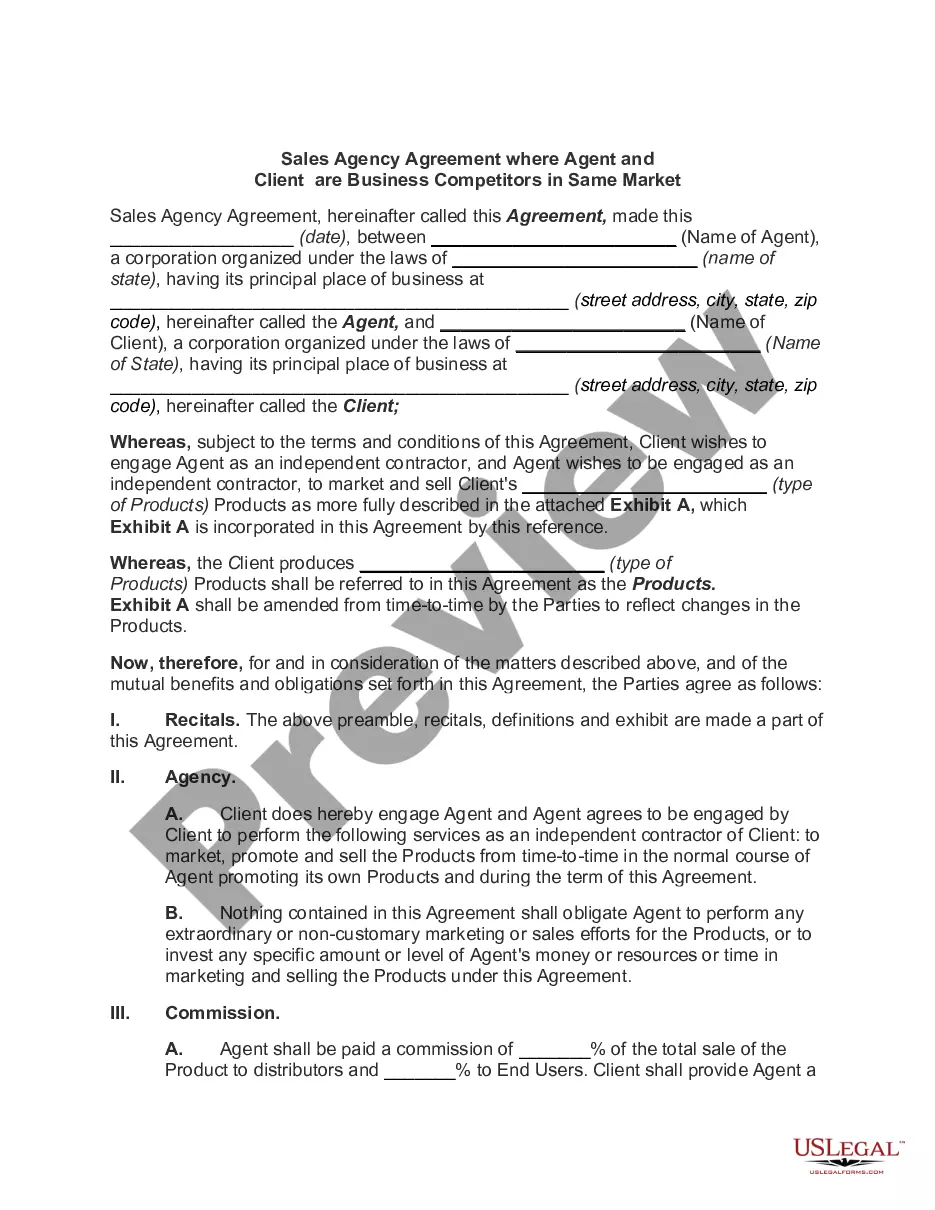
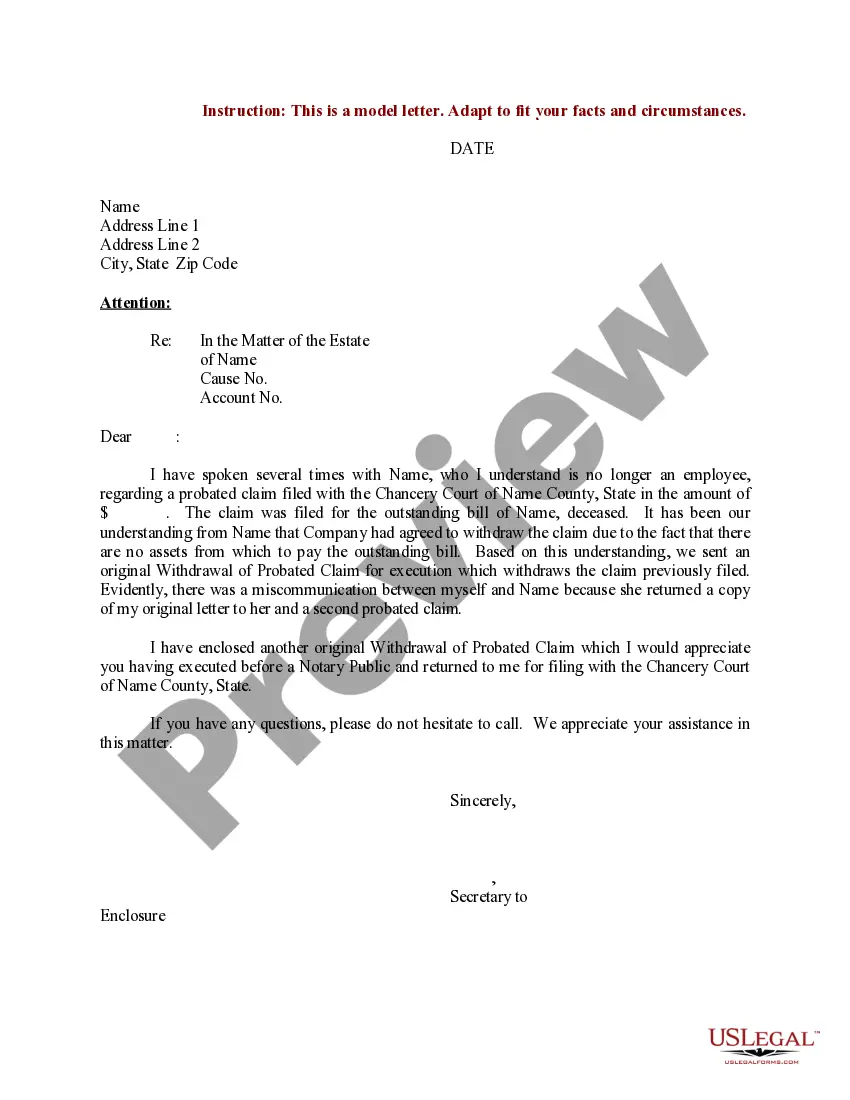
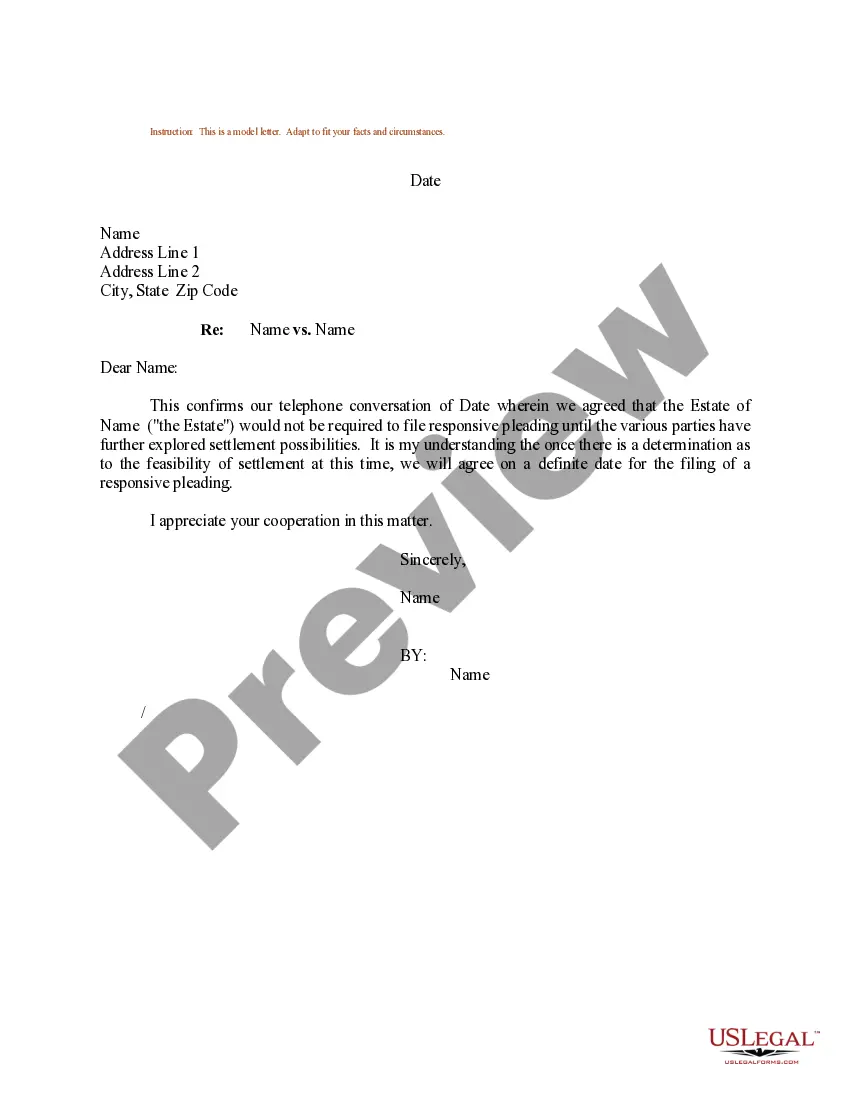
Maine Sample Letter for Claim Settlement Against Decedent's Estate
Description


Get your form ready online
Our built-in tools help you complete, sign, share, and store your documents in one place.
Make edits, fill in missing information, and update formatting in US Legal Forms—just like you would in MS Word.
Download a copy, print it, send it by email, or mail it via USPS—whatever works best for your next step.
Sign and collect signatures with our SignNow integration. Send to multiple recipients, set reminders, and more. Go Premium to unlock E-Sign.
If this form requires notarization, complete it online through a secure video call—no need to meet a notary in person or wait for an appointment.
We protect your documents and personal data by following strict security and privacy standards.

Make edits, fill in missing information, and update formatting in US Legal Forms—just like you would in MS Word.

Download a copy, print it, send it by email, or mail it via USPS—whatever works best for your next step.

Sign and collect signatures with our SignNow integration. Send to multiple recipients, set reminders, and more. Go Premium to unlock E-Sign.

If this form requires notarization, complete it online through a secure video call—no need to meet a notary in person or wait for an appointment.

We protect your documents and personal data by following strict security and privacy standards.
Looking for another form?

How to fill out Sample Letter For Claim Settlement Against Decedent's Estate?
If you require to finalize, obtain, or print legal document templates, utilize US Legal Forms, the largest assortment of legal forms available online.
Take advantage of the site’s straightforward and user-friendly search feature to find the documents you need.
Various templates for business and personal purposes are categorized by type and state, or keywords.
Step 4. Once you have found the form you need, select the Buy now button. Choose the pricing plan you prefer and enter your details to register for an account.
Step 5. Process the transaction. You can use your credit card or PayPal account to complete the transaction. Step 6. Select the format of the legal form and download it to your device. Step 7. Complete, modify, and print or sign the Maine Sample Letter for Claim Settlement Against Decedent's Estate. Every legal document template you obtain is yours forever. You can access every form you downloaded in your account. Click on the My documents section and choose a form to print or download again. Compete and obtain, and print the Maine Sample Letter for Claim Settlement Against Decedent's Estate using US Legal Forms. There are thousands of professional and state-specific forms available for your business or personal needs.
- Utilize US Legal Forms to locate the Maine Sample Letter for Claim Settlement Against Decedent's Estate in just a few clicks.
- If you are currently a US Legal Forms user, Log In to your account and click the Acquire button to get the Maine Sample Letter for Claim Settlement Against Decedent's Estate.
- You can also access forms you previously downloaded in the My documents section of your account.
- If you are using US Legal Forms for the first time, please follow the instructions below.
- Step 1. Ensure you have selected the form for the correct city/state.
- Step 2. Use the Review option to examine the form’s content. Don’t forget to read the overview.
- Step 3. If you are not satisfied with the form, utilize the Search field at the top of the screen to find other forms of the legal type template.
Form popularity
FAQ
Listed below are some of the non-probate assets available in Maine. Any property in a living trust. Life insurance policies. 401(k)s, IRAs, other retirement accounts. Securities in transfer-on-death accounts. Pay-on-death bank accounts. Joint tenancy real property.
Regardless of any notice, no claim can be made later than 9 months from the date of death. Within these limits, Maine maintains a 6-year statute of limitations on general debts, from original due date or most recent payment, whichever is later (see Maine Revised Statutes § 14-205-752).
To decide whether probate is necessary for a particular estate, the individual's assets must be identified and valued. If the probate estate has a total value (value of probate assets minus any liens and encumbrances) of $40,000 or less and does not include any real property, then probate is not necessary.
Once the assets have been distributed, the Personal Representative prepares a final account of all income, expenses, and distributions, and distributes the account to the beneficiaries. Finally, the Personal Representative closes the estate by filing a "Sworn Statement" with the Probate Court.
Probate can be a lengthy process in Maine. It generally takes a minimum of six to twelve months, but it can extend beyond that, often lasting a year or more. Complex estates or disputes among beneficiaries can further lengthen the process.
In Maine, executor fees are not explicitly stated by law. Instead, the state allows for "reasonable" compensation, which is determined on a case-by-case basis. This ambiguity can be both a benefit and a drawback, depending on the complexity of the estate and the amount of work required by the executor.
To start the probate process, you need to file an ?Application for Probate? in the probate court in the county where the decedent lived. In Maine, each county has its own probate court. If there is a Will, it needs to be submitted to the probate court. The probate judge will decide whether or not the Will is valid.
If the person died without a will, you can still proceed with informal probate if there is no dispute regarding the identity of the heirs. Formal probate means that the estate must be opened by filing a petition for a hearing before the probate court and can mean continued involvement of the court.