Maine Conspiracy to Defraud
About this form
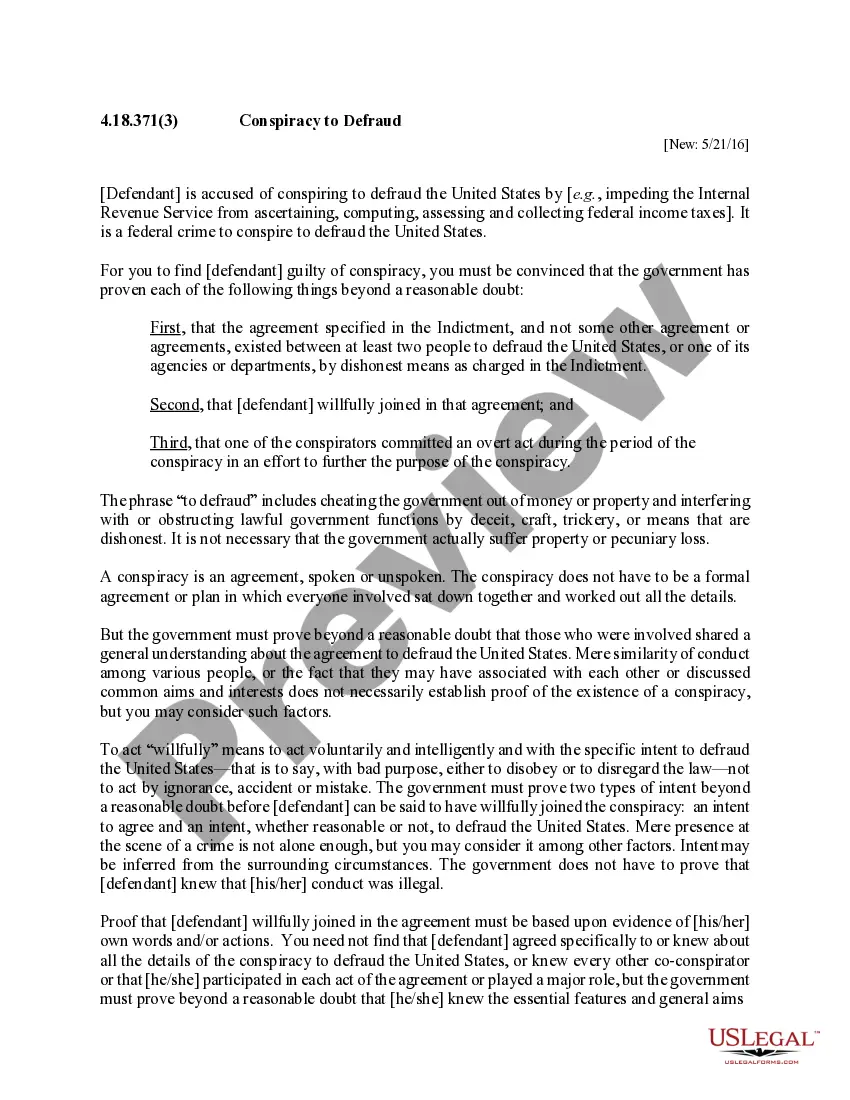
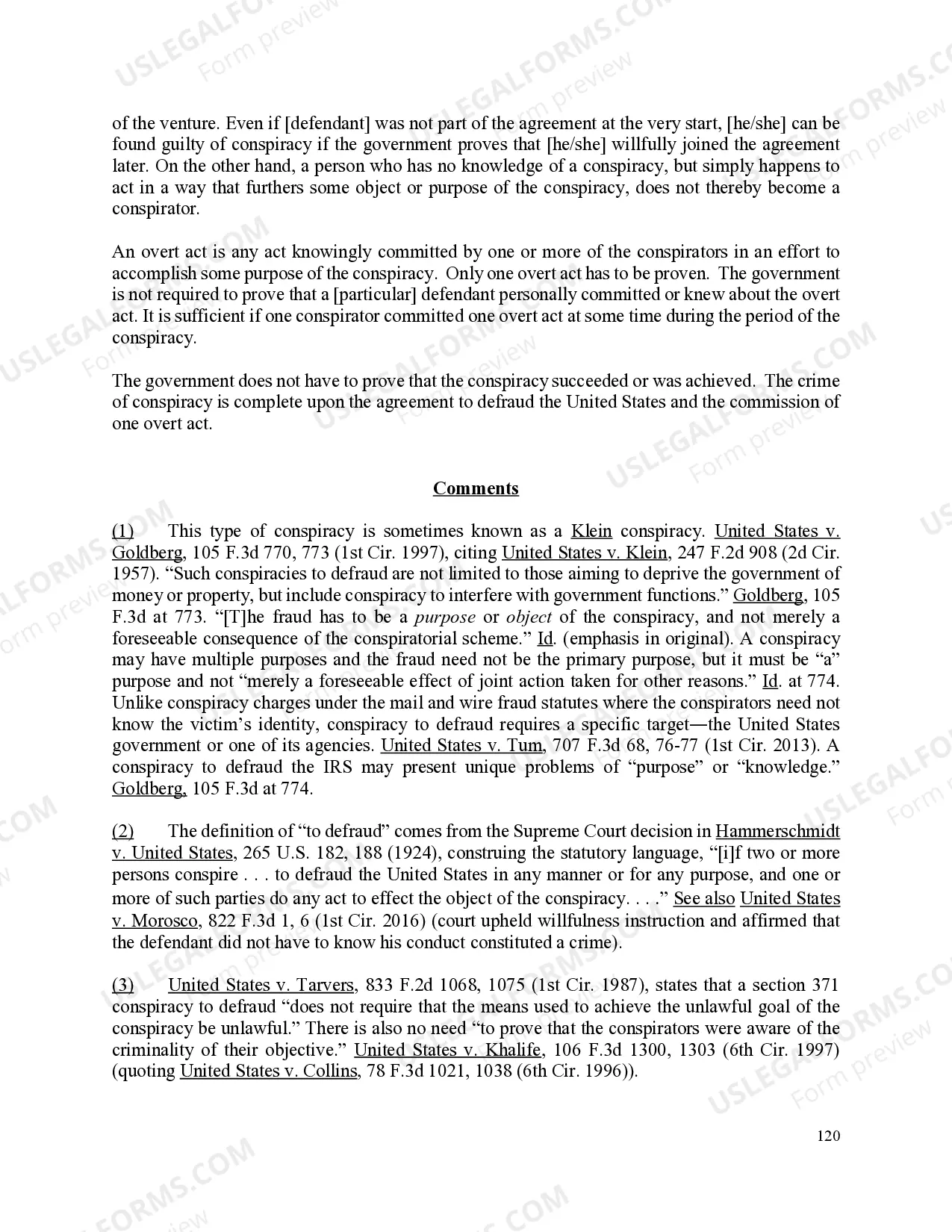
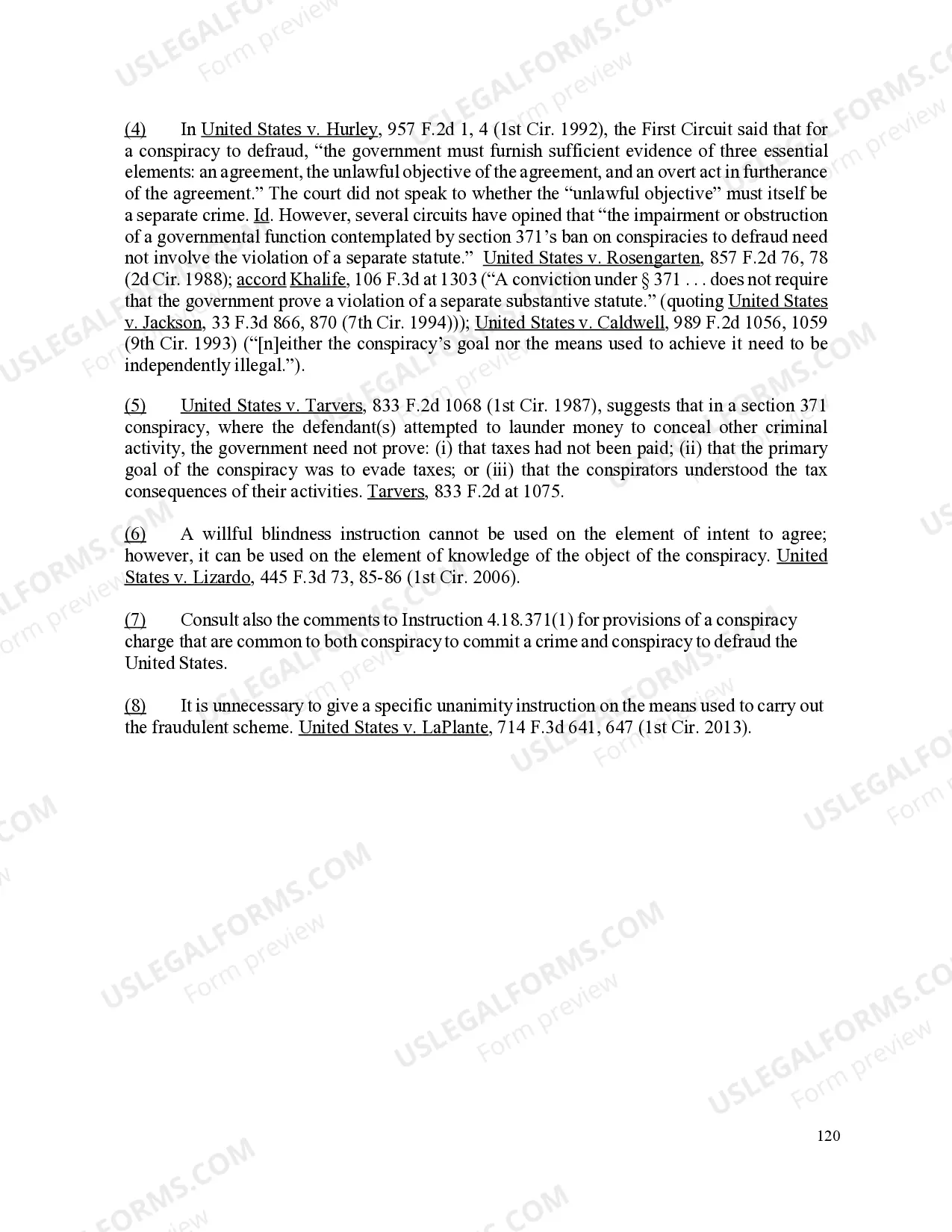
The Conspiracy to Defraud form provides official jury instructions for criminal cases involving allegations of conspiring to defraud the United States. This legally significant document outlines the necessary elements the government must prove to establish guilt in federal court. Unlike other forms that may address fraud in a broader sense, this form specifically pertains to conspiracies targeting the United States, making it vital for defendants and legal practitioners involved in such cases.
What’s included in this form
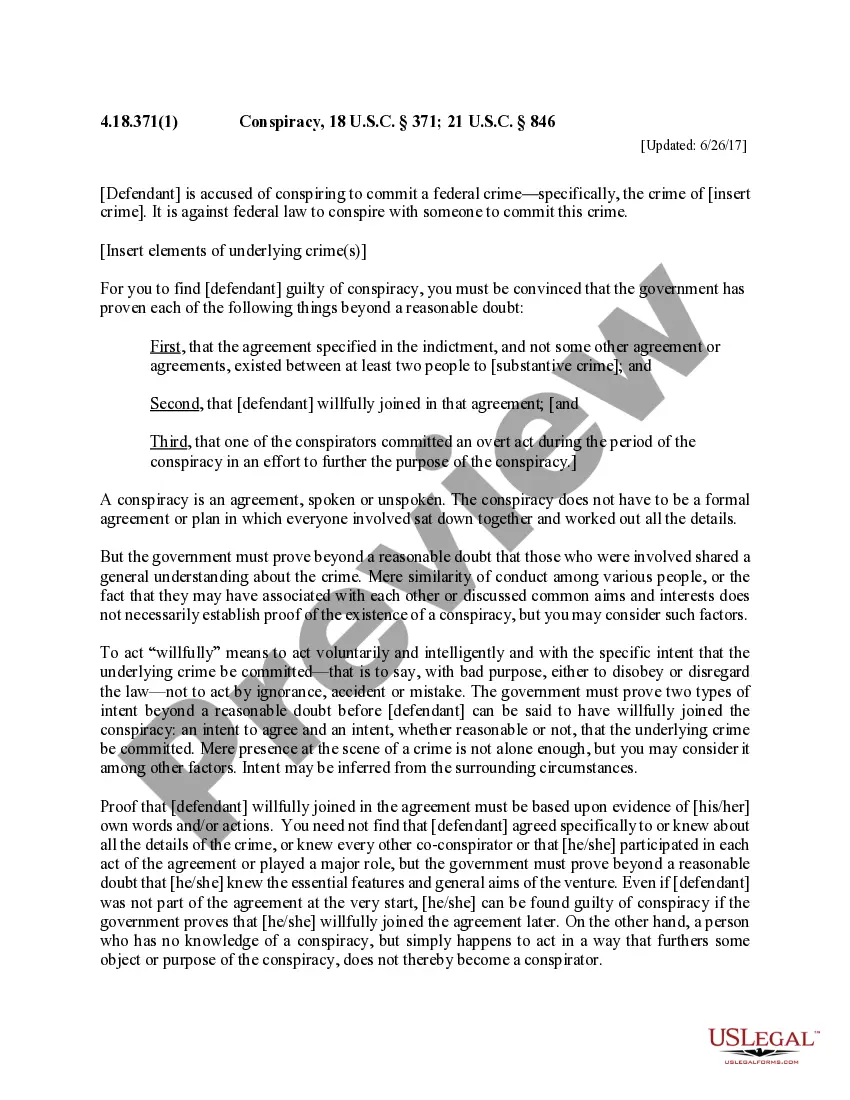
- Description of the conspiracy as an agreement between at least two individuals to commit fraud.
- Criteria for establishing willful participation in the conspiracy.
- Definition of "to defraud" and what constitutes an overt act in furtherance of the conspiracy.
- Clarification that mere presence at a crime scene does not equate to conspiracy involvement.
- Legal context surrounding the need for an intent to defraud.
When this form is needed
This form is used when an individual is accused of conspiring to defraud the United States, particularly in cases involving tax evasion or obstruction of federal functions. Legal practitioners may refer to these jury instructions during trial preparation to ensure that proper legal standards are applied when determining the validity of a conspiracy charge.
Who this form is for
- Defense attorneys representing clients accused of conspiracy to defraud.
- Prosecutors handling federal conspiracy cases.
- Legal scholars or students studying federal conspiracy law.
- Individuals accused of conspiracy seeking to understand jury instructions relevant to their case.
How to prepare this document
- Identify and list the defendants involved in the conspiracy.
- Clearly define the fraudulent agreement and its objectives.
- Document the overt act committed during the conspiracy.
- Ensure that the intent to defraud is established based on the evidence of actions or words.
- Review the jury instructions to ensure understanding of the legal requirements for conspiracy.
Does this document require notarization?
In most cases, this form does not require notarization. However, some jurisdictions or signing circumstances might. US Legal Forms offers online notarization powered by Notarize, accessible 24/7 for a quick, remote process.
Get your form ready online
Our built-in tools help you complete, sign, share, and store your documents in one place.
Make edits, fill in missing information, and update formatting in US Legal Forms—just like you would in MS Word.
Download a copy, print it, send it by email, or mail it via USPS—whatever works best for your next step.
Sign and collect signatures with our SignNow integration. Send to multiple recipients, set reminders, and more. Go Premium to unlock E-Sign.
If this form requires notarization, complete it online through a secure video call—no need to meet a notary in person or wait for an appointment.
We protect your documents and personal data by following strict security and privacy standards.

Make edits, fill in missing information, and update formatting in US Legal Forms—just like you would in MS Word.

Download a copy, print it, send it by email, or mail it via USPS—whatever works best for your next step.

Sign and collect signatures with our SignNow integration. Send to multiple recipients, set reminders, and more. Go Premium to unlock E-Sign.

If this form requires notarization, complete it online through a secure video call—no need to meet a notary in person or wait for an appointment.

We protect your documents and personal data by following strict security and privacy standards.
Avoid these common issues
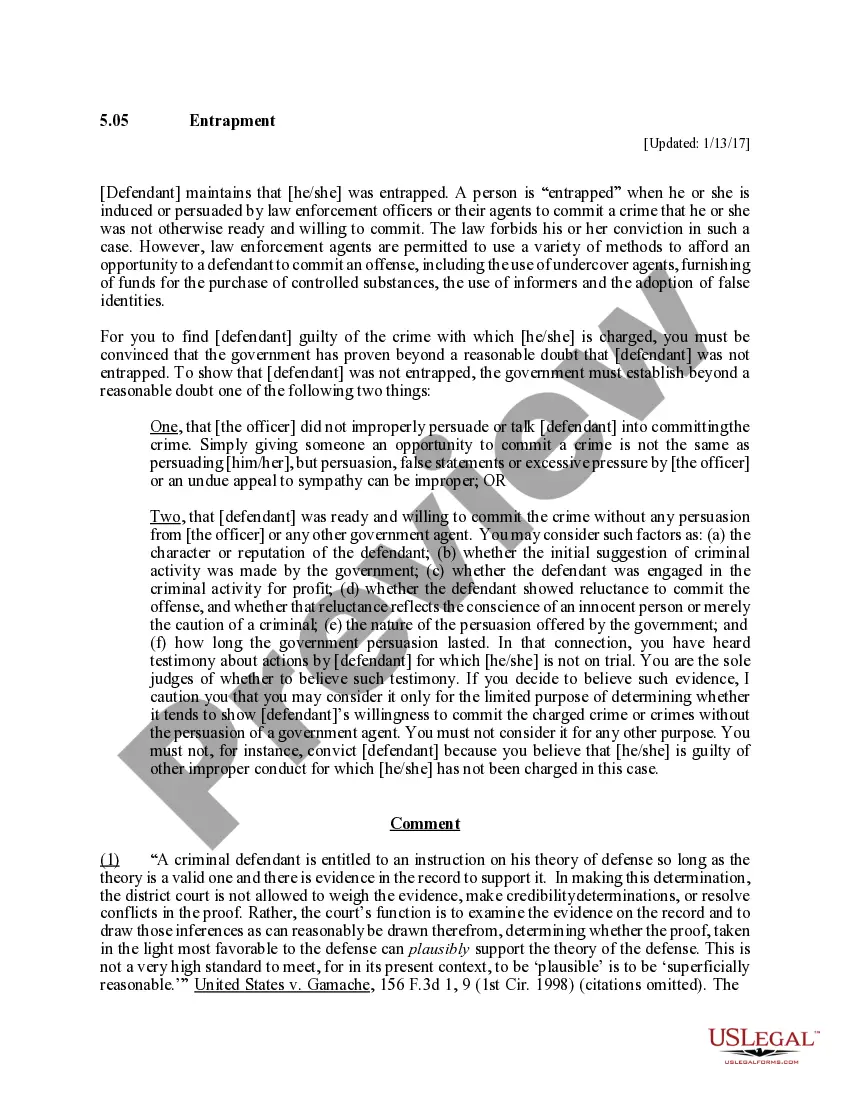
- Failing to establish the overt act necessary to support the conspiracy charge.
- Assuming that mere association with other individuals is sufficient for conspiracy.
- Neglecting to demonstrate intent to defraud as required by law.
- Not adequately documenting the specific terms of the conspiracy agreement.
Why use this form online
- Convenient access to official jury instruction formats designed by licensed attorneys.
- Easy download and editing capabilities to tailor the form to specific case needs.
- Secure and reliable access to legal documents, ensuring compliance with federal laws.
Legal use & context
- This form is important in federal cases and supports the legal framework for conspiracy charges.
- Usage of this form is essential for the correct application of jury instructions in court proceedings.
- The legal definitions outlined in this form are upheld in various federal court interpretations.
Looking for another form?

Form popularity
FAQ
Conspiracy to defraud refers to an agreement between individuals to commit acts designed to deceive others, typically for financial gain. In Maine, this crime illustrates clear intentions to mislead or manipulate for unfair advantage. It does not require the actual commission of fraud; the mere agreement to engage in such wrongful acts is sufficient. Gaining clarity on the meaning of Maine Conspiracy to Defraud is vital for understanding your legal rights.
Theft by deception is a type of theft crime when someone intentionally obtains or withholds someone else's property by deceiving them.
The most serious larceny charge is a Class B felony, which applies when value of the property exceeds than $10,00 or when an explosive device or firearm is stolen. It also applies if a person is armed with a weapon at the time of the crime. Larceny of items valued between $1000 and $10,000 is a Class C felony.
1. A person is guilty of theft if: A. The person obtains or exercises control over property of another as a result of deception and with intent to deprive the other person of the property.
A person is guilty of unsworn falsification if: A. He makes a written false statement which he does not believe to be true, on or pursuant to, a form conspicuously bearing notification authorized by statute or regulation to the effect that false statements made therein are punishable; PL 1981, c.
Class D theft (property valued between $500 - $1,000) results in up to one year in jail and a fine of up to $2,000. Class C theft (property valued between $1,000 - $10,000) results in up to 5 years in jail and a fine of up to $5,000.
If this is the case, and you're facing a new charge for petty theft ? under $500 of property stolen ? then you'll face charges and penalties for a Class C felony, rather than for a Class E misdemeanor. These are only the criminal sanctions that you would face, if convicted for theft by deception.
A person is guilty of theft if: A. The person obtains or exercises control over property of another as a result of deception and with intent to deprive the other person of the property.
A person is guilty of criminal conspiracy if, with the intent that conduct be performed that in fact would constitute a crime or crimes, the actor agrees with one or more others to engage in or cause the performance of the conduct and the most serious crime that is the object of the conspiracy is: A. Murder.