Maryland Last Will and Testament for Domestic Partner with Adult Children from Prior Marriage
About this form
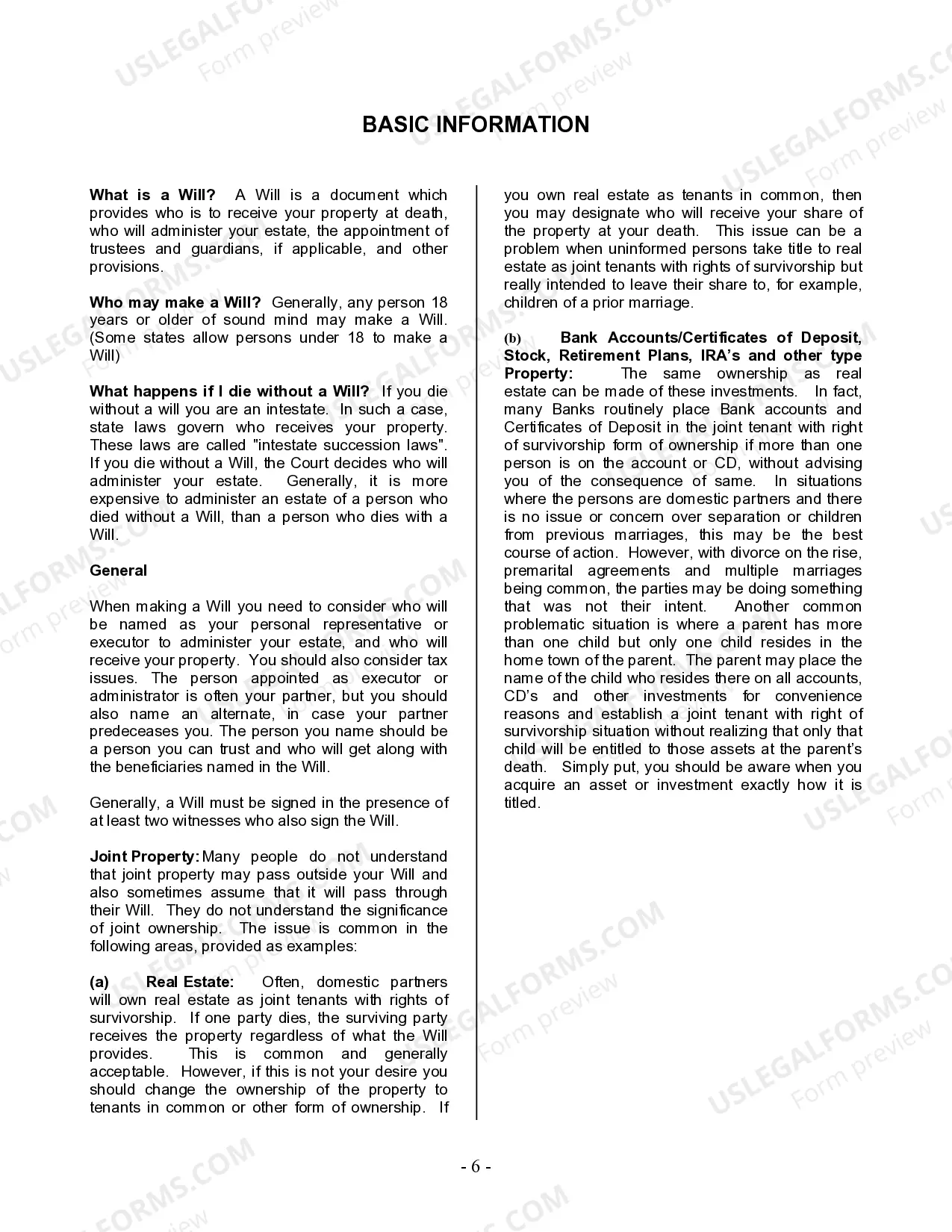
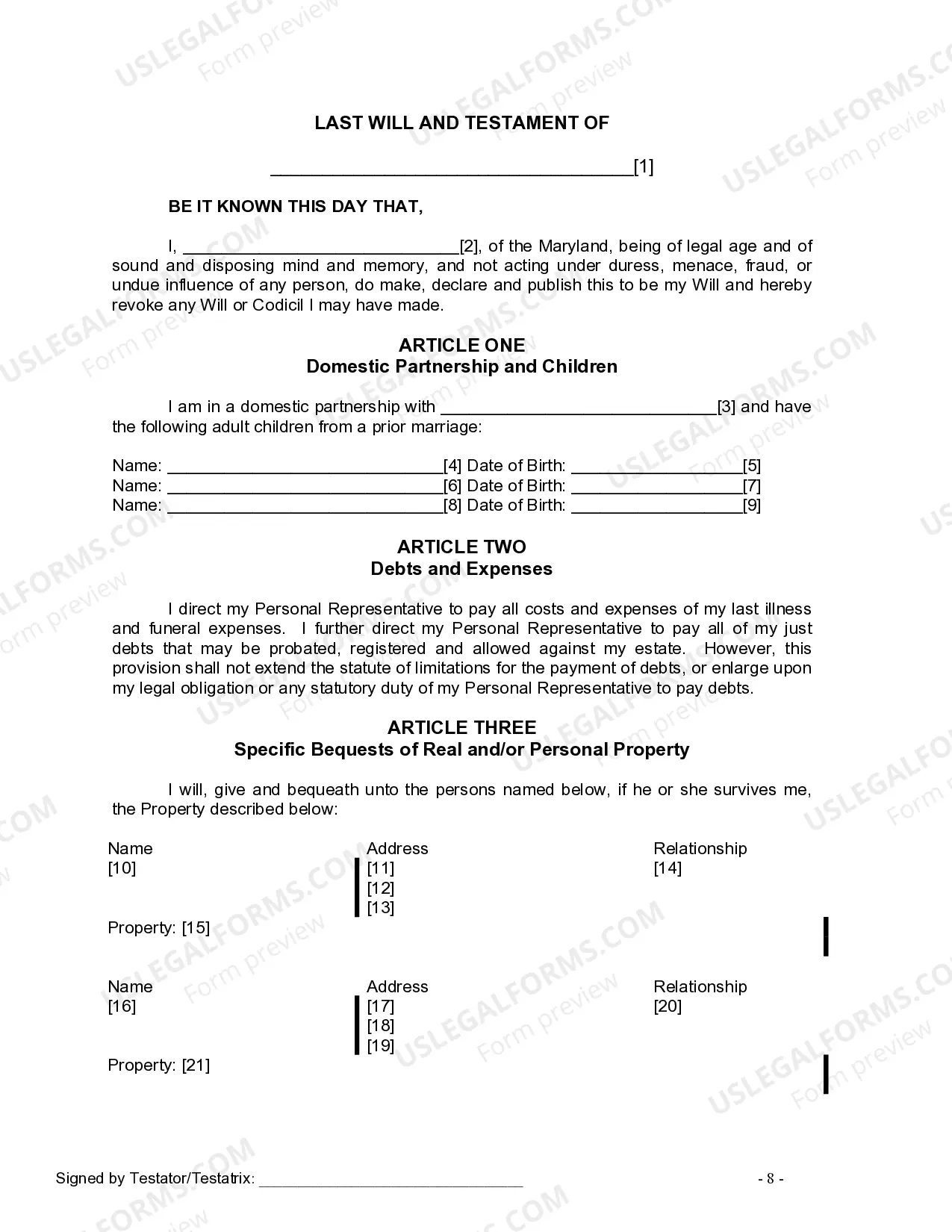
This Last Will and Testament for Domestic Partner with Adult Children from Prior Marriage is a legal document designed for individuals in domestic partnerships who have adult children from a previous marriage. This Will outlines the distribution of your property, the appointment of an executor, and provisions specifically addressing your adult children. It is tailored to ensure that your wishes are respected regarding the distribution of your estate, which may differ from traditional Wills by considering the unique family structure of domestic partners.
Key parts of this document
- Appointment of a personal representative or executor.
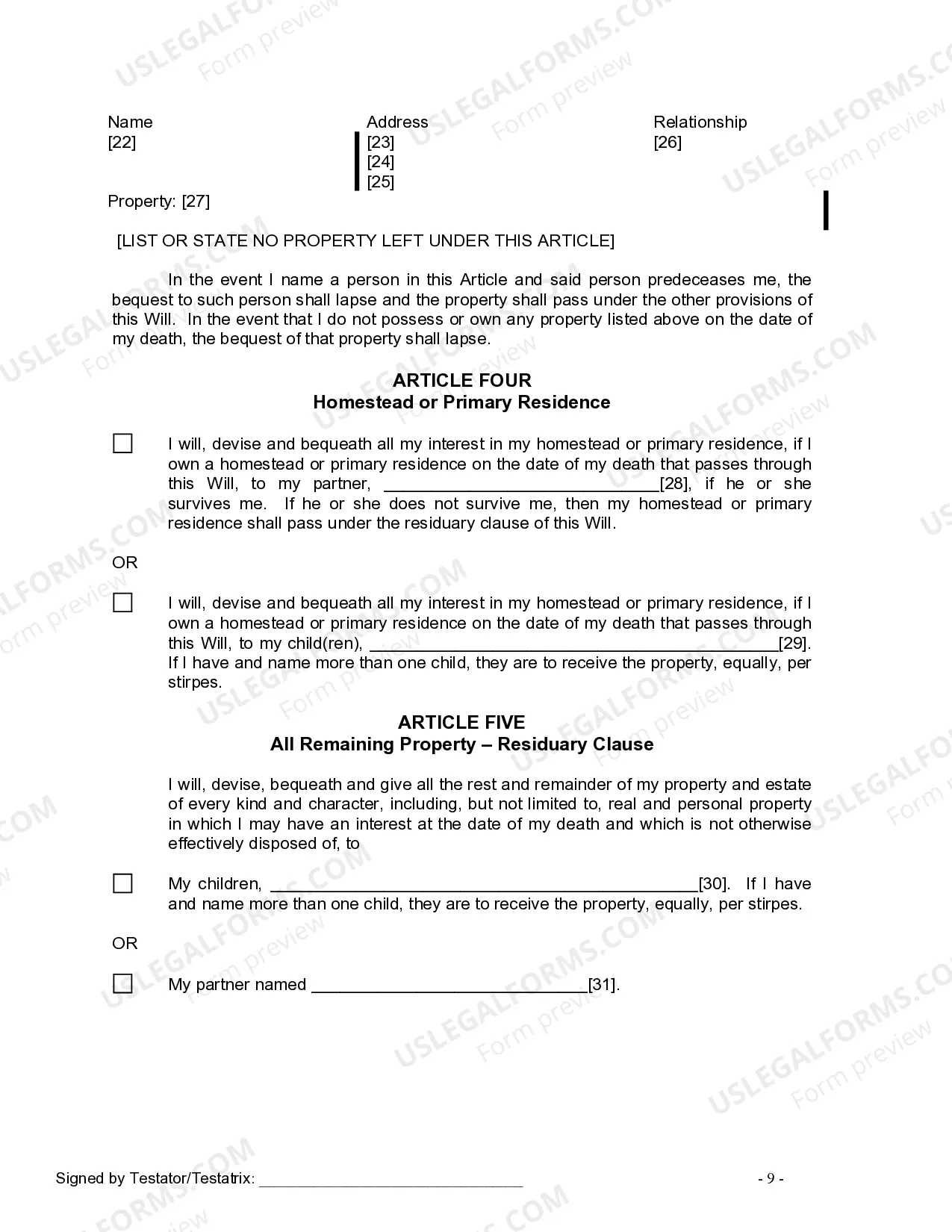
- Designations for property distribution among your partner and adult children.
- Provisions for the management of specific property bequests.
- Instructions related to your homestead or primary residence.
- Contingent provisions in case your partner predeceases you.







Situations where this form applies
This form is ideal for those in a domestic partnership with adult children from a prior marriage. You should consider using this Will if you wish to ensure that your assets are correctly distributed according to your specific family dynamics, particularly if you want to provide for both your partner and your adult children. It is also useful if your circumstances suggest the need for clear guidelines regarding estate management and distribution following your passing.
Who should use this form
- Individuals in a domestic partnership.
- Parents with adult children from a prior marriage.
- Anyone looking to create a legally binding document for their estate distribution wishes.
- People wanting to clarify the roles of executors and beneficiaries within a blended family context.
Instructions for completing this form
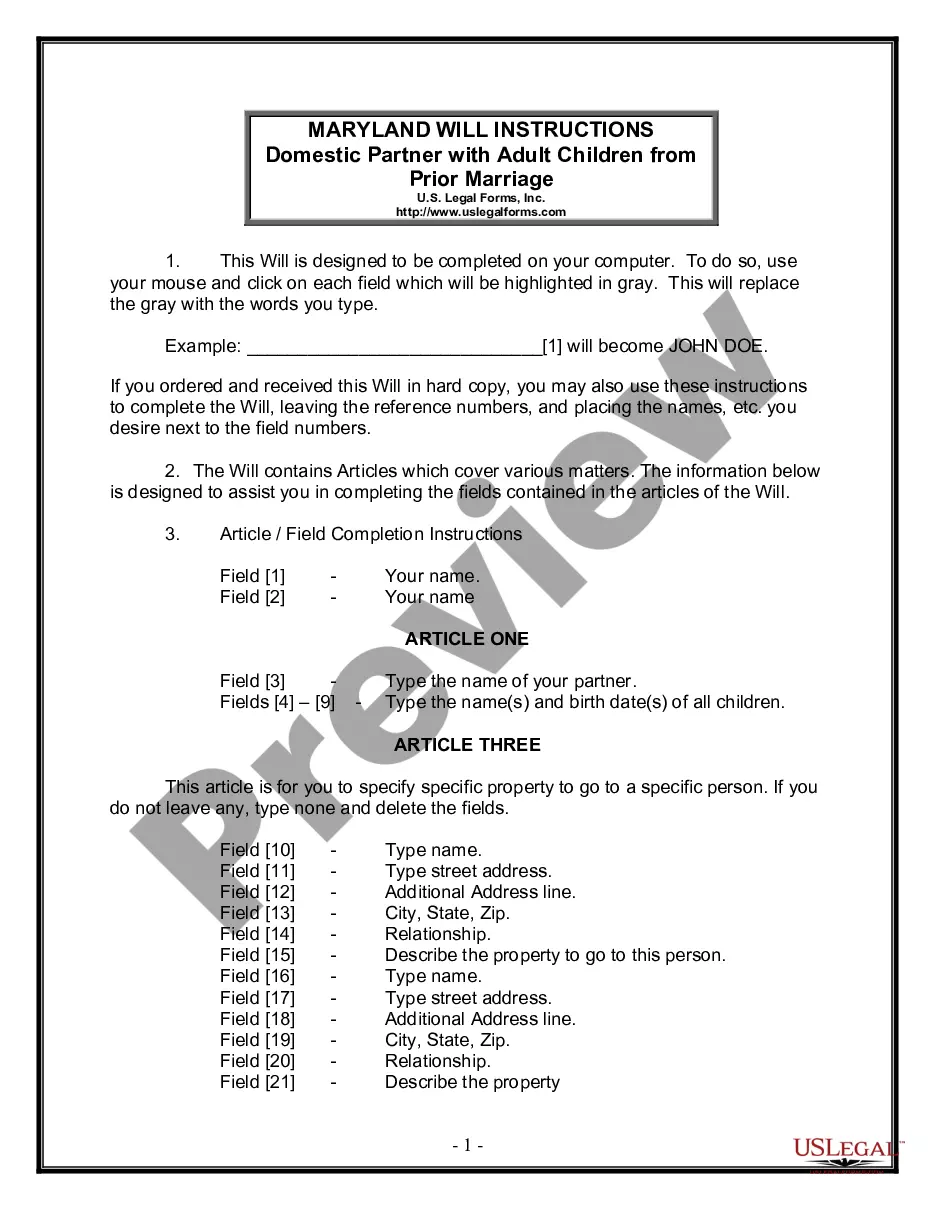
- Identify yourself and your domestic partner by entering your names in the designated fields.
- List all of your adult children from the prior marriage along with their dates of birth.
- Specify the property you wish to leave to specific individuals or entities.
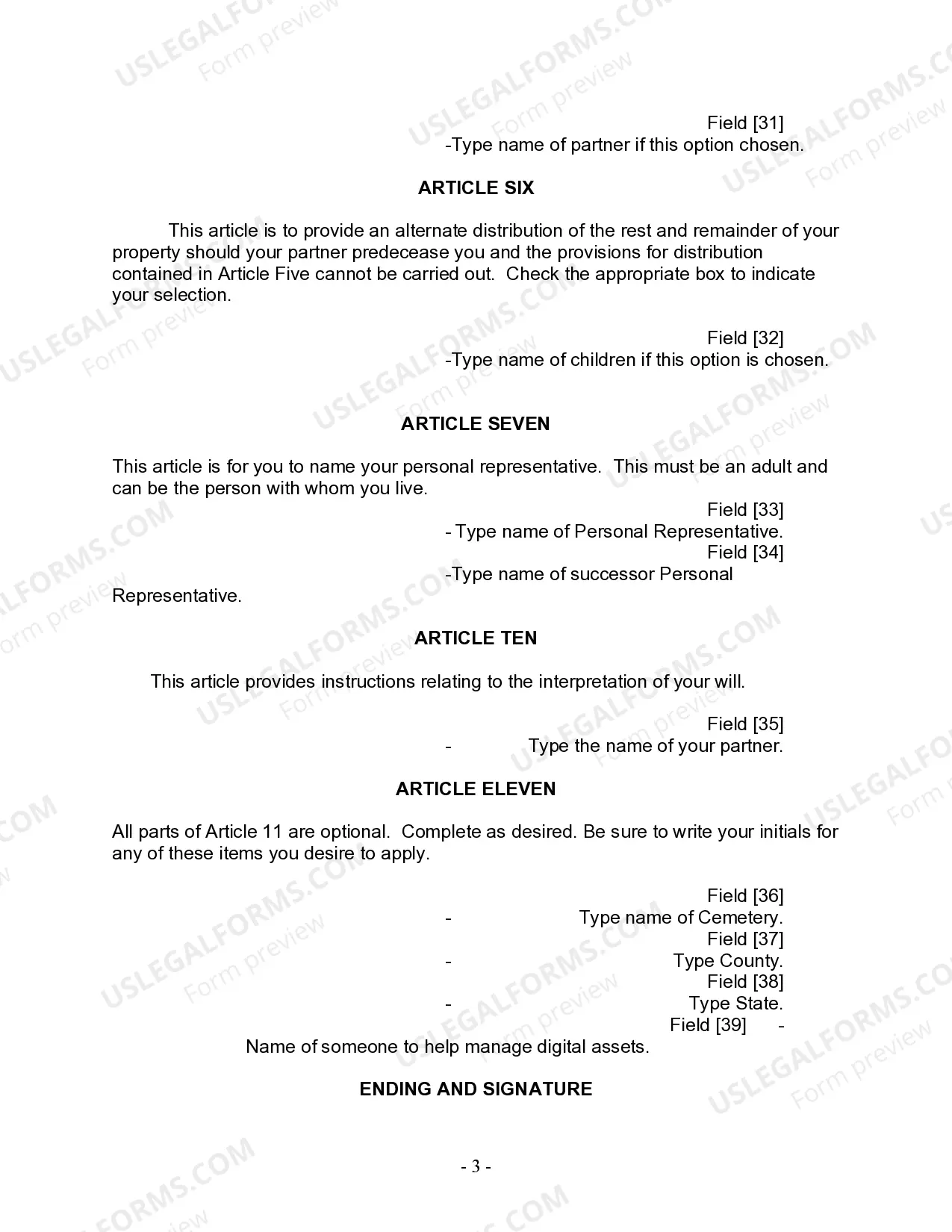
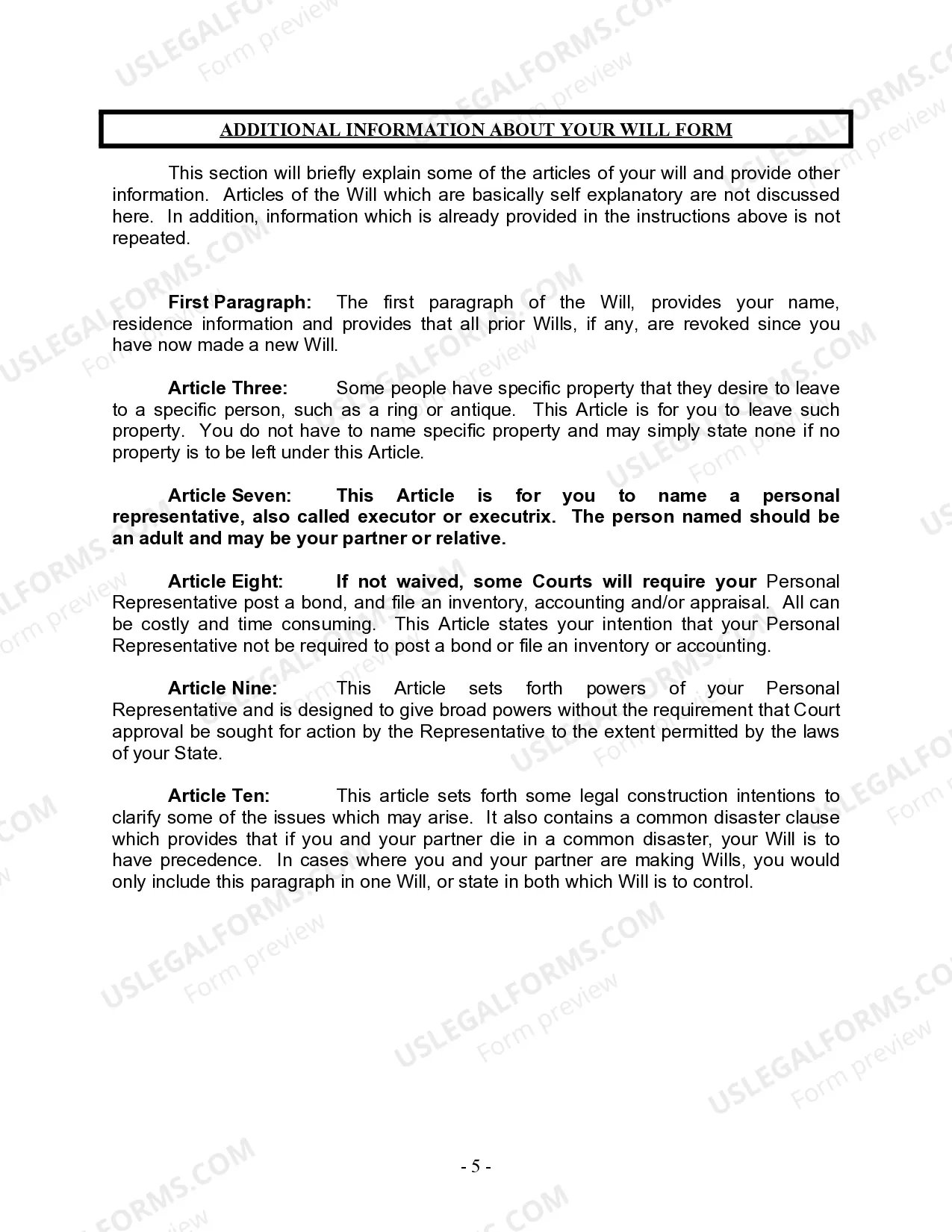
- Designate your personal representative (executor) who will manage your estate.
- Sign the Will in the presence of two witnesses, who must also sign to validate the document.
Does this form need to be notarized?
Notarization is not commonly needed for this form. However, certain documents or local rules may make it necessary. Our notarization service, powered by Notarize, allows you to finalize it securely online anytime, day or night.
Get your form ready online
Our built-in tools help you complete, sign, share, and store your documents in one place.
Make edits, fill in missing information, and update formatting in US Legal Forms—just like you would in MS Word.
Download a copy, print it, send it by email, or mail it via USPS—whatever works best for your next step.
Sign and collect signatures with our SignNow integration. Send to multiple recipients, set reminders, and more. Go Premium to unlock E-Sign.
If this form requires notarization, complete it online through a secure video call—no need to meet a notary in person or wait for an appointment.
We protect your documents and personal data by following strict security and privacy standards.

Make edits, fill in missing information, and update formatting in US Legal Forms—just like you would in MS Word.

Download a copy, print it, send it by email, or mail it via USPS—whatever works best for your next step.

Sign and collect signatures with our SignNow integration. Send to multiple recipients, set reminders, and more. Go Premium to unlock E-Sign.

If this form requires notarization, complete it online through a secure video call—no need to meet a notary in person or wait for an appointment.

We protect your documents and personal data by following strict security and privacy standards.
Avoid these common issues
- Failing to properly witness the signing of the Will, which can invalidate it.
- Omitting the names or details of beneficiaries which can lead to confusion and disputes.
- Assuming that the form will cover all estate aspects without additional legal guidance.
- Not specifying alternate beneficiaries which can complicate asset distribution if primary beneficiaries are unable to inherit.
Benefits of completing this form online
- Convenient access from anywhere with an internet connection.
- Editable templates allow for personalized and specific asset distribution.
- Drafted by licensed attorneys to ensure legal compliance.
- Fast download and printing options for immediate use.
Summary of main points
- Creating a Will is essential for ensuring your assets are distributed according to your wishes.
- This form caters specifically to domestic partners with children from prior relationships, providing clear guidance on asset distribution.
- Ensure you follow the legal signing requirements to validate your Will.
Looking for another form?
Form popularity
FAQ
Make your own will: You can make your own will but you must make sure that it's valid. A will is a legal document so it needs to be written and signed correctly. If you decide to make your own will, it's best to seek advice first.
Create the initial document. Start by titling the document Last Will and Testament" and including your full legal name and address. Designate an executor. Appoint a guardian. Name the beneficiaries. Designate the assets. Ask witnesses to sign your will. Store your will in a safe place.
A joint will is a legal document executed by two (or more) people, which merges their individual wills into a single, combined last will and testament. Like most wills, a joint will lets the will-makers name who will get their property and assets after they die. Joint wills are usually created by married couples.
Maryland law requires that your will be in writing, signed by the testator (you) and witnessed by two individuals in the testator's presence. This is called "executing a will." When you are ready to execute your will, you should have at least two witnesses, although three is better.
Is a holographic (handwritten) Will legal in Maryland ? Yes, if it complies with Maryland Law.
Create the initial document. Start by titling the document Last Will and Testament" and including your full legal name and address. Designate an executor. Appoint a guardian. Name the beneficiaries. Designate the assets. Ask witnesses to sign your will. Store your will in a safe place.
Property in a living trust. One of the ways to avoid probate is to set up a living trust. Retirement plan proceeds, including money from a pension, IRA, or 401(k) Stocks and bonds held in beneficiary. Proceeds from a payable-on-death bank account.
Include personal identifying information. Include a statement about your age and mental status. Designate an executor. Decide who will take care of your children. Choose your beneficiaries. List your funeral details. Sign and date your Last Will and Testament.
No. You can make your own will in Maryland, using Nolo's do-it-yourself will software or online will programs. However, you may want to consult a lawyer in some situations. For example, if you think that your will might be contested or if you want to disinherit your spouse, you should talk with an attorney.