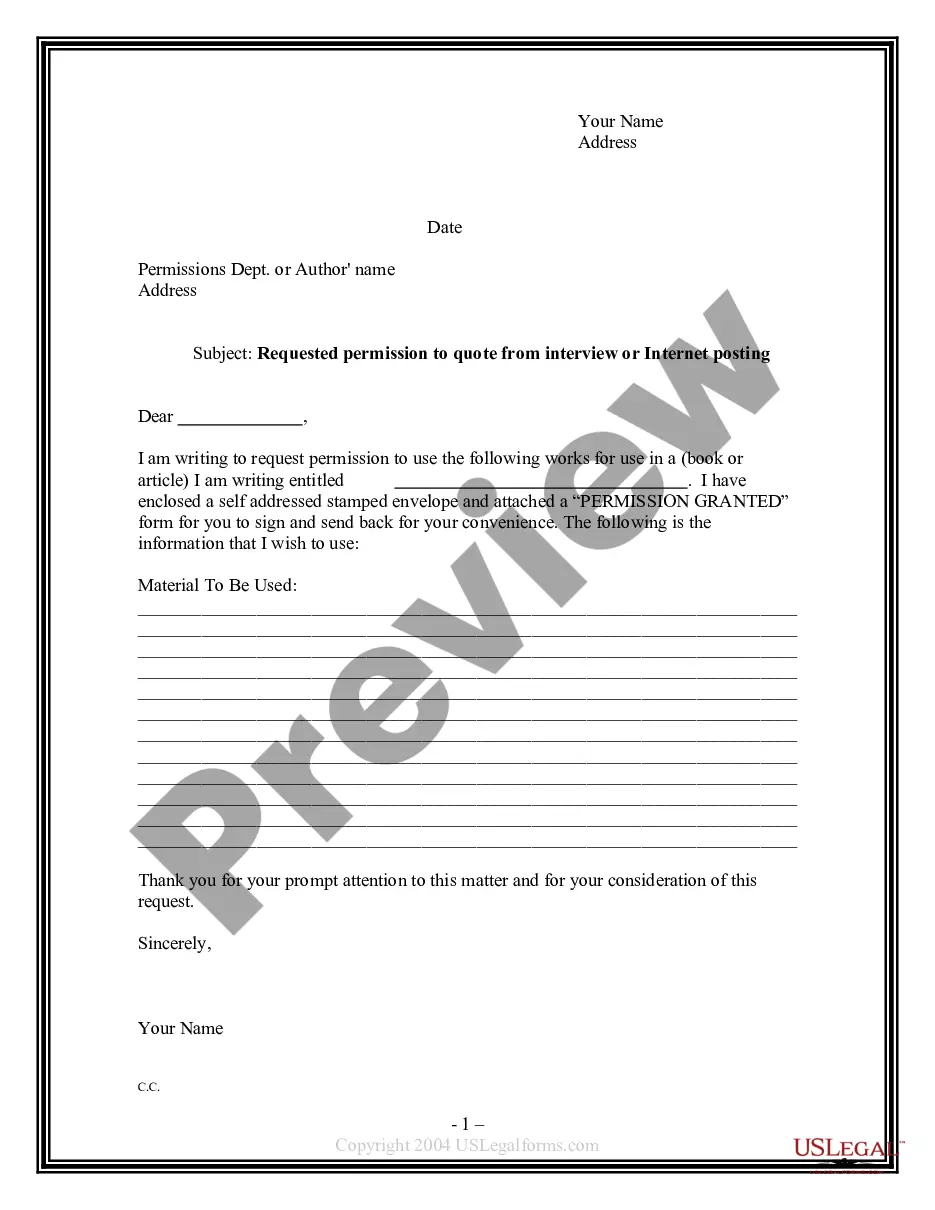
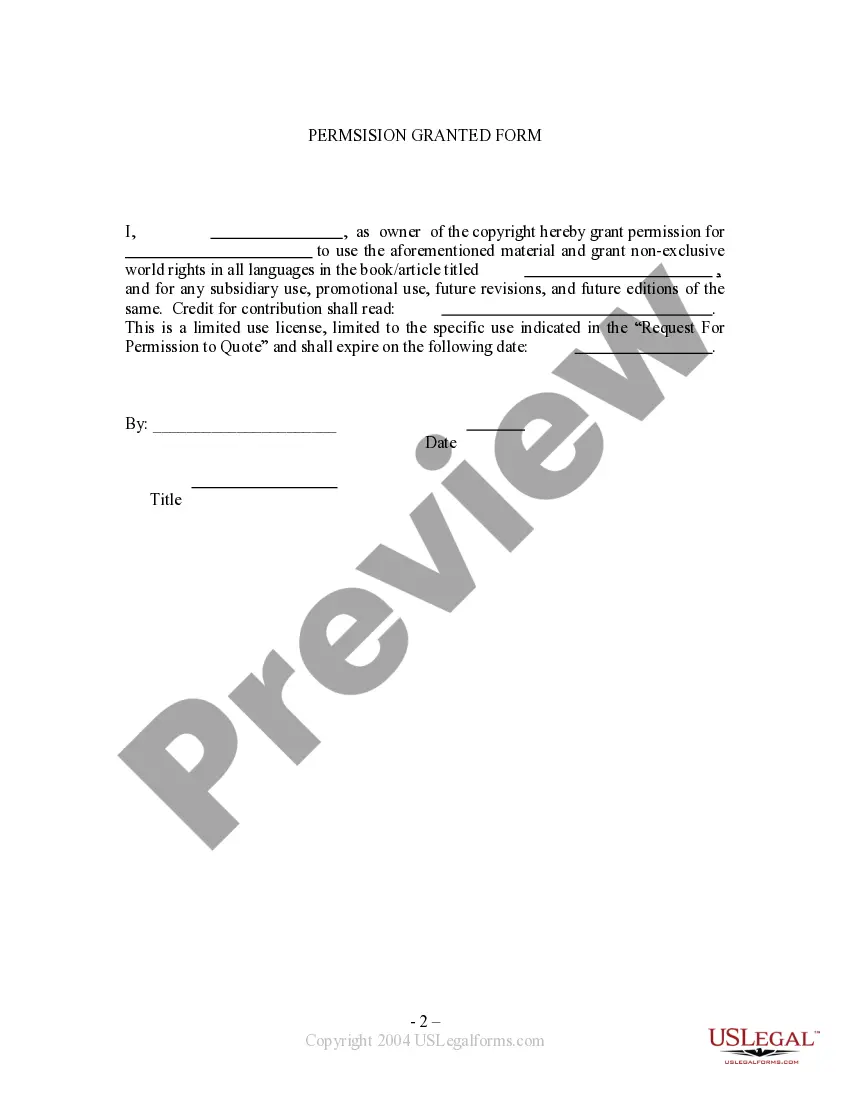
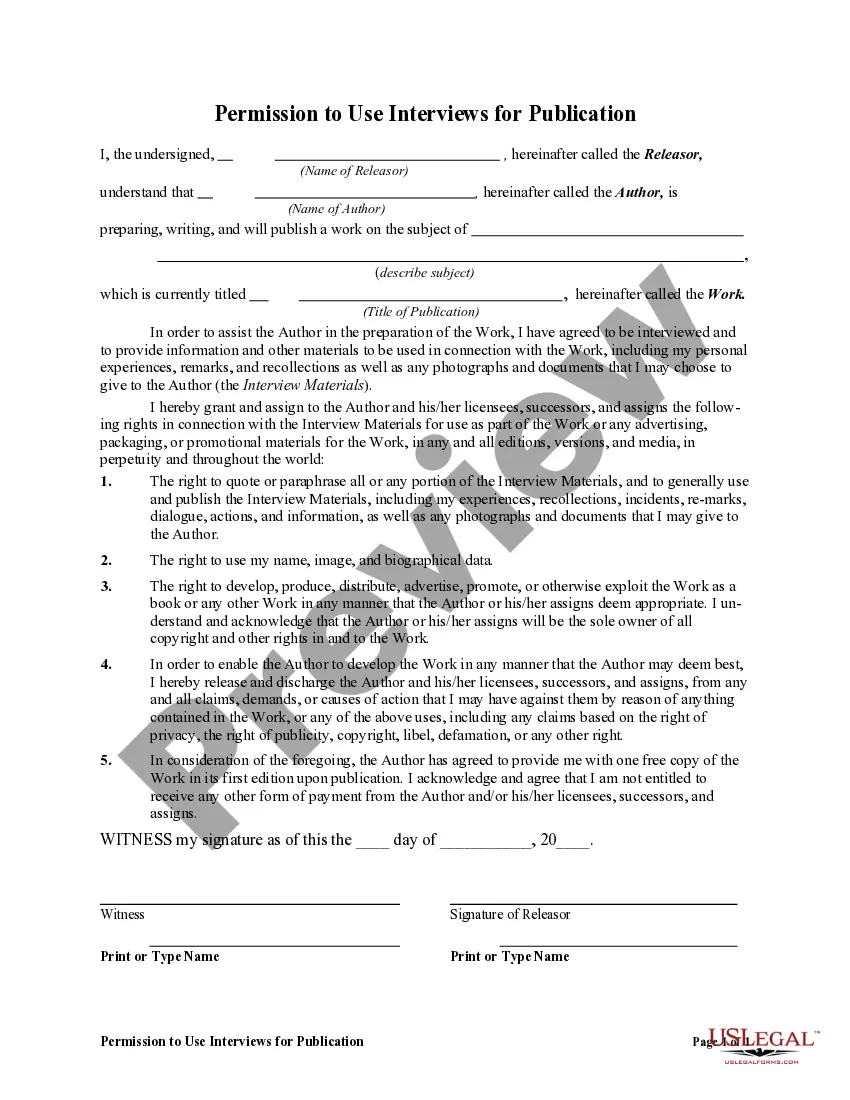
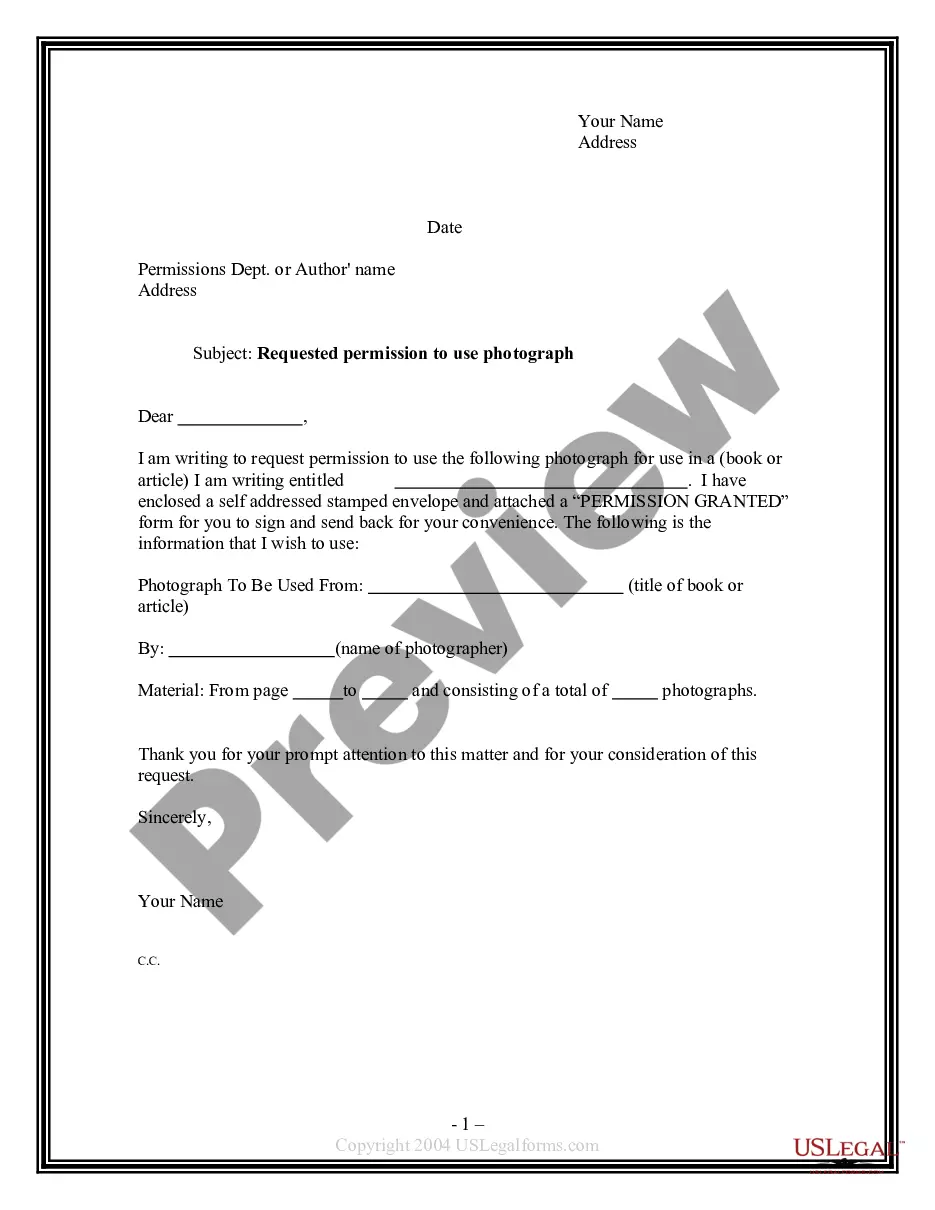
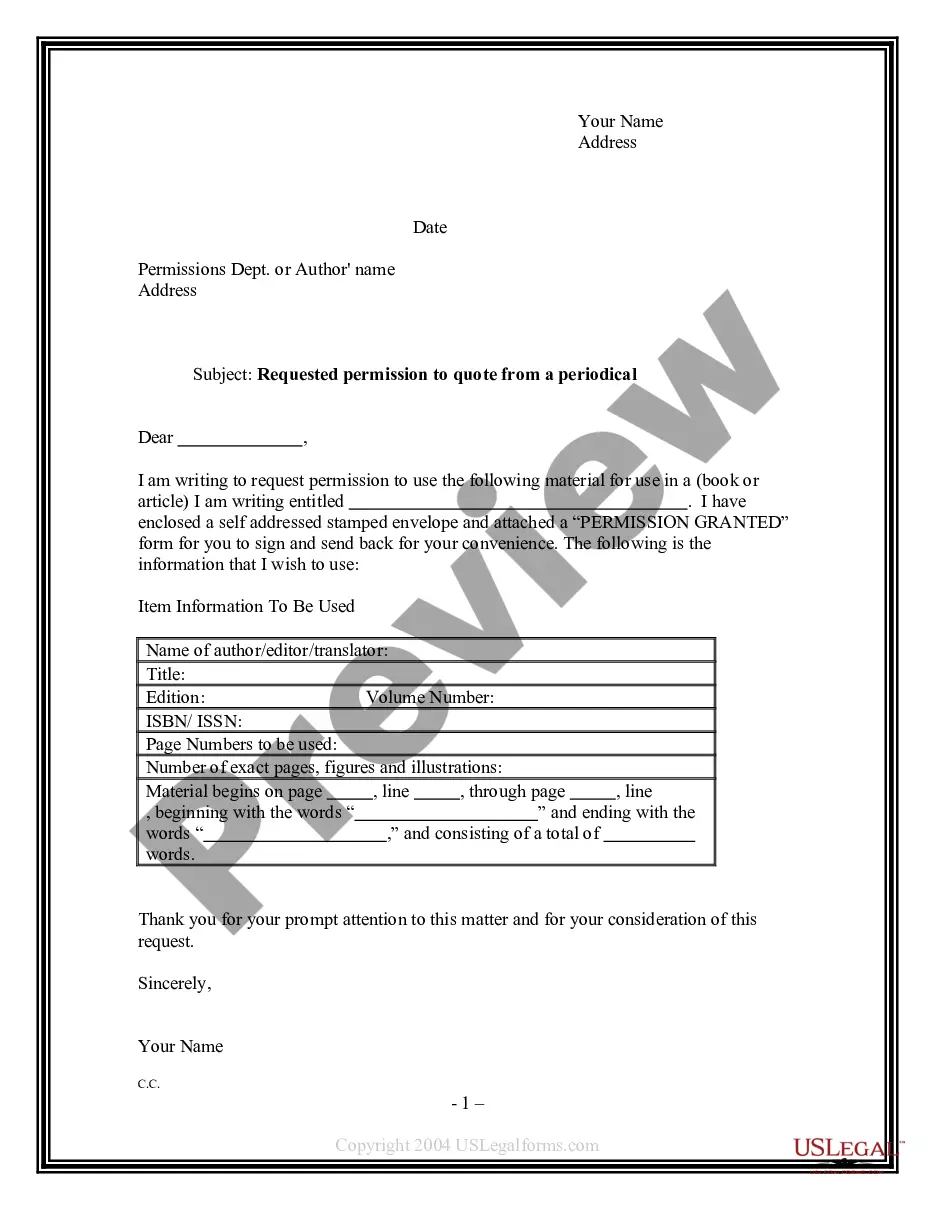
This is a request to the holder of a copyright asking permission to use the copyrighted material in a book or article. There is an attached addendum for the copyright holder to sign granting permission. The request can be granted for only a fixed period of time if the copyright holder does not want to grant the request to be used indefinitely.
Maryland Requested Permission to Quote From Interview or Internet Posting
Category:
State:
Multi-State
Control #:
US-PRM-06
Format:
Word;
Rich Text
Instant download
Description
Free preview

Get your form ready online
Our built-in tools help you complete, sign, share, and store your documents in one place.
Built-in online Word editor
Make edits, fill in missing information, and update formatting in US Legal Forms—just like you would in MS Word.
Export easily
Download a copy, print it, send it by email, or mail it via USPS—whatever works best for your next step.
E-sign your document
Sign and collect signatures with our SignNow integration. Send to multiple recipients, set reminders, and more. Go Premium to unlock E-Sign.
Notarize online 24/7
If this form requires notarization, complete it online through a secure video call—no need to meet a notary in person or wait for an appointment.
Store your document securely
We protect your documents and personal data by following strict security and privacy standards.

Make edits, fill in missing information, and update formatting in US Legal Forms—just like you would in MS Word.

Download a copy, print it, send it by email, or mail it via USPS—whatever works best for your next step.

Sign and collect signatures with our SignNow integration. Send to multiple recipients, set reminders, and more. Go Premium to unlock E-Sign.

If this form requires notarization, complete it online through a secure video call—no need to meet a notary in person or wait for an appointment.

We protect your documents and personal data by following strict security and privacy standards.
Looking for another form?



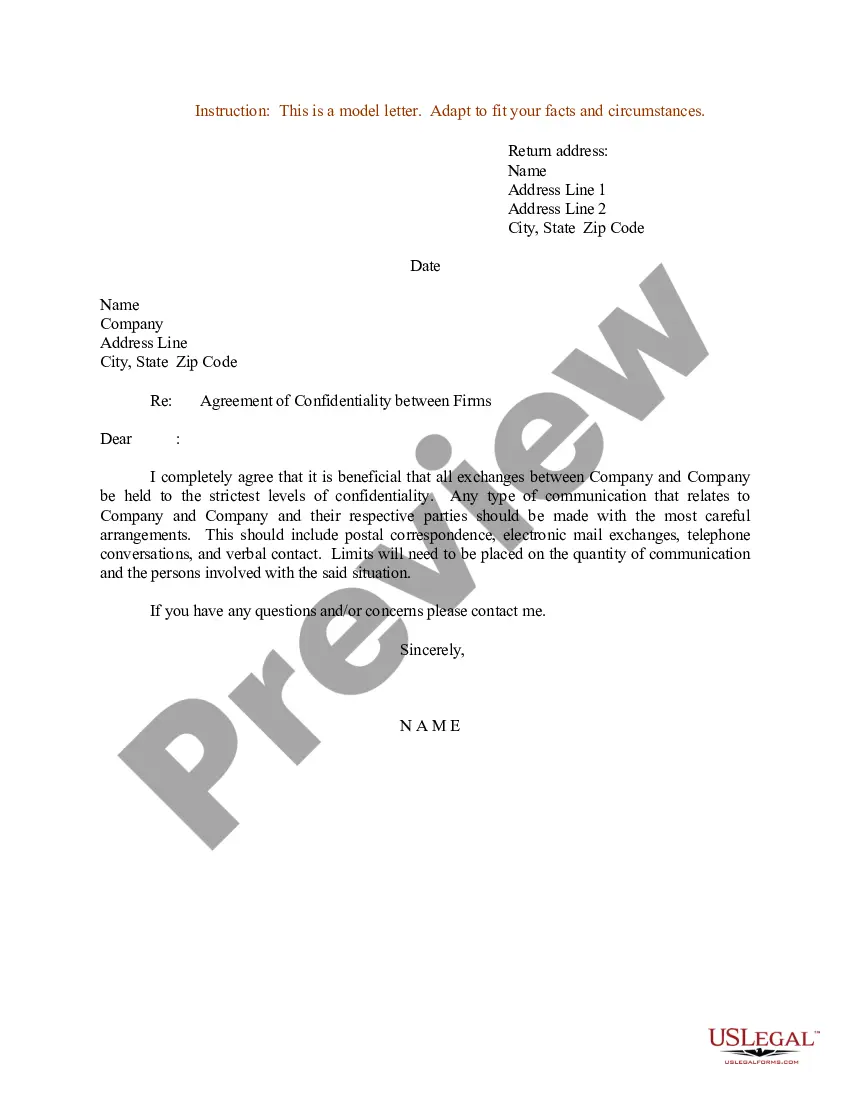





How to fill out Requested Permission To Quote From Interview Or Internet Posting?
If you want to aggregate, download, or create legal document templates, utilize US Legal Forms, the largest repository of legal forms available online.
Employ the site’s straightforward and user-friendly search to locate the documents you need.
An assortment of templates for business and personal purposes are organized by categories and states, or keywords.
Step 4. Once you have found the form you need, select the Get now button. Choose the pricing plan you prefer and enter your credentials to register for the account.
Step 5. Complete the transaction. You can use your credit card or PayPal account to finalize the purchase. Step 6. Choose the format of the legal document and download it to your device. Step 7. Fill out, edit, and print or sign the Maryland Requested Permission to Cite From Interview or Internet Post. Each legal document template you purchase is yours indefinitely. You have access to every form you downloaded in your account. Click on the My documents section and select a form to print or download again. Complete and download, and print the Maryland Requested Permission to Cite From Interview or Internet Post with US Legal Forms. There are thousands of professional and state-specific forms available for your business or personal needs.
- Use US Legal Forms to find the Maryland Requested Permission to Cite From Interview or Internet Post with just a few clicks.
- If you are already a US Legal Forms customer, Log In to your account and click the Download button to retrieve the Maryland Requested Permission to Cite From Interview or Internet Post.
- You can also access forms you have previously downloaded in the My documents section of your account.
- If you are using US Legal Forms for the first time, follow the steps below.
- Step 1. Ensure you have selected the form for the correct state/region.
- Step 2. Use the Preview option to review the form’s details. Remember to read through the summary.
- Step 3. If you are not satisfied with the form, utilize the Search field at the top of the screen to find other types of legal forms.
Form popularity
FAQ
When asking for permission to use content, start by clearly stating your request and providing details about the specific content you wish to use. Be polite and concise; explain how you intend to use the content and the audience it will reach. This approach not only shows respect for the creator’s work but also complies with the Maryland Requested Permission to Quote From Interview or Internet Posting requirements. For a streamlined process, consider using platforms like US Legal Forms, which offer templates to facilitate these requests.
To get permission to use a quote, first identify the original source of the quote and review any copyright information. Next, contact the author or publisher through their official channels, and clearly state your intention to use the quote. Mention how you plan to use it, whether in a publication or online, to ensure you provide all necessary context. Following these steps aligns with the Maryland Requested Permission to Quote From Interview or Internet Posting guidelines.
In Maryland, reporters generally need to obtain permission before quoting someone from an interview or an internet posting. The concept of Maryland Requested Permission to Quote From Interview or Internet Posting ensures that individuals have control over their words and how they are used. If you prefer not to be quoted, it is important to communicate that clearly during your conversation or in your online content. Using platforms like US Legal Forms can help you understand your rights and create necessary permissions that protect your statements.
To obtain permission to use quotes in your book, you must first identify the source of the quote. Next, reach out directly to the author or publisher to request permission. Specify the context in which you plan to use the quote, including its location in your book and the format of publication. If you are in Maryland, the process may involve submitting a formal request for permission to quote from an interview or internet posting, ensuring you comply with local copyright laws.
Yes, quotes are protected under copyright law.
Every publisher sets their own threshold of fair use versus requiring permissions. One publisher requires permission for using 25 words or more from any one source, aggregate over the entirety of your book. This means if you quote 16 words in one place and 10 words in another, you must get written permission.
Giving attribution to an author's quote does not make it legal to use, however it is recommended that you always give attribution and not pass work off as your own- even if it's in public domain or you have written permission to use.
It's perfectly okay to quote an excerpt of another author's work in your writing, but it's not always okay to do so without permission. If you don't want to be sued for copyright infringement, it's important to know when you need permission and when you don't. And that's not always obvious.
Quotes are considered intellectual property, which is protected under the law. This means that if you're not a quote's original author and you want to SELL something with the quote on it, one of two things must be true: 1. You have the author's written permission to use their words on your work.
Nope, because you'd be paraphrasing their work and presenting it as your own, and that would still be plagiarism.