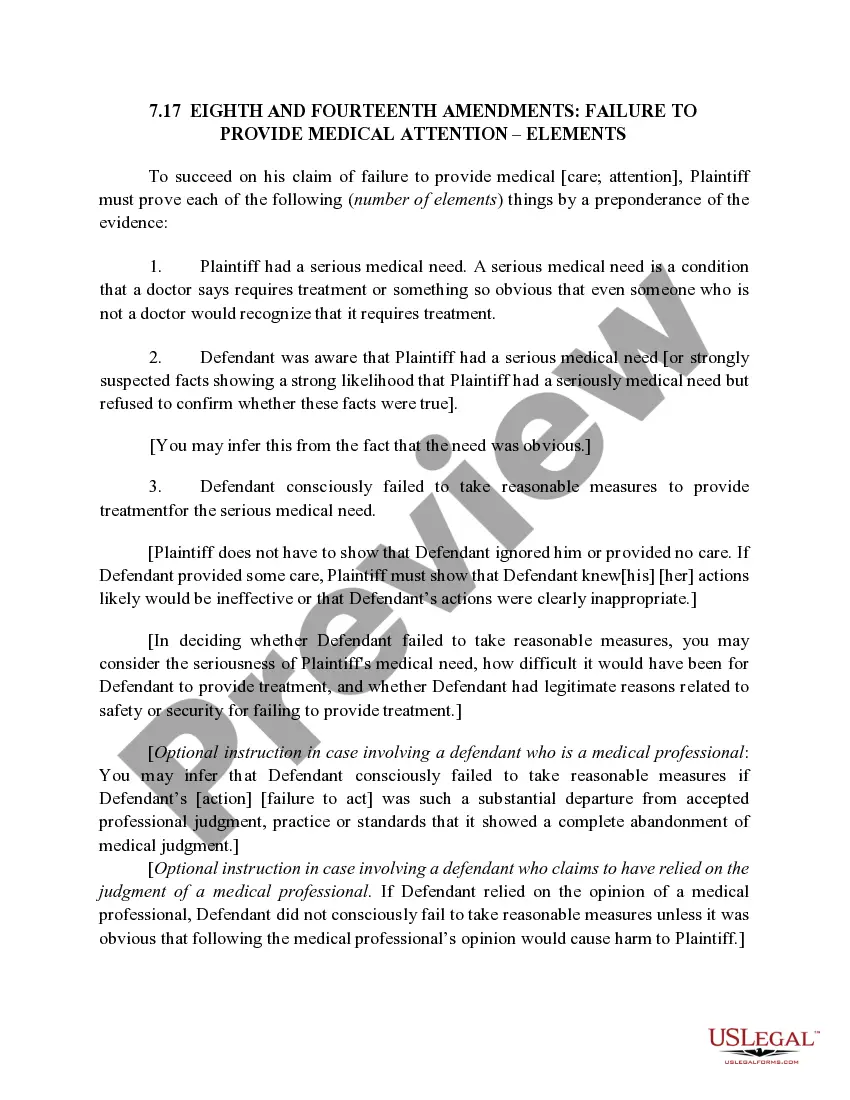
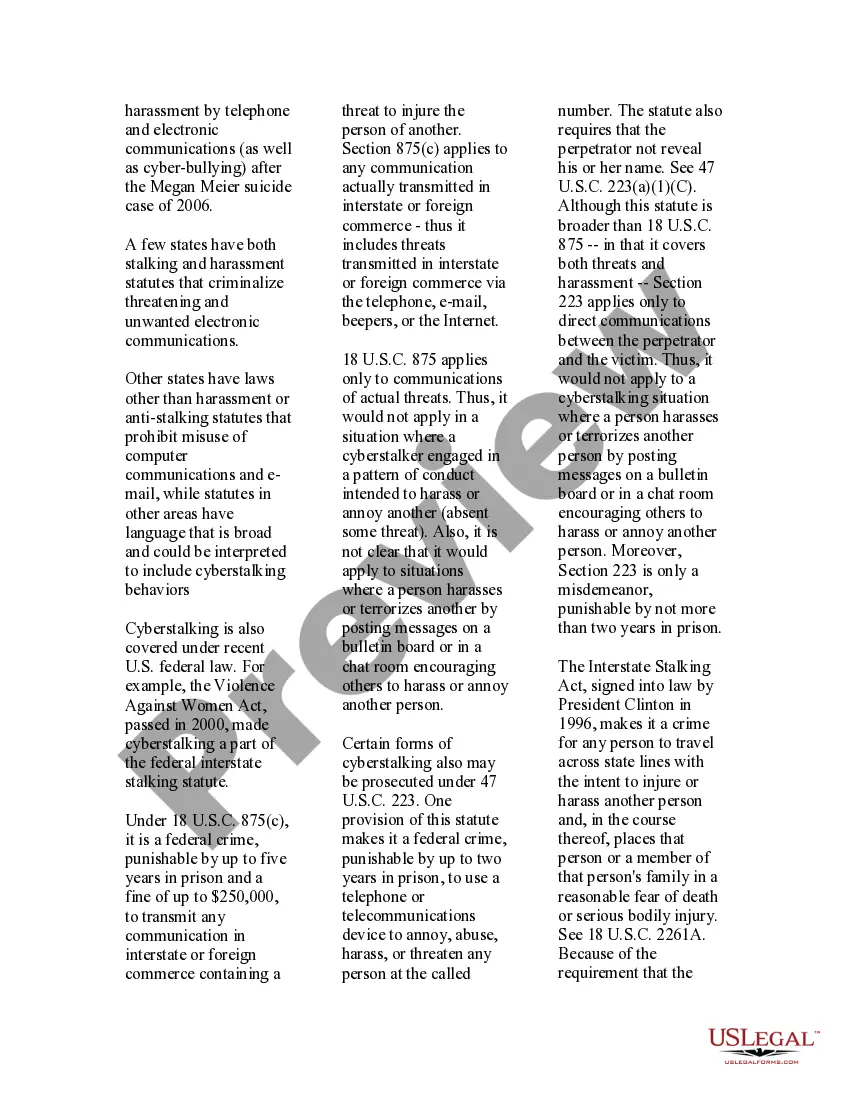
This guide provides an overview of the law of stalking. Topics covered include civil compared to criminal offenses, protective orders, cyberstalking, and links to other resources.
Maryland USLegal Guide to Stalking
Instant download
Description
Free preview
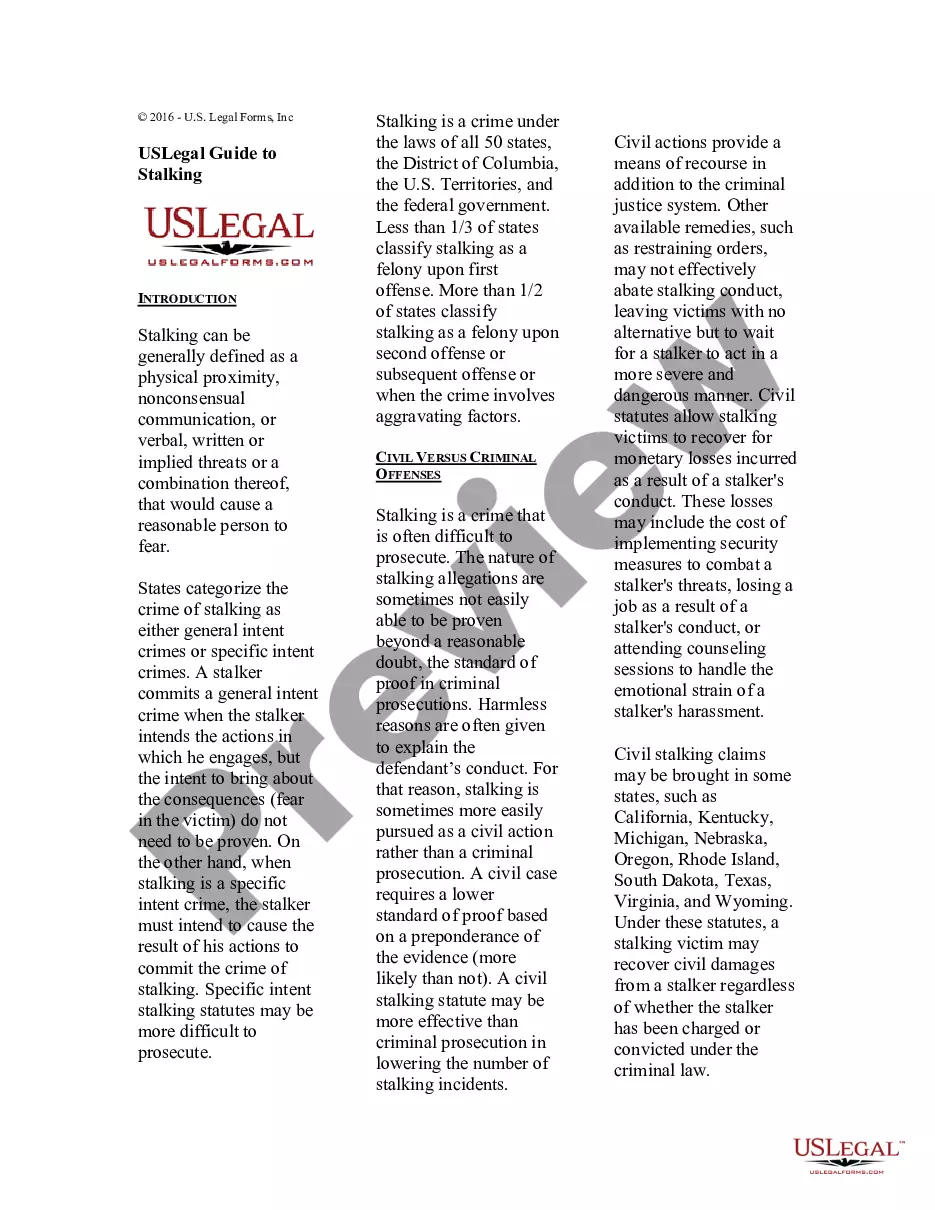
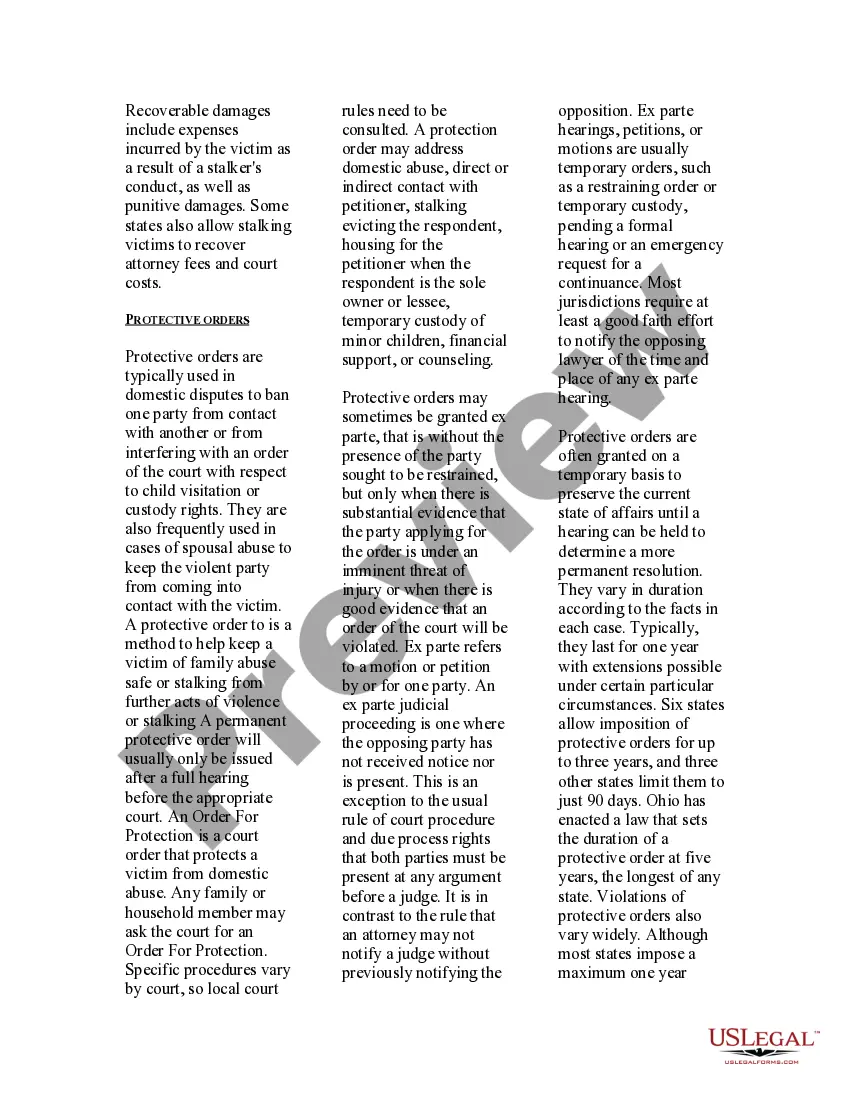
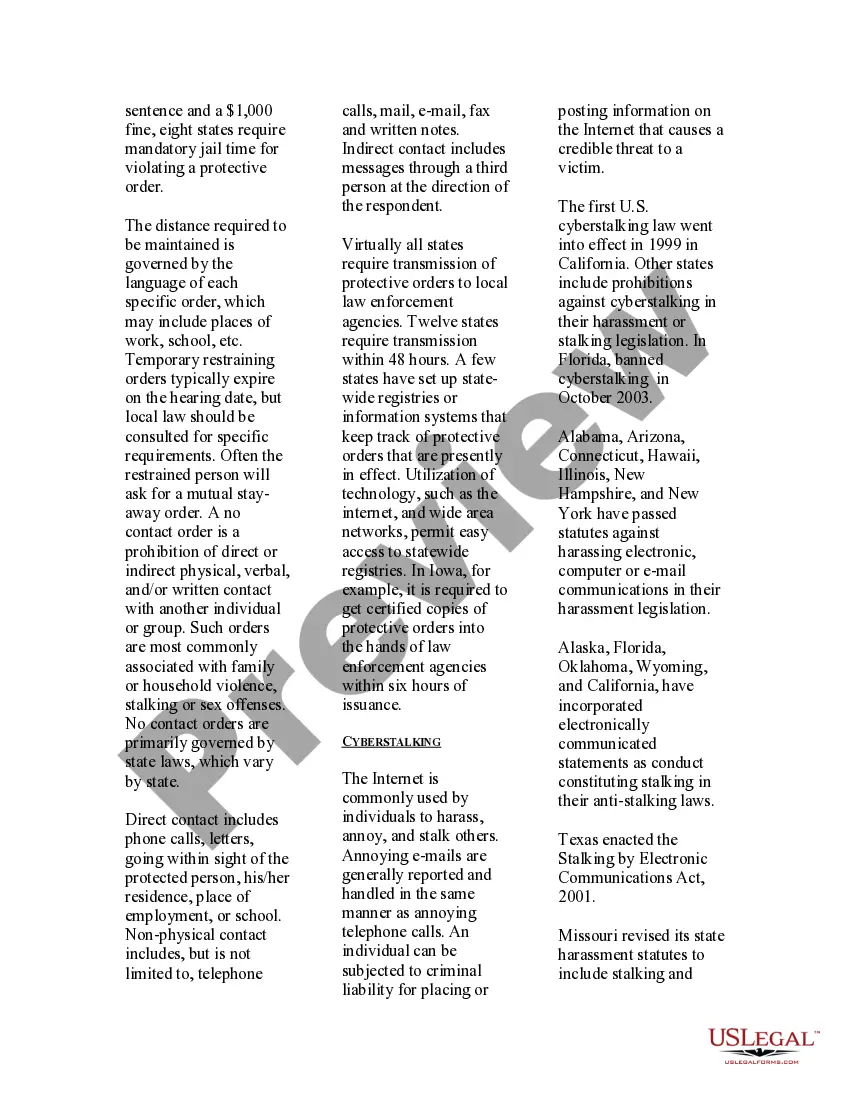
How to fill out USLegal Guide To Stalking?
Are you presently within a situation the place you will need files for both company or specific functions just about every day time? There are a lot of legal file layouts accessible on the Internet, but getting types you can depend on isn`t straightforward. US Legal Forms offers thousands of form layouts, much like the Maryland USLegal Guide to Stalking, which are published to satisfy state and federal requirements.
In case you are previously acquainted with US Legal Forms site and possess a free account, merely log in. Afterward, you may acquire the Maryland USLegal Guide to Stalking design.
Should you not offer an account and would like to begin to use US Legal Forms, follow these steps:
- Find the form you need and make sure it is for the correct metropolis/county.
- Make use of the Review switch to analyze the shape.
- Browse the information to actually have chosen the correct form.
- When the form isn`t what you are trying to find, utilize the Research area to obtain the form that meets your needs and requirements.
- Whenever you discover the correct form, click Get now.
- Opt for the pricing program you want, fill out the required details to generate your account, and pay money for your order making use of your PayPal or bank card.
- Select a hassle-free paper formatting and acquire your duplicate.
Get each of the file layouts you may have bought in the My Forms menu. You can obtain a additional duplicate of Maryland USLegal Guide to Stalking whenever, if possible. Just click on the necessary form to acquire or print the file design.
Use US Legal Forms, by far the most considerable assortment of legal forms, to conserve time and stay away from blunders. The services offers professionally created legal file layouts which you can use for an array of functions. Create a free account on US Legal Forms and start generating your life easier.
Form popularity
FAQ
Stalking Intent In most states, the defendant must commit the criminal act willfully or maliciously (Cal. Penal Code § 646.9, 2011). This indicates a specific intent or purposeful conduct. However, in states that require the victim to experience harm, a different criminal intent could support the harm offense element.
Harassment, covered by state code § 3-803, is defined as following another individual in or around a public place, or maliciously engaging in repeated behavior that seriously annoys or alarms another individual: With the intent to annoy, alarm or harass.
In 1996 Congress passed an anti-stalking law as part of the Violence Against Women Act (VAWA). Under this law it is a federal felony to cross state lines to stalk or harass an individual if the conduct causes fear of serious bodily injury or death to the stalking victim or to the victim's immediate family members.
If a person is guilty of stalking, then the individual faces conviction of a misdemeanor with up to five years in prison and/or a fine of $5,000 or less.
In order to gain a conviction in a case of harassment, the state must prove that the defendant followed another in or about a public place, or that the defendant maliciously engaged in a course of conduct that alarmed or seriously annoyed another.
California Penal Code 646.9 PC makes it a crime to follow, harass, or threaten someone to the point they fear for their safety. In a domestic violence case, the criminal offense of stalking is a serious issue. California has some of the toughest and most comprehensive laws in the United States.
In order to gain a conviction in a case of harassment, the state must prove that the defendant followed another in or about a public place, or that the defendant maliciously engaged in a course of conduct that alarmed or seriously annoyed another.