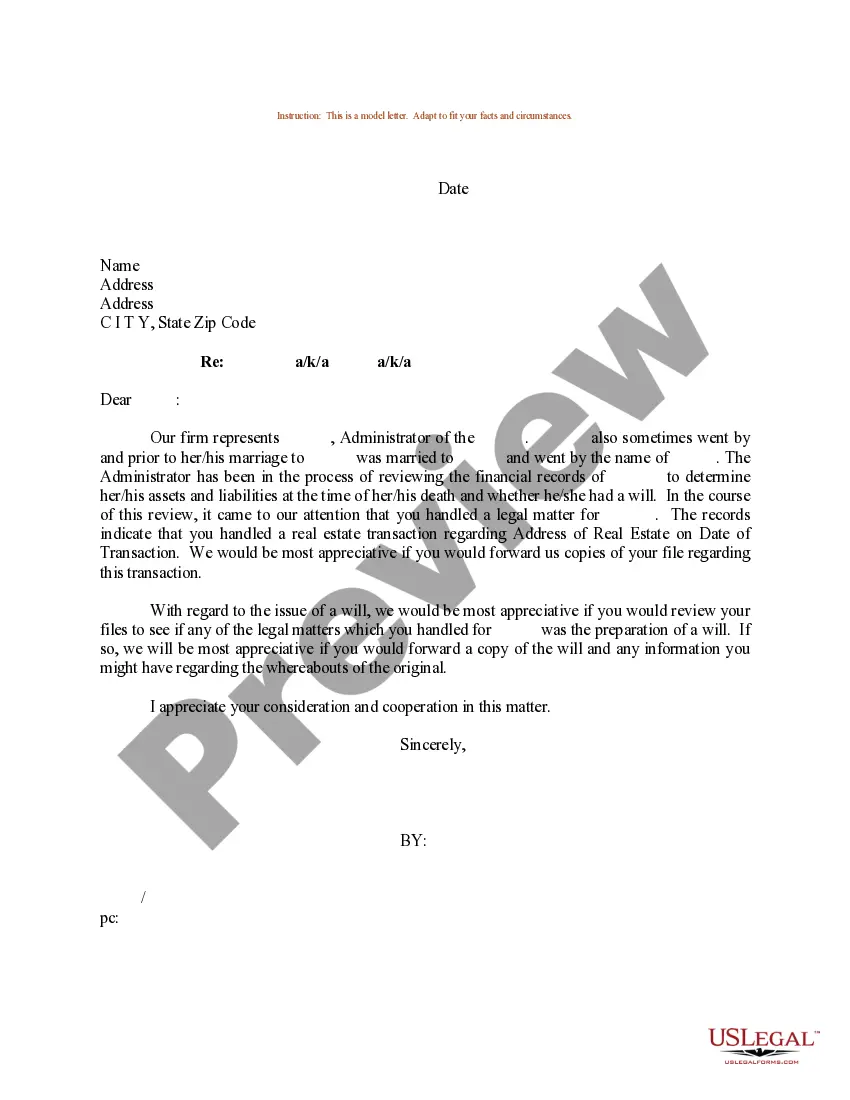
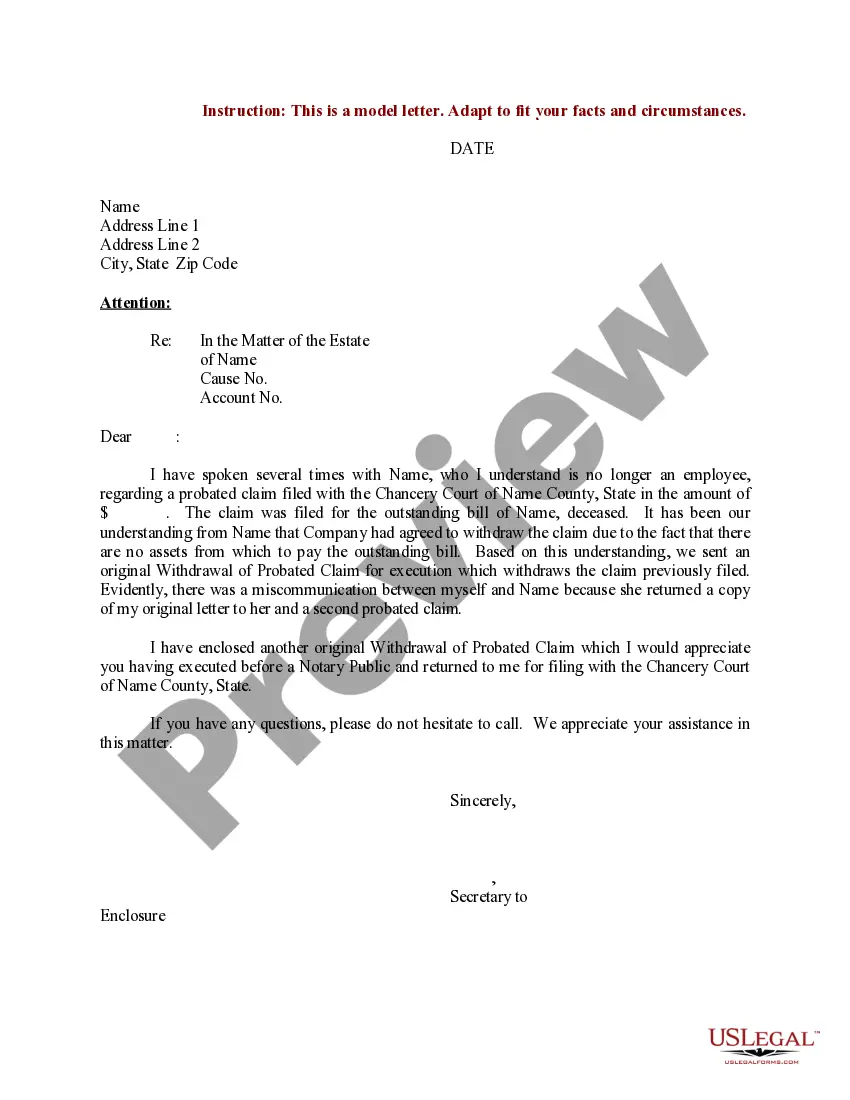
Maryland Sample Letter for Claim Settlement Against Decedent's Estate
Description


Get your form ready online
Our built-in tools help you complete, sign, share, and store your documents in one place.
Make edits, fill in missing information, and update formatting in US Legal Forms—just like you would in MS Word.
Download a copy, print it, send it by email, or mail it via USPS—whatever works best for your next step.
Sign and collect signatures with our SignNow integration. Send to multiple recipients, set reminders, and more. Go Premium to unlock E-Sign.
If this form requires notarization, complete it online through a secure video call—no need to meet a notary in person or wait for an appointment.
We protect your documents and personal data by following strict security and privacy standards.

Make edits, fill in missing information, and update formatting in US Legal Forms—just like you would in MS Word.

Download a copy, print it, send it by email, or mail it via USPS—whatever works best for your next step.

Sign and collect signatures with our SignNow integration. Send to multiple recipients, set reminders, and more. Go Premium to unlock E-Sign.

If this form requires notarization, complete it online through a secure video call—no need to meet a notary in person or wait for an appointment.

We protect your documents and personal data by following strict security and privacy standards.
Looking for another form?





How to fill out Sample Letter For Claim Settlement Against Decedent's Estate?
US Legal Forms - one of the most important collections of legal documents in the USA - offers a broad selection of legal form templates that you can acquire or print.
By using the website, you can access thousands of forms for business and personal purposes, organized by categories, states, or keywords. You can obtain the latest versions of forms such as the Maryland Sample Letter for Claim Settlement Against Decedent's Estate in seconds.
If you already have a membership, Log In and download the Maryland Sample Letter for Claim Settlement Against Decedent's Estate from the US Legal Forms library. The Download button will appear on every form you view. You can access all previously saved forms in the My documents tab of your account.
Every template you added to your account does not have an expiration date and is yours indefinitely. So, if you want to acquire or print another copy, just visit the My documents section and click on the form you need.
Access the Maryland Sample Letter for Claim Settlement Against Decedent's Estate with US Legal Forms, the most extensive library of legal document templates. Utilize a multitude of professional and state-specific templates that fulfill your business or personal needs and requirements.
- Ensure you have selected the correct form for your city/state. Click the Preview button to examine the form’s content. Review the form details to ensure you have selected the right form.
- If the form doesn’t meet your needs, use the Search field at the top of the screen to find one that does.
- If you are satisfied with the form, confirm your choice by clicking the Buy now button. Then, choose the payment plan you want and provide your credentials to register for the account.
- Process the transaction. Use your Visa or MasterCard or PayPal account to complete the transaction.
- Select the format and download the form onto your device.
- Make modifications. Fill out, edit, print, and sign the saved Maryland Sample Letter for Claim Settlement Against Decedent's Estate.
Form popularity
FAQ
If there is a surviving spouse and the net value is under $100,000 a small estate is necessary. If the net value is over $50,000 and there is no surviving spouse, a regular estate is necessary.
Download form #1128 - Claim Against Decedent's Estate from our Forms Page. Complete the form and submit it along with supporting documentation. The cost to file is $3.00 per claim. Please note that claims must be filed within 6 months from the date of death.
A Personal Representative must be appointed by the Register of Wills or the Orphans' Court before disposing of any assets. When appointed, Letters of Administration will be issued to the Personal Representative. Forms and procedures herein are mandated by Maryland Code and Maryland Rules.
(1) A claimant may make a claim against the estate, within the time allowed for presenting claims, (A) by serving it on the personal representative, (B) by filing it with the register and serving a copy on the personal representative, or (C) by filing suit.
Ideally, you should be able to close the estate within 13 months of the decedent's death. However, depending on the size and complexity of the estate, it may take longer. In any case, it's important to keep meticulous records throughout the process to prove to the court that you've fulfilled all your fiduciary duties.
Does the property of everyone who dies end up in probate? No. The only time the property of a person who passes away goes through the probate process is if the decedent held property just in his or her name alone.
Length of Probate Process in Maryland The administration of an estate often takes approximately one year. This includes marshaling all of the assets, valuing the assets as of the date of death and then making the distribution.
Generally, the Intestacy statutes provide for property to be distributed to a decedent's closest living relatives, i.e., to a surviving spouse and children, if there are any; to children in equal shares if there is no surviving spouse; to parents if there are no spouse and children; and so on to more distant relatives.
