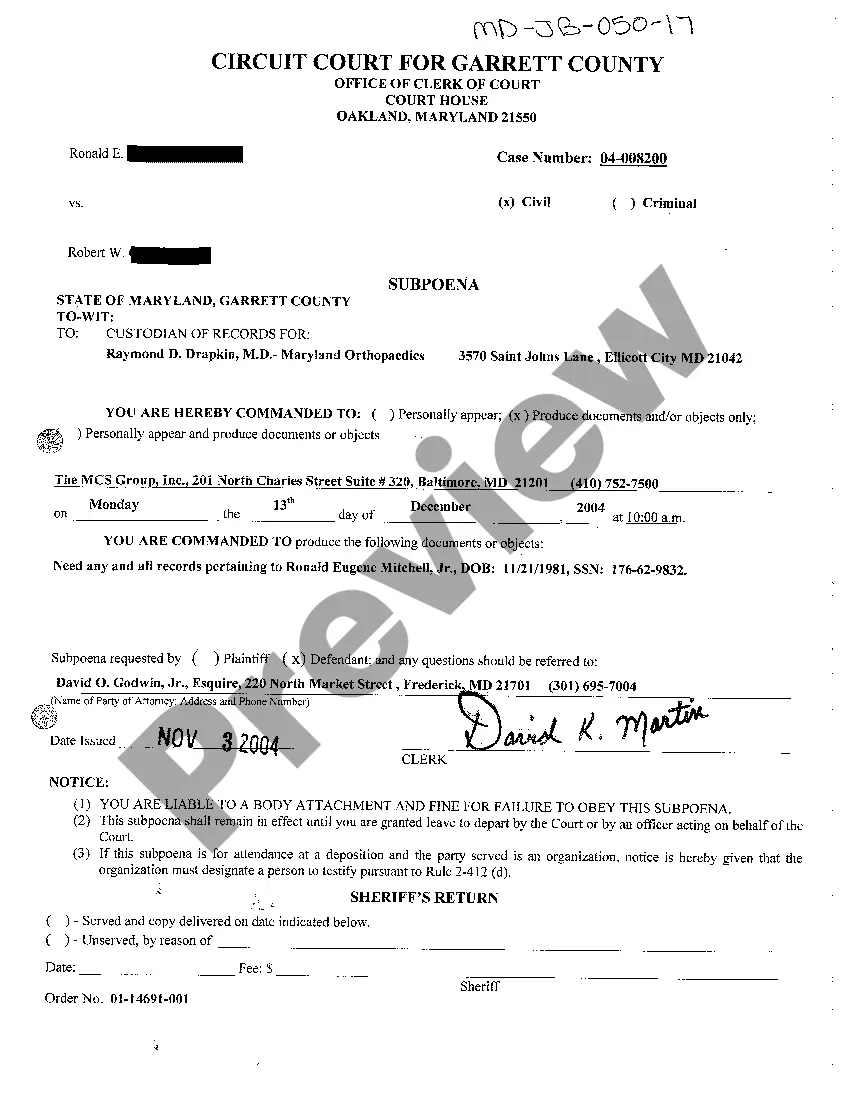
Maryland Subpoena of Doctor for Medical Records
Description

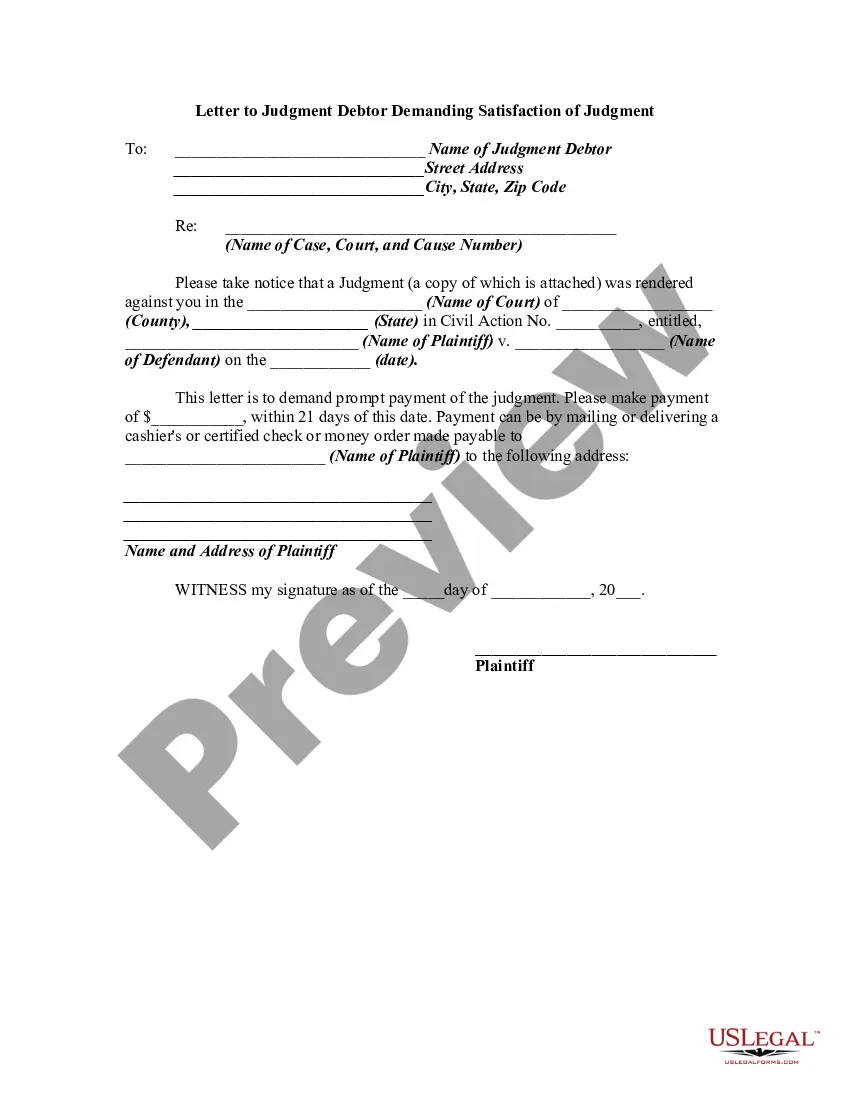

How to fill out Maryland Subpoena Of Doctor For Medical Records?
Welcome to the largest legal documents library, US Legal Forms. Right here you can get any template including Maryland Subpoena of Doctor for Medical Records forms and save them (as many of them as you want/require). Prepare official files in just a couple of hours, instead of days or even weeks, without spending an arm and a leg with an lawyer. Get your state-specific sample in a few clicks and feel confident understanding that it was drafted by our qualified legal professionals.
If you’re already a subscribed consumer, just log in to your account and then click Download near the Maryland Subpoena of Doctor for Medical Records you need. Because US Legal Forms is web-based, you’ll always have access to your downloaded templates, no matter what device you’re utilizing. See them inside the My Forms tab.
If you don't come with an account yet, just what are you waiting for? Check out our guidelines below to start:
- If this is a state-specific form, check out its validity in the state where you live.
- Look at the description (if available) to understand if it’s the proper template.
- See more content with the Preview function.
- If the sample fulfills all of your needs, just click Buy Now.
- To create your account, select a pricing plan.
- Use a card or PayPal account to register.
- Download the document in the format you want (Word or PDF).
- Print the document and complete it with your/your business’s info.
As soon as you’ve filled out the Maryland Subpoena of Doctor for Medical Records, send it to your lawyer for confirmation. It’s an extra step but an essential one for making sure you’re fully covered. Become a member of US Legal Forms now and access a large number of reusable examples.
Form popularity
FAQ
Consult with an attorney to determine if a motion to quash the subpoena is necessary. Typically five years of prior records is reasonable, but it could even be less. An attorney should obtain the prior records via your signed authorization before deciding how to handle the subpoena.
Subpoenas are legal documents issued by courts which require a person to attend court and give evidence or provide documents to the court. A patient's right to confidentiality is overridden when medical records are requested under a subpoena.A failure to comply with a subpoena can result in contempt of court.
Most often, the attorneys involved in that case will serve a subpoena on a mental health professional to produce his or her records, give a deposition or come to trial and testify. Should you respond to that subpoena and turn over your records or give a deposition? The answer is usually NO.
Examples of reasonable efforts to notify the patient include calling the patient or sending the patient a letter via mail or email explaining that you've received a subpoena requesting disclosure of their protected health information, and you are required to respond unless the patient has the subpoena set aside before
A subpoena issued by someone other than a judge, such as a court clerk or an attorney in a case, is different from a court order. A HIPAA-covered provider or plan may disclose information to a party issuing a subpoena only if the notification requirements of the Privacy Rule are met.
First, falsifying a medical record is a crime punishable by a fine or even jail time. Additionally, altering medical records can make it harder for doctors to win medical malpractice cases. Juries do not trust liars, and a questionable change to a record implies that something is being covered up.
You can sue your doctor for lying, provided certain breaches of duty of care occur. A doctor's duty of care is to be truthful about your diagnosis, treatment options, and prognosis. If a doctor has lied about any of this information, it could be proof of a medical malpractice claim.
Subpoenas are legal documents issued by courts which require a person to attend court and give evidence or provide documents to the court. A patient's right to confidentiality is overridden when medical records are requested under a subpoena.A failure to comply with a subpoena can result in contempt of court.
It depends on why you can't go. If it is a good enough reason, call the attorney who subpoenaed you and ask if you can be excused. If not, file a motion to quash the subpoena (you may need to hire an attorney to do this).