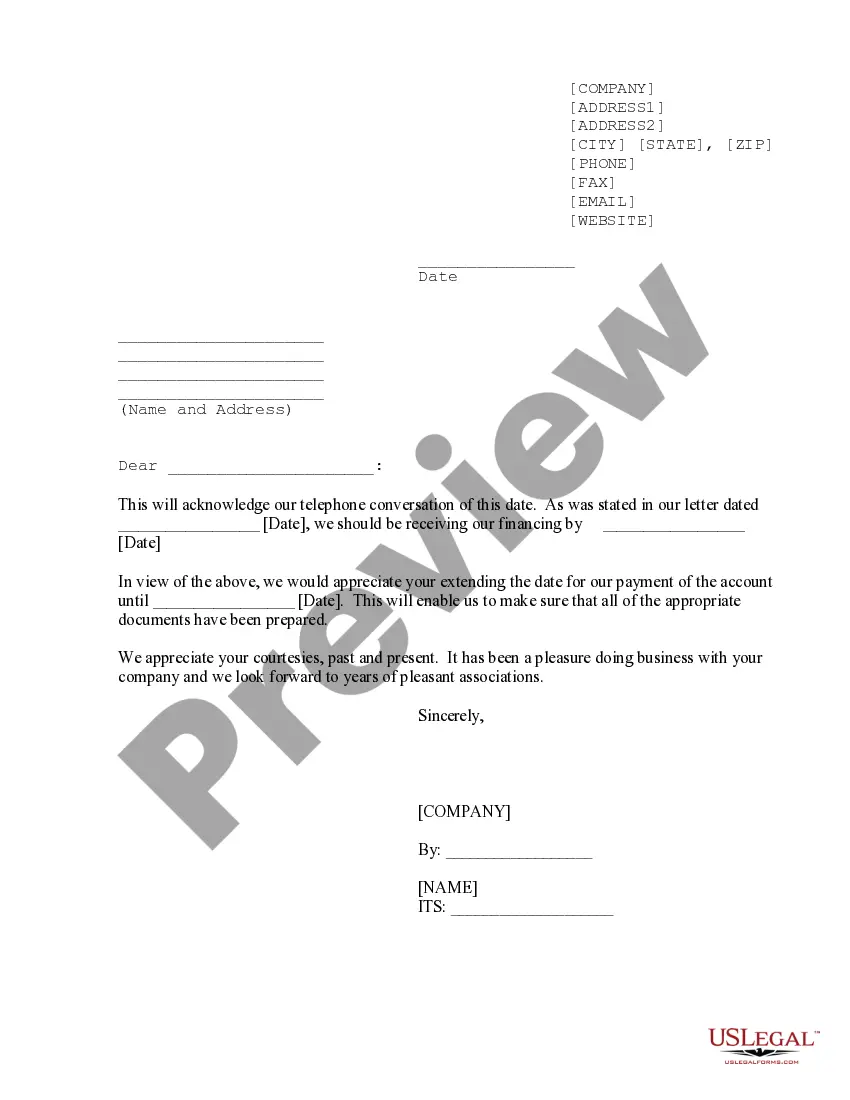
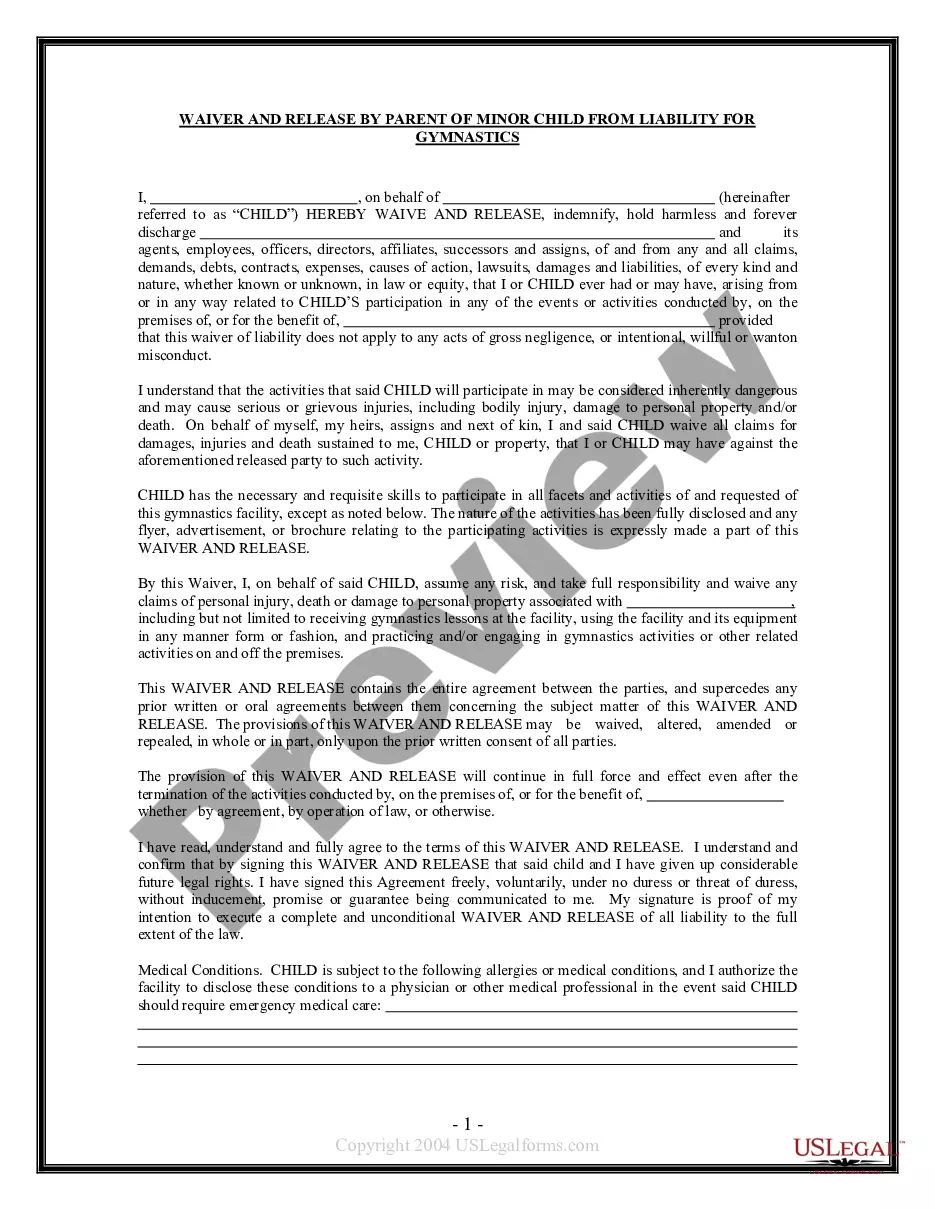
This form allows a parent or guardian to release a minor for cheerleading from liability for injuries which may be incurred by a minor child while on the premises, taking part in activities, etc.
Massachusetts Waiver and Release From Liability For Minor Child for Cheerleading
Category:
State:
Multi-State
Control #:
US-WAV-93M
Format:
Word;
Rich Text
Instant download
Description
Free preview
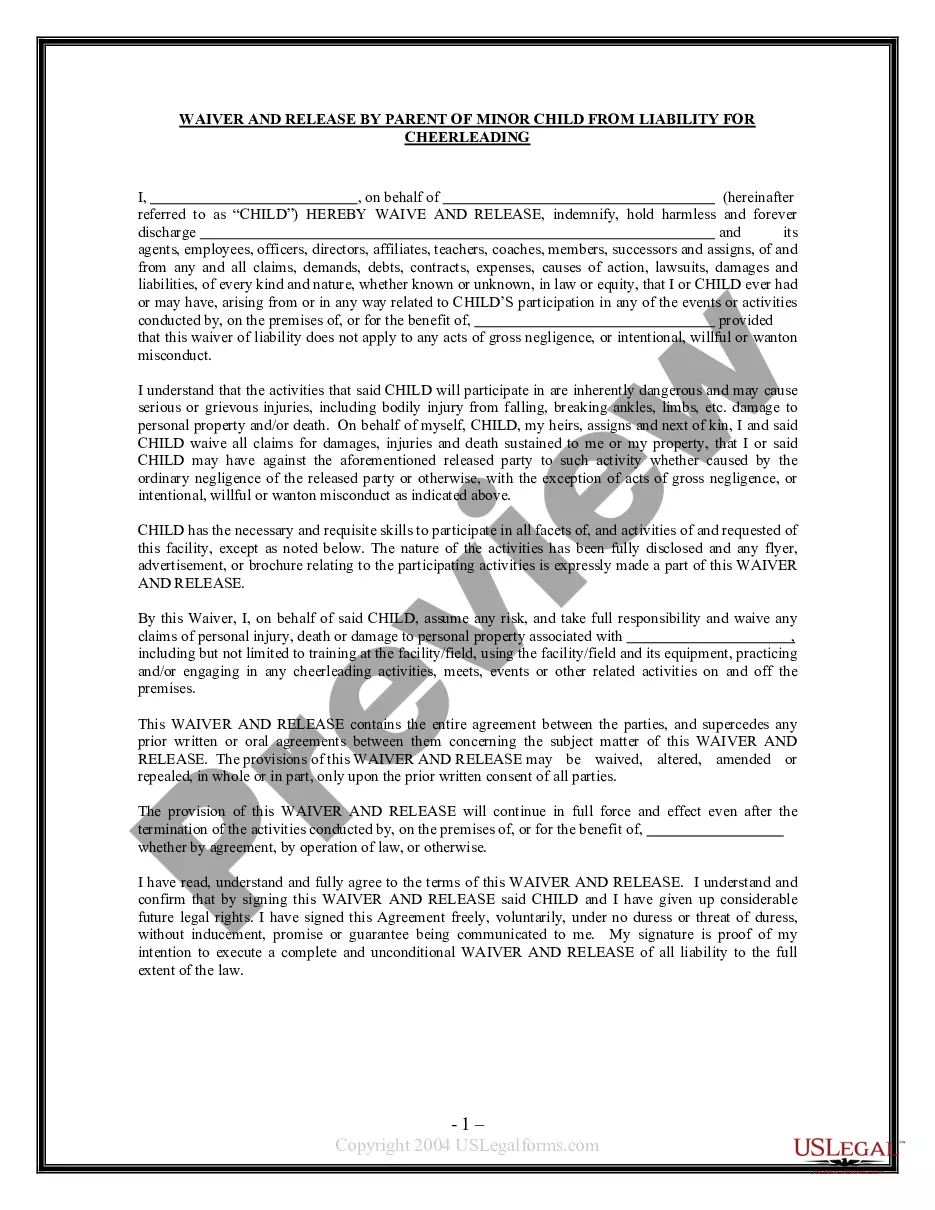
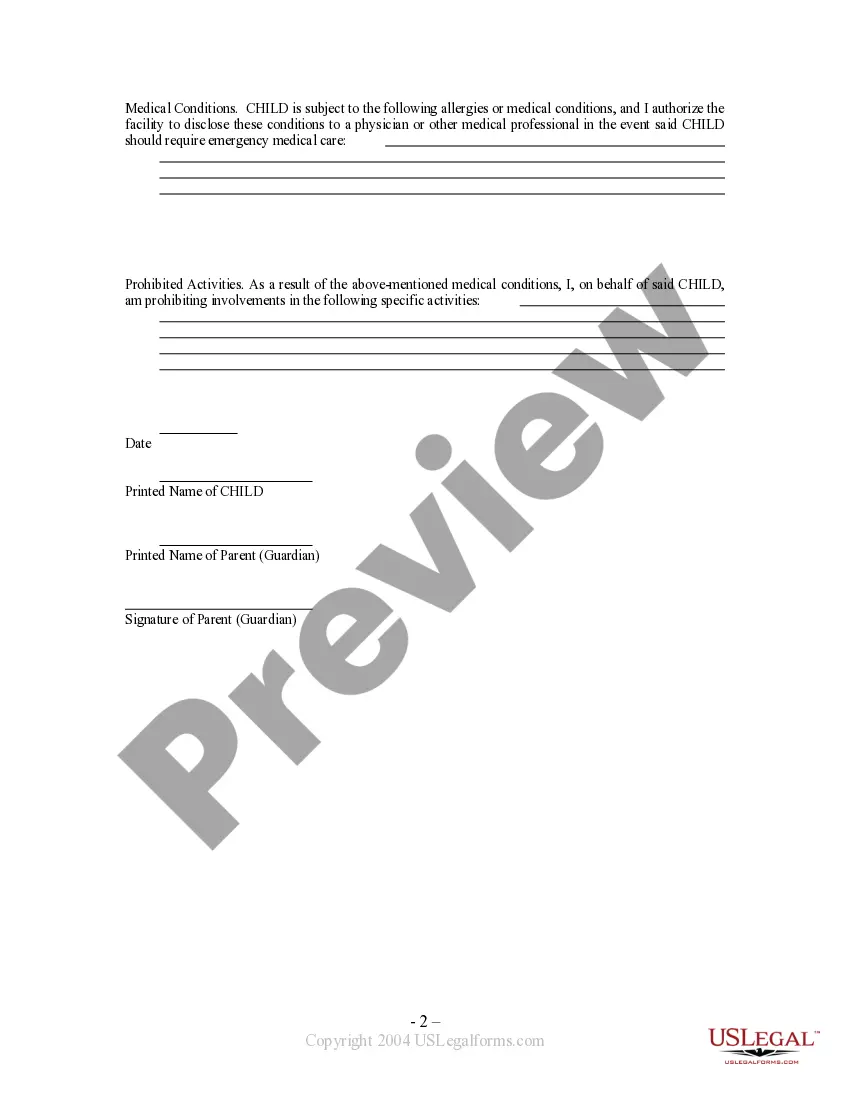

How to fill out Waiver And Release From Liability For Minor Child For Cheerleading?
If you need to total, acquire, or print legal document templates, utilize US Legal Forms, the largest collection of legal forms available online.
Take advantage of the site's simple and user-friendly search to find the documents you need. A range of templates for business and personal purposes are organized by categories, states, or keywords.
Use US Legal Forms to locate the Massachusetts Waiver and Release From Liability For Minor Child for Cheerleading in just a few clicks.
Every legal document template you purchase is yours indefinitely. You will have access to all forms you saved in your account. Navigate to the My documents section and select a form to print or download again.
Complete and download, and print the Massachusetts Waiver and Release From Liability For Minor Child for Cheerleading with US Legal Forms. There are thousands of professional and state-specific forms available for your business or personal needs.
- If you are already a US Legal Forms user, sign in to your account and click on the Obtain button to retrieve the Massachusetts Waiver and Release From Liability For Minor Child for Cheerleading.
- You can also access forms you previously saved from the My documents section of your account.
- If you are using US Legal Forms for the first time, follow the steps below.
- Step 1. Ensure you have selected the form for the correct city/state.
- Step 2. Use the Review option to examine the form's content. Be sure to read the description.
- Step 3. If you are not satisfied with the form, use the Search field at the top of the screen to find alternative versions of the legal document template.
- Step 4. Once you have found the form you need, click the Acquire now button. Choose your preferred pricing plan and provide your details to register for an account.
- Step 5. Complete the transaction. You can use your credit card or PayPal account to finalize the purchase.
- Step 6. Select the format of the legal document and download it to your device.
- Step 7. Complete, modify, and print or sign the Massachusetts Waiver and Release From Liability For Minor Child for Cheerleading.
Form popularity
FAQ
An effective waiver of liability must meet three key requirements. First, it should clearly specify the activity, such as cheerleading, and the inherent risks involved, particularly in the Massachusetts Waiver and Release From Liability For Minor Child for Cheerleading. Second, the language must be explicit and unambiguous, allowing participants to understand what they are agreeing to. Lastly, the waiver must be signed voluntarily by the participant or their guardian, demonstrating informed consent.
To write a simple release of liability, start with a clear title that indicates the document's purpose. You should mention the specific activity, like the Massachusetts Waiver and Release From Liability For Minor Child for Cheerleading, to eliminate ambiguity. Next, include a statement where the participant acknowledges the risks and voluntarily agrees to release the organization from liability. Finally, ensure that the form includes signature lines for both the minor's guardian and the participant.
Writing a liability waiver form requires clarity and specificity. Begin by defining the scope of the waiver, focusing on the Massachusetts Waiver and Release From Liability For Minor Child for Cheerleading. Clearly describe the activities and potential risks associated with cheerleading. Make sure to include sections for participant acknowledgment and consent, and conclude with a signature line for all involved parties to affirm their understanding and acceptance of the terms.
To fill out a general waiver and release form, start by clearly stating the purpose of the waiver. Include the names of all parties involved, ensuring you specify the minor child’s name when addressing the Massachusetts Waiver and Release From Liability For Minor Child for Cheerleading. Next, outline the activities covered by the waiver and explicitly mention the risks involved. Finally, have all parties sign and date the document to ensure it is legally binding.
A waiver is an exculpatory contract. That means it's used to excuse a party from responsibility when the other contracted party is injured by either known or unknown risks in a particular activity. This includes inherent risks and ordinary negligence.
Liability waivers are enforceable in California solely to the extent they shift to the customer the risk of ordinary negligence. Under California law, a liability waiver cannot excuse an injury caused by a defendant's gross negligence, recklessness or intentionally wrongful act.
A liability waiver, or release waiver, is a legal document that a company or organization requires members of the public to sign in order to protect their organization from being sued if you sustain an injury.
Signing a waiver does not mean you automatically do not have the right to file a lawsuit after suffering a serious injury in California. Liability laws are complex and often require an attorney's assistance. If you signed a waiver before an activity that gave you an injury, speak to a lawyer about your rights.
A release of liability is a legal agreement between two parties in which one party waives the right to hold another party responsible for potential damages or injuries.
If you are injured as a result of ordinary negligence, the liability waiver may fully protect the defendant and leave you without legal recourse. If you are injured as a result of gross negligence, then you may have a case.