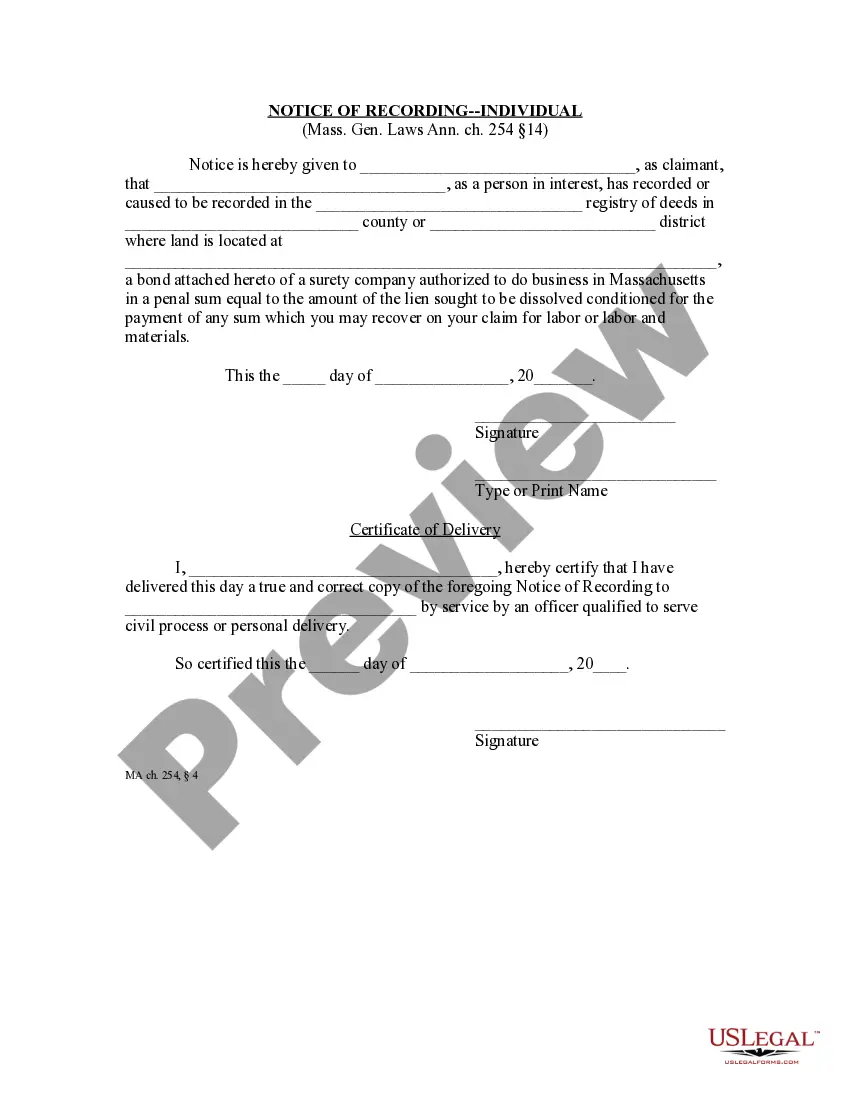
Massachusetts Notice of Recording - Individual
About this form
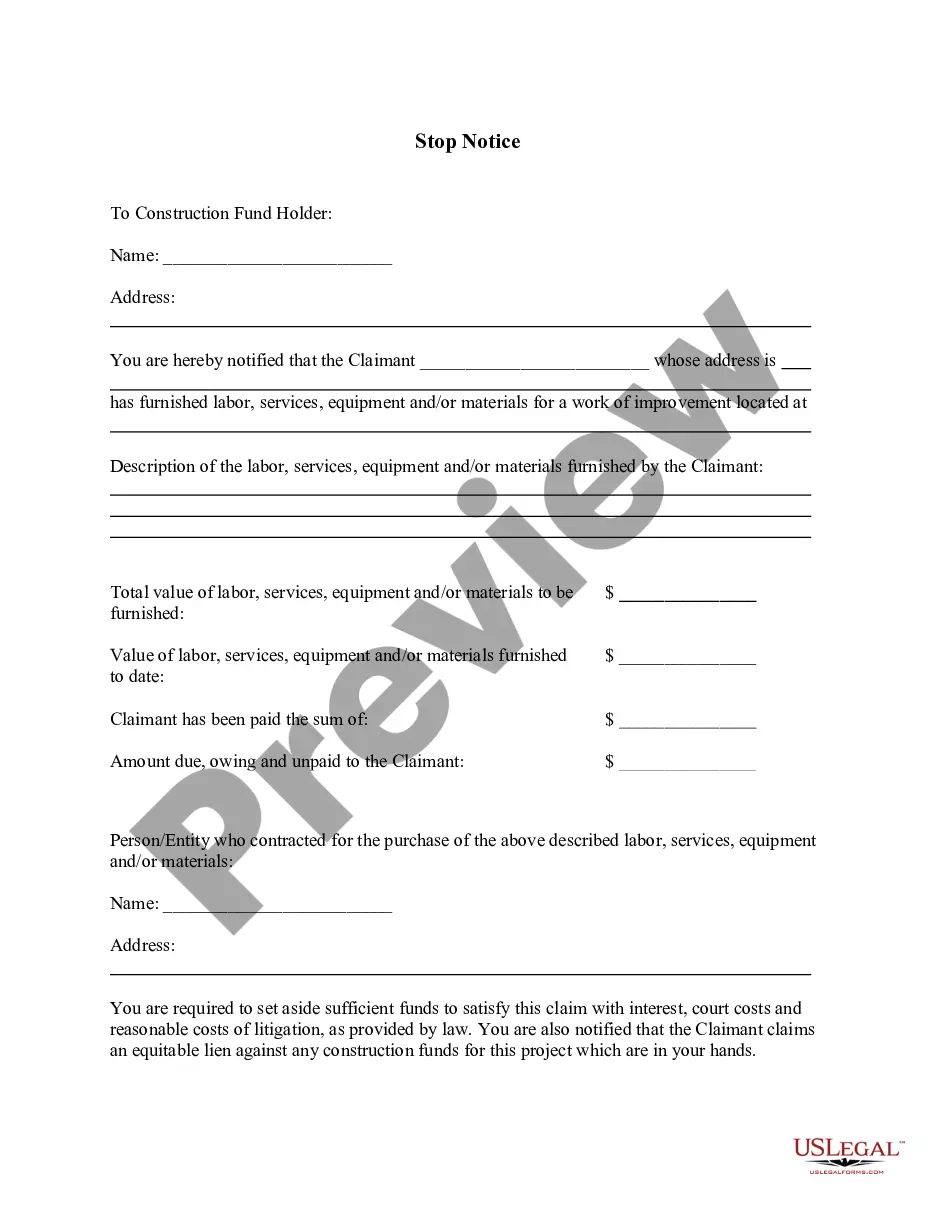
The Notice of Recording - Individual is a legal document that allows an individual person in interest to formally notify a claimant that they have recorded a bond in the registry of deeds. This bond serves as a surety for the payment of any claims related to labor or materials against specific property. This form helps protect property owners from liens by ensuring that labor claims are backed by a financial guarantee, distinguishing it from other forms by its specific focus on bond recording and lien dissolution.
Key components of this form
- Claimantâs name: Identifies the party making the claim.
- Person in interest: Indicates the individual who recorded the bond.
- Registry of deeds: Specifies the office where the bond is recorded.
- Property details: Describes the location of the property in question.
- Bond attachment: Includes the bond as part of the document.
- Certification of delivery: Confirms that the notice has been properly delivered to the claimant.
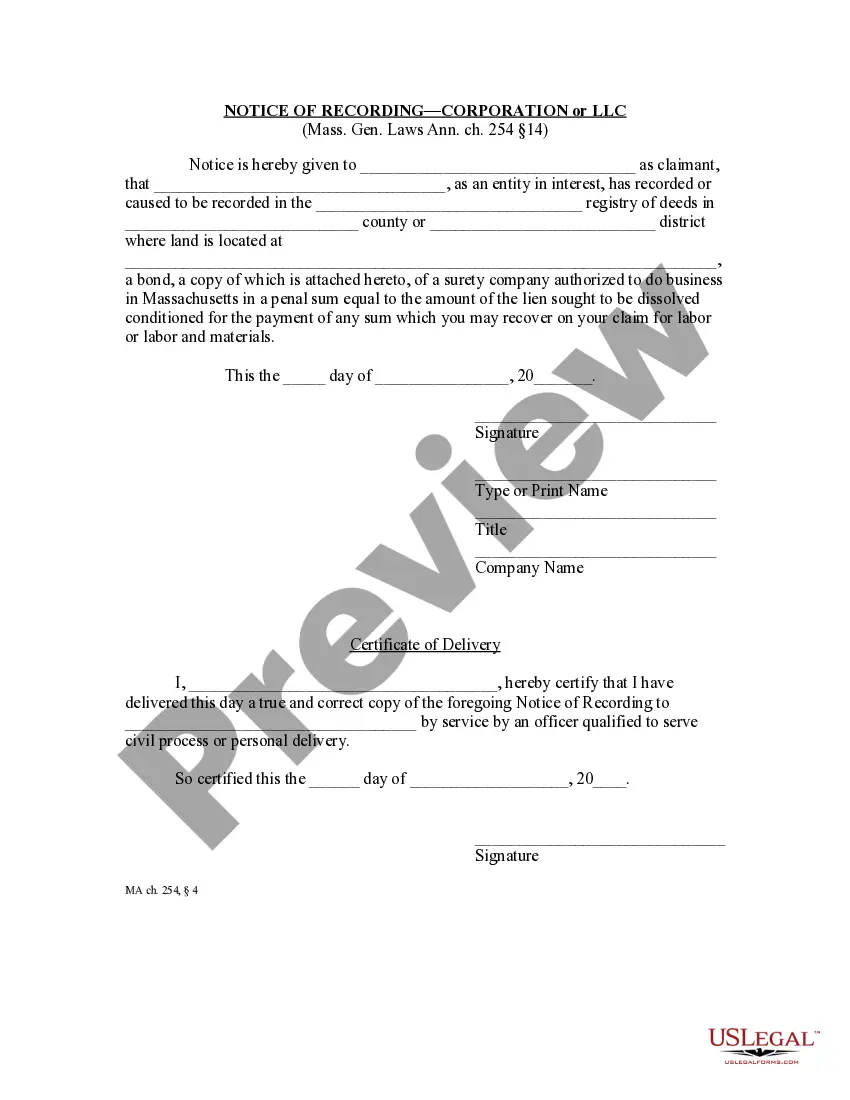
When to use this form
This form should be used when an individual wants to formally notify a claimant about a recorded bond intended to contest a lien. It is particularly useful when there is a dispute over labor or material claims related to property and the individual wishes to dissolve such liens through proper legal channels. Situations may include contractor disputes, unpaid invoices for materials, or resolving potential legal actions that could affect property ownership.
Who should use this form
- Individuals who have recorded a bond to contest a lien on their property.
- Property owners facing claims from contractors or suppliers for unpaid work or materials.
- Anyone who needs to notify a claimant of their bond recording to ensure legal compliance.
Steps to complete this form
- Identify the claimant and enter their name in the designated field.
- Provide your name as the person in interest and ensure it is clearly indicated.
- Specify the registry of deeds where the bond has been recorded.
- Enter the county or district where the property is located.
- Attach the bond to the form as required.
- Sign and date the form and ensure delivery certification to the claimant.
Notarization guidance
This form does not typically require notarization unless specified by local law. Always check the specific regulations in your jurisdiction to ensure compliance.
Get your form ready online
Our built-in tools help you complete, sign, share, and store your documents in one place.
Make edits, fill in missing information, and update formatting in US Legal Forms—just like you would in MS Word.
Download a copy, print it, send it by email, or mail it via USPS—whatever works best for your next step.
Sign and collect signatures with our SignNow integration. Send to multiple recipients, set reminders, and more. Go Premium to unlock E-Sign.
If this form requires notarization, complete it online through a secure video call—no need to meet a notary in person or wait for an appointment.
We protect your documents and personal data by following strict security and privacy standards.

Make edits, fill in missing information, and update formatting in US Legal Forms—just like you would in MS Word.

Download a copy, print it, send it by email, or mail it via USPS—whatever works best for your next step.

Sign and collect signatures with our SignNow integration. Send to multiple recipients, set reminders, and more. Go Premium to unlock E-Sign.

If this form requires notarization, complete it online through a secure video call—no need to meet a notary in person or wait for an appointment.

We protect your documents and personal data by following strict security and privacy standards.
Common mistakes to avoid
- Failing to include the bond as an attachment.
- Not properly identifying the claimant or person in interest.
- Incorrectly filling out property details or registry information.
- Neglecting to sign the form before delivery.
Benefits of completing this form online
- Convenient access to downloadable templates tailored for specific legal needs.
- Editable forms allow for customization based on individual circumstances.
- Secure storage and access to legal documents at any time.
Main things to remember
- The Notice of Recording is essential for contesting liens on property through a recorded bond.
- Properly completing and delivering this form can protect your legal rights regarding property claims.
- Ensure you comply with local laws regarding the recording and delivery of this notice.
Looking for another form?

Form popularity
FAQ
Rule 5 of civil procedure in Massachusetts discusses the service of pleadings and other papers. It ensures all parties involved in a lawsuit receive the necessary documents promptly. Understanding this rule is vital if you are dealing with recording issues under the Massachusetts Notice of Recording - Individual.
Massachusetts's wiretapping law often referred to is a "two-party consent" law. More accurately, Massachusetts makes it a crime to secretly record a conversation, whether the conversation is in-person or taking place by telephone or another medium.
Massachusetts Recording Law Summary:Massachusetts recording law stipulates that it is a two-party consent state. In Massachusetts, it is a criminal offense to use any device to record and/or disseminate communications, whether they're wire, oral or electronic, without the consent of all contributing parties.
Eleven (11) states require the consent of everybody involved in a conversation or phone call before the conversation can be recorded. Those states are: California, Delaware, Florida, Illinois, Maryland, Massachusetts, Montana, Nevada, New Hampshire, Pennsylvania and Washington.
California is an all-party consent state. It is illegal to record a confidential conversation, including a private conversation or telephone call, without consent in California. A violation of this rule is the crime of eavesdropping, per Penal Code 632 PC.
Massachusetts is a Two-Party Consent State. Massachusetts is a two-party consent state that requires the consent of any individual whose voice is being recorded. Recording another individual's words without the individual's knowledge or consent is a felony in Massachusetts.
An individual could be ordered to pay damages in a civil lawsuit against them or might even face jail time or a hefty fine. So, if someone recorded you without your consent, it is considered a gross infringement on your privacy, and you can initiate a lawsuit against them.
California's wiretapping law is a "two-party consent" law. California makes it a crime to record or eavesdrop on any confidential communication, including a private conversation or telephone call, without the consent of all parties to the conversation. See Cal. Penal Code § 632.