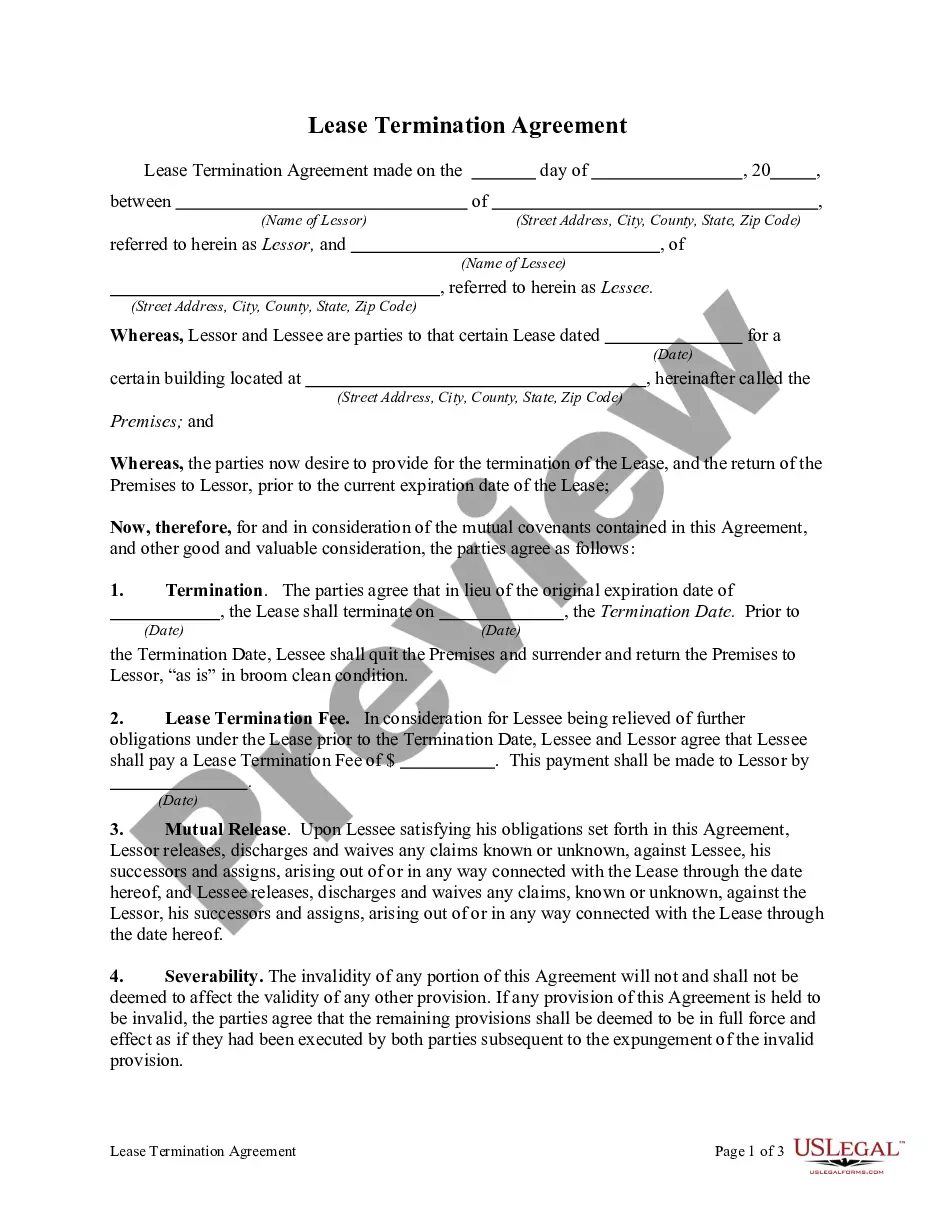
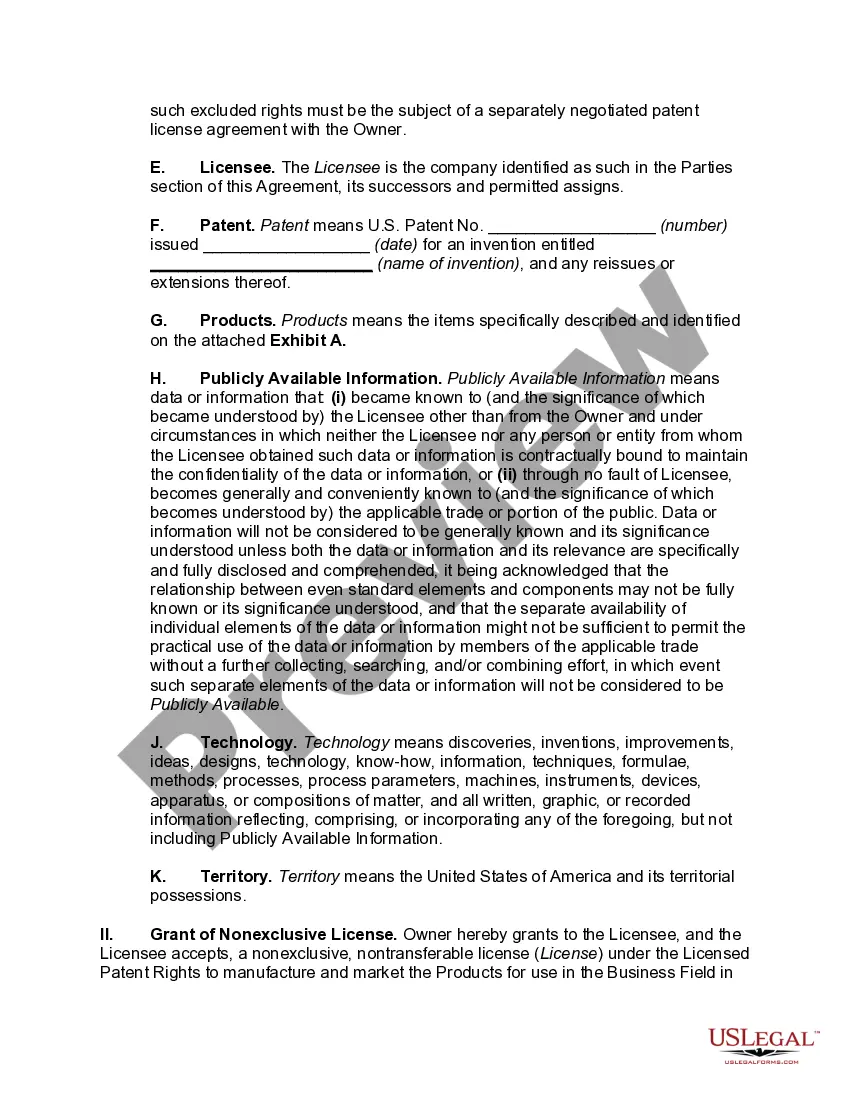
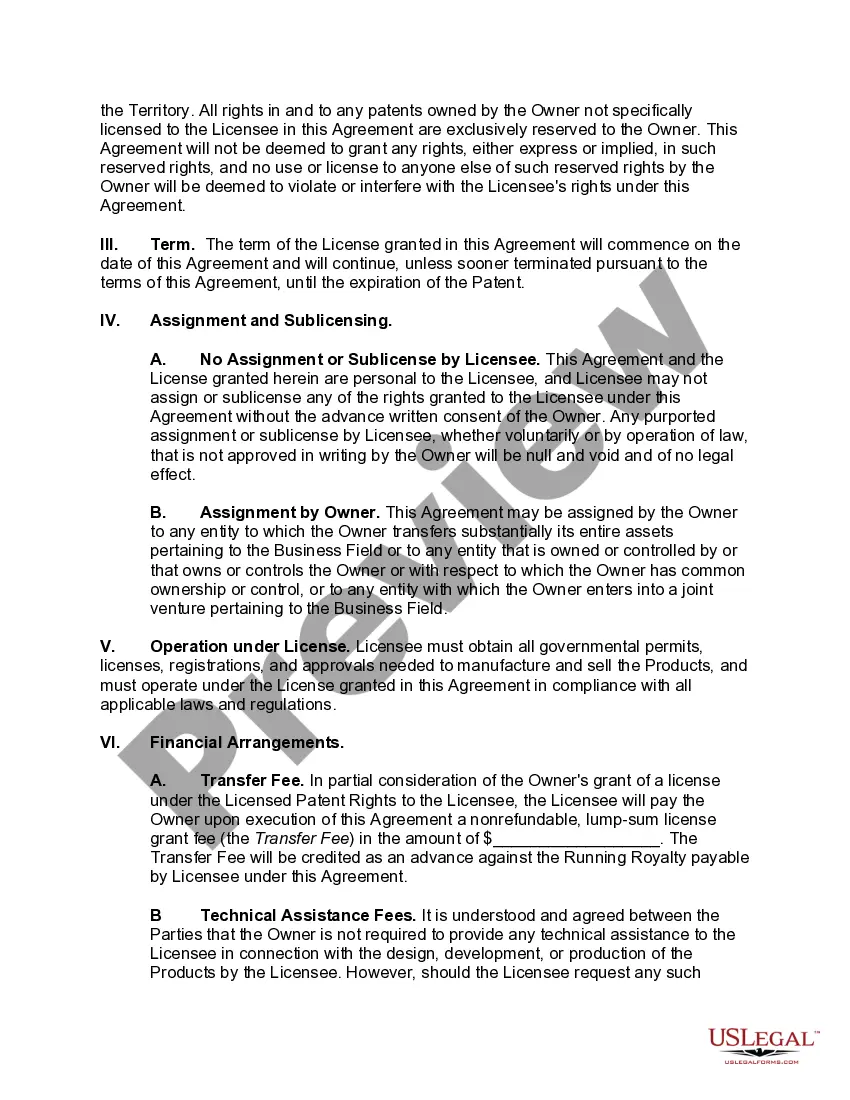
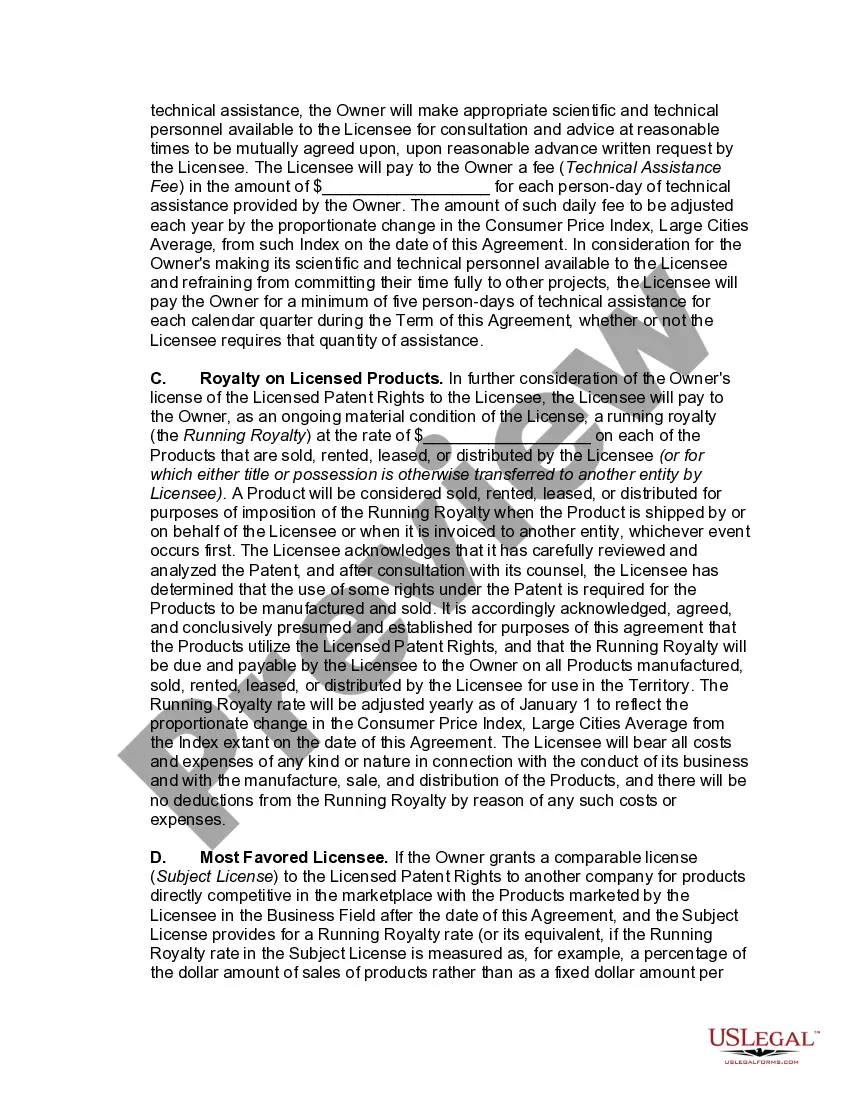
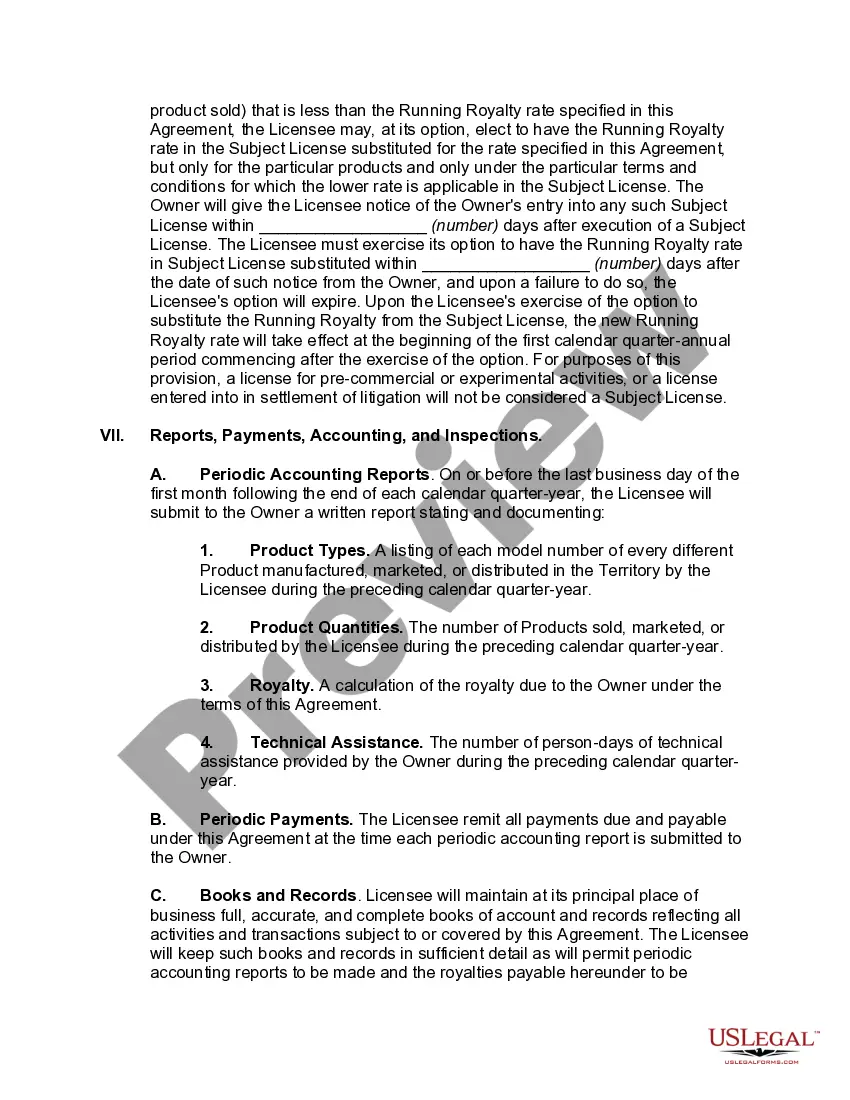
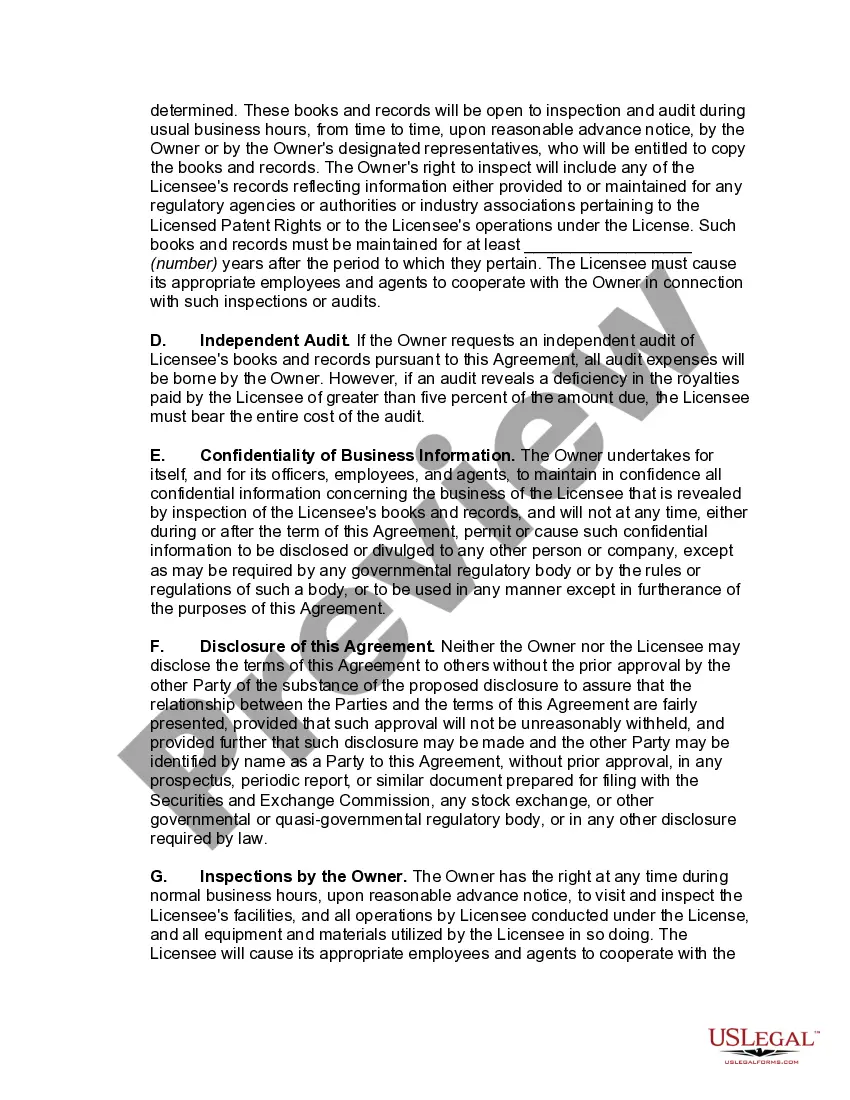
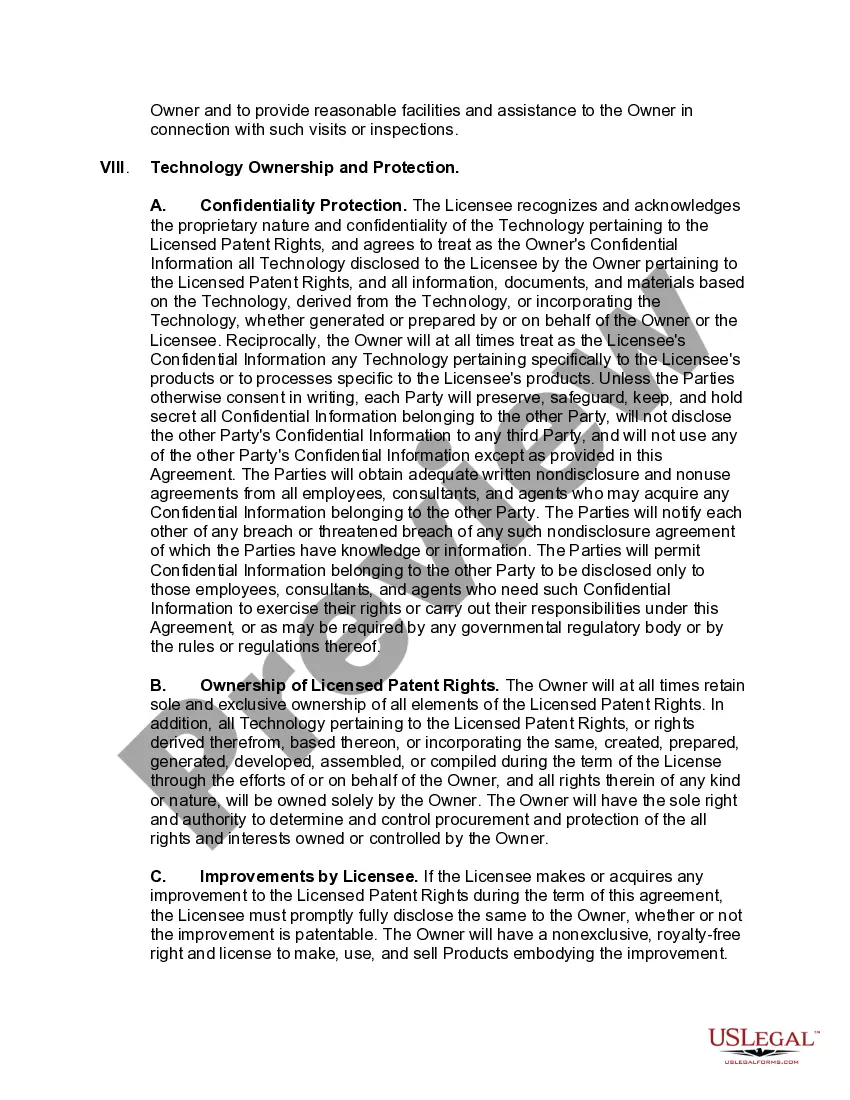
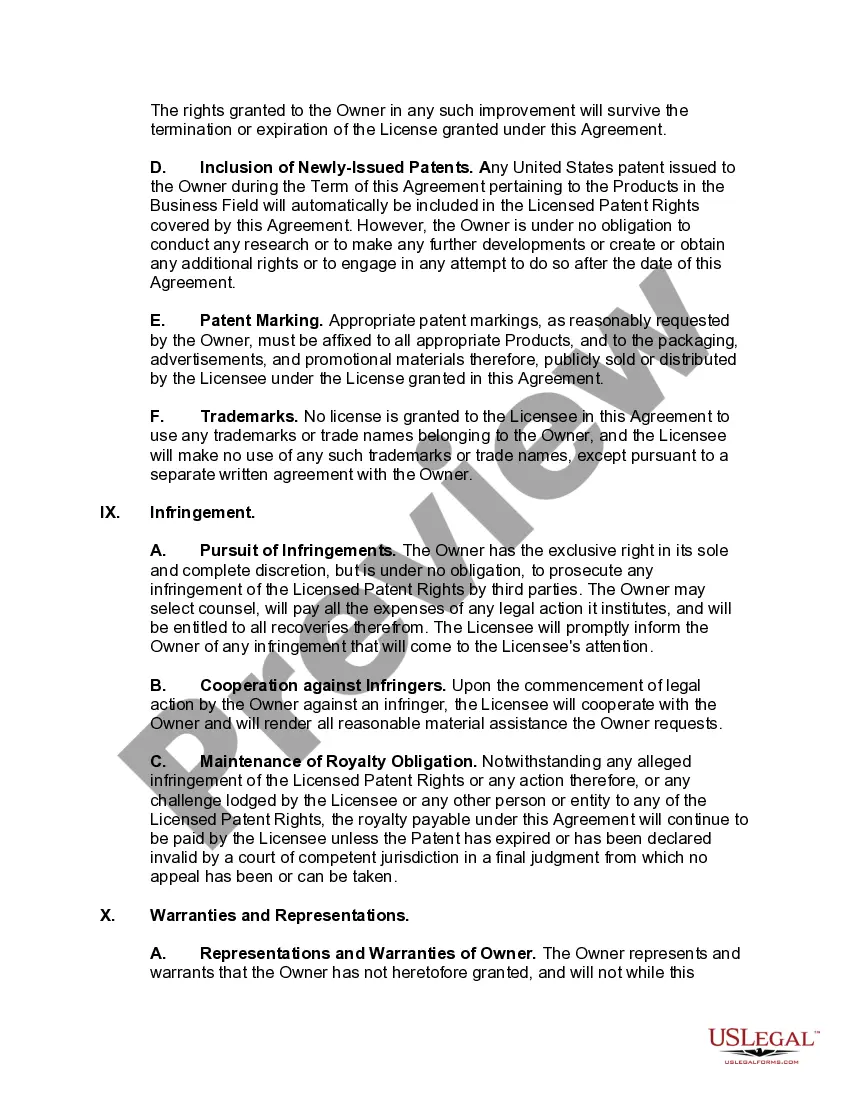
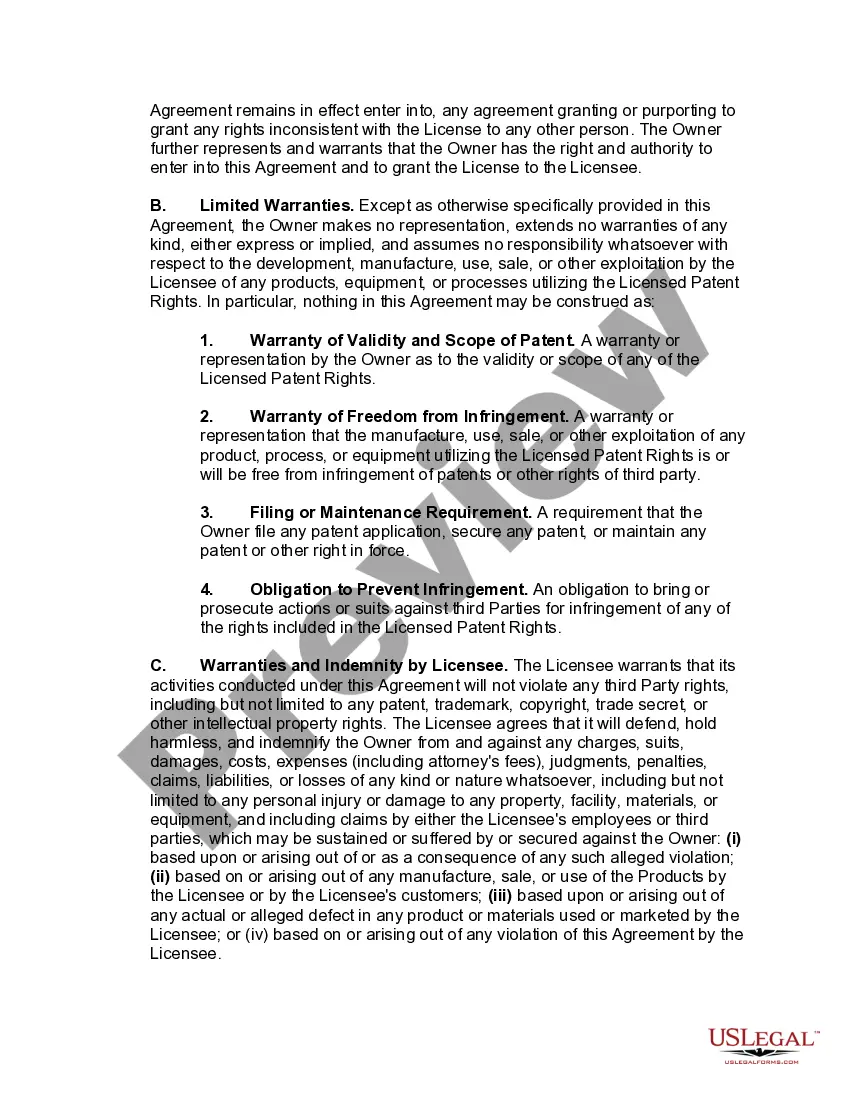
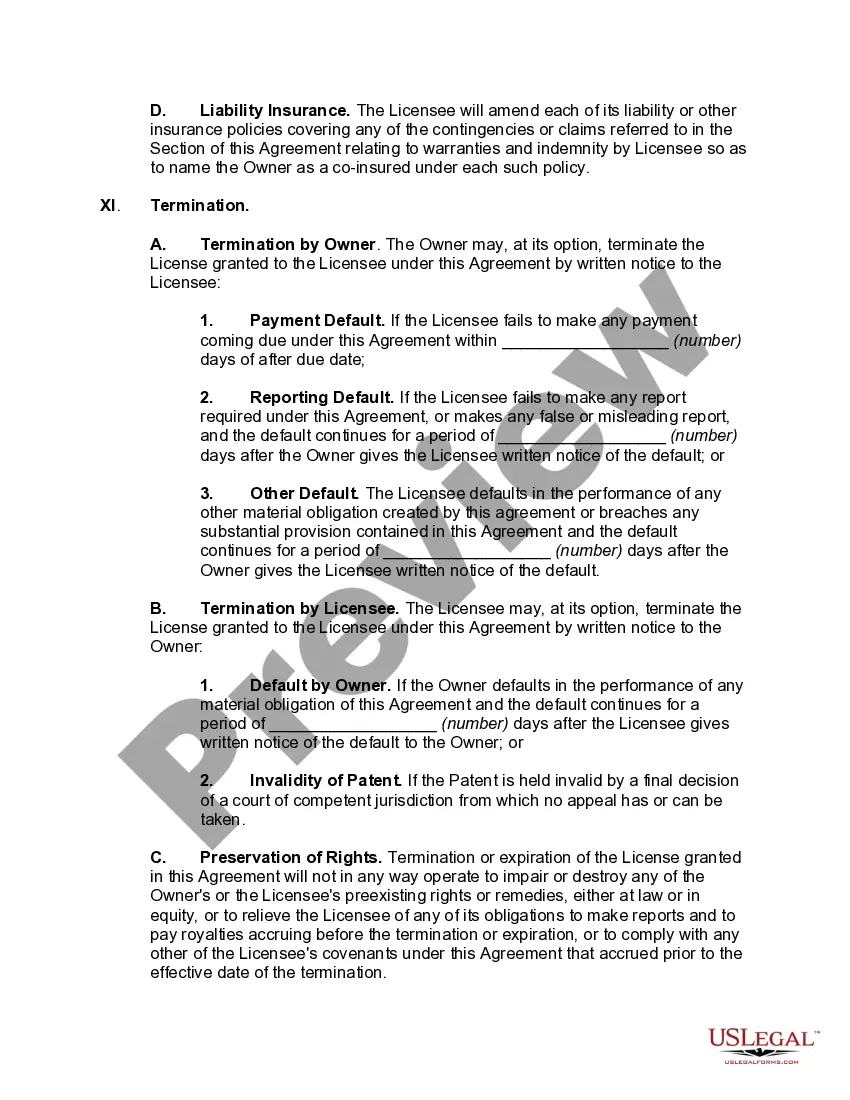
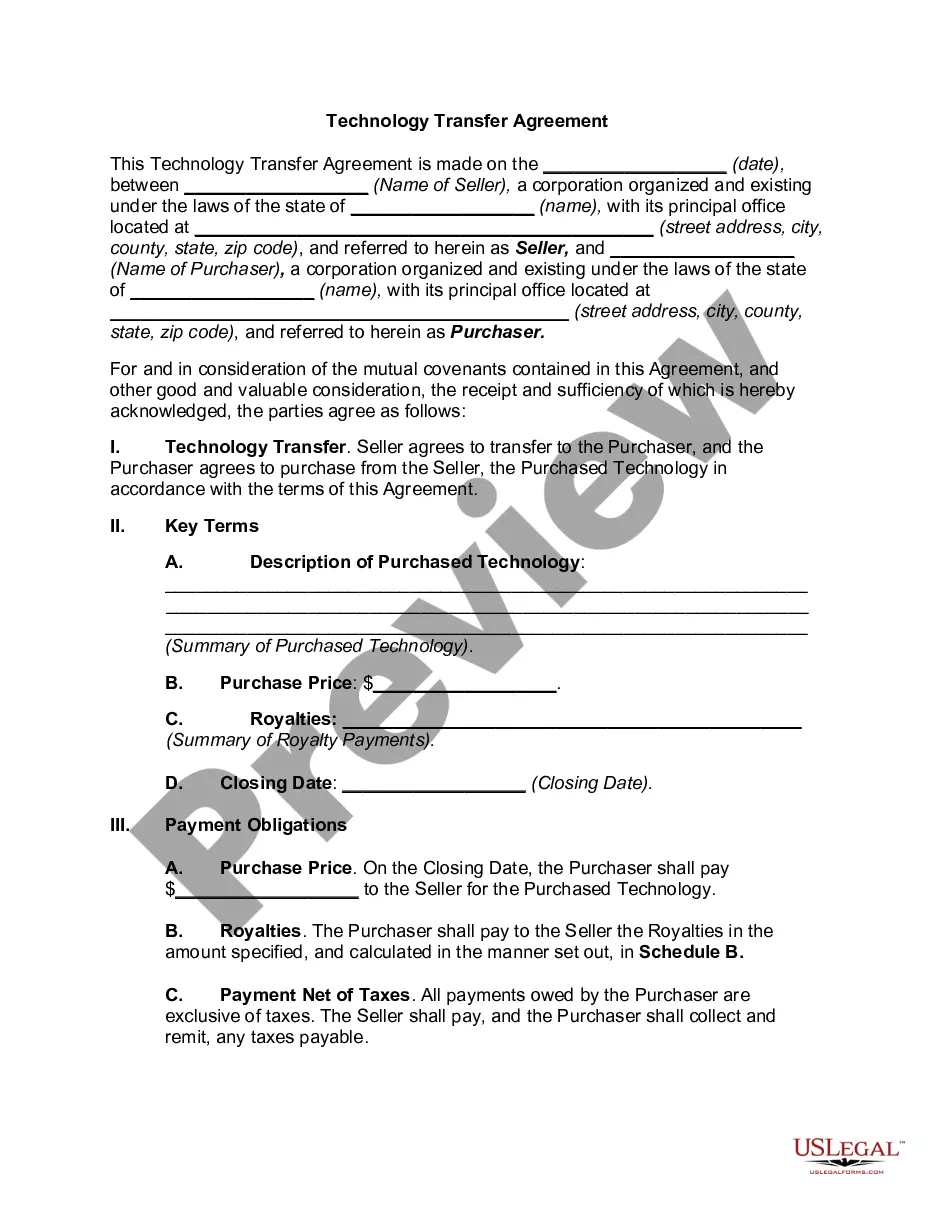
Technology Licensing is the process by which patentable intellectual property is made
marketable and is licensed or otherwise disposed for use by the pubic.
Louisiana Technology Licensing Agreement
Instant download
Description
Free preview
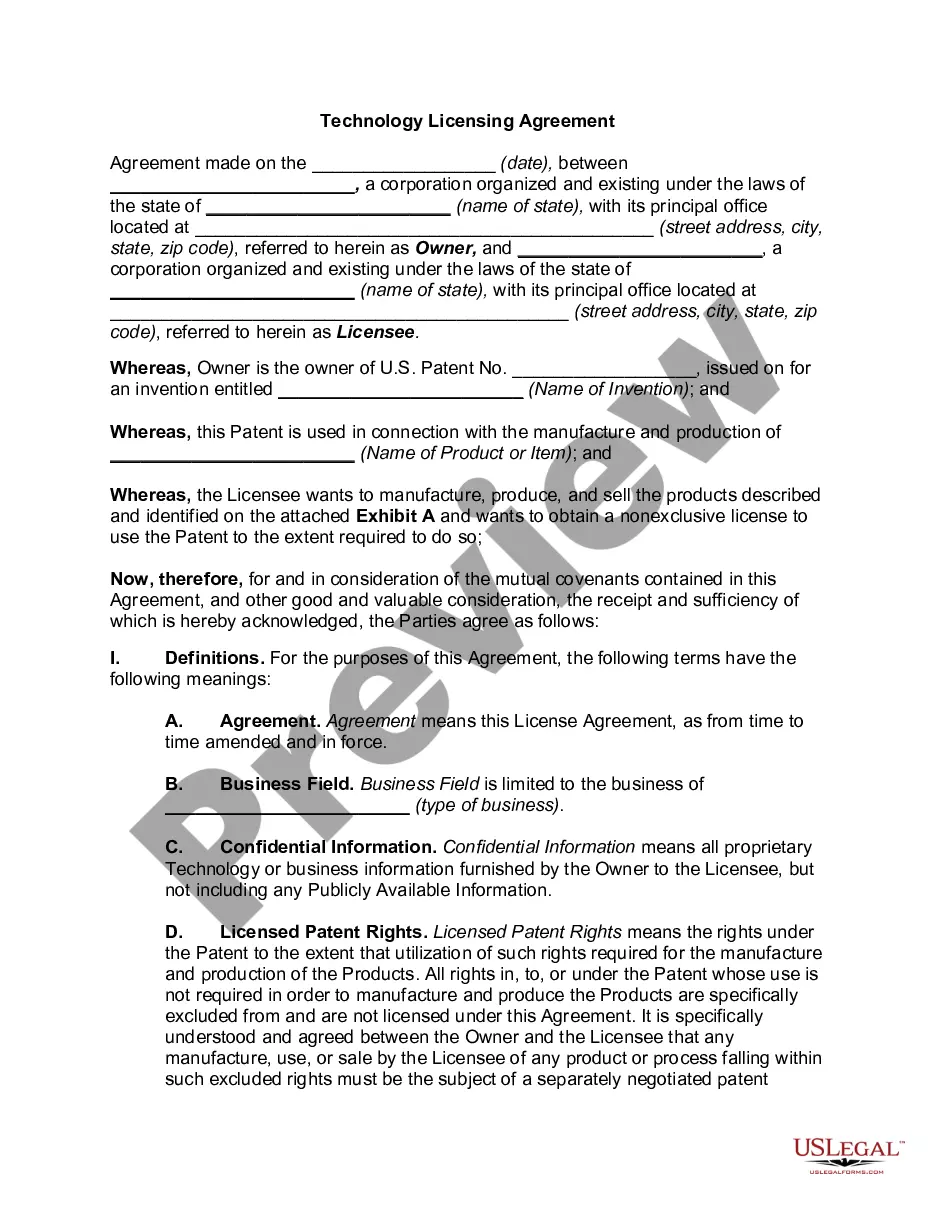

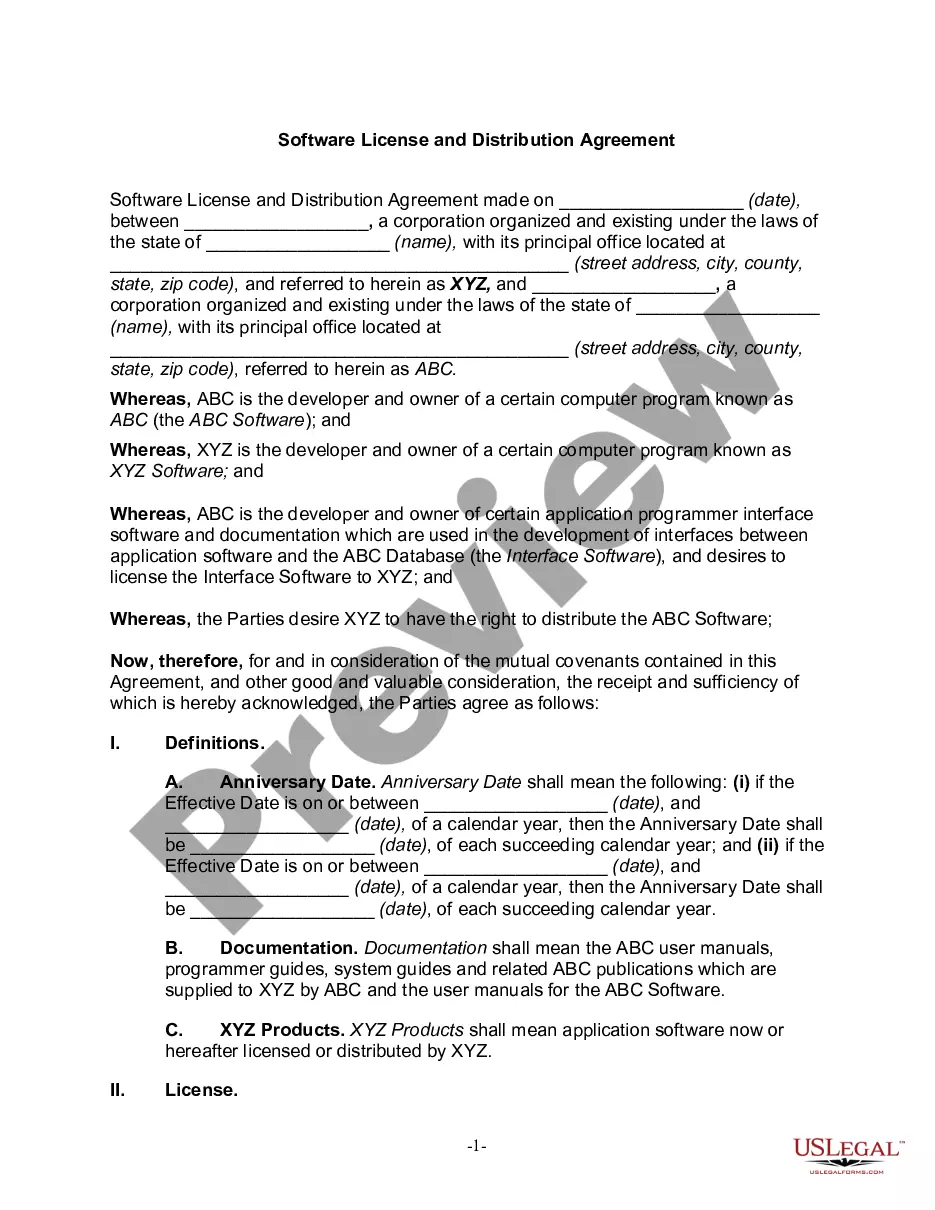
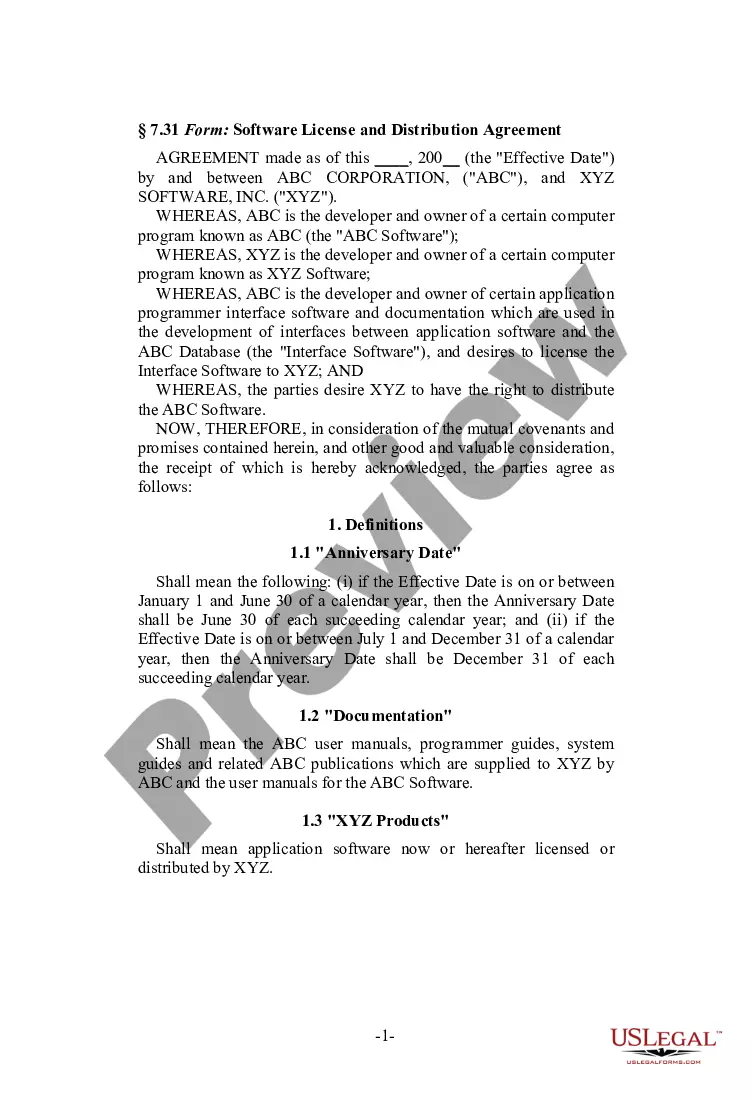
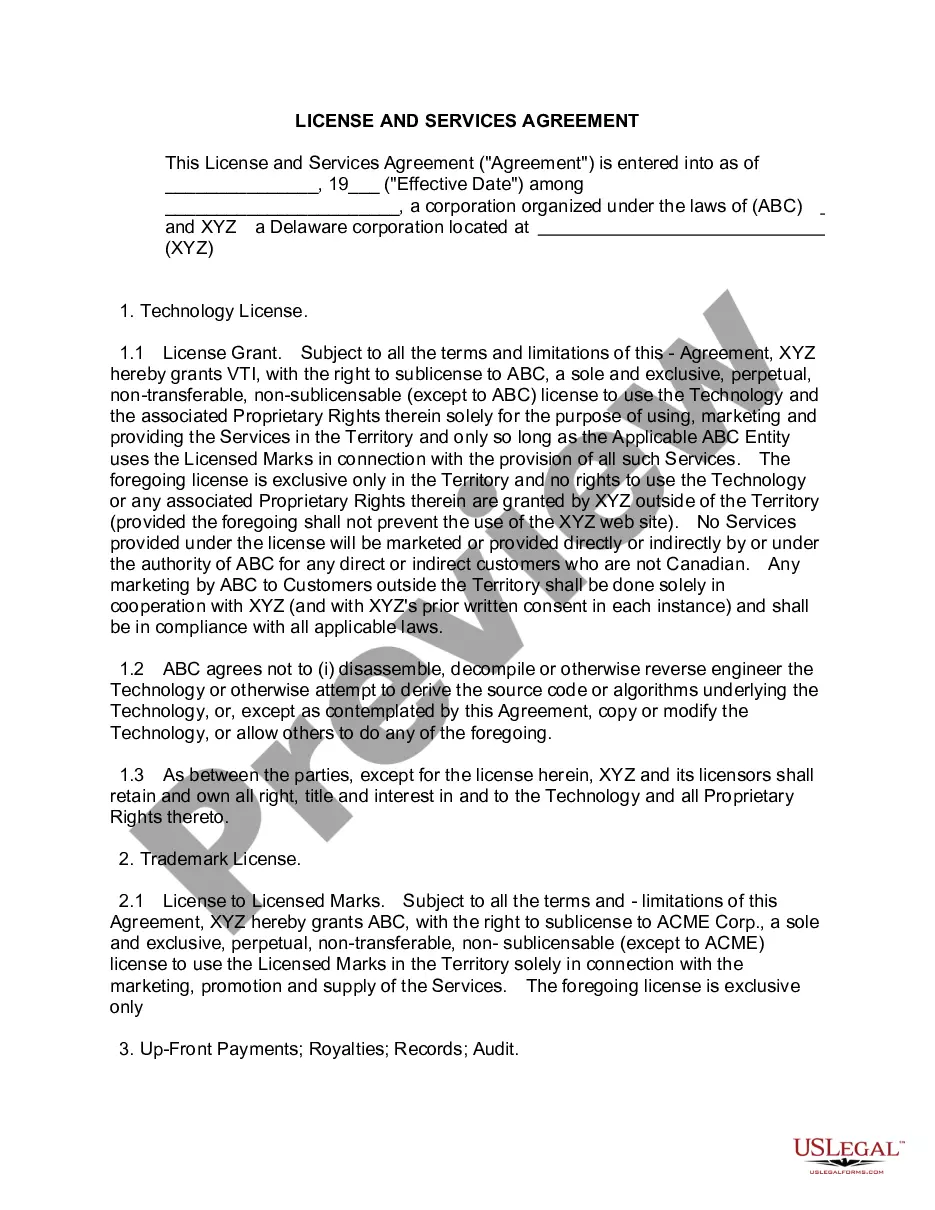

Get your form ready online
Our built-in tools help you complete, sign, share, and store your documents in one place.
Built-in online Word editor
Make edits, fill in missing information, and update formatting in US Legal Forms—just like you would in MS Word.
Export easily
Download a copy, print it, send it by email, or mail it via USPS—whatever works best for your next step.
E-sign your document
Sign and collect signatures with our SignNow integration. Send to multiple recipients, set reminders, and more. Go Premium to unlock E-Sign.
Notarize online 24/7
If this form requires notarization, complete it online through a secure video call—no need to meet a notary in person or wait for an appointment.
Store your document securely
We protect your documents and personal data by following strict security and privacy standards.

Make edits, fill in missing information, and update formatting in US Legal Forms—just like you would in MS Word.

Download a copy, print it, send it by email, or mail it via USPS—whatever works best for your next step.

Sign and collect signatures with our SignNow integration. Send to multiple recipients, set reminders, and more. Go Premium to unlock E-Sign.

If this form requires notarization, complete it online through a secure video call—no need to meet a notary in person or wait for an appointment.

We protect your documents and personal data by following strict security and privacy standards.
Looking for another form?


How to fill out Technology Licensing Agreement?
US Legal Forms - a prominent collection of legal documents across America - provides a broad selection of legal templates that can be downloaded or printed.
Through the website, you can access thousands of forms for business and individual purposes, organized by categories, claims, or keywords. You will discover the latest versions of forms such as the Louisiana Technology Licensing Agreement in just a few minutes.
If you currently hold a monthly subscription, Log In to your US Legal Forms library to download the Louisiana Technology Licensing Agreement. The Download button will appear on every form you view. You can access all previously acquired forms in the My documents section of your account.
Proceed with the transaction. Use a credit card or PayPal account to complete the transaction.
Choose the format and download the form onto your device. Make modifications. Complete, adjust, print, and sign the acquired Louisiana Technology Licensing Agreement. Every template you added to your account has no expiration date and belongs to you indefinitely. Therefore, if you wish to download or print another copy, simply return to the My documents section and click on the form you need. Access the Louisiana Technology Licensing Agreement with US Legal Forms, the most comprehensive library of legal template formats. Utilize thousands of professional and state-specific templates that fulfill your business or personal needs and requirements.
- If you are using US Legal Forms for the first time, here are straightforward instructions to get you started.
- Ensure you have selected the correct form for your region/county.
- Click the Preview button to examine the form's content.
- Review the form description to confirm you have chosen the right document.
- If the form does not meet your needs, utilize the Search field at the top of the page to find one that does.
- If you are satisfied with the form, confirm your choice by clicking the Get now button.
- Next, choose the pricing plan you desire and provide your credentials to register for an account.
Form popularity
FAQ
Practitioners and licensing executives often refer to three basic types of voluntary licenses: non-exclusive, sole, and exclusive. A non-exclusive licence allows the licensor to retain the right to use the licensed property and the right to grant additional licenses to third parties.
The steps for making a license agreement are as follows:Download a template for a licensing agreement.Choose your role as the licensor or licensee.Define the license(s) in the agreement.Decide whether the license is exclusive or not.Settle the matter of fees and payment schedule.Add a renewal date and rules.More items...?
Examples of licenses include a company using the design of a popular character, e.g. Mickey Mouse, on their products. Another example would be a clothing manufacturer like Life is Good licensing its designs and brand in a certain country to a local company.
Technology licenses are agreements in which the owner of technological IP lets another party use, change, or even resell the property in exchange for compensation. The compensation can be either a lump sum royalty, royalties based on the value of production, or the right to use the licensee's technology.
A licensing agreement is a legal contract between two parties, known as the licensor and the licensee. In a typical licensing agreement, the licensor grants the licensee the right to produce and sell goods, apply a brand name or trademark, or use patented technology owned by the licensor.
Examples of Licensing AgreementsThe software company may require you to sign a licensing agreement in order to use its software. Another example is when franchises have licensing agreements with the headquarters of a restaurant. The licensing allows the franchisee to use the company's branding and marketing materials.
In a typical licensing agreement, the licensor grants the licensee the right to produce and sell goods, apply a brand name or trademark, or use patented technology owned by the licensor.
Precisely identifying which intellectual property will be the subject of the license is necessary to ensure both parties are on the same page and not exceeding their rights.Scope of the Grant.Exclusivity.Territory.Term.Compensation.Termination.Conclusion.
The steps for making a license agreement are as follows:Download a template for a licensing agreement.Choose your role as the licensor or licensee.Define the license(s) in the agreement.Decide whether the license is exclusive or not.Settle the matter of fees and payment schedule.Add a renewal date and rules.More items...?
The contract stipulates the type of agreement, the length of the relationship, payments and royalties that are due and when, and the extent to which licensing is allowed. Licensing also allows both parties to retain control over certain facets of the deal, including exclusivity and how a product or service is marketed.