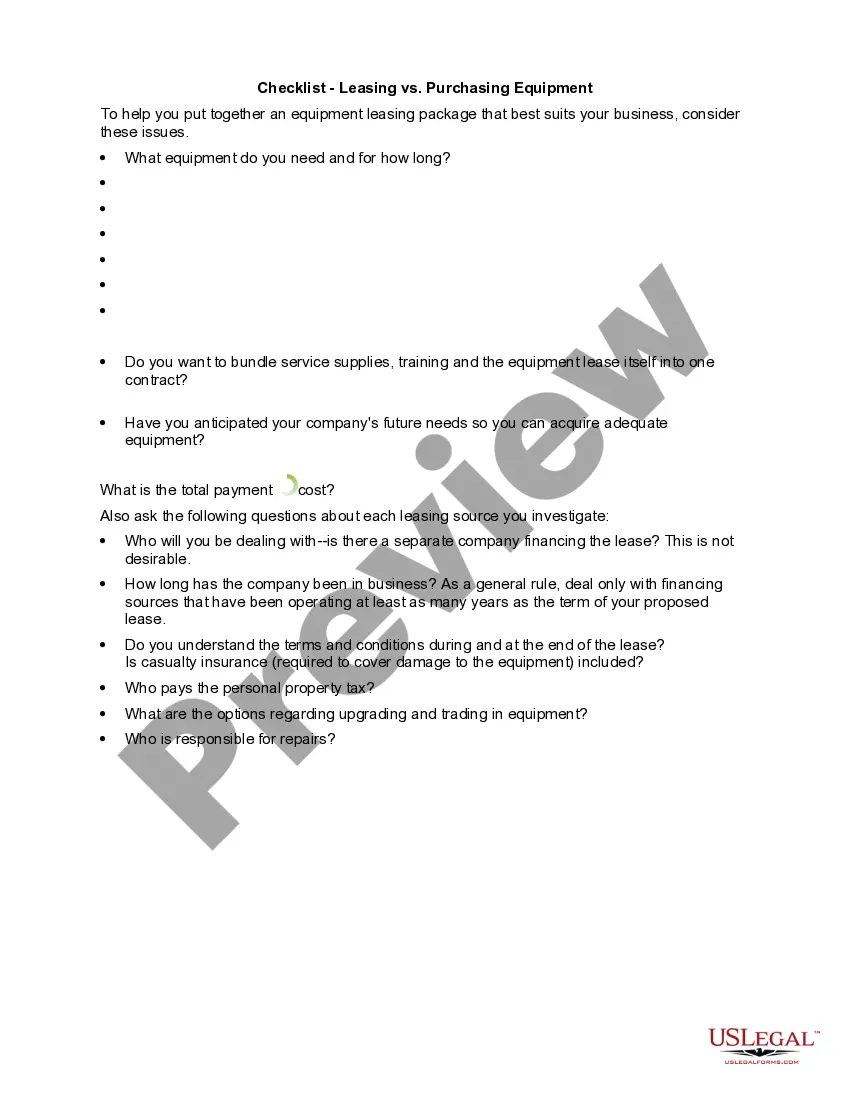
Leasing equipment can help your business stay up-to-date with the latest technology. Other benefits of leasing include making lower monthly payments than you would have with a loan, getting a fixed financing rate instead of a floating rate, benefiting from tax advantages, and conserving working capital by avoiding cash-devouring down payments. Leasing also has its downside, however: You may pay a higher price over the long term. You are also committed to retaining a piece of equipment for a certain time period, which can be problematic if your business is in flux.
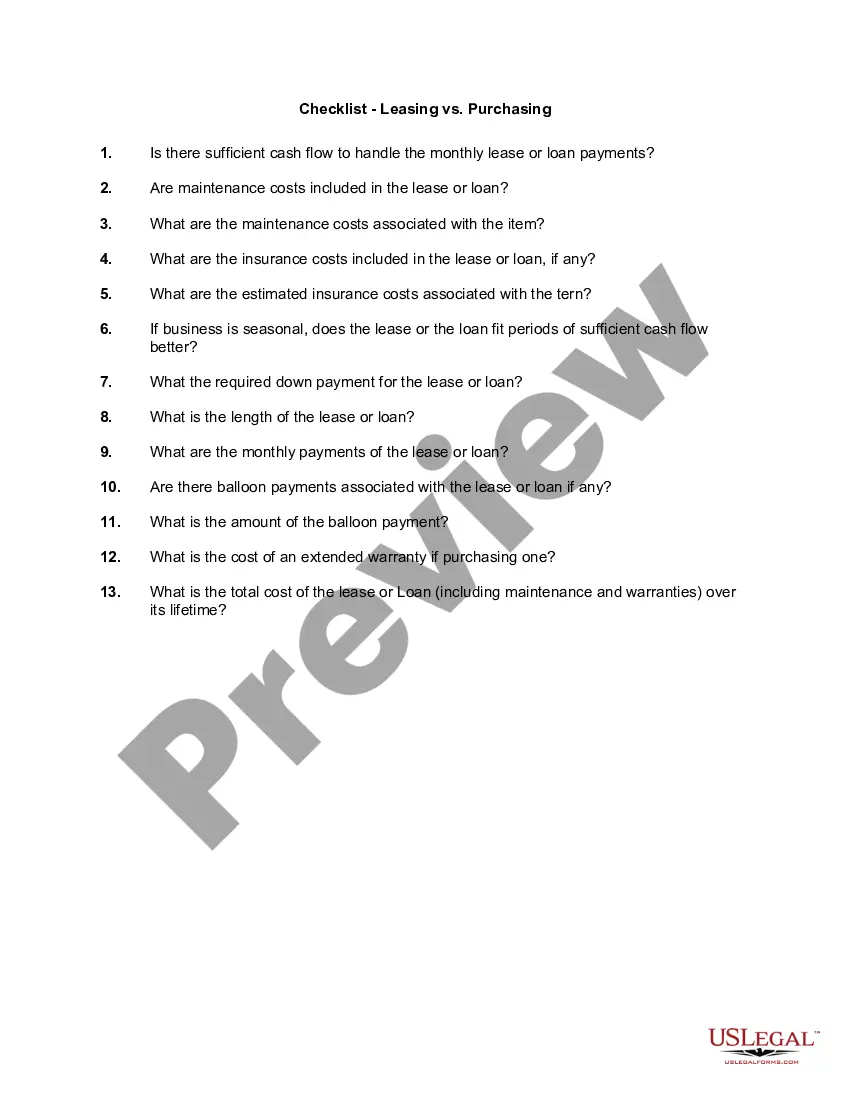
Every lease decision is unique so it's important to study the lease agreement carefully. When deciding to obtain equipment, you need to determine whether it is better to lease or purchase the equipment. You might use this checklist to compare the costs for each option.
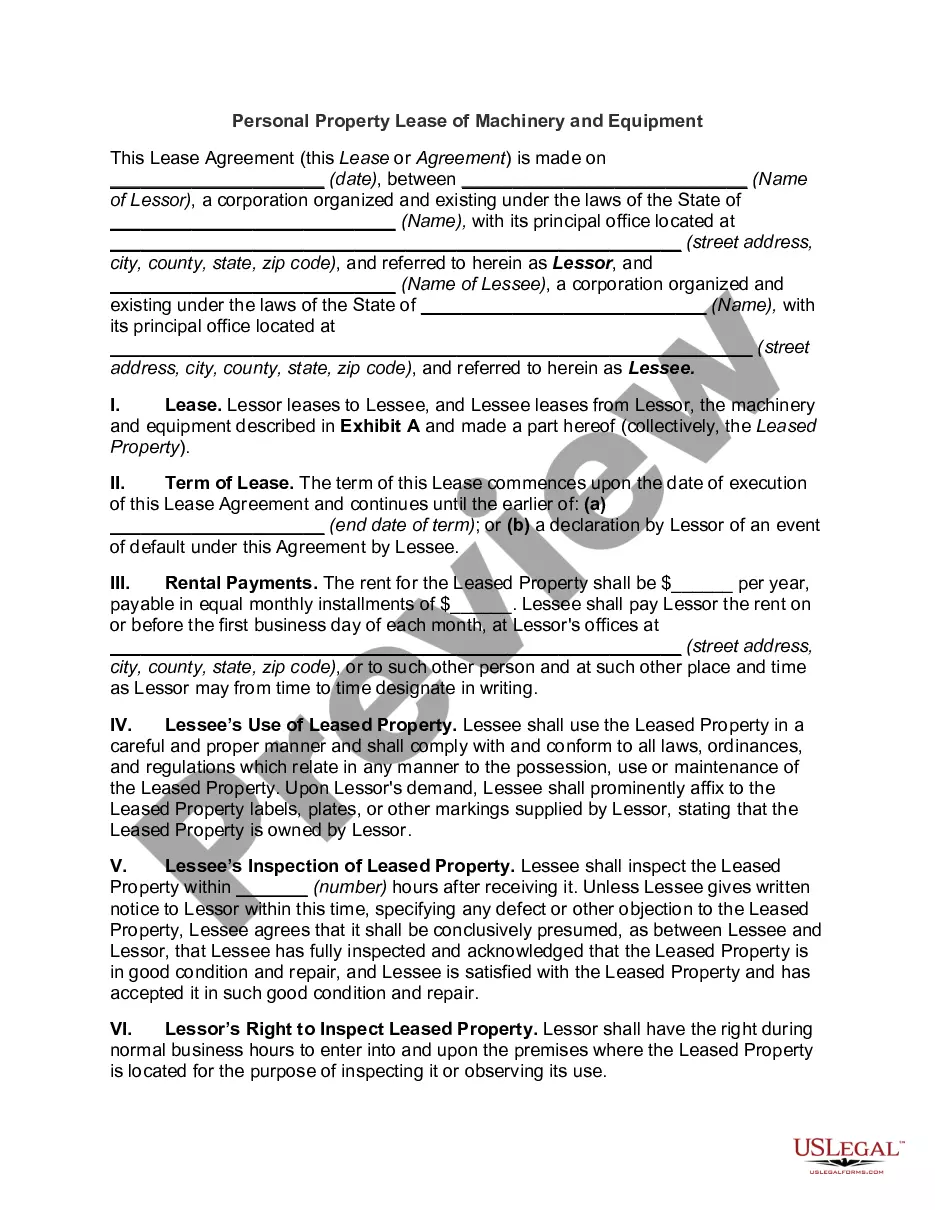
Louisiana Checklist - Leasing vs. Purchasing Equipment
Category:
State:
Multi-State
Control #:
US-03082BG
Format:
Word;
Rich Text
Instant download
Description
Get your form ready online
Our built-in tools help you complete, sign, share, and store your documents in one place.
Built-in online Word editor
Make edits, fill in missing information, and update formatting in US Legal Forms—just like you would in MS Word.
Export easily
Download a copy, print it, send it by email, or mail it via USPS—whatever works best for your next step.
E-sign your document
Sign and collect signatures with our SignNow integration. Send to multiple recipients, set reminders, and more. Go Premium to unlock E-Sign.
Notarize online 24/7
If this form requires notarization, complete it online through a secure video call—no need to meet a notary in person or wait for an appointment.
Store your document securely
We protect your documents and personal data by following strict security and privacy standards.

Make edits, fill in missing information, and update formatting in US Legal Forms—just like you would in MS Word.

Download a copy, print it, send it by email, or mail it via USPS—whatever works best for your next step.

Sign and collect signatures with our SignNow integration. Send to multiple recipients, set reminders, and more. Go Premium to unlock E-Sign.

If this form requires notarization, complete it online through a secure video call—no need to meet a notary in person or wait for an appointment.

We protect your documents and personal data by following strict security and privacy standards.
Looking for another form?




How to fill out Checklist - Leasing Vs. Purchasing Equipment?
Are you facing a circumstance where you require documentation for both organization or specific purposes nearly every day.
There are numerous legal document templates available online, but locating ones you can trust is challenging.
US Legal Forms offers a wide array of form templates, such as the Louisiana Checklist - Leasing vs. Purchasing Equipment, which can be tailored to meet federal and state requirements.
Once you find the right form, click on Acquire now.
Choose the payment plan you prefer, provide the necessary information to complete your purchase, and place an order using your PayPal or Visa or MasterCard. Select a convenient document format and download your copy. Access all the document templates you have purchased in the My documents menu. You can obtain another version of the Louisiana Checklist - Leasing vs. Purchasing Equipment at any time if needed. Just click on the required form to download or print the document template. Use US Legal Forms, the most extensive collection of legal forms, to save time and prevent mistakes. The service offers well-crafted legal document templates that can be used for various purposes. Create an account on US Legal Forms and start simplifying your life.
- If you are currently familiar with the US Legal Forms website and have an account, simply Log In.
- Then, you can download the Louisiana Checklist - Leasing vs. Purchasing Equipment template.
- If you do not have an account and wish to start using US Legal Forms, follow these steps.
- Find the form you need and verify that it is for your specific area/region.
- Use the Preview button to examine the form.
- Check the overview to ensure that you have selected the correct template.
- If the form isn't what you're searching for, use the Search field to locate a form that fits your needs and requirements.
Form popularity
FAQ
When you buy assets, you own them outright, which allows for long-term control and potential resale value. On the other hand, leasing involves paying for the use of the asset over a set period, after which you typically return it to the owner. This distinction is crucial for understanding your financial commitments. Our Louisiana Checklist - Leasing vs. Purchasing Equipment can help clarify these differences and assist you in making informed decisions.
Leasing equipment can be advantageous because it usually requires less initial investment and includes maintenance and repairs. It allows businesses to upgrade to newer models more frequently, keeping them competitive. The Louisiana Checklist - Leasing vs. Purchasing Equipment highlights the benefits of leasing as part of your overall financial strategy.
Buying equipment provides ownership, allowing for potential resale value later, while leasing grants access without ownership responsibilities. Lease agreements often come with lower down payments and maintenance included, but purchasing offers long-term savings. The Louisiana Checklist - Leasing vs. Purchasing Equipment allows you to see these distinctions clearly and decide what suits you best.
For tax purposes, the choice between leasing and buying equipment can vary based on your specific situation. Generally, lease payments can be deducted as a business expense, while purchasing may allow for depreciation deductions. Utilizing the Louisiana Checklist - Leasing vs. Purchasing Equipment clarifies these tax advantages so you can make a well-informed decision.
To record an equipment lease in accounting, first determine if the lease is a capital or operating lease. For capital leases, create journal entries for both the asset and liability; for operating leases, record lease payments as expenses periodically. For specific instructions, consult the Louisiana Checklist - Leasing vs. Purchasing Equipment.
Whether an equipment lease is classified as an asset or expense depends on the lease type. For capital leases, the equipment is recorded as an asset on the balance sheet, while operating leases are recorded as rental expenses. Use the Louisiana Checklist - Leasing vs. Purchasing Equipment to determine how your lease will be classified.
The journal entry for a lease generally includes debiting the lease asset account and crediting the lease liability account for capital leases. For operating leases, you might simply record the lease payment as an expense in the journal. For a clear understanding, refer to the Louisiana Checklist - Leasing vs. Purchasing Equipment, which provides step-by-step guidance.
Typically, leasing companies prefer a credit score of at least 650 for equipment leases. However, requirements can vary depending on the leasing company and lease type. Always check specific requirements and consult the Louisiana Checklist - Leasing vs. Purchasing Equipment for comprehensive information that suits your situation.
To record a lease on equipment, first identify whether it is a capital or operating lease. For capital leases, you record an asset and a corresponding liability. For operating leases, simply record the lease payments as expenses on your income statement each period. Refer to the Louisiana Checklist - Leasing vs. Purchasing Equipment for detailed examples.
In accounting, a lease is recorded as either an operating lease or a capital lease based on its characteristics. An operating lease shows up as an expense on the income statement, while a capital lease is recorded as an asset on the balance sheet with an associated liability. Make sure to check the guidelines outlined in the Louisiana Checklist - Leasing vs. Purchasing Equipment for accurate classification.