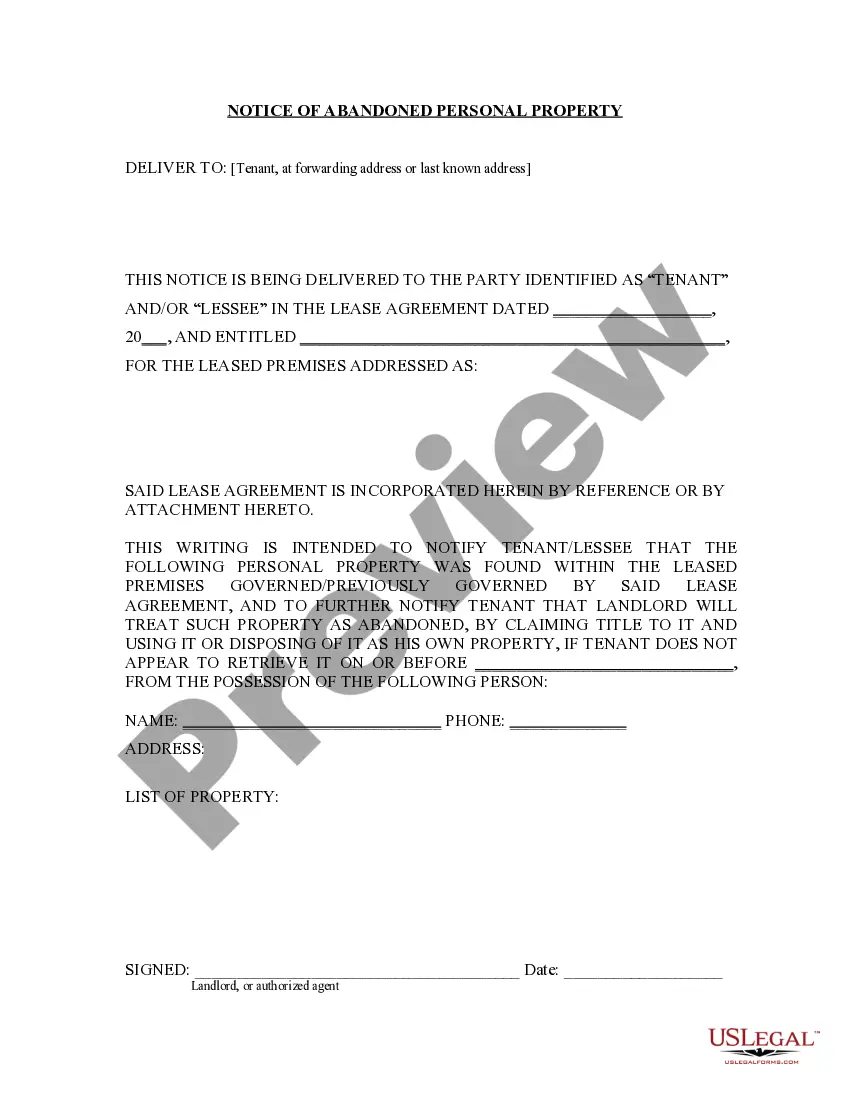
The Letter from Landlord to Tenant as Notice of Abandoned Personal Property is an official communication issued by a landlord to a tenant regarding personal items that have been left behind. This document specifies that the landlord intends to treat these items as abandoned unless the tenant retrieves them by a certain date. This form is essential for landlords to comply with legal requirements when addressing the issue of abandoned property and ensures clear communication about their rights regarding the items left on the premises.
This form should be used in scenarios where a tenant has left personal property in a rental unit after moving out or abandoning the property. It is applicable when the landlord needs to notify the tenant that these items will be treated as abandoned, allowing the landlord to dispose of or claim ownership of them if the tenant does not respond. This situation often arises in residential leases or rental agreements.
This form is designed for:
In most cases, this form does not require notarization. However, some jurisdictions or signing circumstances might. US Legal Forms offers online notarization powered by Notarize, accessible 24/7 for a quick, remote process.
Our built-in tools help you complete, sign, share, and store your documents in one place.
Make edits, fill in missing information, and update formatting in US Legal Forms—just like you would in MS Word.
Download a copy, print it, send it by email, or mail it via USPS—whatever works best for your next step.
Sign and collect signatures with our SignNow integration. Send to multiple recipients, set reminders, and more. Go Premium to unlock E-Sign.
If this form requires notarization, complete it online through a secure video call—no need to meet a notary in person or wait for an appointment.
We protect your documents and personal data by following strict security and privacy standards.

Make edits, fill in missing information, and update formatting in US Legal Forms—just like you would in MS Word.

Download a copy, print it, send it by email, or mail it via USPS—whatever works best for your next step.

Sign and collect signatures with our SignNow integration. Send to multiple recipients, set reminders, and more. Go Premium to unlock E-Sign.

If this form requires notarization, complete it online through a secure video call—no need to meet a notary in person or wait for an appointment.

We protect your documents and personal data by following strict security and privacy standards.
Starting to Write State the most recent information you have on file and detail the attempts you have made to contact them. Warn that if there is no response within a specific time frame action will be taken. Post the letter to the last known address of the individual.
The landlord cannot rummage through your dresser drawers, or inspect the contents of boxes or the clothing in the closet. He can make you move items out of the closet or the under-sink cabinets to facilitate an inspection.
Job abandonment is when an employee fails to report to work for consecutive days without notice, and cannot be reached. Most company policies state that a job has been abandoned after 3 consecutive days, but it can vary. Job abandonment is a voluntary termination.
Starting to Write State the most recent information you have on file and detail the attempts you have made to contact them. Warn that if there is no response within a specific time frame action will be taken. Post the letter to the last known address of the individual.
Abandonment of a Property - when a Tenant leaves their Property without giving notice to Evolve Housing and the Property is found to be vacant.
Sue the landlord and whoever for up to $10,000 in small claims court for trespassing, breach of contract, invasion of privacy, and breach of quiet enjoyment; if you are two or more tenants, each can separately sue them for up to $10,000, and a joint action is not required.
A landlord cannot evict a tenant without an adequately obtained eviction notice and sufficient time. A landlord cannot retaliate against a tenant for a complaint. A landlord cannot forego completing necessary repairs or force a tenant to do their own repairs.A landlord cannot remove a tenant's personal belongings.
Abandonment can only be assumed from the tenant leaving the property, taking their possessions and handing in the keys. However as surrender of the property is implied from the same actions, an Abandonment Notice may be unnecessary.
While a landlord has a right of entry, this is balanced against your right to privacy as a tenant. Landlords are not entitled to go through your unit and belongings at will. They generally must have a valid reason to enter the unit and give you proper notice, unless you gave them permission in advance.