Louisiana Answer to Intrafamily Adoption
Overview of this form
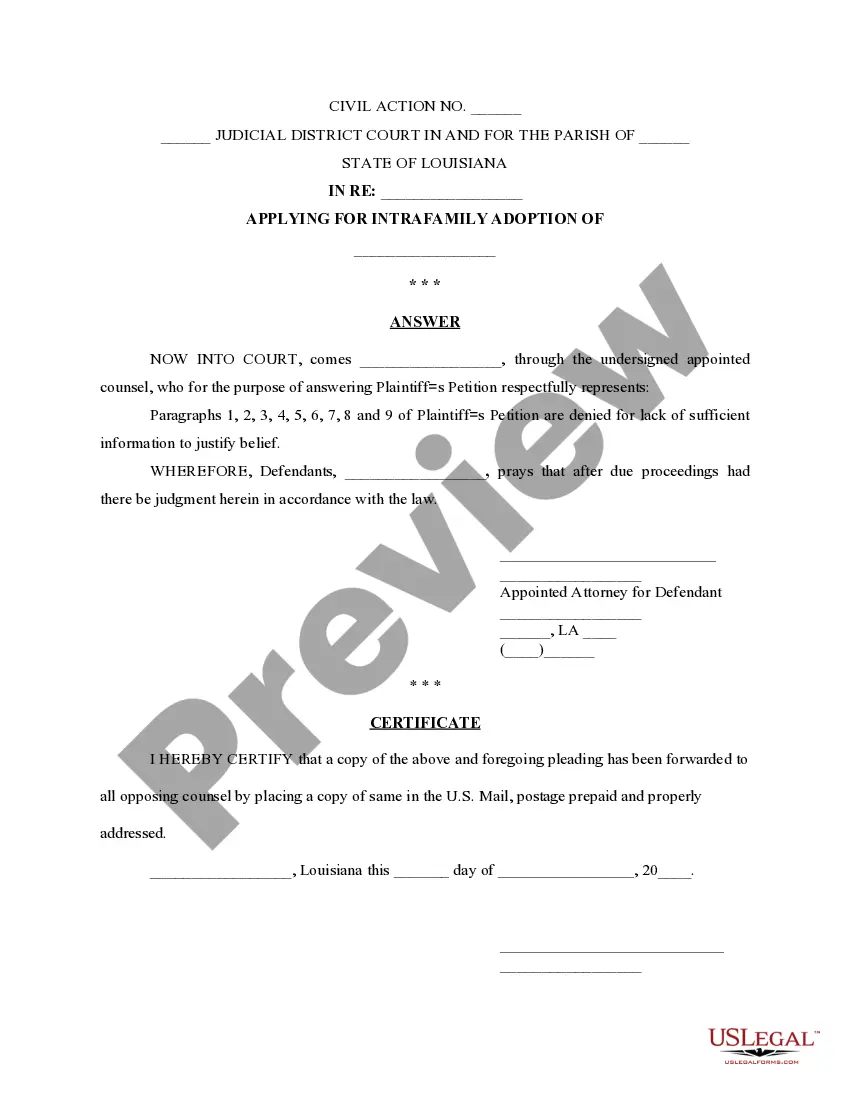
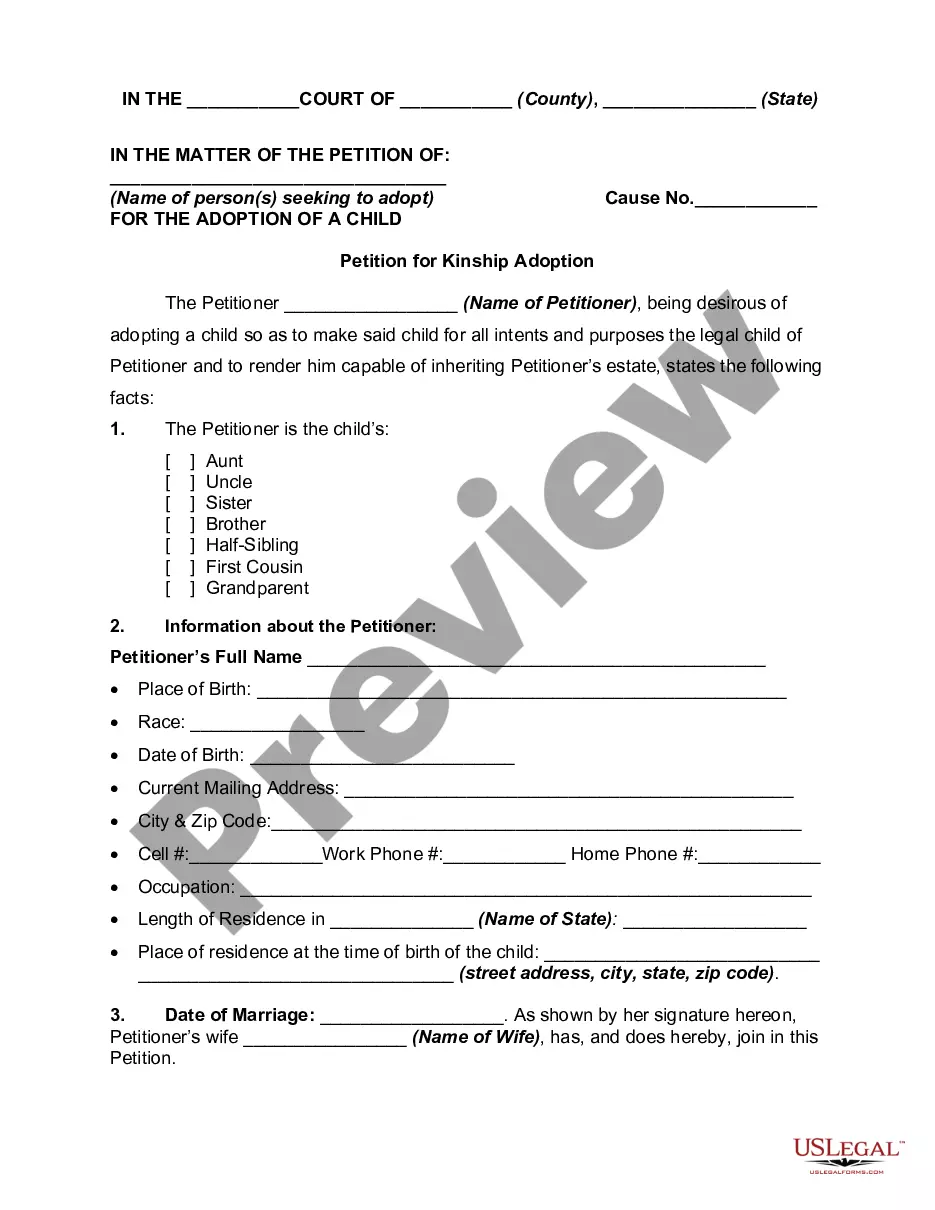
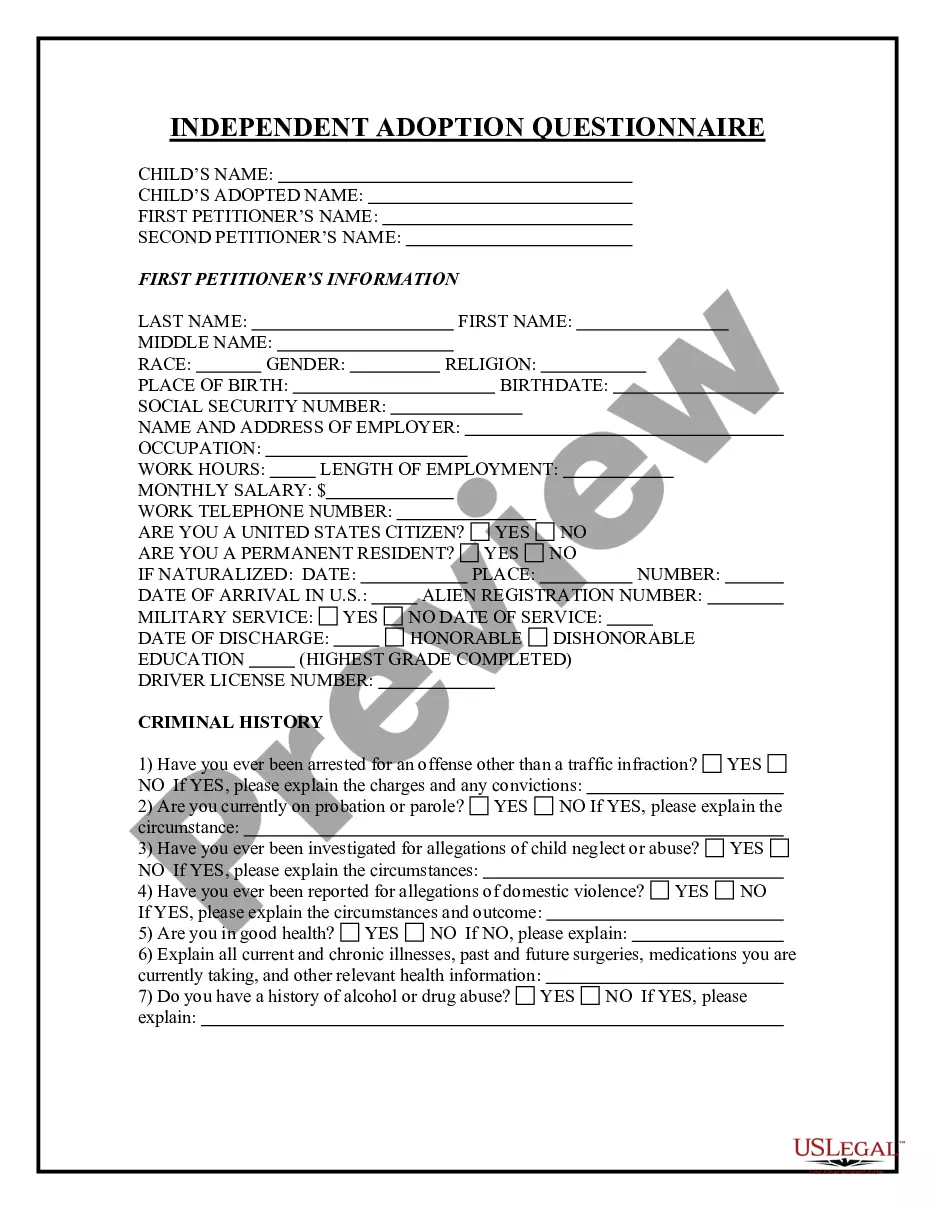
The Answer to Intrafamily Adoption is a legal document used by a defendant in response to a plaintiff's petition for the adoption of a family member. This form not only addresses each allegation made in the petition but also requests the court to make a judgment according to the law. It plays a crucial role in ensuring the legal process is followed, distinguishing itself from other adoption-related forms by specifically acting as a reply to the initial petition.
Main sections of this form
- Header section including the judicial district and parish information.
- The introduction of the defendant and their appointed counsel.
- Responses to each paragraph of the plaintiff's petition, indicating any denials.
- A prayer for judgment aligning with legal standards.
- Certification section for proof of service to opposing counsel.
When to use this form
This form should be used when a defendant wants to formally respond to a petition for intrafamily adoption filed by another party. It is typically used in situations where the defendant may dispute the adoption, seek clarification, or where the legal requirements demand a formal reply to ensure fair proceedings.
Who needs this form
- Individuals served with a petition for intrafamily adoption.
- Defendants who wish to contest or respond to adoption claims.
- Legal representatives instructed to defend against a petition for adoption.
Steps to complete this form
- Identify the correct judicial district and parish information.
- Provide the full name of the defendant and their appointed counsel.
- Respond to each paragraph of the plaintiff's petition clearly, denying allegations as appropriate.
- Prepare a prayer for judgment that aligns with legal stipulations.
- Certify service of the document to the opposing counsel and include the date and location of service.
Does this document require notarization?
This form does not typically require notarization unless specified by local law, ensuring ease of use for defendants responding to adoption petitions.
Get your form ready online
Our built-in tools help you complete, sign, share, and store your documents in one place.
Make edits, fill in missing information, and update formatting in US Legal Forms—just like you would in MS Word.
Download a copy, print it, send it by email, or mail it via USPS—whatever works best for your next step.
Sign and collect signatures with our SignNow integration. Send to multiple recipients, set reminders, and more. Go Premium to unlock E-Sign.
If this form requires notarization, complete it online through a secure video call—no need to meet a notary in person or wait for an appointment.
We protect your documents and personal data by following strict security and privacy standards.

Make edits, fill in missing information, and update formatting in US Legal Forms—just like you would in MS Word.

Download a copy, print it, send it by email, or mail it via USPS—whatever works best for your next step.

Sign and collect signatures with our SignNow integration. Send to multiple recipients, set reminders, and more. Go Premium to unlock E-Sign.

If this form requires notarization, complete it online through a secure video call—no need to meet a notary in person or wait for an appointment.

We protect your documents and personal data by following strict security and privacy standards.
Mistakes to watch out for
- Failing to respond to all allegations in the petition.
- Omitting necessary signatures or dates.
- Submitting the form without proper service to opposing counsel.
- Incorrectly completing jurisdictional details.
Benefits of using this form online
- Convenient access to legally vetted templates.
- Editable forms that can be customized for individual circumstances.
- Reliable resources that ensure compliance with jurisdiction-specific laws.
Legal use & context
- This form is legally recognized in Louisiana for responding to adoption petitions.
- Proper completion and submission are essential for maintaining legal standing in adoption proceedings.
- Users must ensure compliance with local adoption laws and procedures to avoid delays.
Quick recap
- The Answer to Intrafamily Adoption form is vital for defendants in adoption cases seeking to respond to allegations.
- Each part of the form must be accurately filled out to ensure proper legal proceedings.
- It is important to understand state-specific requirements, particularly in Louisiana.
Looking for another form?



Form popularity
FAQ
As of now, the states that allow reinstatement of parental rights include: Alaska, Colorado, California, Delaware, Hawaii, Illinois, Louisiana, Maine, North Carolina, Nevada, New York, Oklahoma, and Washington; and while state statutes vary and each has its own terms and conditions when considering restoration of
Parties who can reverse an adoption usually include the birth parents, adoptive parents and the child being adopted. In order for an adoption to be reversed, a petition must usually be filed by one of these parties and the court must be convinced of a compelling reason to reverse or annul the adoption.
Yes, in limited situations, adoptions can be reversed in Louisiana. The laws regarding the nullification of adoptions are stringent and are rarely granted. There are various reasons a person may want to undo an adoption, but once a final order approving the adoption has been entered, it isn't very easy to reverse.
Intrafamily adoption is the adoption of a child by a step parent or relative. Intrafamily adoption includes: Step parent adoption - where the partner (married or de facto) of the custodial parent (parent caring for the child) applies with their partner to adopt the child in their care.
A relative adoption, sometimes also referred to as a kinship adoption, is when an adult adopts an eligible family member.This family member becomes the child's legal parent, but the child's birth mother will still be able to remain an active part of the child's life.
Adopting Through an Agency. Adopting Independently. Adopting Through Identification. Adopting Internationally. Adopt as Stepparents. Adopting as a Same-Sex Couple. Relative Adoptions. Adult Adoptions.
Adoption negligence, also referred to as wrongful adoption, refers to a lawsuit brought by adoptive parents who were either negligently or intentionally misinformed about the health or background of their adoptive child, and as a consequence suffered harms or losses associated with raising a disabled child.
Answer. If your parental rights have been terminated by a court of law and/or your children have been legally adopted, in most states there is no provision for reinstating parental rights or reversing an adoption decree except under certain circumstances such as fraud, duress, coercion, etc.
Therefore, the only way a birth parent could reclaim custody of an adopted child is by proving to a court that the decision to sign the relinquishment document was done under fraud or duress. In most cases a court will automatically deny custody to a birth parent when their parental rights have been terminated.