Louisiana Motion and Order to Amend Minutes
Overview of this form
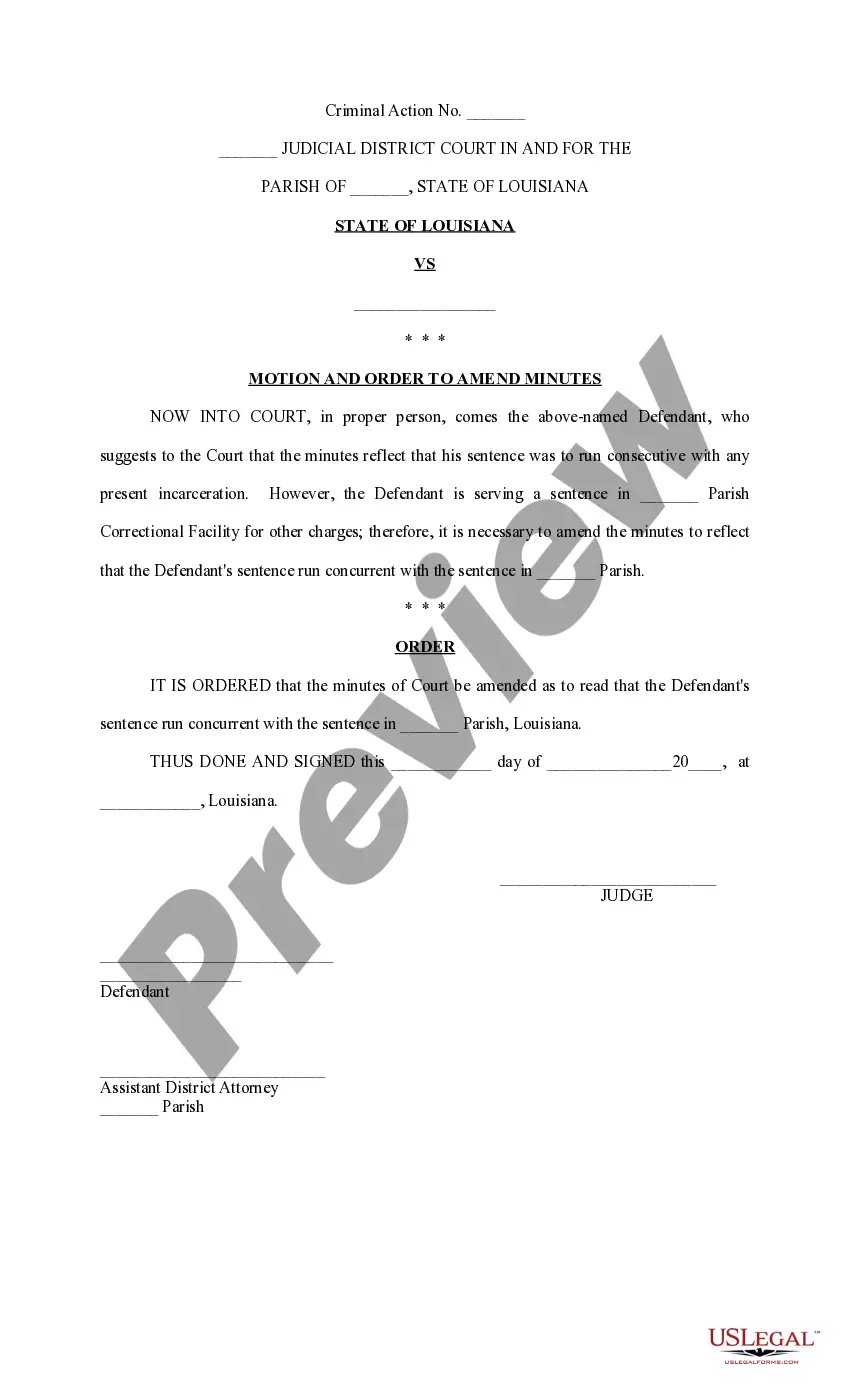
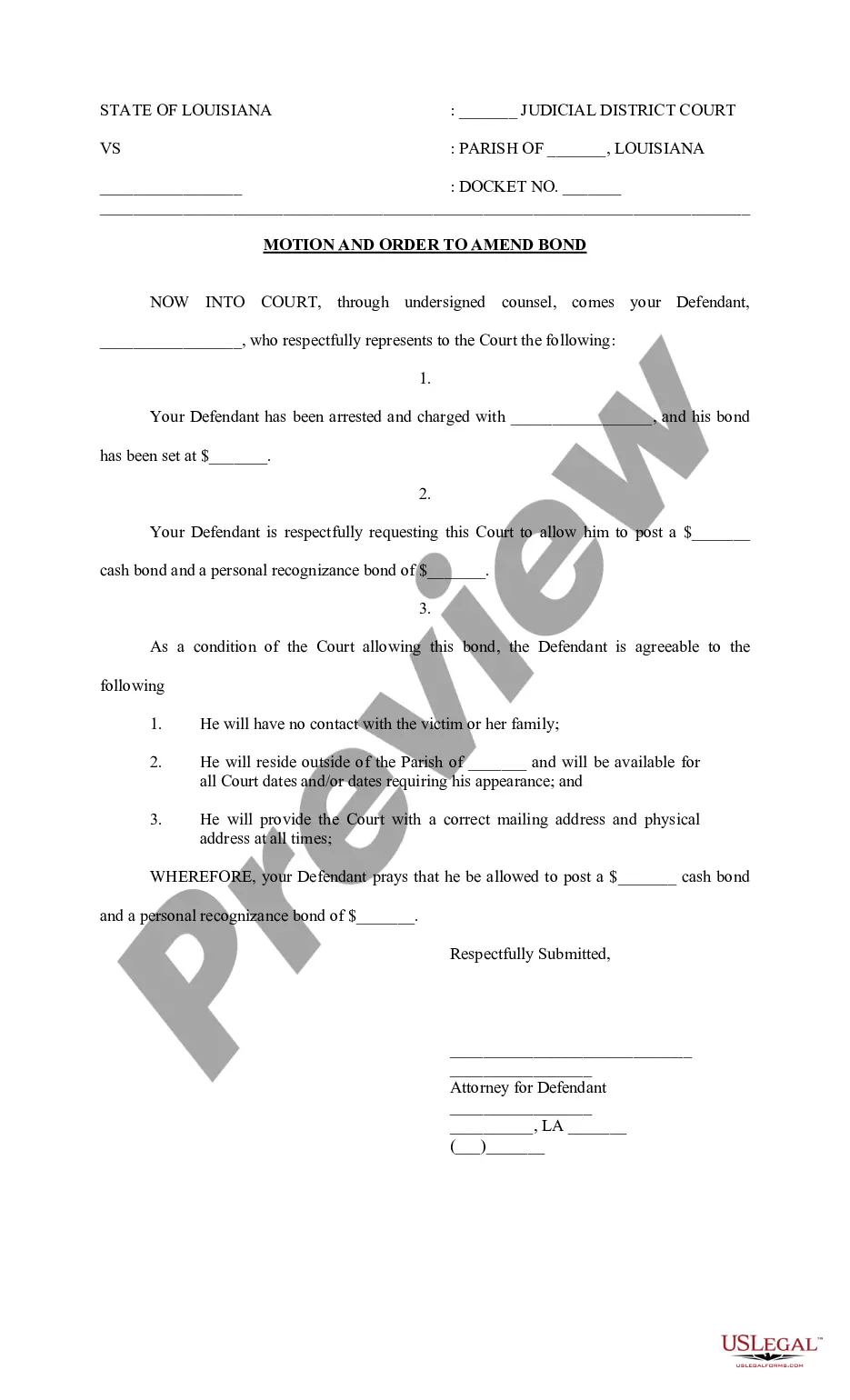
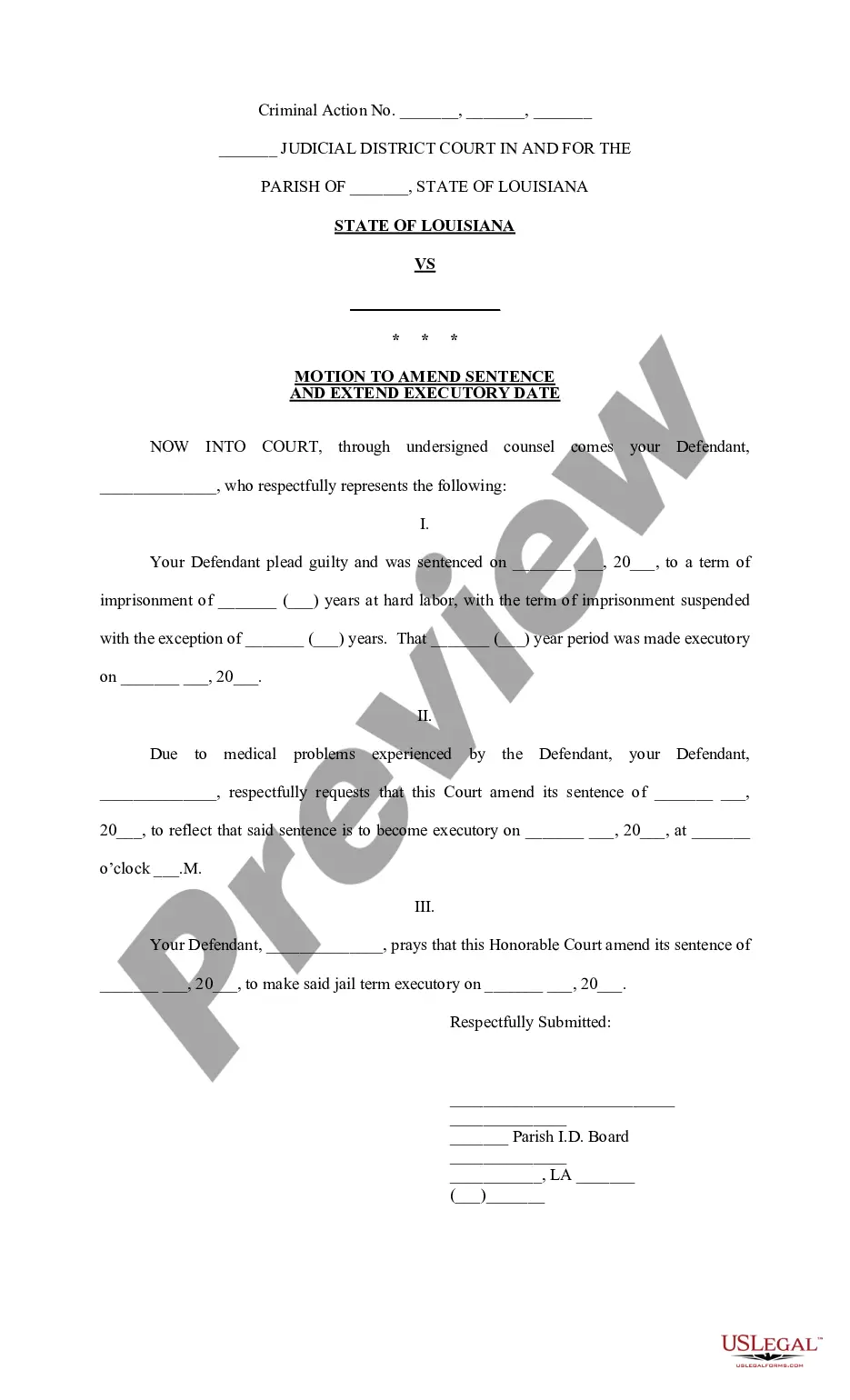
The Motion and Order to Amend Minutes is a legal document filed by defense counsel in criminal cases. Its purpose is to request changes to court minutes regarding a defendant's sentencing, specifically whether the sentence should run concurrent or consecutive to any existing sentences. This form differs from other motions in that it seeks to clarify the specifics of how a sentence is applied when a defendant is serving time for separate charges in different jurisdictions.
Main sections of this form
- Caption: Identifies the court and case title.
- Defendant's information: Details the defendant's name and current incarceration status.
- Motion section: Requests the amendment of court minutes to reflect concurrent sentencing.
- Order section: Formalizes the court's decision to amend the sentencing details.
- Signature lines: Spaces for signatures from the judge, defendant, and district attorney.
When to use this document
This form is used when a defendant believes that the court minutes inaccurately reflect the terms of their sentencing in relation to another active sentence. It is necessary in situations where clarity is required to ensure that sentencing runs concurrently, thus impacting eligibility for parole and overall sentence determination. It is often filed when the defendant is already incarcerated due to other charges and seeks to have both sentences served simultaneously.
Who needs this form
- Defendants facing overlapping sentences in multiple jurisdictions.
- Defense attorneys representing clients who need to correct court minutes.
- Individuals looking to clarify the conditions of their incarceration.
How to prepare this document
- Enter the name of the judicial district court and the parish where the case is filed.
- Provide the names of the parties involved in the case.
- Specify the details of the current sentence and the location of incarceration.
- Complete the motion section by describing the request for concurrent sentencing.
- Fill out the order section to formalize the judge's decision with the necessary signatures.
Is notarization required?
In most cases, this form does not require notarization. However, some jurisdictions or signing circumstances might. US Legal Forms offers online notarization powered by Notarize, accessible 24/7 for a quick, remote process.
Get your form ready online
Our built-in tools help you complete, sign, share, and store your documents in one place.
Make edits, fill in missing information, and update formatting in US Legal Forms—just like you would in MS Word.
Download a copy, print it, send it by email, or mail it via USPS—whatever works best for your next step.
Sign and collect signatures with our SignNow integration. Send to multiple recipients, set reminders, and more. Go Premium to unlock E-Sign.
If this form requires notarization, complete it online through a secure video call—no need to meet a notary in person or wait for an appointment.
We protect your documents and personal data by following strict security and privacy standards.

Make edits, fill in missing information, and update formatting in US Legal Forms—just like you would in MS Word.

Download a copy, print it, send it by email, or mail it via USPS—whatever works best for your next step.

Sign and collect signatures with our SignNow integration. Send to multiple recipients, set reminders, and more. Go Premium to unlock E-Sign.

If this form requires notarization, complete it online through a secure video call—no need to meet a notary in person or wait for an appointment.

We protect your documents and personal data by following strict security and privacy standards.
Mistakes to watch out for
- Failing to include the correct court and case information.
- Not clearly stating the reason for the amendment request.
- Omitting signatures from required parties.
- Using incorrect terminology that does not adhere to local rules.
Advantages of online completion
- Immediate access to a professionally drafted legal form.
- Easily customizable fields to fit specific circumstances.
- Convenient download for printing or filing directly in court.
Looking for another form?


Form popularity
FAQ
By striking out words, sentences, or paragraphs. By striking out and inserting words (with the words inserted replacing the words struck out) By amending by substitution (a form of strike out and insert applied to paragraphs or entire motions)
Two amendments may be on the floor at one time: the first amendment modifies the main motion, and the second amendment must relate to the first amendment. When an amendment is on the floor, only the amendment may be debated.
Only one amendment to an amendment is permissible. Sometimes a main motion is worded poorly, and several amendments may be presented to improve the wording.
Inserting or adding words or paragraphs. Striking out words or paragraphs. Striking out words and inserting or adding others, or substituting an entire paragraph or complete resolution for another.
Amend something previously adopted - is a change motion that can be made only if no action has been taken on the original motion. It is used to strike out only a part of the text or make a change to the wording. It must be seconded, is debatable and requires 2/3 of the members to vote in the affirmative to pass.
To Amend a Motion. Raise your hand and make the following motion: I move to amend the motion on the floor. This also requires a second. After the motion to amend is seconded, a majority vote is needed to decide whether the amendment is accepted. Then a vote is taken on the amended motion.
To Amend a Motion. Raise your hand and make the following motion: I move to amend the motion on the floor. This also requires a second. After the motion to amend is seconded, a majority vote is needed to decide whether the amendment is accepted. Then a vote is taken on the amended motion.
By striking out words, sentences, or paragraphs. By striking out and inserting words (with the words inserted replacing the words struck out) By amending by substitution (a form of strike out and insert applied to paragraphs or entire motions)