Louisiana Memorandum regarding Motion to Suppress
About this form
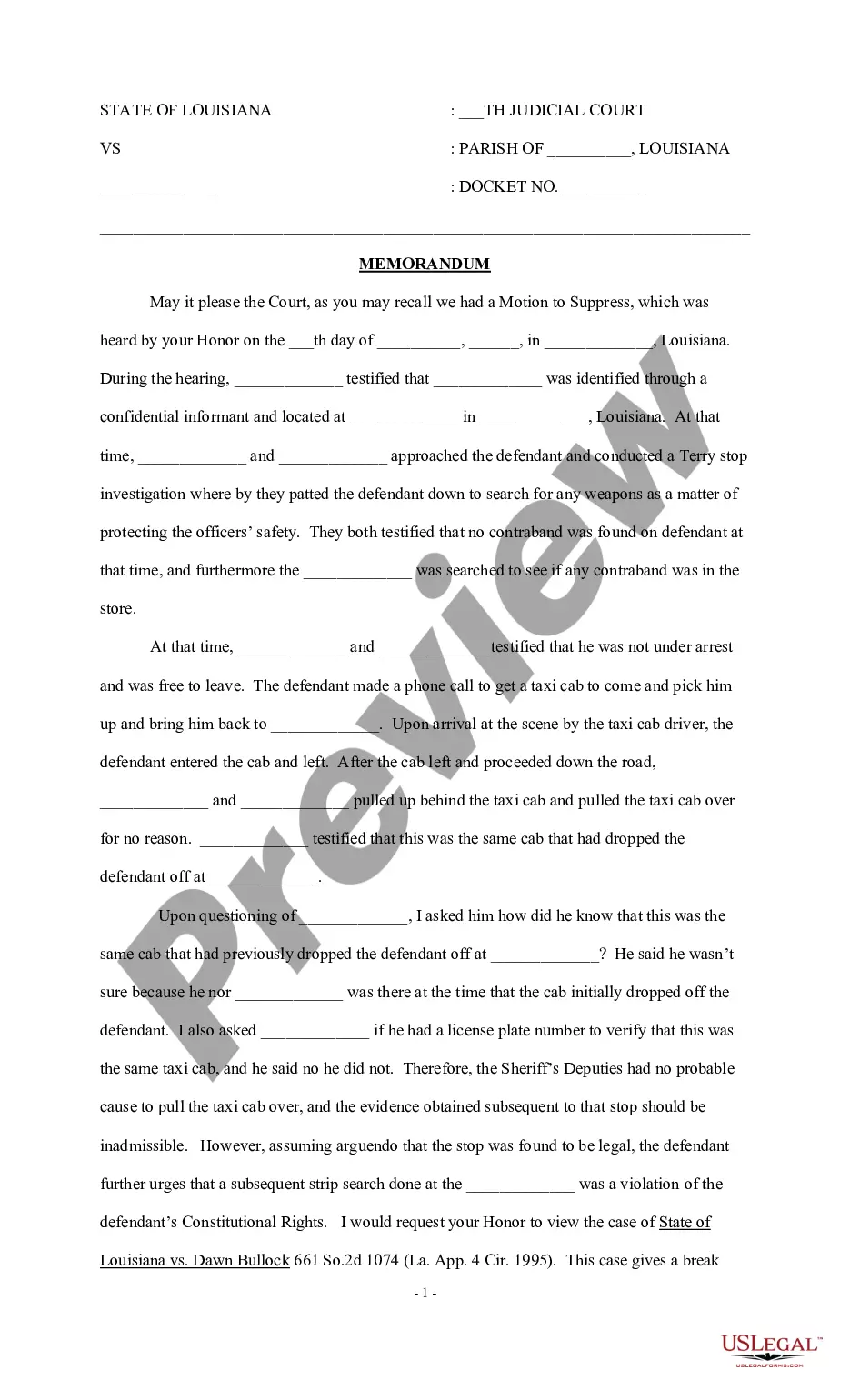
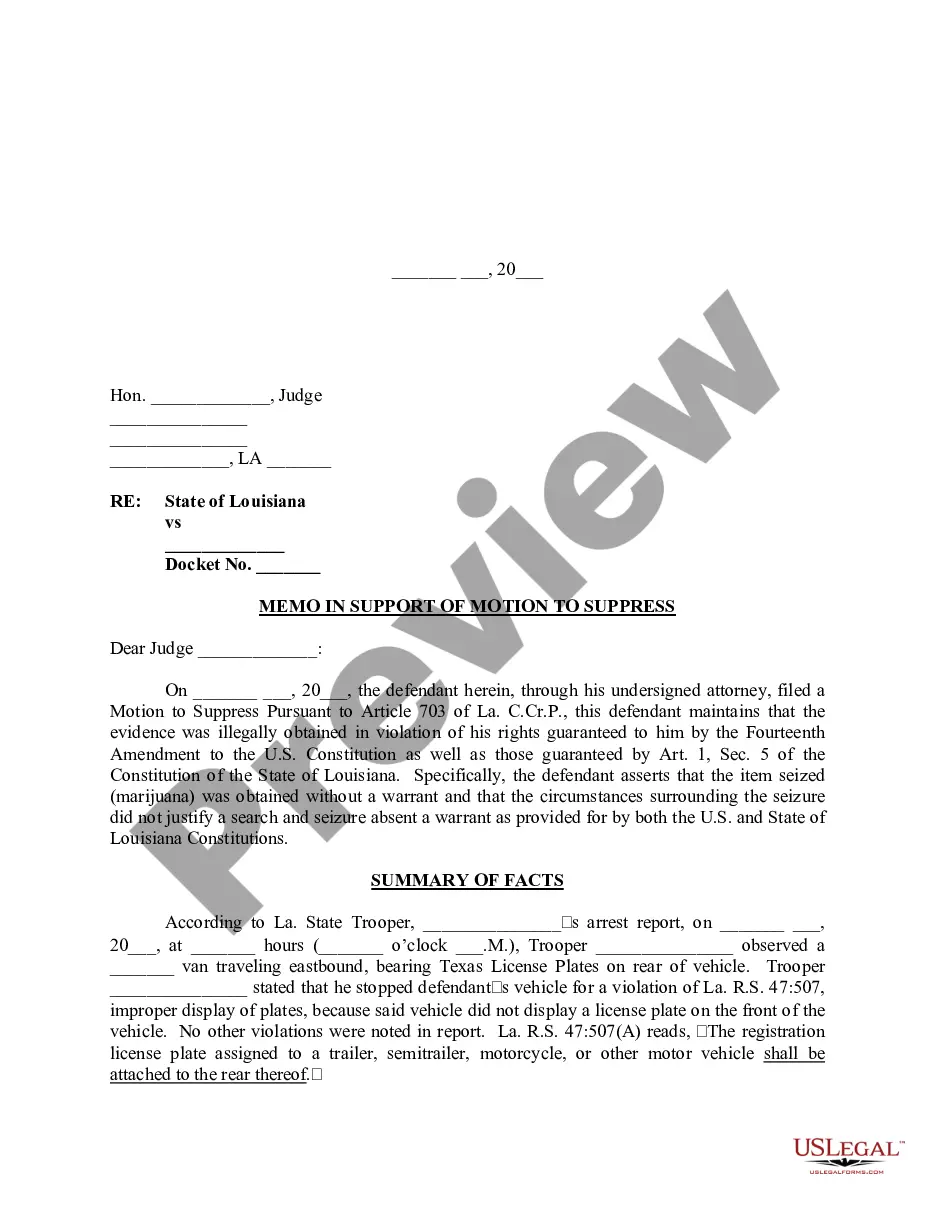
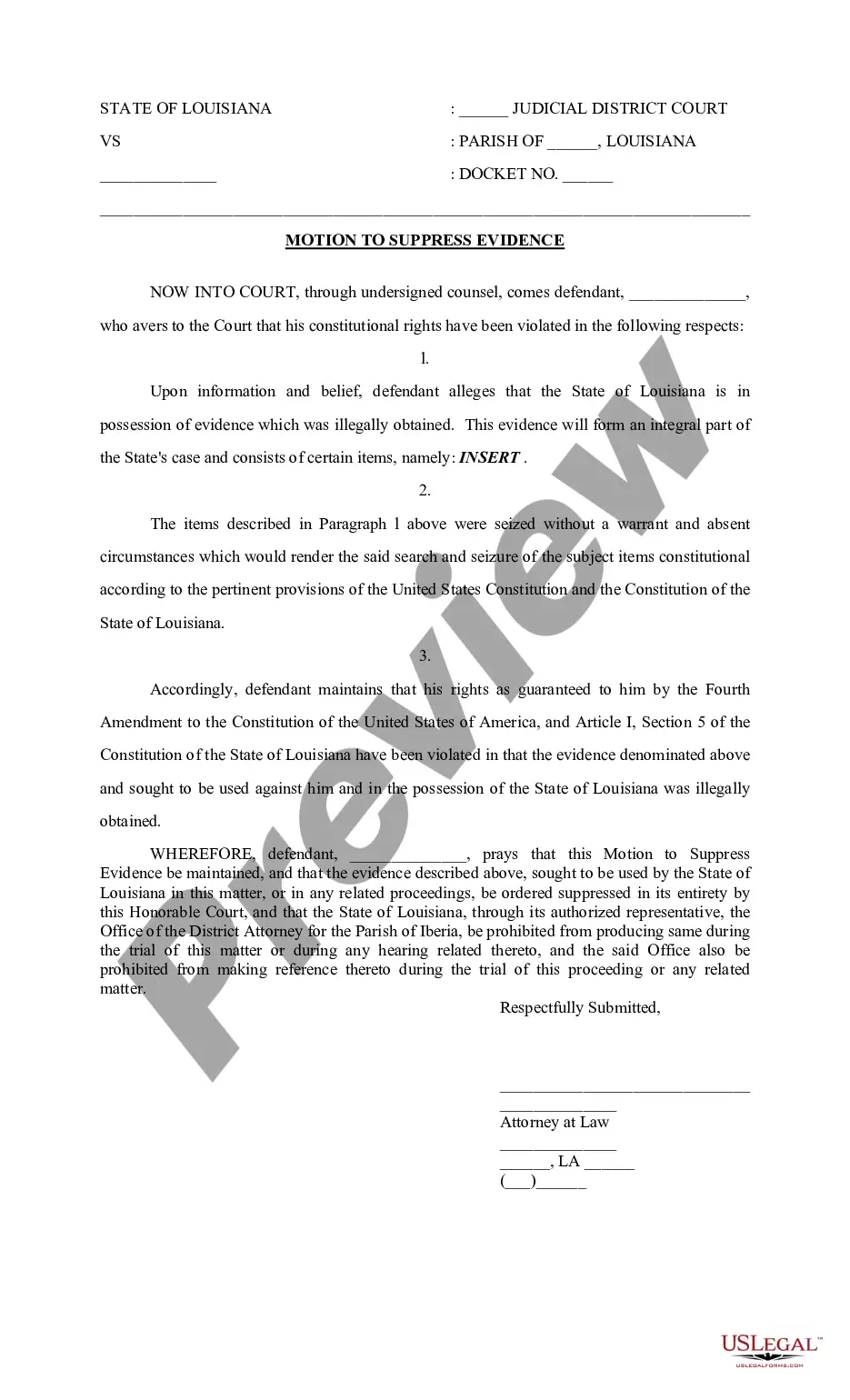
The Memorandum regarding Motion to Suppress is a legal document used in court to support a motion aimed at excluding certain evidence from trial. This form is specifically used when there are claims that the evidence was obtained in violation of an individual's rights, particularly under the Fourth Amendment. It helps articulate legal arguments concerning unlawful searches and seizures, distinguishing it from other motions that may not address suppression of evidence.
Main sections of this form
- Title and docket number: Clearly identifies the document and related case.
- Introduction: States the purpose of the memorandum and the context of the motion.
- Factual background: Summarizes the events leading to the evidence collection.
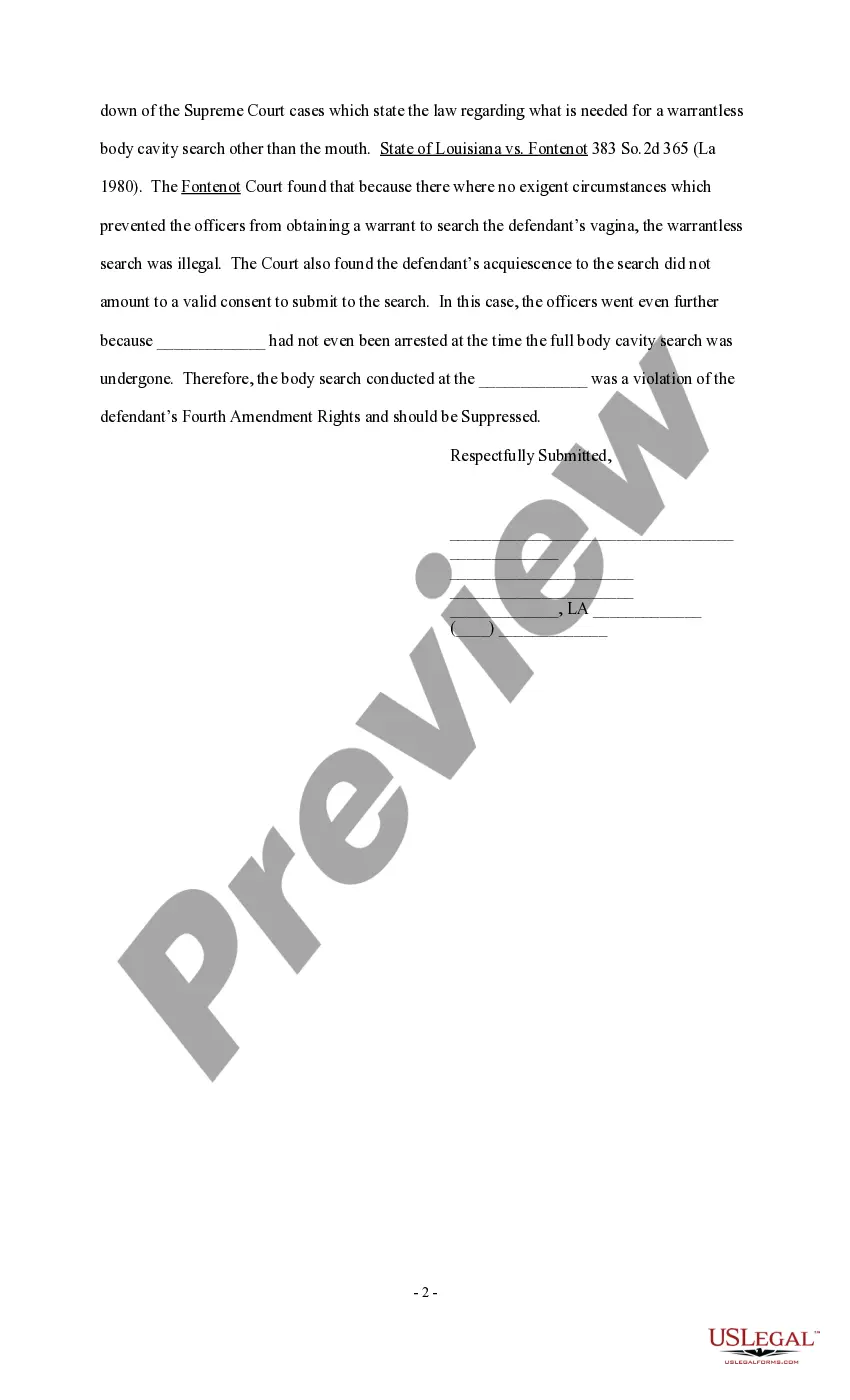
- Legal arguments: Outlines constitutional violations and references relevant case law.
- Conclusion: Requests the court to suppress the evidence based on the outlined arguments.
- Signature block: Space for attorney signatures and contact information.

When to use this document
This form should be used in criminal cases where the defendant wants to challenge the legality of a search or seizure conducted by law enforcement. It is particularly pertinent when the defendant believes that evidence obtained, such as from a full body cavity search, violates their constitutional rights and should not be admitted in court.
Intended users of this form
- Defendants in criminal cases facing charges where evidence from searches is contested.
- Attorneys representing clients in cases involving potential Fourth Amendment violations.
- Individuals seeking to understand how to formally object to unlawfully obtained evidence.
Instructions for completing this form
- Identify the parties involved, including the defendant and the court.
- Specify the relevant case details, including the docket number and hearing dates.
- Describe the factual background, detailing the circumstances of the search or seizure.
- Outline the legal arguments, referencing specific laws and previous court rulings.
- Conclude with a clear request for the court to suppress the evidence.
- Sign and date the document, including attorney contact details.
Does this document require notarization?
This form does not typically require notarization unless specified by local law. Be sure to check with your jurisdiction's requirements to ensure compliance before filing.
Get your form ready online
Our built-in tools help you complete, sign, share, and store your documents in one place.
Make edits, fill in missing information, and update formatting in US Legal Forms—just like you would in MS Word.
Download a copy, print it, send it by email, or mail it via USPS—whatever works best for your next step.
Sign and collect signatures with our SignNow integration. Send to multiple recipients, set reminders, and more. Go Premium to unlock E-Sign.
If this form requires notarization, complete it online through a secure video call—no need to meet a notary in person or wait for an appointment.
We protect your documents and personal data by following strict security and privacy standards.

Make edits, fill in missing information, and update formatting in US Legal Forms—just like you would in MS Word.

Download a copy, print it, send it by email, or mail it via USPS—whatever works best for your next step.

Sign and collect signatures with our SignNow integration. Send to multiple recipients, set reminders, and more. Go Premium to unlock E-Sign.

If this form requires notarization, complete it online through a secure video call—no need to meet a notary in person or wait for an appointment.

We protect your documents and personal data by following strict security and privacy standards.
Typical mistakes to avoid
- Failing to clearly articulate the basis for the motion, making the arguments unclear.
- Not referencing specific case law or legal precedents that support the motion.
- Omitting crucial facts about the search or seizure conducted.
- Rushing the signature process or forgetting to include contact details.
Benefits of using this form online
- Convenience of downloading the form immediately after purchase.
- Editability allows for easy customization to fit specific cases.
- Reliable access to professionally drafted templates by licensed attorneys.
Looking for another form?

Form popularity
FAQ
Article 218.1 of the Louisiana Code of Criminal Procedure outlines the procedures for post-conviction relief. This article gives defendants the opportunity to seek remedies for wrongful convictions or ineffective legal representation. Understanding this article is essential when preparing a Louisiana Memorandum regarding Motion to Suppress, as it may provide pathways for appeal or reconsideration of a case.
Article 334 of the Louisiana Code of Criminal Procedure provides guidelines for the issuance of arrest warrants. This article helps ensure that warrants are issued based on probable cause and due process. When considering a Louisiana Memorandum regarding Motion to Suppress, one must examine how these warrants were obtained to determine their legality.
Rule 9.9 in Louisiana pertains to specific procedural requirements within legal motions, especially in criminal proceedings. It addresses the protocols attorneys must follow when filing motions, like the Motion to Suppress. Understanding this rule is essential for navigating the legal landscape effectively. A Louisiana Memorandum regarding Motion to Suppress can help clarify the relevance of Rule 9.9 in your case.
Some examples of evidence commonly suppressed include: Evidence obtained by an unreasonable search in violation of your Fourth Amendment rights. Evidence obtained due to an unlawful traffic stop or arrest, which constitutes an unreasonable seizure in violation of your Fourth Amendment rights.
You simply need to request that the court deny the defendant's motion to dismiss. For example, you could write the following: For the foregoing reasons and all the others discussed in Plaintiff's Complaint, the present Motion to Dismiss should be denied.
The procedural process of filing a motion to suppress evidence begins when you notify the court and the prosecution that you believe there has been a violation of the law, of someone's rights, or of the procedural standards. The court would then schedule a hearing.
While in general, on a motion to suppress, the defendant has the burden of proving, by a preponderance of the evidence, that the material in question was seized in violation of his constitutional rights, there are several situations where the burden shifts to the government. United States v. De La Fuente, 548 F.
You must include a summary of the legal basis for your opposition, explain the reason you are opposing the motion, and state what you would like the judge to order.
Penal Code 1538.5 PC Motion to suppress evidence. ((o) Within 30 days after a defendant's motion is granted at a special hearing in a felony case, the people may file a petition for writ of mandate or prohibition in the court of appeal, seeking appellate review of the ruling regarding the search or seizure motion.
Use general discovery motions to your advantage. Always cite Tex. File a motion in limine along with your motion to suppress. Request a jury charge. Don't reveal specific grounds for the motion until the hearing. Consider Tex. Attack the probable cause affidavit.