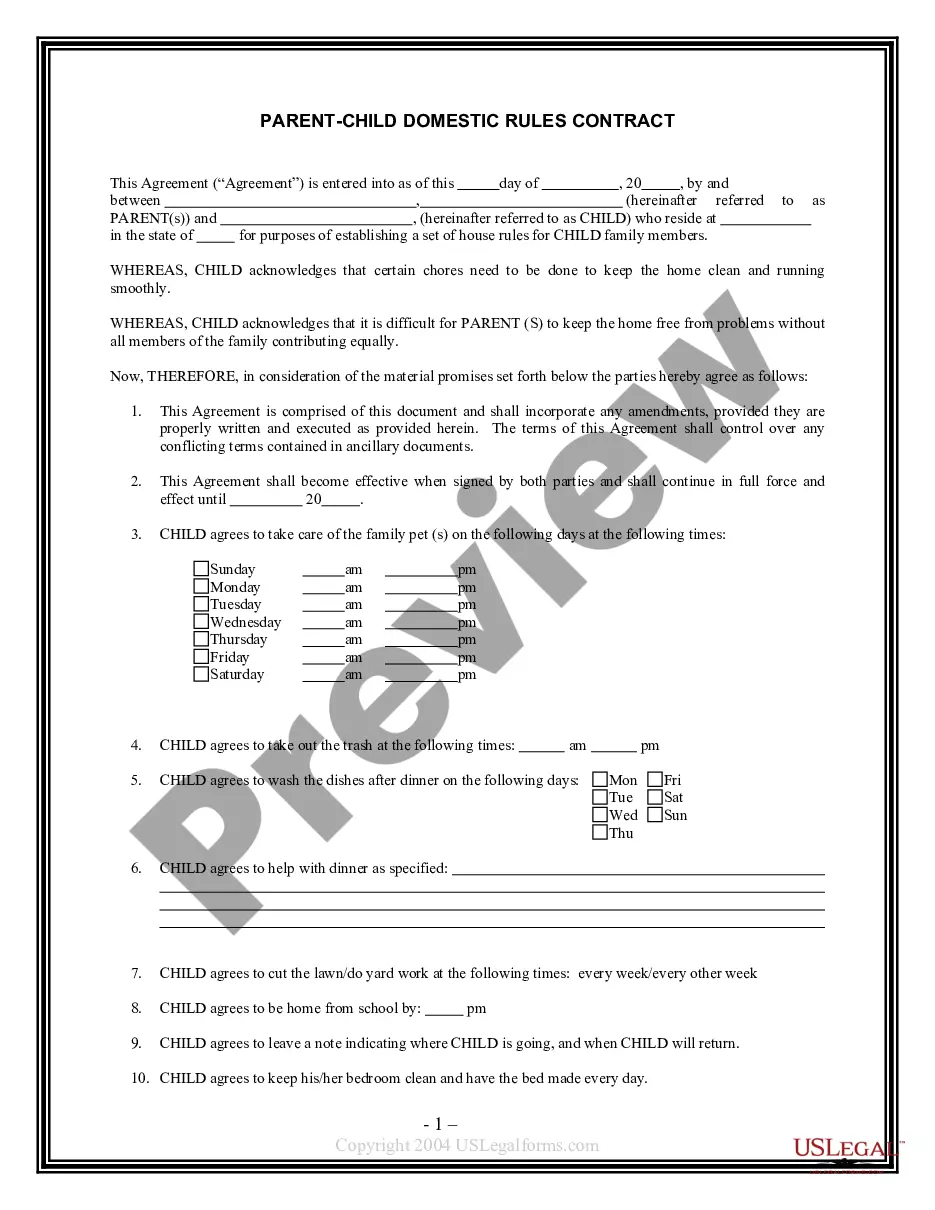
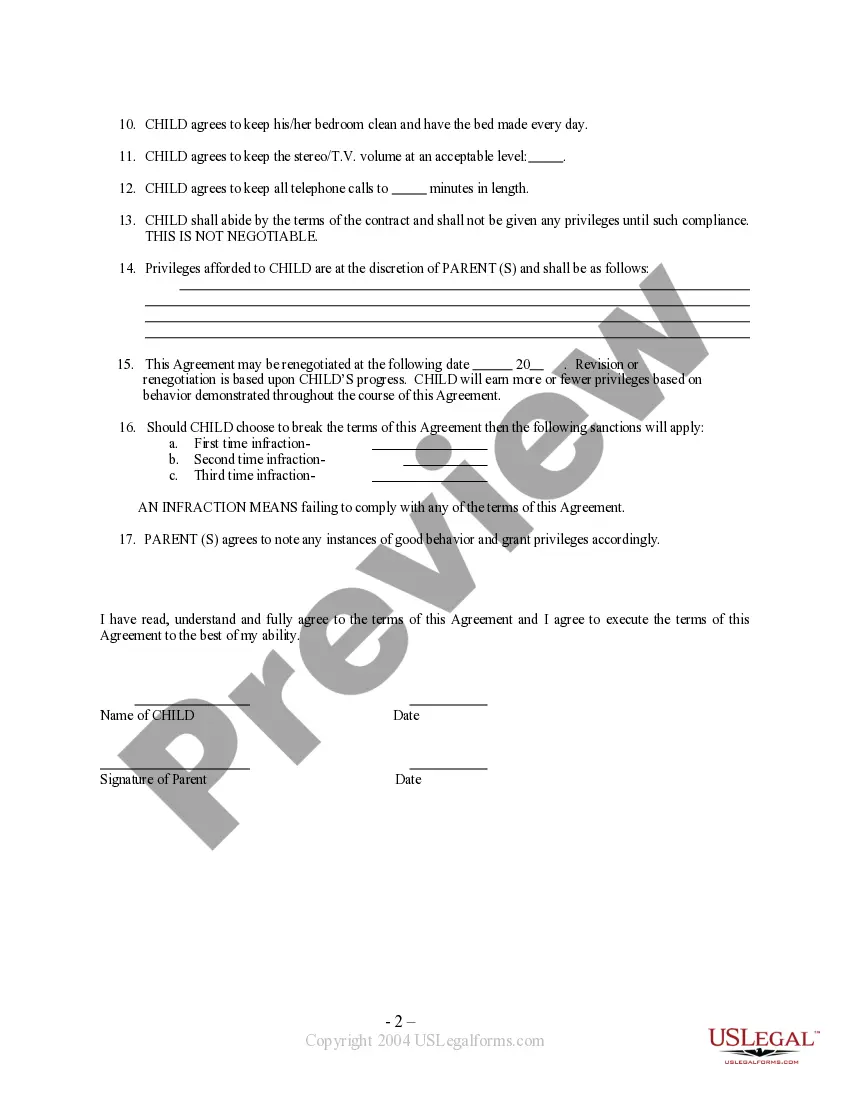
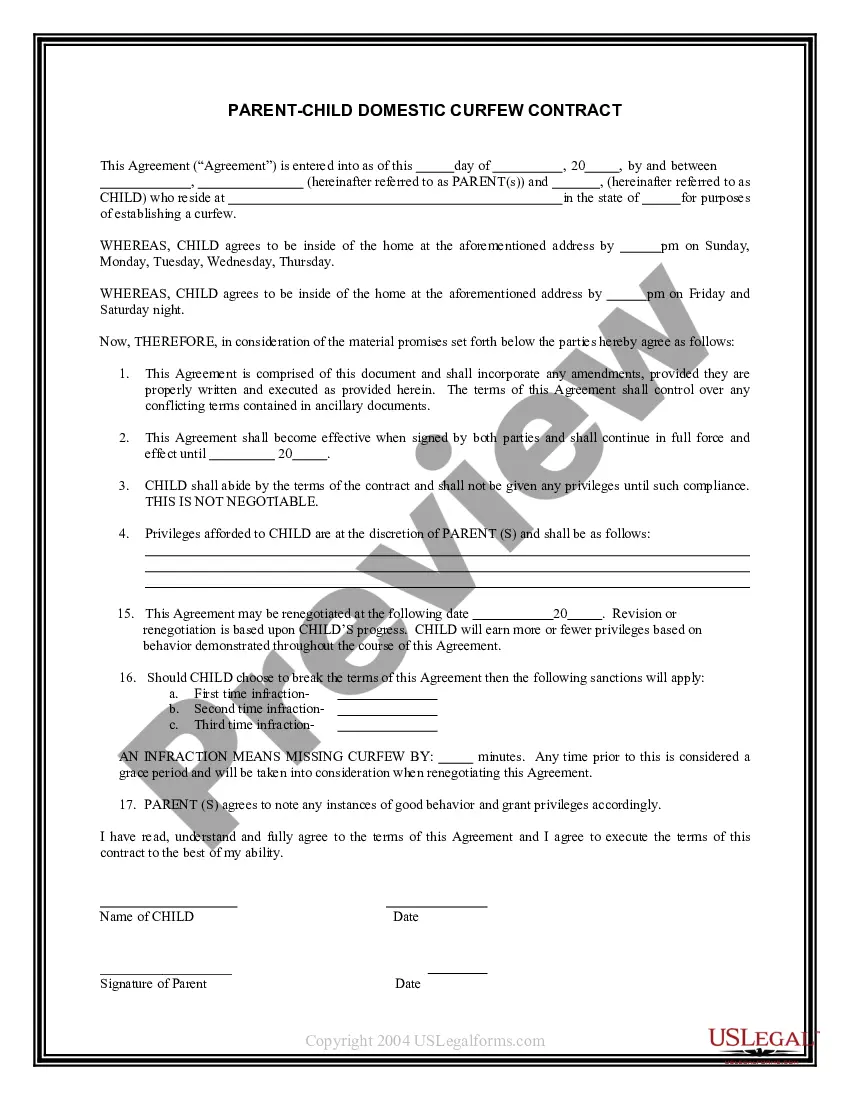
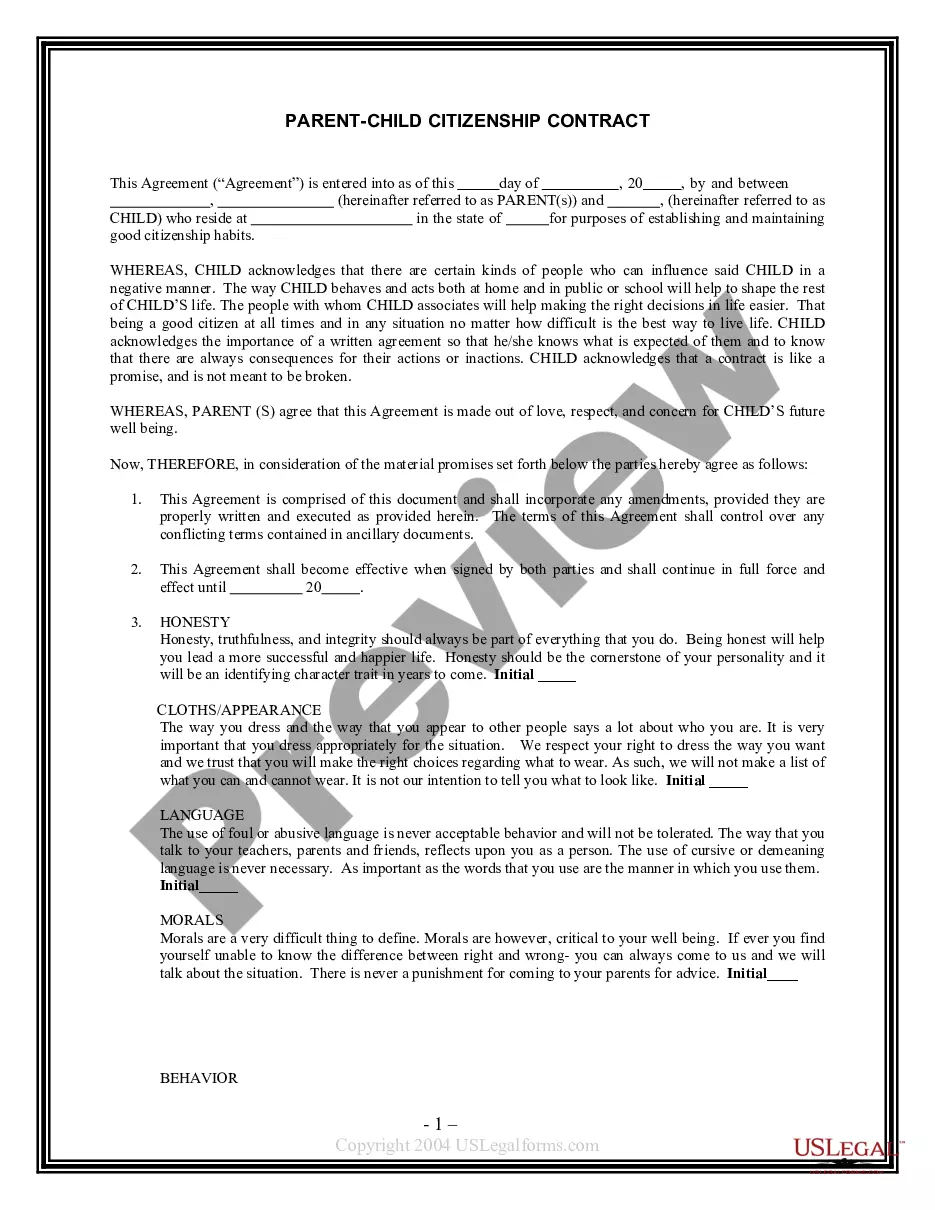
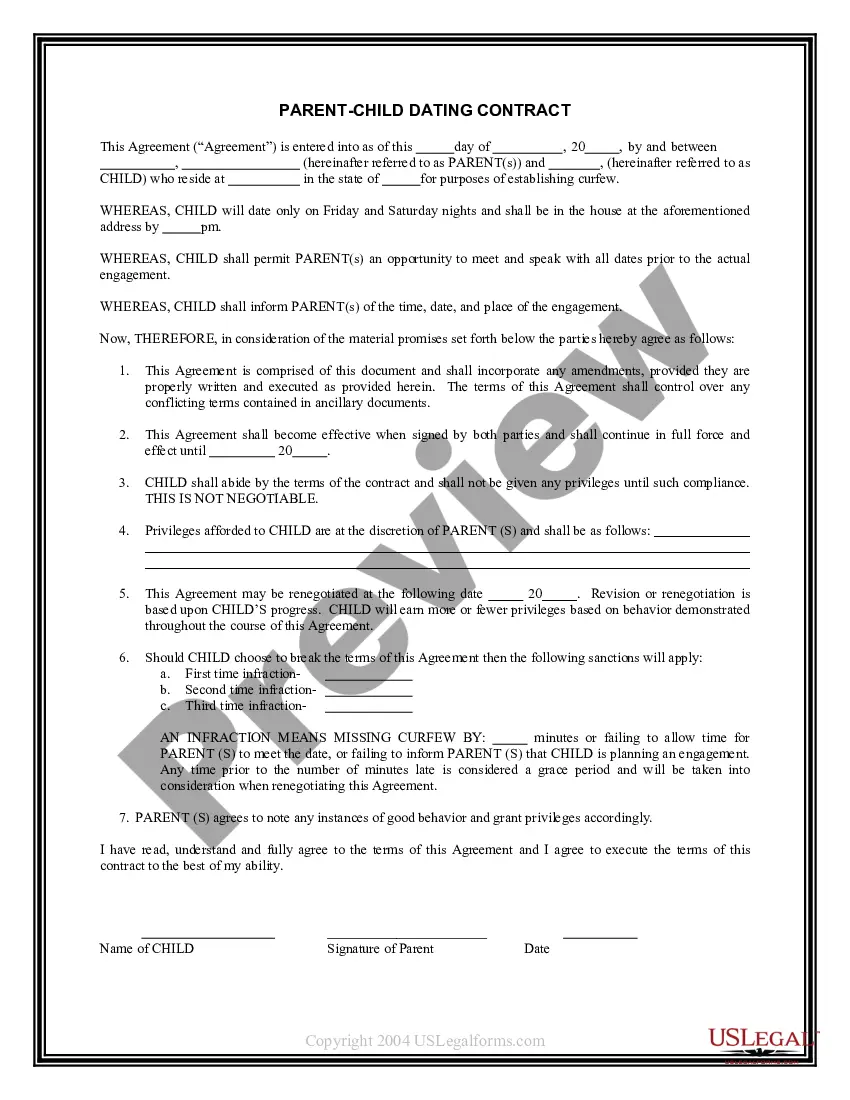
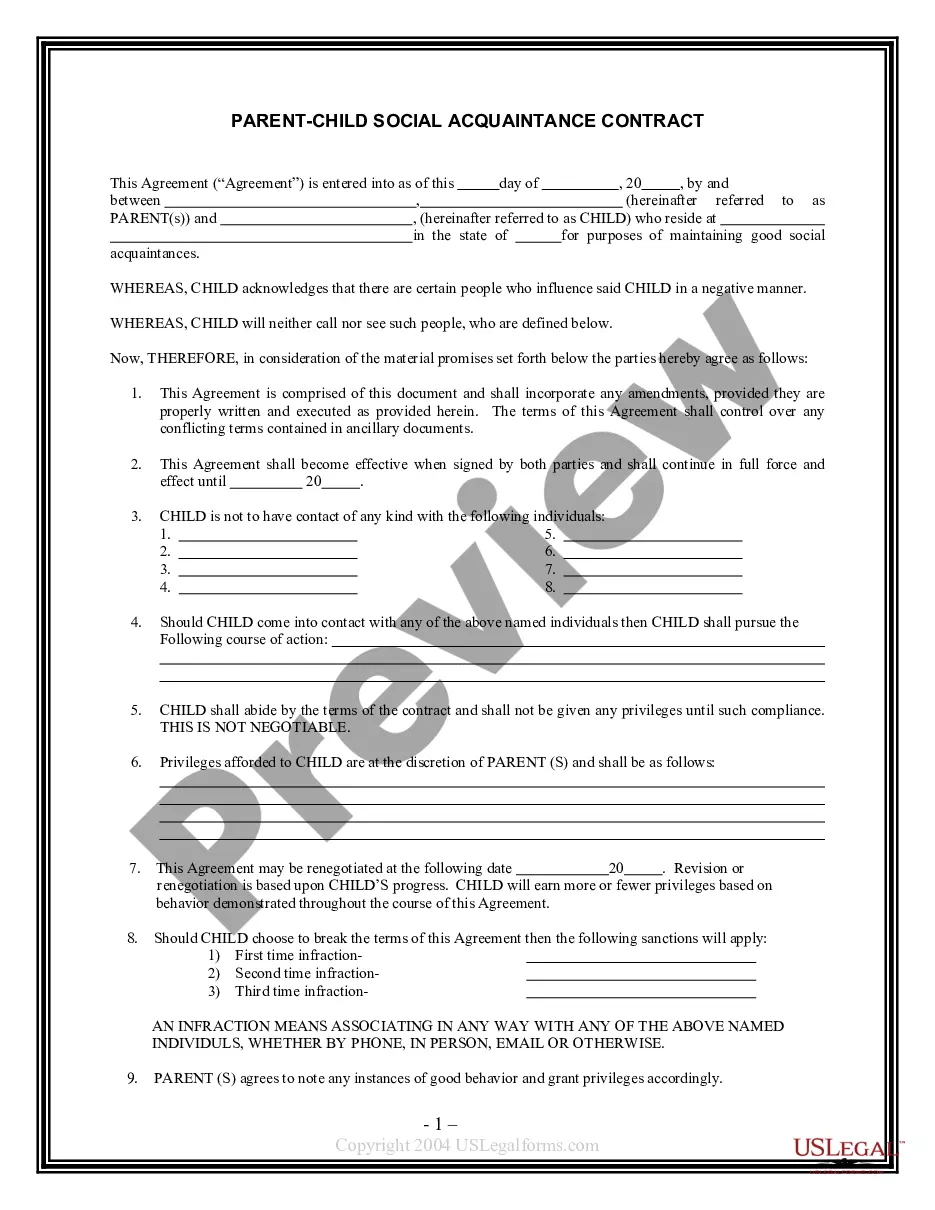
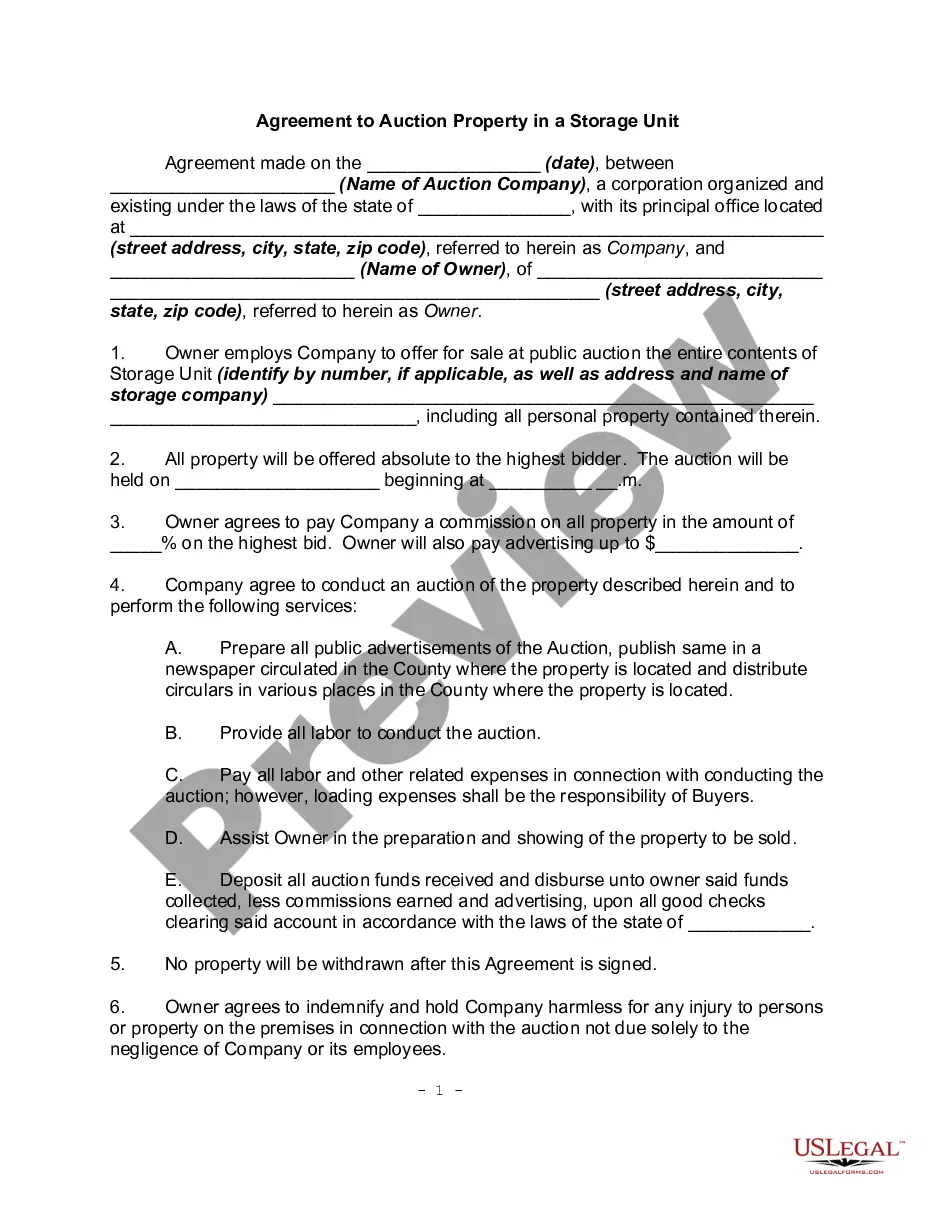
This is a contract between parent(s) and child indicating what chores are expected of child, and on what days and times child is expected to complete the chores. This contract also lists what privileges will be extended for abiding by the contract and what repercussions will follow for breaking the contract.
Kansas Parent - Child Domestic Rules Contract
Category:
State:
Multi-State
Control #:
US-PC08
Format:
Word;
Rich Text
Instant download
Description
Free preview








How to fill out Parent - Child Domestic Rules Contract?
US Legal Forms - one of the largest collections of legal documents in the United States - offers a broad selection of legal form templates that you can download or print. By utilizing the website, you will discover an extensive number of forms for business and personal purposes, organized by categories, states, or keywords. You can obtain the most current versions of forms such as the Kansas Parent - Child Domestic Rules Contract in just seconds.
If you already possess a membership, Log In and download the Kansas Parent - Child Domestic Rules Contract from the US Legal Forms catalog. The Download button will appear on each form you view. You have access to all previously saved forms in the My documents section of your account.
If you wish to use US Legal Forms for the first time, here are simple instructions to get you started: Make sure you have selected the correct form for your city/state. Click on the Review button to examine the form's content. Check the form's details to confirm you have chosen the right one. If the form does not meet your requirements, utilize the Search field at the top of the screen to find one that does.
Access the Kansas Parent - Child Domestic Rules Contract with US Legal Forms, the most extensive collection of legal document templates. Utilize a vast array of professional and state-specific templates that fulfill your business or personal requirements and needs.
- Once you are satisfied with the form, confirm your selection by clicking the Get now button.
- Next, choose the pricing plan you prefer and provide your information to register for an account.
- Process the payment. Use your credit card or PayPal account to complete the transaction.
- Select the format and download the form to your device.
- Make modifications. Fill out, edit, print, and sign the saved Kansas Parent - Child Domestic Rules Contract.
- Every template you add to your account has no expiration date and is yours indefinitely. Therefore, if you wish to download or print another copy, simply navigate to the My documents section and click on the form you need.
Form popularity
FAQ
Kansas does not recognize alienation of affection as a cause of action. This means that you cannot sue someone for interfering in your relationship with your child or co-parent. However, understanding the Kansas Parent - Child Domestic Rules Contract can help clarify your rights and obligations in co-parenting situations. If you have concerns about parental interference, consulting with a legal expert can provide guidance.
A written agreement between parents regarding child custody and visitation is generally legally binding in Kansas. The Kansas Parent - Child Domestic Rules Contract serves as a useful framework for these agreements. Such documents can provide clarity and help prevent future disputes. Always ensure that any agreement is properly drafted and reviewed by a legal professional.
Yes, moving out of state with your child without proper legal consent can lead to serious consequences. The Kansas Parent - Child Domestic Rules Contract emphasizes the importance of mutual agreement between parents. If you do not have the father's permission, it is crucial to seek legal advice to understand your options. Protecting your parental rights is vital in such situations.
In Kansas, there is no specific age at which a child can unilaterally decide where to live. However, the court may consider the child's preferences when they reach a certain level of maturity. The Kansas Parent - Child Domestic Rules Contract can provide clarity on how such decisions should be approached. Consulting with a legal expert can help you navigate this sensitive issue.
Moving out of state with your child without the father's agreement can lead to legal complications. The Kansas Parent - Child Domestic Rules Contract outlines the rights of both parents regarding such decisions. It is advisable to seek legal guidance before making any moves. Understanding your rights and obligations will help you avoid potential disputes.
Under Kansas law, when a parent has legal custody (meaning, the right to make important decisions about a child's life) or physical custody (the child lives with that parent some or all of the time), or when a parent has a right to parenting time (visitation), that parent can't just move away with the kids without the
The judge will consider a child's preference whenever the child is of sufficient age, maturity, and understanding. However, there's no specific age when a child can choose to live with one parent over the other.
The law specifically provides that no presumption exists that it is in the best interests of any infant or young child to award custody to the mother. In other words, when parents ask a Kansas court to determine custody of a child, the mother and father are on equal footing.
If the child is a teenager, the judge may be willing to consider the child's wishes as to residence and the child's reasons. There is no specific age when a child gets to decide where they live, but normally, the older the child, the more weight that child's desires are given by the court.
If one parent wants to take a child on an out of state vacation and the other parent will not give permission, then the parties may have to petition the court to settle the matter.