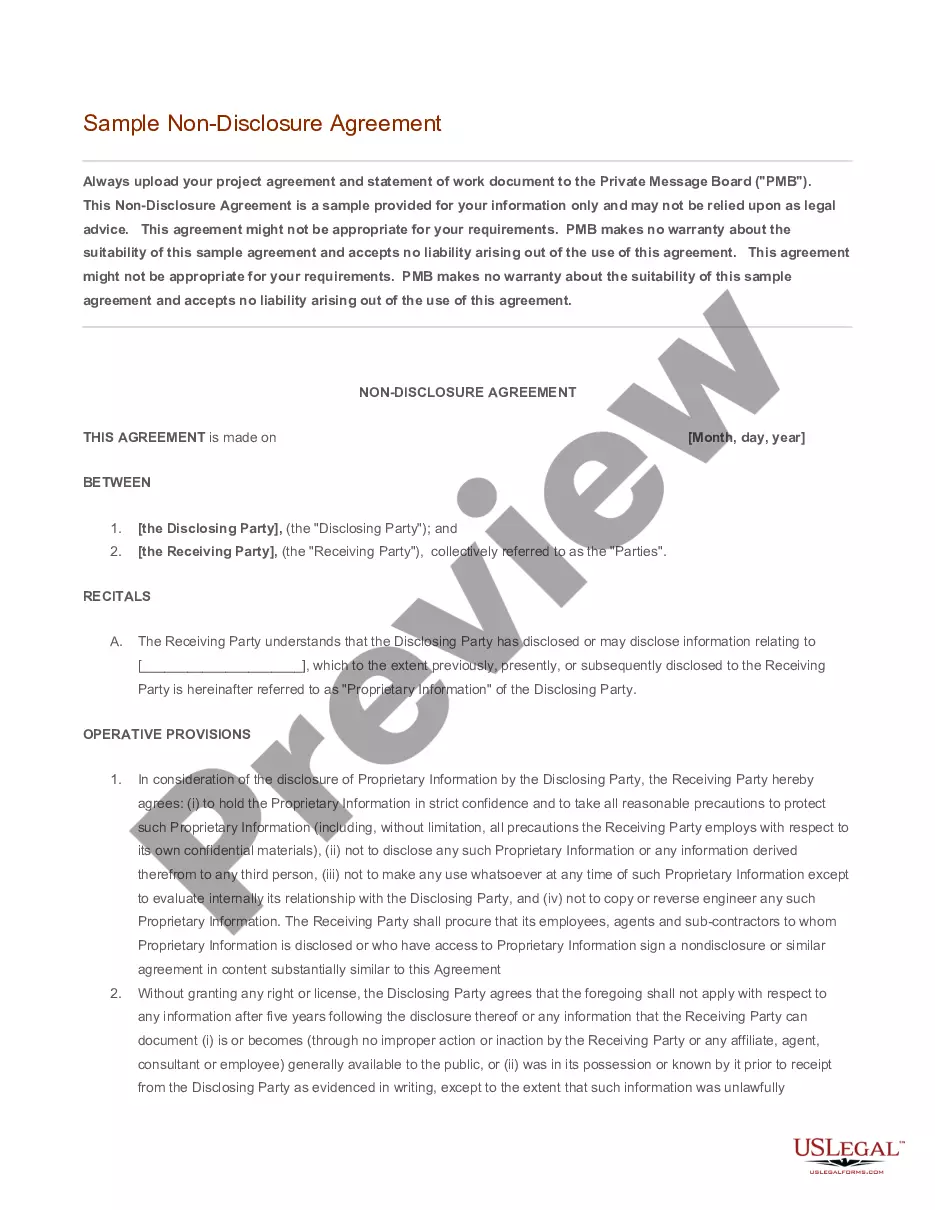
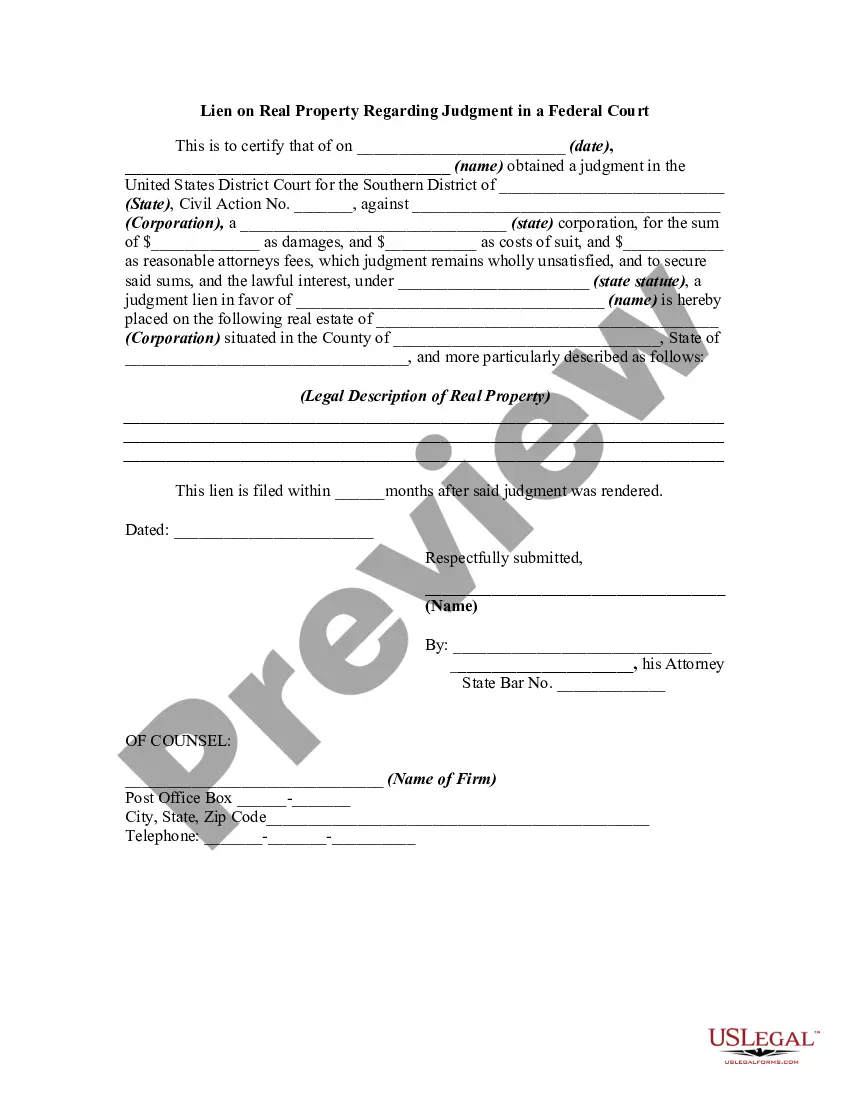
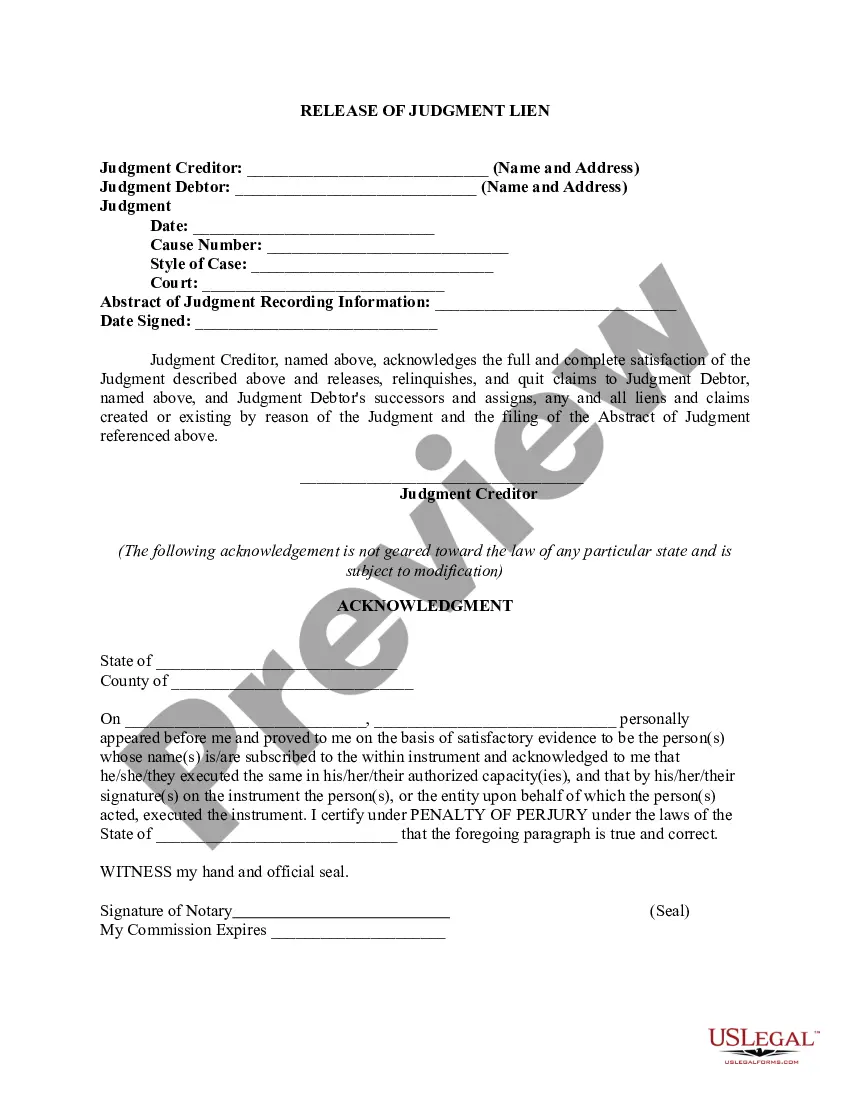
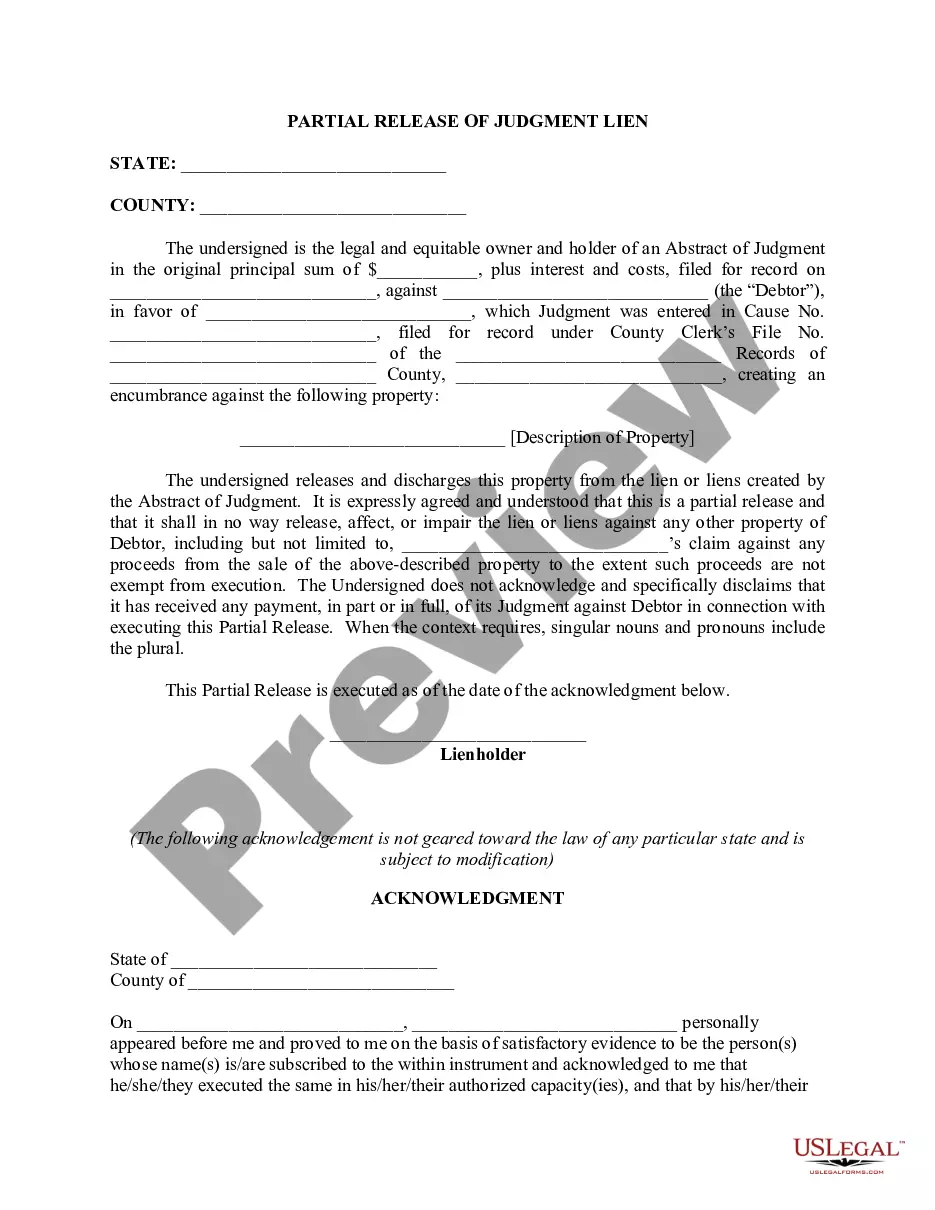
A judgment lien is created when a court grants a creditor an interest in the debtor's property, based upon a court judgment. A plaintiff who obtains a monetary judgment is termed a "judgment creditor." The defendant becomes a "judgment debtor."
Judgment liens may be created through a wide variety of circumstances.
Kansas Lien on Real Property Regarding Judgment in a Federal Court
Instant download
Description
Get your form ready online
Our built-in tools help you complete, sign, share, and store your documents in one place.
Built-in online Word editor
Make edits, fill in missing information, and update formatting in US Legal Forms—just like you would in MS Word.
Export easily
Download a copy, print it, send it by email, or mail it via USPS—whatever works best for your next step.
E-sign your document
Sign and collect signatures with our SignNow integration. Send to multiple recipients, set reminders, and more. Go Premium to unlock E-Sign.
Notarize online 24/7
If this form requires notarization, complete it online through a secure video call—no need to meet a notary in person or wait for an appointment.
Store your document securely
We protect your documents and personal data by following strict security and privacy standards.

Make edits, fill in missing information, and update formatting in US Legal Forms—just like you would in MS Word.

Download a copy, print it, send it by email, or mail it via USPS—whatever works best for your next step.

Sign and collect signatures with our SignNow integration. Send to multiple recipients, set reminders, and more. Go Premium to unlock E-Sign.

If this form requires notarization, complete it online through a secure video call—no need to meet a notary in person or wait for an appointment.

We protect your documents and personal data by following strict security and privacy standards.
Looking for another form?

How to fill out Lien On Real Property Regarding Judgment In A Federal Court?
Are you in the location where you will require documents for either business or personal purposes almost every working day.
There are numerous authentic form templates available online, but finding ones you can rely on is not easy.
US Legal Forms provides thousands of form templates, such as the Kansas Lien on Real Property Regarding Judgment in a Federal Court, that are designed to comply with federal and state regulations.
Utilize US Legal Forms, the most extensive collection of legal forms, to save time and avoid mistakes.
The service offers professionally crafted legal document templates that you can use for various purposes. Create an account on US Legal Forms and start making your life a bit easier.
- If you are already familiar with the US Legal Forms website and have an account, simply Log In.
- Then, you can download the Kansas Lien on Real Property Regarding Judgment in a Federal Court template.
- If you do not have an account and wish to start using US Legal Forms, follow these instructions.
- Obtain the form you need and ensure it is for the correct city/area.
- Use the Preview button to review the document.
- Read the description to confirm you have selected the right form.
- If the form is not what you’re looking for, utilize the Search field to find the form that meets your needs and specifications.
- Once you have the correct form, click Get now.
- Select the pricing plan you prefer, enter the required information to create your account, and complete your order using your PayPal or credit card.
- Choose a suitable file format and download your copy.
- Access all the form templates you have purchased in the My documents menu. You can retrieve an additional copy of the Kansas Lien on Real Property Regarding Judgment in a Federal Court anytime, if necessary. Click the desired form to download or print the document template.
Form popularity
FAQ
A Kansas judgment is enforceable for five (5) years.
(2) A "renewal affidavit" is a statement under oath, signed by the judgment creditor or the judgment creditor's attorney, filed in the proceedings in which the judgment was entered and stating the remaining balance due and unpaid on the judgment.
Judgments Last Five Years in Kansas This means that unless the judgment is renewed by the courts, after five years, it will cease to operate as a lien against the defendant's estate. In other words, the defendant is no longer responsible for paying off any amount remaining on the judgment.
Statutes of limitations for each state (in number of years) StateWritten contractsOpen-ended accounts (including credit cards)Kansas53Kentucky155Louisiana103Maine6647 more rows ?
A judgment lien is a type of non-consensual lien (a lien that attaches to a property without the owner's agreement). It's created when someone wins a lawsuit against the property owner and then records the judgment against an asset such as a house, land, bank account, or other personal assets.
Judgment liens can be levied by a court when someone fails to repay a debt. Judgment liens are general, and can be either voluntary (if the homeowner chooses to use their property as collateral for the debt) or involuntary (if the court orders the lien against their wishes).
The most common properties seized because of a judgment lien are real estate, vehicles and wages. In most cases, a collector will start with wage garnishment to pay off a debt, and then move to the seizure and sale of property to fund the judgment through proceeds.
(b) Offer of judgment. At any time more than 21 days before the trial begins, a party defending against a claim may serve upon the adverse party an offer to allow judgment to be taken against such party for the money or property or to the effect specified in such party's offer, with costs then accrued.