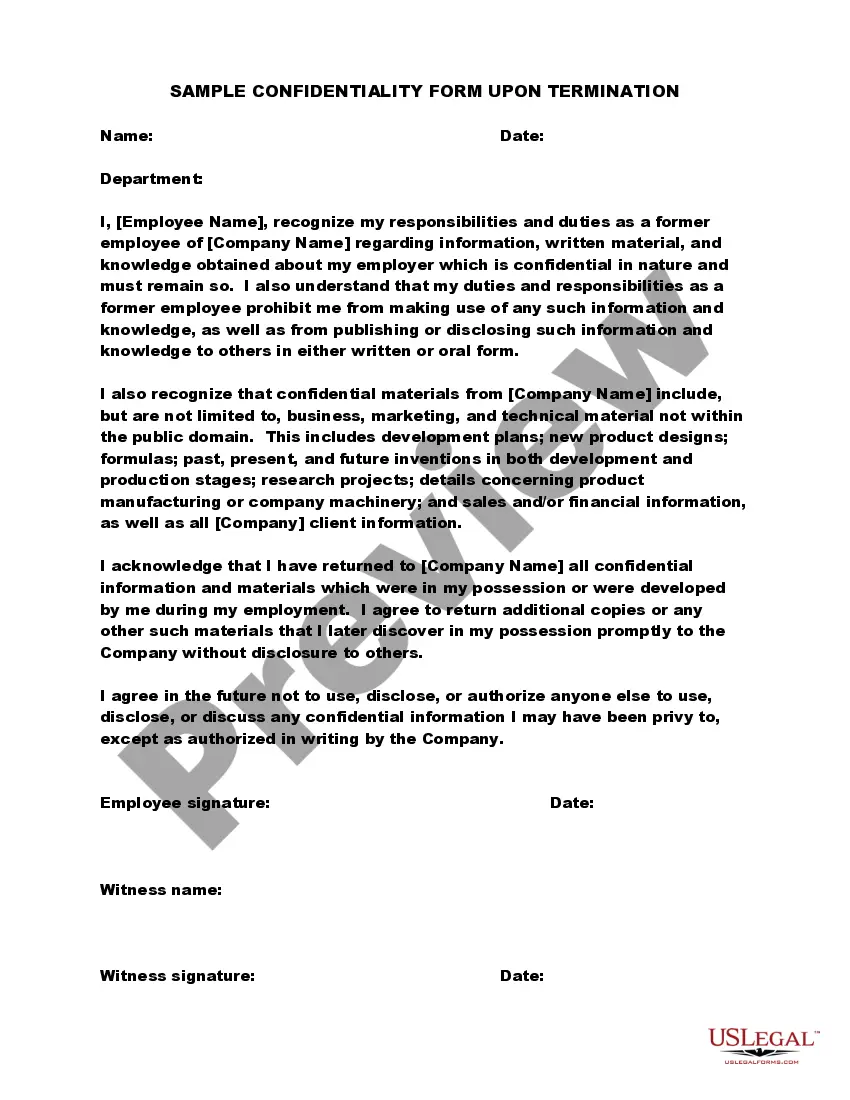
Indiana Sample Confidentiality Form Upon Termination
Description
Get your form ready online
Our built-in tools help you complete, sign, share, and store your documents in one place.
Make edits, fill in missing information, and update formatting in US Legal Forms—just like you would in MS Word.
Download a copy, print it, send it by email, or mail it via USPS—whatever works best for your next step.
Sign and collect signatures with our SignNow integration. Send to multiple recipients, set reminders, and more. Go Premium to unlock E-Sign.
If this form requires notarization, complete it online through a secure video call—no need to meet a notary in person or wait for an appointment.
We protect your documents and personal data by following strict security and privacy standards.

Make edits, fill in missing information, and update formatting in US Legal Forms—just like you would in MS Word.

Download a copy, print it, send it by email, or mail it via USPS—whatever works best for your next step.

Sign and collect signatures with our SignNow integration. Send to multiple recipients, set reminders, and more. Go Premium to unlock E-Sign.

If this form requires notarization, complete it online through a secure video call—no need to meet a notary in person or wait for an appointment.

We protect your documents and personal data by following strict security and privacy standards.
Looking for another form?





How to fill out Sample Confidentiality Form Upon Termination?
Finding the appropriate legal document format can be quite challenging.
Of course, there are numerous templates accessible online, but how can you get the legal form you need.
Utilize the US Legal Forms website. This service provides a wide array of templates, including the Indiana Sample Confidentiality Form Upon Termination, suitable for both business and personal needs.
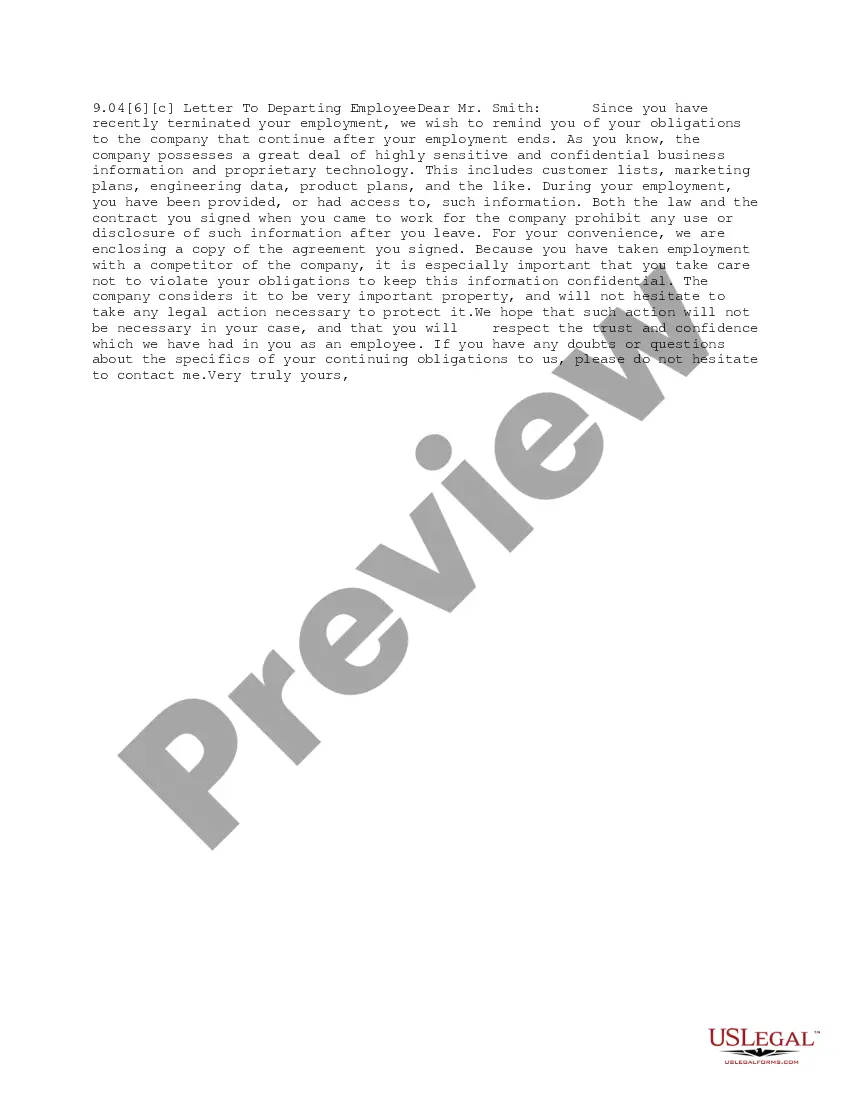
You can view the form using the Preview option and read the form description to verify it is the right one for you.
- All forms are reviewed by experts and meet federal and state regulations.
- If you are already registered, Log In to your account and click the Download option to acquire the Indiana Sample Confidentiality Form Upon Termination.
- Utilize your account to browse through the legal forms you have previously purchased.
- Navigate to the My documents tab in your account to retrieve another copy of the document you need.
- If you are a new user of US Legal Forms, here are simple instructions for you to follow.
- First, ensure you have selected the correct form for your city/county.
Form popularity
FAQ
No Expiration Dates So long as they are kept secret, trade secrets do not expire. Likewise, the confidentiality obligations in an NDA should have no expiration date.
The obligations of confidentiality and limitation of use described in this Article 9 shall survive the expiration and termination of the Agreement for a period of two (2) years (or such longer period as may be required by law).
A confidentiality agreement is a standard written agreement that is used to protect the owner of an invention or idea for a new business. It is also an important document between two companies that are contemplating a merger or a commercial transaction that must be withheld from public knowledge.
How to Write a Non-Disclosure Agreement: Common ClausesStep 1 Disclosing and Receiving Parties.Step 2 Confidential Information.Step 3 Exclusions from Confidential Information.Step 4 Non-Disclosure Obligations.Step 5 Time Frame / Termination.Step 6 Jurisdiction.Step 7 Signatures.Step 8 Additional Clauses.
"There are several key pieces of information that should be included in NDAs, or non-disclosure agreements. The most important items include customer lists, financial and profit margin information, product breakdowns, bestselling segments and sales scripting and messaging."
Those provisions that by their nature are intended to survive termination or expiration of this Agreement shall so survive. OK, so something survives if the parties intended it to survive! An intention doesn't have to be made explicit in a contract. Instead, it can be gleaned from the context.
Each party shall keep such information confidential and cannot disclose any related information without the other party's prior written consent, but the following information shall not subject to such confidentiality: (a)information that is or will be generally known to the public (provided that such information does
A confidentiality agreement is a legal contract or clause that is used to protect the owner's proprietary or sensitive information from disclosure by others.
Confidentiality agreements can run indefinitely, covering the parties' disclosures of confidential information at any time, or can terminate on a certain date or event. Whether or not the overall agreement has a definite term, the parties' nondisclosure obligations can be stated to survive for a set period.
Two accrued obligations that are most commonly recognised by the courts as surviving termination are: The obligation to pay money due under a contract; and. The obligation to pay compensation/damages.