Indiana Petition for Contempt
What this document covers
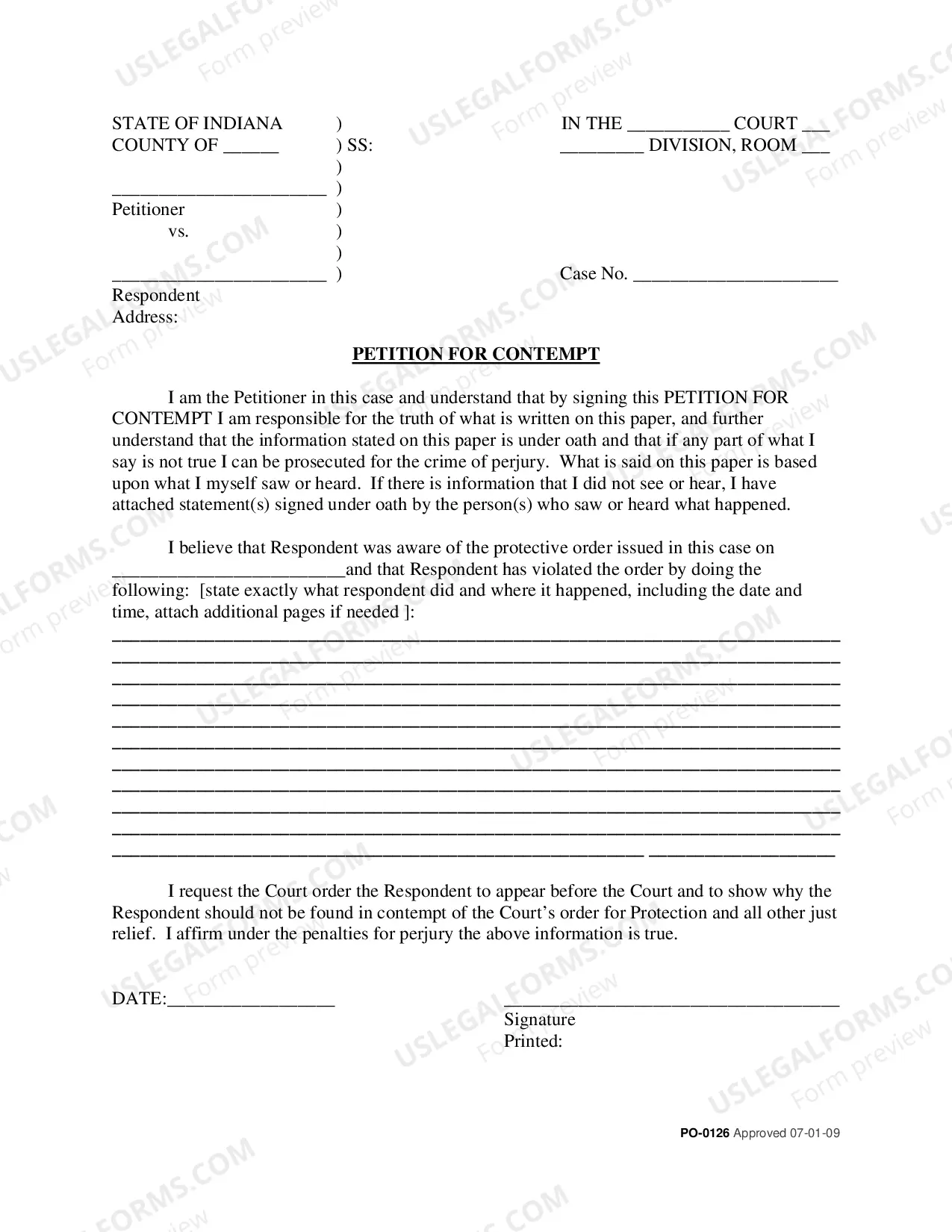
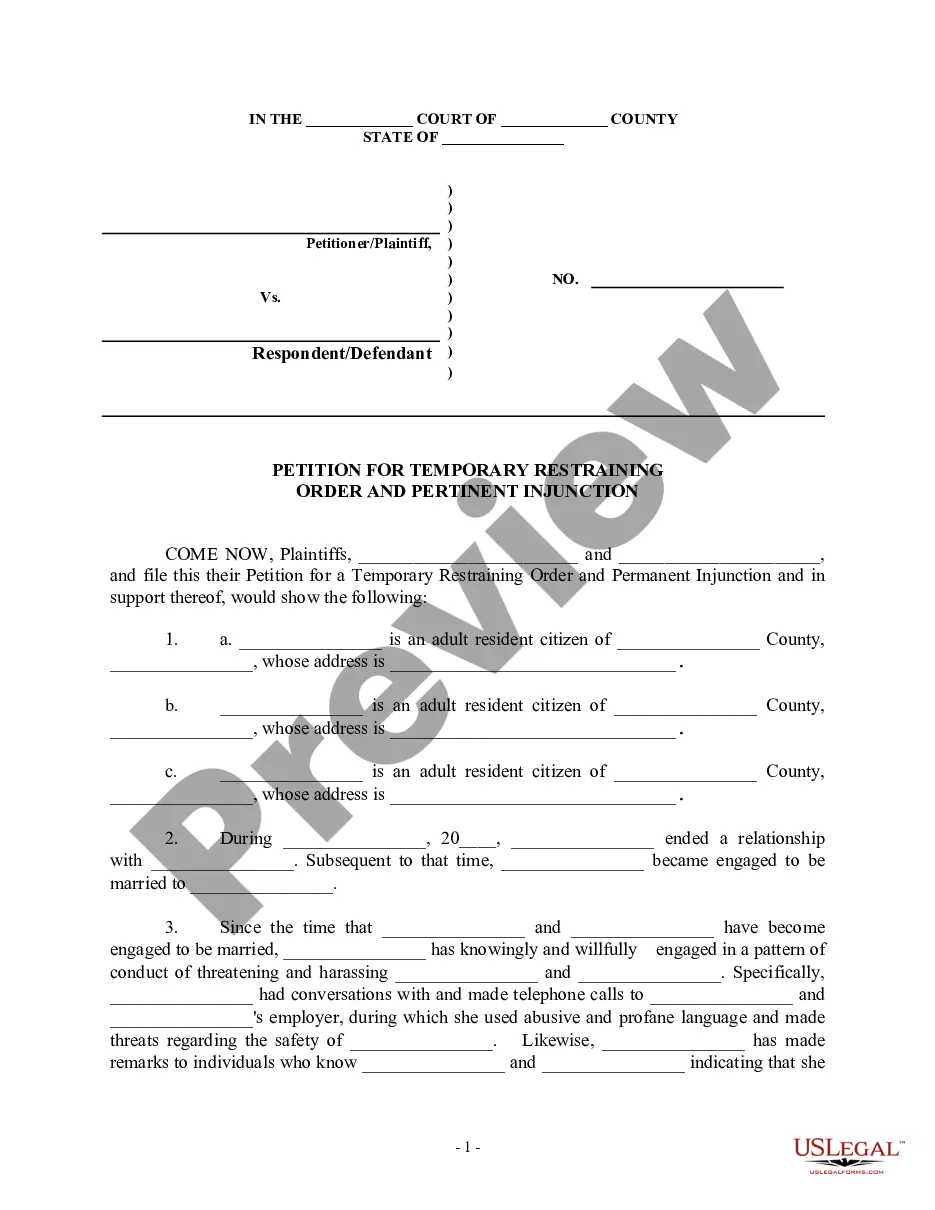
The Petition for Contempt is a legal document used to request a court to take action against a party who has violated a court order, such as a protective order. This form serves to formally notify the court of the alleged contemptuous actions of the respondent and seek an order for them to appear before the court. Unlike other forms related to family law or protective orders, this petition specifically addresses violations of existing court orders, making it crucial in enforcing legal decisions.
Main sections of this form
- Title indicating the nature of the petition.
- The court information, including state and county.
- Name and address of the petitioner and respondent.
- A description of the contemptuous actions of the respondent.
- A request for the court to compel the respondent to appear.
- Signature and printed name of the petitioner accompanied by date.
When to use this document
This form should be used when a party believes that another party has disobeyed a court order, specifically a protective order. Common scenarios include instances where the respondent has contacted the petitioner against the order or failed to adhere to conditions set by the court meant to ensure safety and compliance. A petitioner may also use this form when seeking to enforce the terms of child custody or support agreements that have been disregarded.
Who should use this form
- Individuals who are parties in a legal case involving a protective order.
- Petitioners seeking enforcement of a court order.
- Anyone who has evidence of a violation of a court directive.
Instructions for completing this form
- Identify the appropriate court and fill in the court name and county.
- Provide the names and addresses of both the petitioner and the respondent.
- Clearly state the details of the contemptuous actions with specific descriptions, dates, and locations.
- Request a court order for the respondent to appear and explain their contempt.
- Sign and date the form, ensuring all information is accurate and truthful.
Is notarization required?
This form does not typically require notarization unless specified by local law. It is important to check local court requirements to ensure compliance with any additional procedures that may apply.
Get your form ready online
Our built-in tools help you complete, sign, share, and store your documents in one place.
Make edits, fill in missing information, and update formatting in US Legal Forms—just like you would in MS Word.
Download a copy, print it, send it by email, or mail it via USPS—whatever works best for your next step.
Sign and collect signatures with our SignNow integration. Send to multiple recipients, set reminders, and more. Go Premium to unlock E-Sign.
If this form requires notarization, complete it online through a secure video call—no need to meet a notary in person or wait for an appointment.
We protect your documents and personal data by following strict security and privacy standards.

Make edits, fill in missing information, and update formatting in US Legal Forms—just like you would in MS Word.

Download a copy, print it, send it by email, or mail it via USPS—whatever works best for your next step.

Sign and collect signatures with our SignNow integration. Send to multiple recipients, set reminders, and more. Go Premium to unlock E-Sign.

If this form requires notarization, complete it online through a secure video call—no need to meet a notary in person or wait for an appointment.

We protect your documents and personal data by following strict security and privacy standards.
Common mistakes
- Failing to provide specific details about the respondent's actions.
- Not signing the petition or omitting the date.
- Using vague language that does not clearly explain the contempt.
- Filing the petition in the wrong court.
Benefits of using this form online
- Convenient access to legally drafted templates at any time.
- Edit and customize forms based on individual circumstances swiftly.
- Reliable and secure download options ensure document safety.
Legal use & context
The Petition for Contempt serves as a legal mechanism to uphold court orders. It is important to understand that misuse of this form can result in legal repercussions, and accuracy in the information provided is critical for enforceability. This form enables the court to take necessary actions to mitigate disregard for the established legal framework.
Quick recap
- The Petition for Contempt is essential for enforcing compliance with court orders.
- Provide detailed and accurate information to support your allegations.
- Check state-specific requirements to ensure proper usage and filing.
Looking for another form?


Form popularity
FAQ
Or, the judge may notice you and order you to stand up. If you don't stand up, the judge might hold you in contempt and fine you or sen...
Request a modification ? One of the best ways to avoid being held in contempt of court is to know your situation and limitations. If you know that you will struggle to comply with the terms of a court order or judgment, respectfully seek a modification to change the terms of the court order.
Filing Your Case To file your case you will need to take the original and copies of your pleadings to the clerk of the court and ask them to file the paperwork. You may want to call the clerks office to confirm the number of copies you will need to file. The clerk will provide a case number and process the forms.
Civil contempt is the failure of someone to comply with a court order. Judges use civil contempt sanctions to push a person into conceding with a court order the person has violated.
There is no cost associated with filing contempt actions.
(2) Justices of the peace may punish a person adjudged guilty of a direct contempt of court by a fine of not more than fifty dollars, or imprisonment in the parish jail for not more than twenty-four hours, or both.
§ 34-47-3-6 o Defendant is required to answer Rule to Show Cause. o If defendant fails to appear or refuses to answer, trial court may proceed to attach and punish defendant for contempt. Intentional act or omission that violates the terms of a court order made for the benefit of the opposing party.
Crimes against public justice in Scotland: Perjury, contempt of court and more.