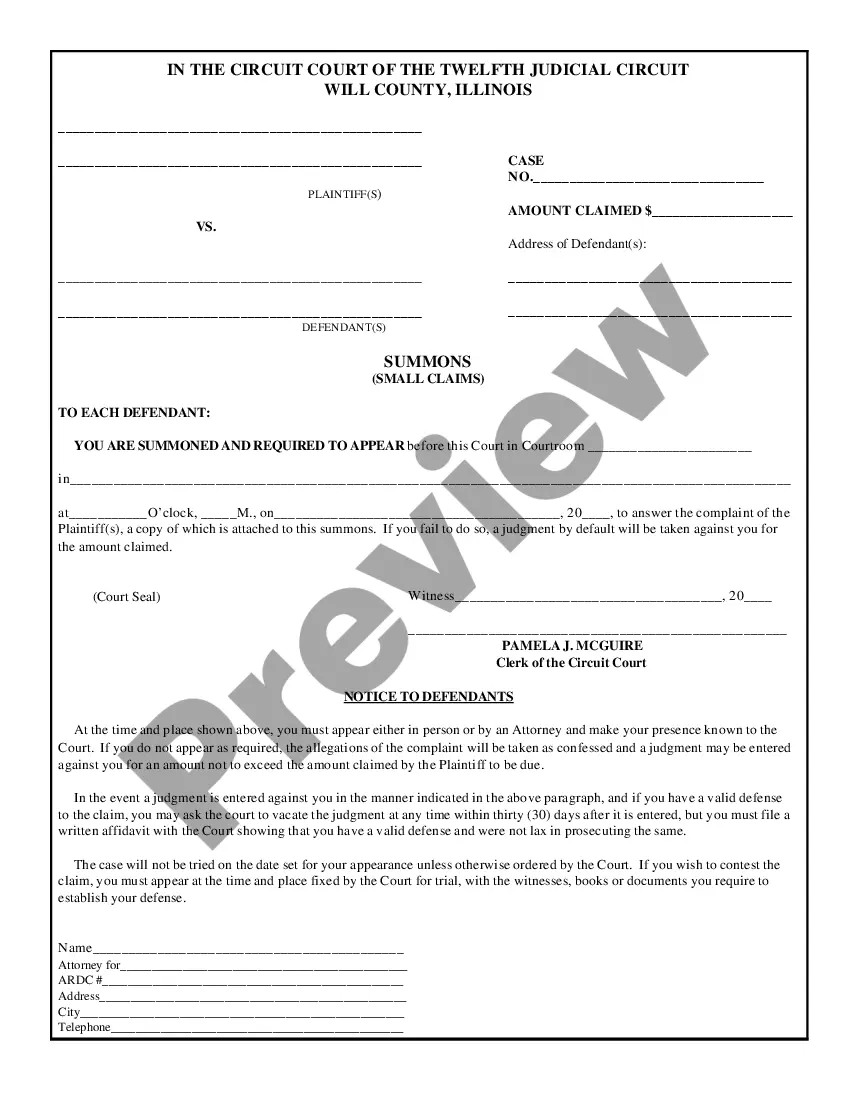
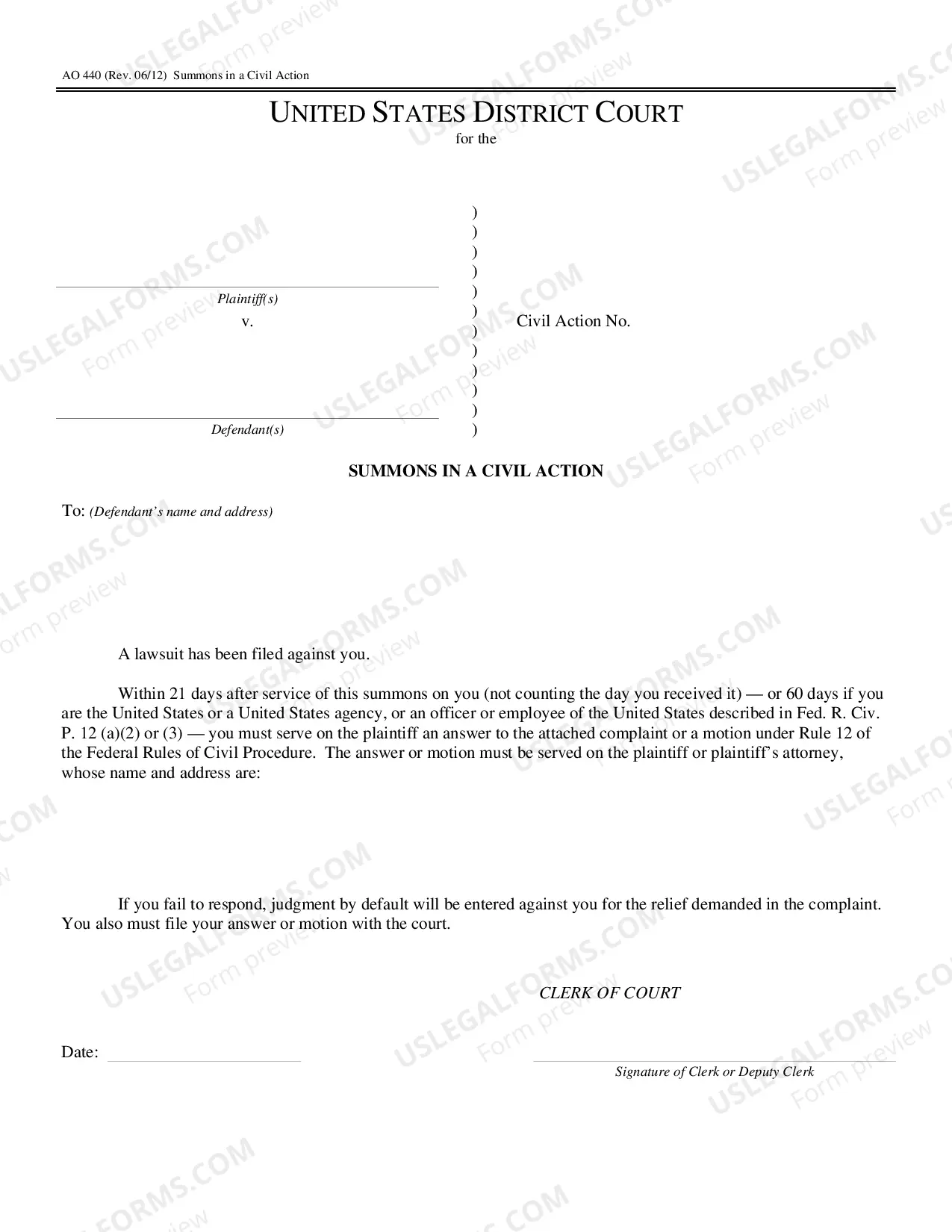
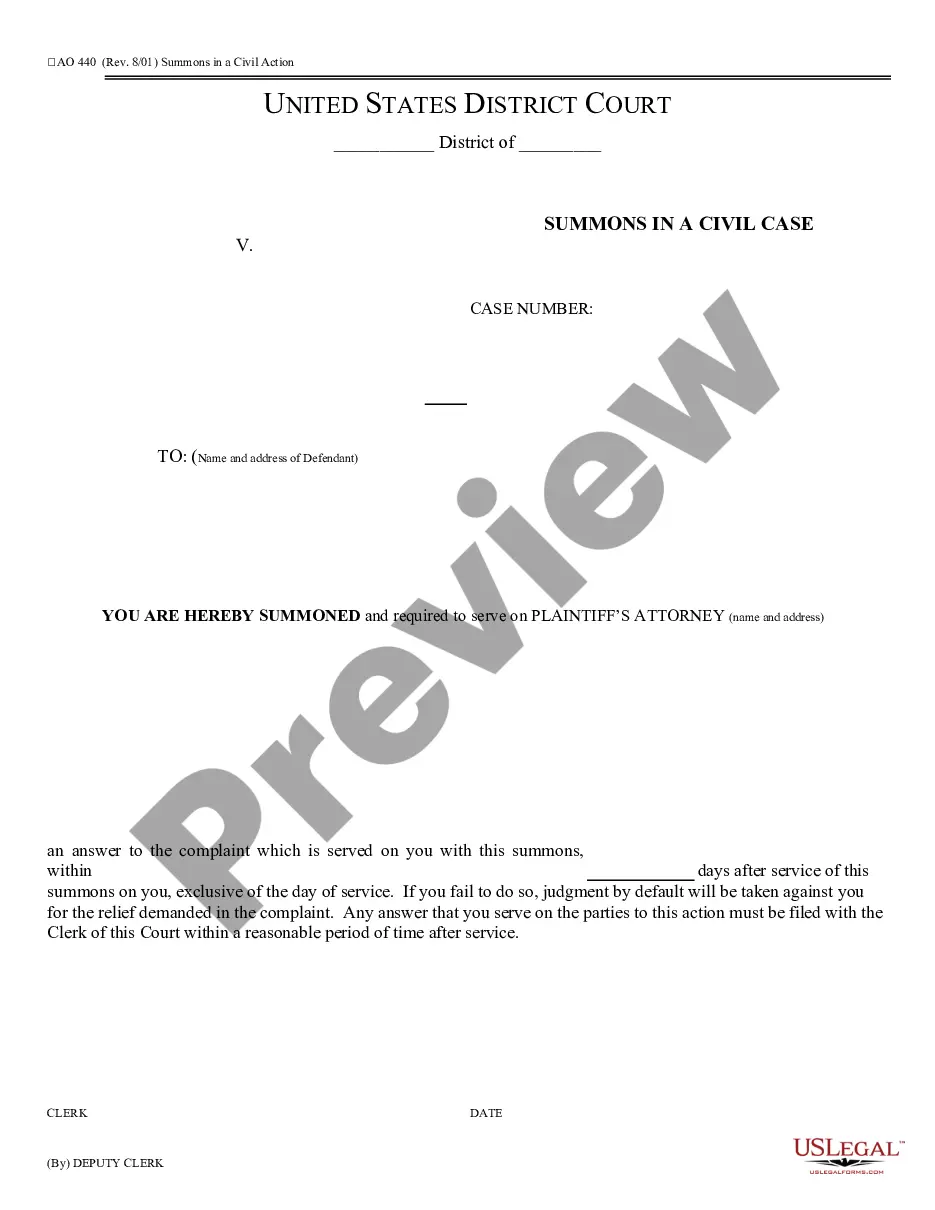
This official form from Will County, Illinois, is a Summons in small claims cases that do not exceed $10,000 to a defendant commanding him/her to file a written appearance or risk a default judgment being entered against them in the case at bar.
Illinois Summons - Small Claims
State:
Illinois
Category:
Control #:
IL-WSMC-003
Format:
PDF
Instant download
This website is not affiliated with any governmental entity
Public form
Description
Get your form ready online
Our built-in tools help you complete, sign, share, and store your documents in one place.
Built-in online Word editor
Make edits, fill in missing information, and update formatting in US Legal Forms—just like you would in MS Word.
Export easily
Download a copy, print it, send it by email, or mail it via USPS—whatever works best for your next step.
E-sign your document
Sign and collect signatures with our SignNow integration. Send to multiple recipients, set reminders, and more. Go Premium to unlock E-Sign.
Notarize online 24/7
If this form requires notarization, complete it online through a secure video call—no need to meet a notary in person or wait for an appointment.
Store your document securely
We protect your documents and personal data by following strict security and privacy standards.

Make edits, fill in missing information, and update formatting in US Legal Forms—just like you would in MS Word.

Download a copy, print it, send it by email, or mail it via USPS—whatever works best for your next step.

Sign and collect signatures with our SignNow integration. Send to multiple recipients, set reminders, and more. Go Premium to unlock E-Sign.

If this form requires notarization, complete it online through a secure video call—no need to meet a notary in person or wait for an appointment.

We protect your documents and personal data by following strict security and privacy standards.
Looking for another form?


How to fill out Illinois Summons - Small Claims?
Searching for Illinois Summons - Small Claims papers and filling them out can be an ordeal.
To conserve time, expenses, and effort, utilize US Legal Forms and discover the appropriate template specifically for your state within just a few clicks.
Our legal experts prepare all documents, so you merely have to complete them.
Now you can print the Illinois Summons - Small Claims template or complete it using any online editor. Don't worry about making errors because your sample can be used and sent, and printed multiple times as you wish. Try US Legal Forms and gain access to over 85,000 state-specific legal and tax documents.
- Log in to your account and return to the form's page to save the sample.
- Your downloaded templates are stored in My documents and can be accessed anytime for future use.
- If you haven’t subscribed yet, you need to sign up.
- Review our comprehensive guidelines on how to obtain your Illinois Summons - Small Claims template in a matter of minutes.
- To acquire a titled sample, verify its suitability for your state.
- Examine the sample using the Preview feature (if available).
- If there's a description, read it to understand the specifics.
- Press the Buy Now button if you found what you are searching for.
- Select your plan on the pricing page and set up your account.
- Indicate whether you prefer to pay by credit card or PayPal.
- Download the document in your desired format.
Form popularity
FAQ
Step 1: File your Answer/Response to Complaint/Petition with the Circuit Clerk in the county where the court case is filed. you can use to e-file your form. Step 2: Send a copy of your Answer/Response to Complaint/Petition to the other parties.
Provide the name of the court at the top of the Answer. You can find the information on the summons. List the name of the plaintiff on the left side. Write the case number on the right side of the Answer. Address the Judge and discuss your side of the case. Ask the judge to dismiss the case.
Step 1: Gather your evidence. Step 2: Send your evidence to the defendant and the court. Step 3: Review evidence received from the defendant. Step 4: File and serve subpoenas (if relevant) Step 5: Plan what to say in court. Step 6: Plan what to take to court.
If you do not have an attorney, write one yourself. Include why you feel the court should rule in your favor. State difficulty to appear because you live out of state and request to appear by phone. Mail a copy of your response to the county clerk's office in the location where the case has been filed within 20 days.
Current filing fees are: In district court, the fee for defendant's first filing is typically $223.00, but that might vary depending on the type of case. To verify your filing fee, click to visit Filing Fees and Waivers. In justice court, the fee for defendant's first filing is typically $71.
Contact the clerk's office of the court where the lawsuit was filed. You'll find a phone number and address for the clerk's office on your summons. The clerk will be able to tell you exactly what documents you should file with your answer and whether any filing fee is required.
Read the summons and make sure you know the date you must answer by. Read the complaint carefully. Write your answer. Sign and date the answer. Make copies for the plaintiff and yourself. Mail a copy to the plaintiff. File your answer with the court by the date on the summons.