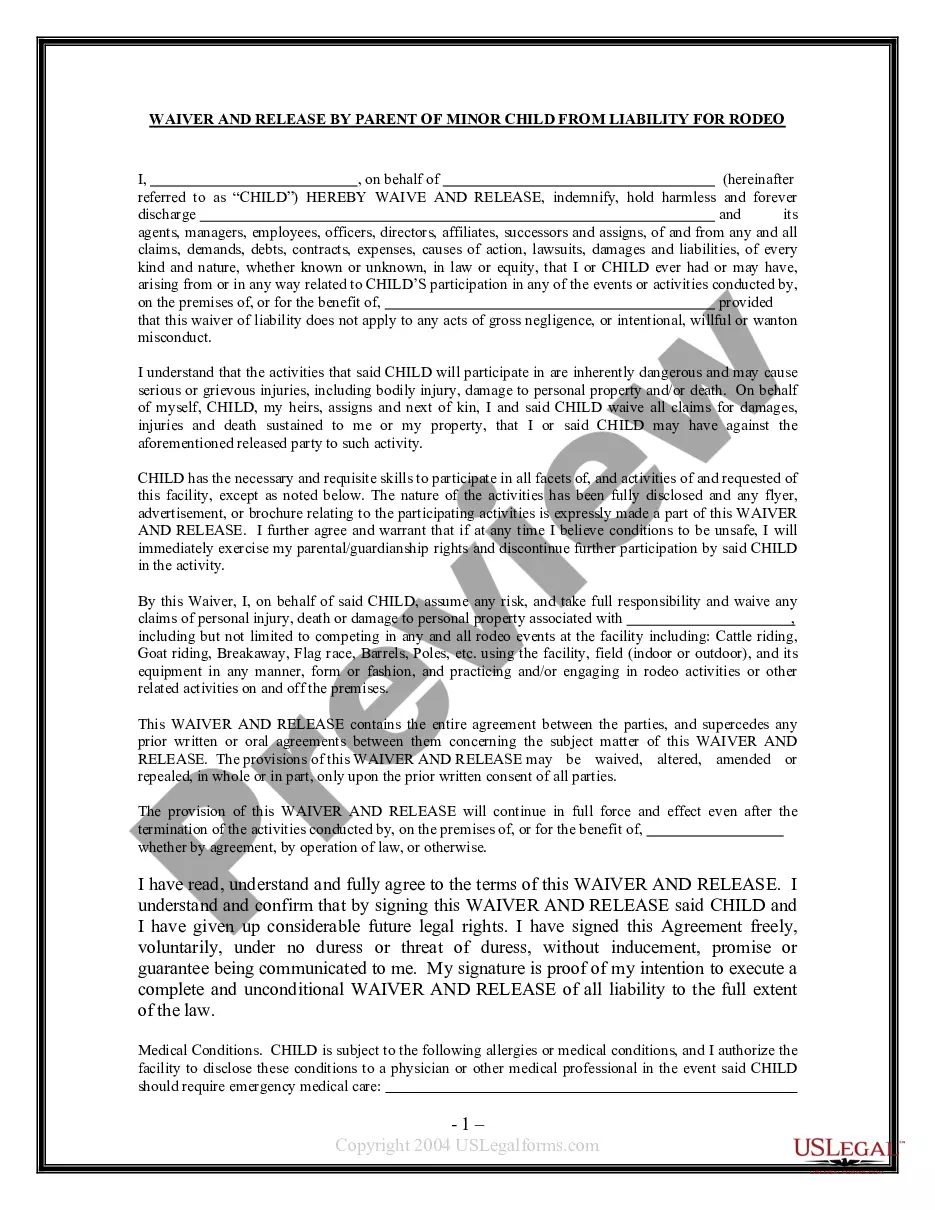
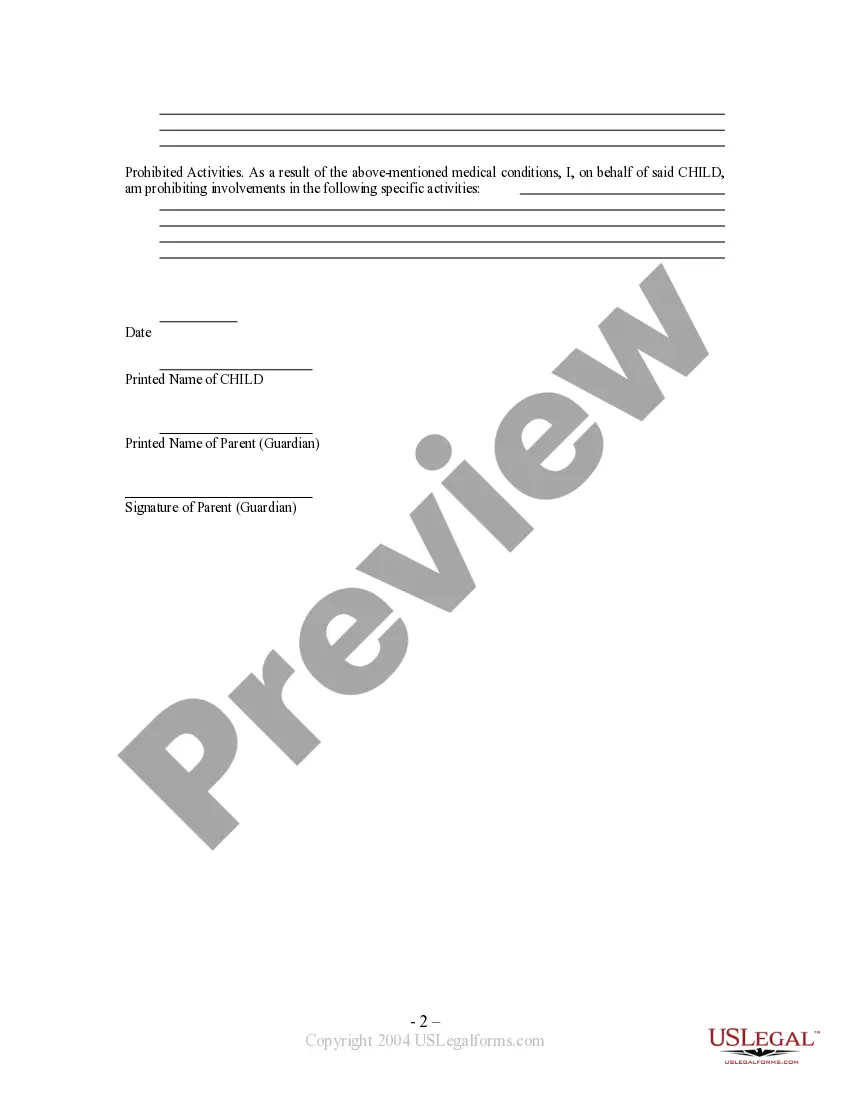
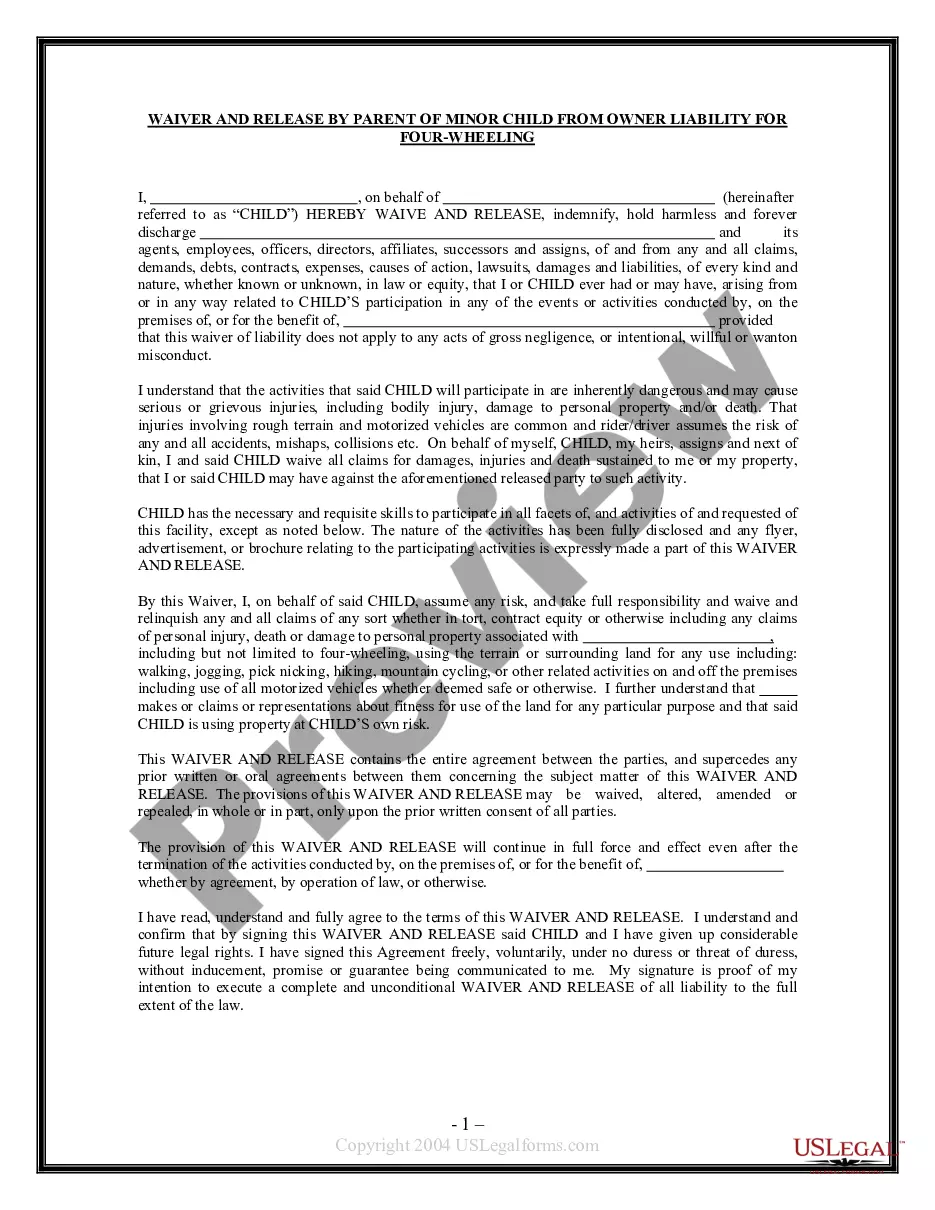
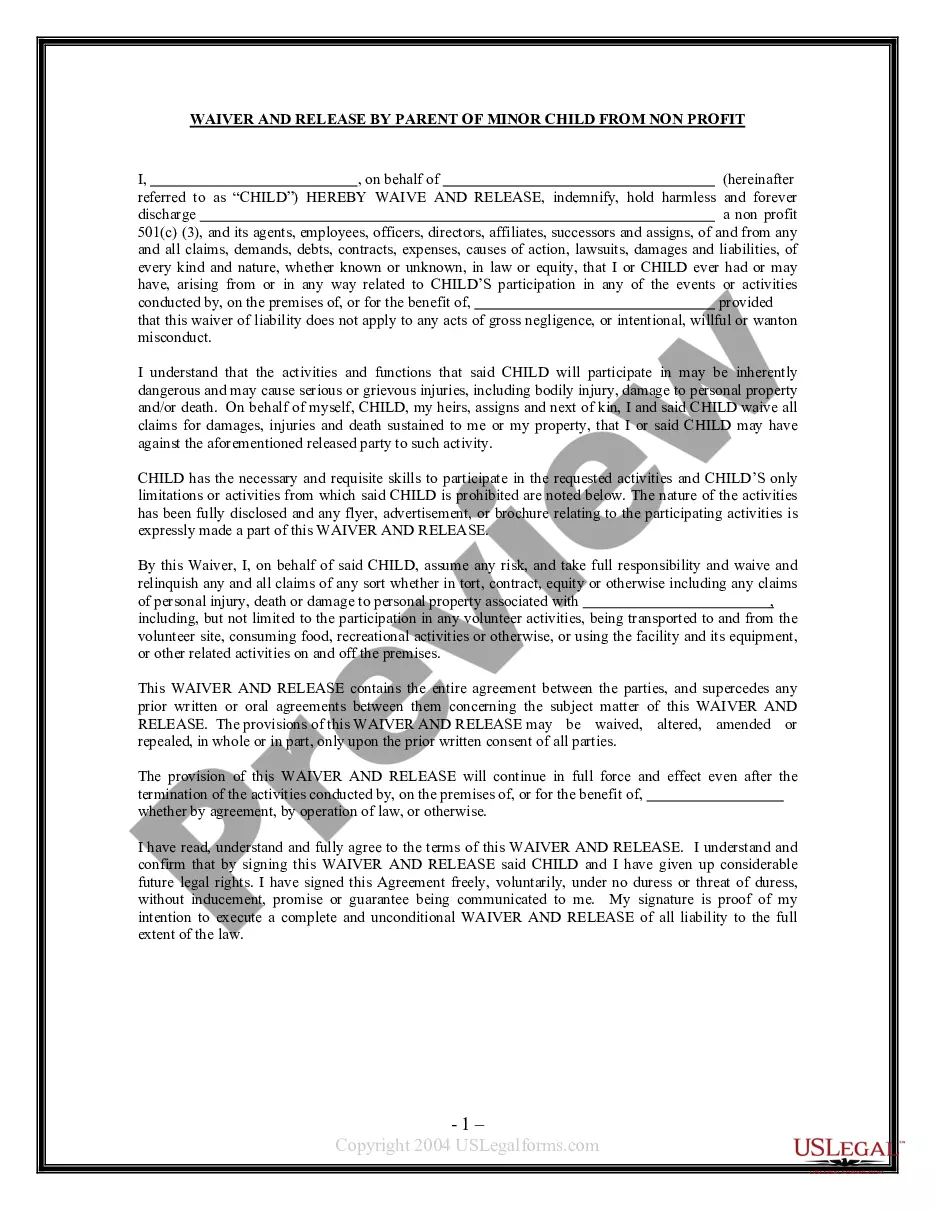
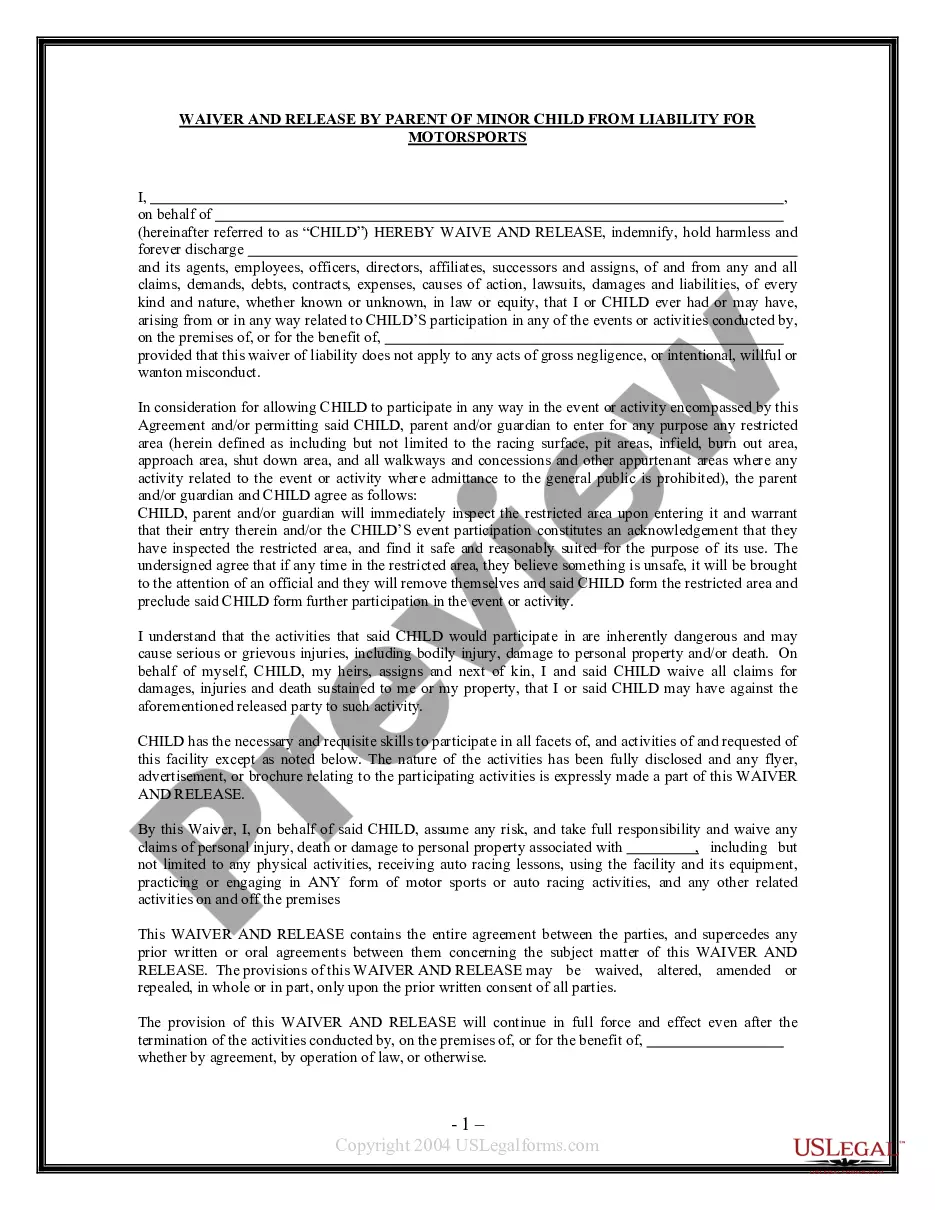
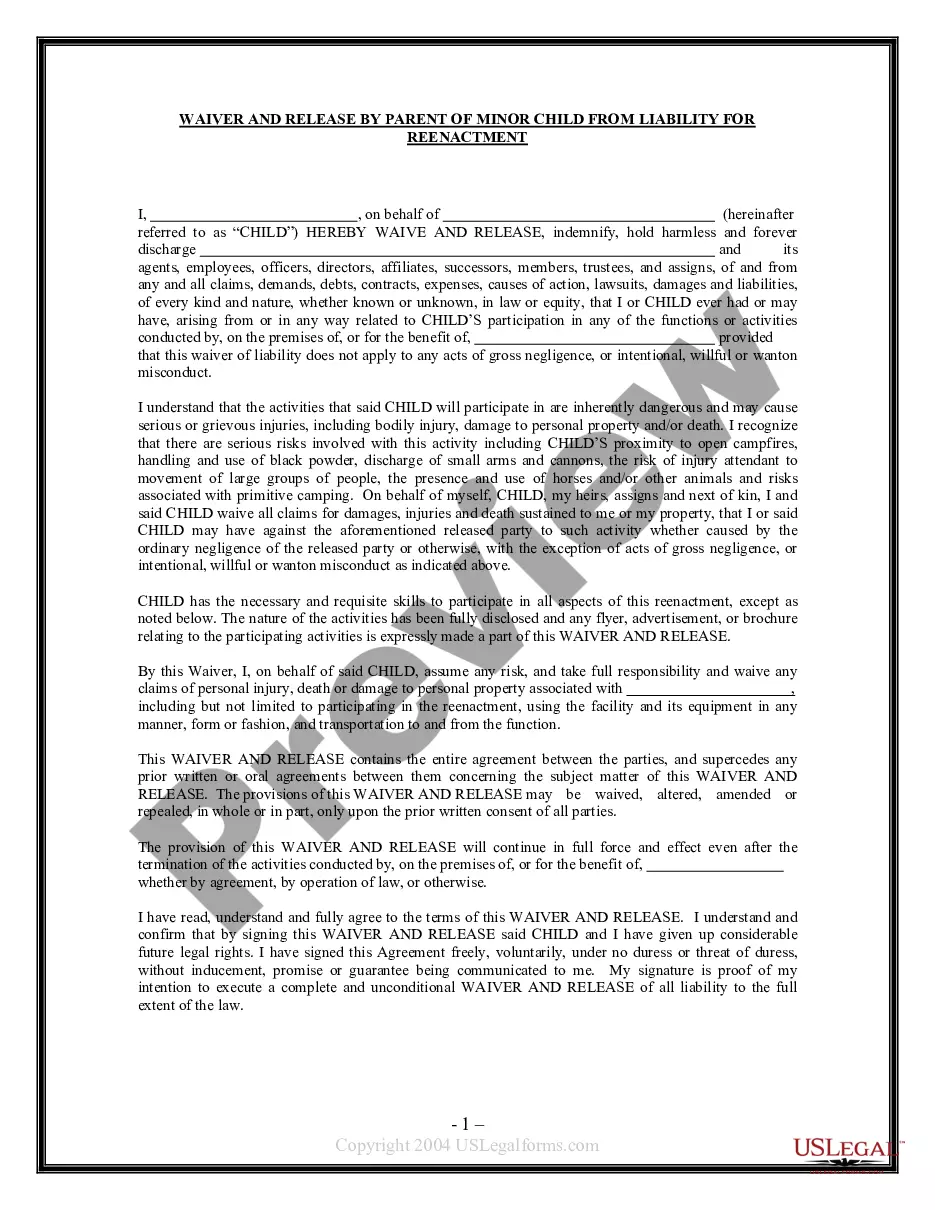
This form allows a parent or guardian to release a rodeo facility from liability for injuries which may be incurred by a minor child while on the premises, taking part in activities, etc.
Illinois Waiver and Release From Liability For Minor Child for Rodeo
Category:
State:
Multi-State
Control #:
US-WAV-49M
Format:
Word;
Rich Text
Instant download
Description
Free preview
How to fill out Waiver And Release From Liability For Minor Child For Rodeo?
If you wish to finalize, obtain, or print legal document templates, utilize US Legal Forms, the largest selection of legal forms available online. Take advantage of the website's user-friendly and efficient search to find the documents you need. Various templates for business and personal use are organized by categories and states, or keywords.
Employ US Legal Forms to acquire the Illinois Waiver and Release From Liability For Minor Child for Rodeo with just a few clicks. If you are already a US Legal Forms user, Log In to your account and click on the Download button to access the Illinois Waiver and Release From Liability For Minor Child for Rodeo. You can also access forms you previously downloaded in the My documents section of your account.
If you are using US Legal Forms for the first time, follow the steps below: Step 1. Ensure you have selected the form for the correct city/state. Step 2. Use the Review option to examine the form’s content. Remember to read the instructions. Step 3. If you are not satisfied with the form, utilize the Search box at the top of the screen to find other versions of the legal document template. Step 4. Once you have found the form you need, click on the Get now button. Choose the pricing plan you prefer and enter your details to register for an account. Step 5. Complete the transaction. You can use your credit card or PayPal account to process the payment. Step 6. Select the format of the legal document and download it to your device. Step 7. Fill out, modify, and print or sign the Illinois Waiver and Release From Liability For Minor Child for Rodeo.
- Every legal document template you obtain is yours indefinitely.
- You will have access to all forms you downloaded within your account.
- Click the My documents section and select a form to print or download again.
- Compete and download, and print the Illinois Waiver and Release From Liability For Minor Child for Rodeo with US Legal Forms.
- There are millions of professional and state-specific forms you may utilize for your business or personal needs.
Form popularity
FAQ
A release and waiver agreement is an enforceable promise not to pursue legal action in exchange for compensation. The releasee gives money or some other form of compensation to the releasor, who then agrees not to press charges, sue, or take any other legal action against the releasee.
A generic form of release agreement for use when parties to a commercial contract are terminating or have terminated the contract (or a portion of it) and have agreed to deliver a mutual release of claims. This Standard Document has integrated notes with important explanations and drafting tips.
An agreement of release will only be enforceable if it is valid. Generally, release agreements are valid and enforceable under circumstances such as: When the attempt to excuse one party from liability is expressed in clear, definite, and unambiguous language in the agreement.
Waiver and release refers to the waiving of rights or privileges and the release of a party from their obligations or rights.
A minor usually cannot legally release his or her rights. Only the minor's parent or guardian can do so. So, a release signed only by the minor is not enforceable. In addition, the release must be signed before any injury has occurred.
A release form, or general release form, is a legal document that serves as consent in writing to release the legal liability of a releasee by a releasor.
Components of a waiverGet help. Writing a waiver should not be complicated.Use the correct structure. Waivers should be written in a certain structure.Proper formatting.Include a subject line.Include a caution!Talk about the activity risks.Do not forget an assumption of risk.Hold harmless.More items...?
Release Agreement means an agreement, substantially in a form approved by the Company, pursuant to which Executive releases all current or future claims, known or unknown, arising on or before the date of the release against the Company, its subsidiaries and its officers.
A waiver is a legal agreement the primary purpose of which is to let you or another party modify or relinquish a right, privilege, or claim. The agreement can be a separate document on its own, such as if you sign a waiver form, or added to a contract as a waiver clause.
The main difference between releases and waivers is the transferring of ownership. When rights are released, they are transferred to another party. When rights are waived, they are gone altogether. If intellectual property rights are waived, the IP can be used by any other party that has access to it.