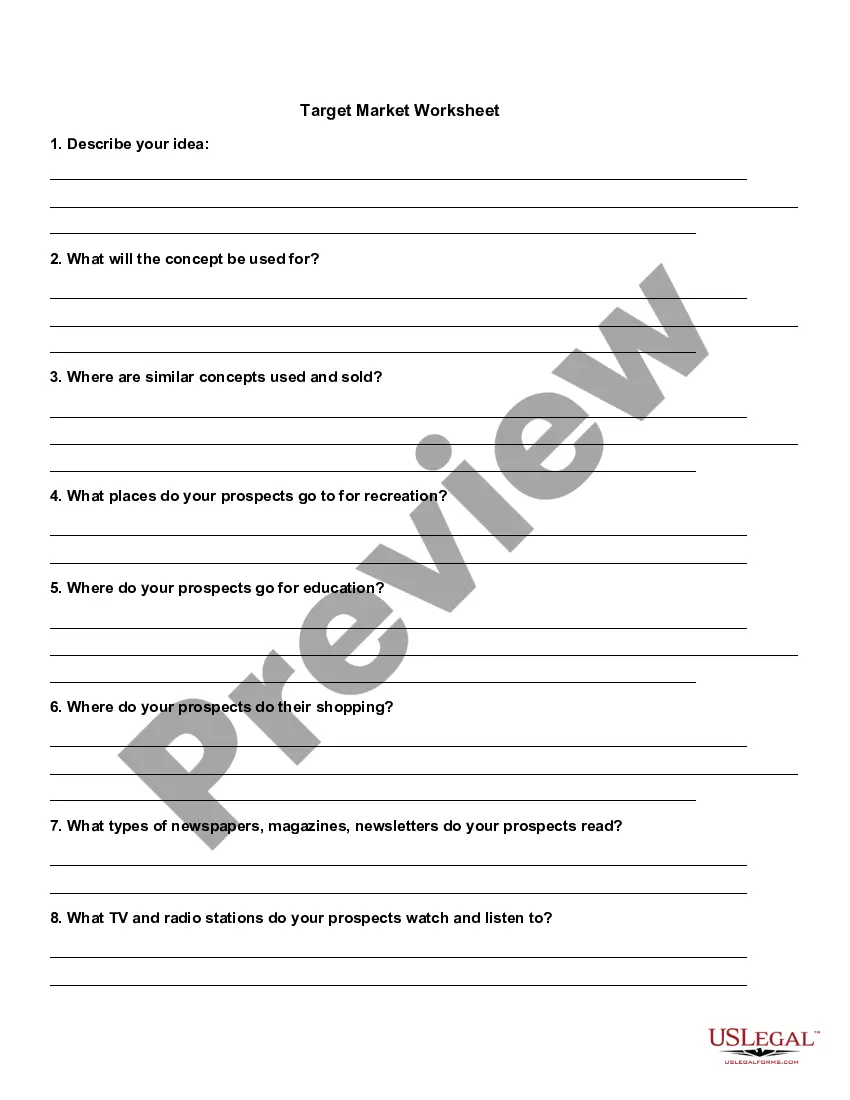
Illinois Target Market Worksheet
Description
Get your form ready online
Our built-in tools help you complete, sign, share, and store your documents in one place.
Make edits, fill in missing information, and update formatting in US Legal Forms—just like you would in MS Word.
Download a copy, print it, send it by email, or mail it via USPS—whatever works best for your next step.
Sign and collect signatures with our SignNow integration. Send to multiple recipients, set reminders, and more. Go Premium to unlock E-Sign.
If this form requires notarization, complete it online through a secure video call—no need to meet a notary in person or wait for an appointment.
We protect your documents and personal data by following strict security and privacy standards.

Make edits, fill in missing information, and update formatting in US Legal Forms—just like you would in MS Word.

Download a copy, print it, send it by email, or mail it via USPS—whatever works best for your next step.

Sign and collect signatures with our SignNow integration. Send to multiple recipients, set reminders, and more. Go Premium to unlock E-Sign.

If this form requires notarization, complete it online through a secure video call—no need to meet a notary in person or wait for an appointment.

We protect your documents and personal data by following strict security and privacy standards.
Looking for another form?

How to fill out Target Market Worksheet?
You have the capability to invest hours online searching for the legal document template that meets the federal and state requirements you desire.
US Legal Forms provides a vast selection of legal forms that have been reviewed by professionals.
You can download or print the Illinois Target Market Worksheet from their service.
If available, use the Preview button to review the document template as well.
- If you already have a US Legal Forms account, you can Log In and then click the Download button.
- Afterwards, you can complete, modify, print, or sign the Illinois Target Market Worksheet.
- Each legal document template you acquire is yours permanently.
- To obtain another copy of the purchased form, go to the My documents section and click the relevant button.
- If you are using the US Legal Forms website for the first time, follow the simple instructions outlined below.
- First, confirm that you have chosen the correct document template for your county/region of choice.
- Read the form description to ensure you have selected the appropriate form.
Form popularity
FAQ
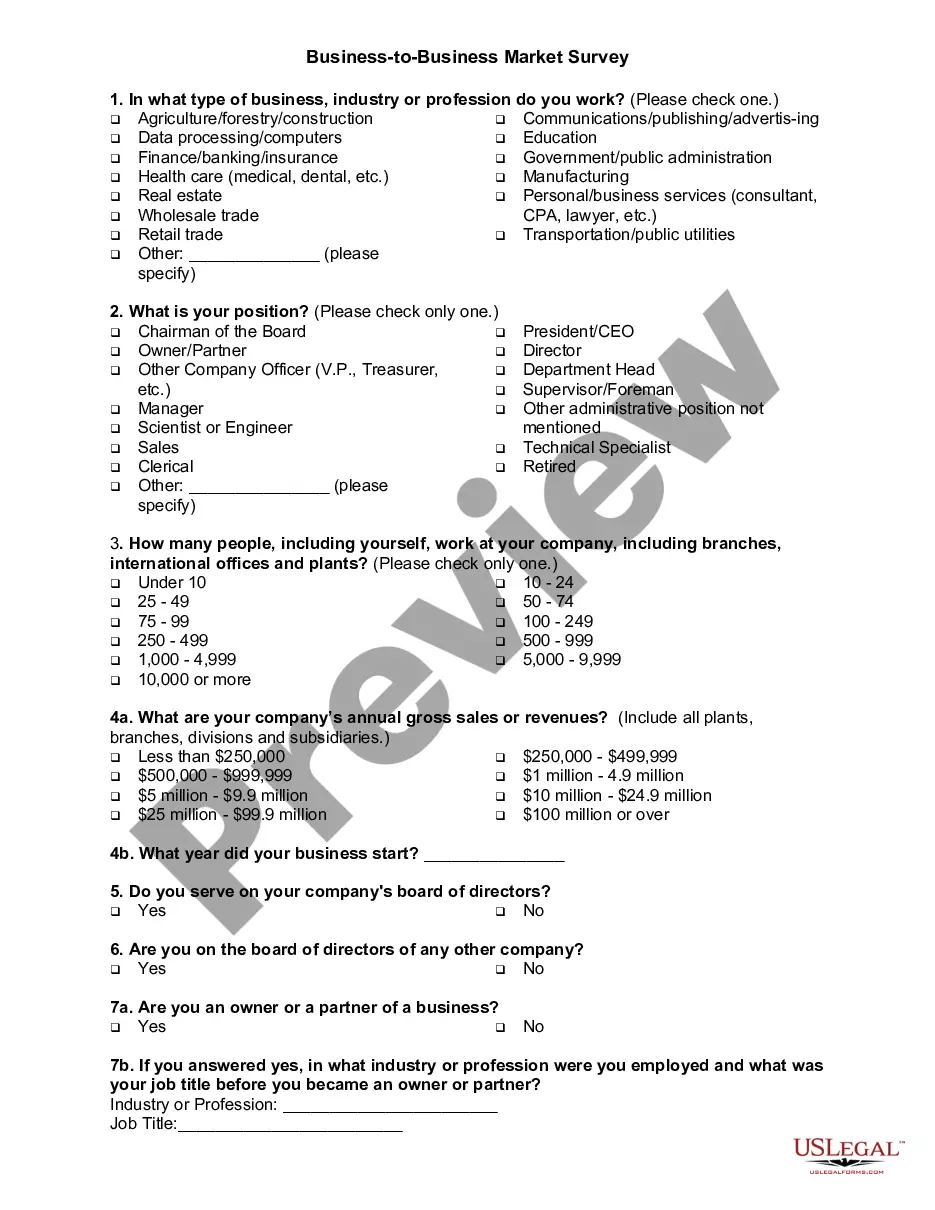
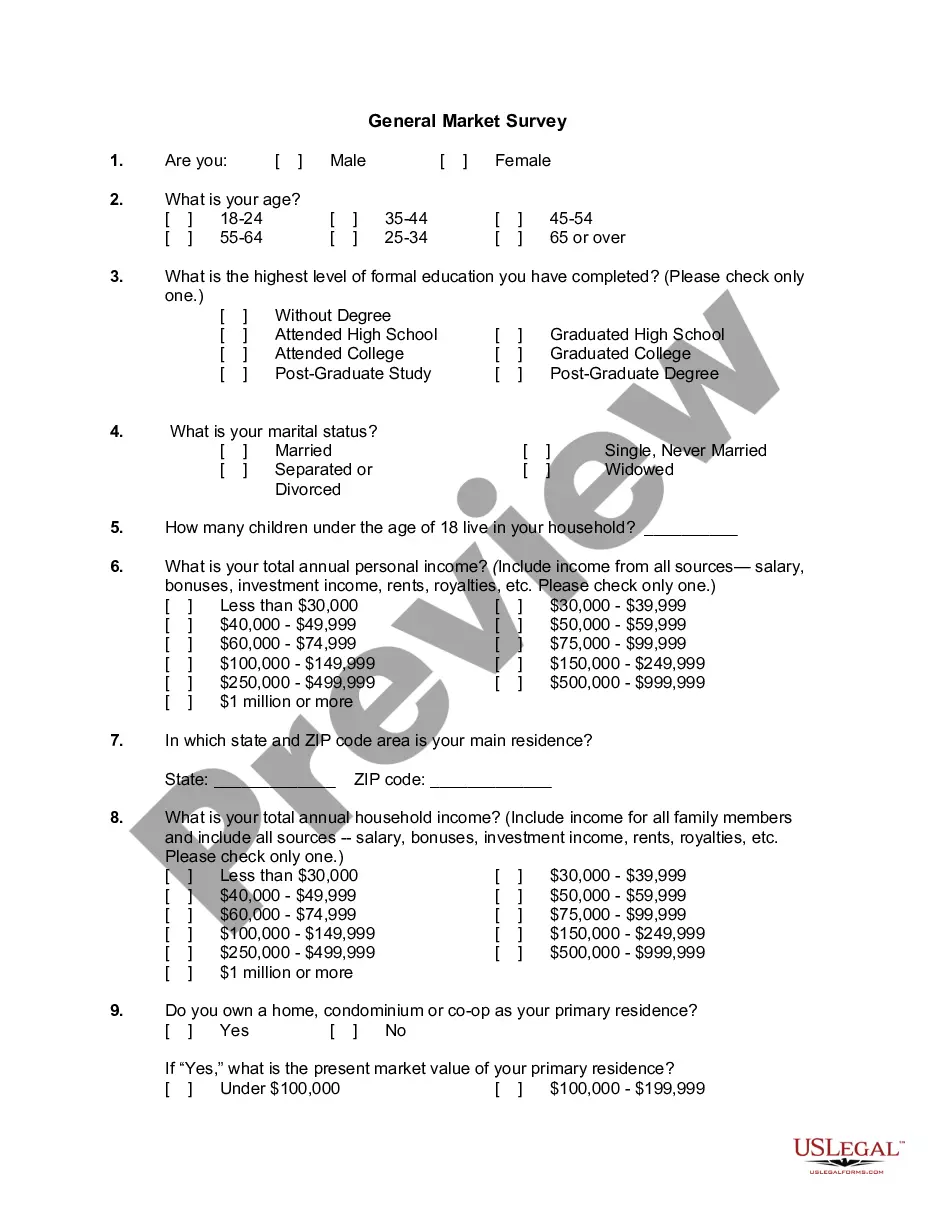
What is a target market? A target market is a group of potential customers that you identify to sell products or services to. Each group can be divided into smaller segments. Segments are typically grouped by age, location, income and lifestyle.
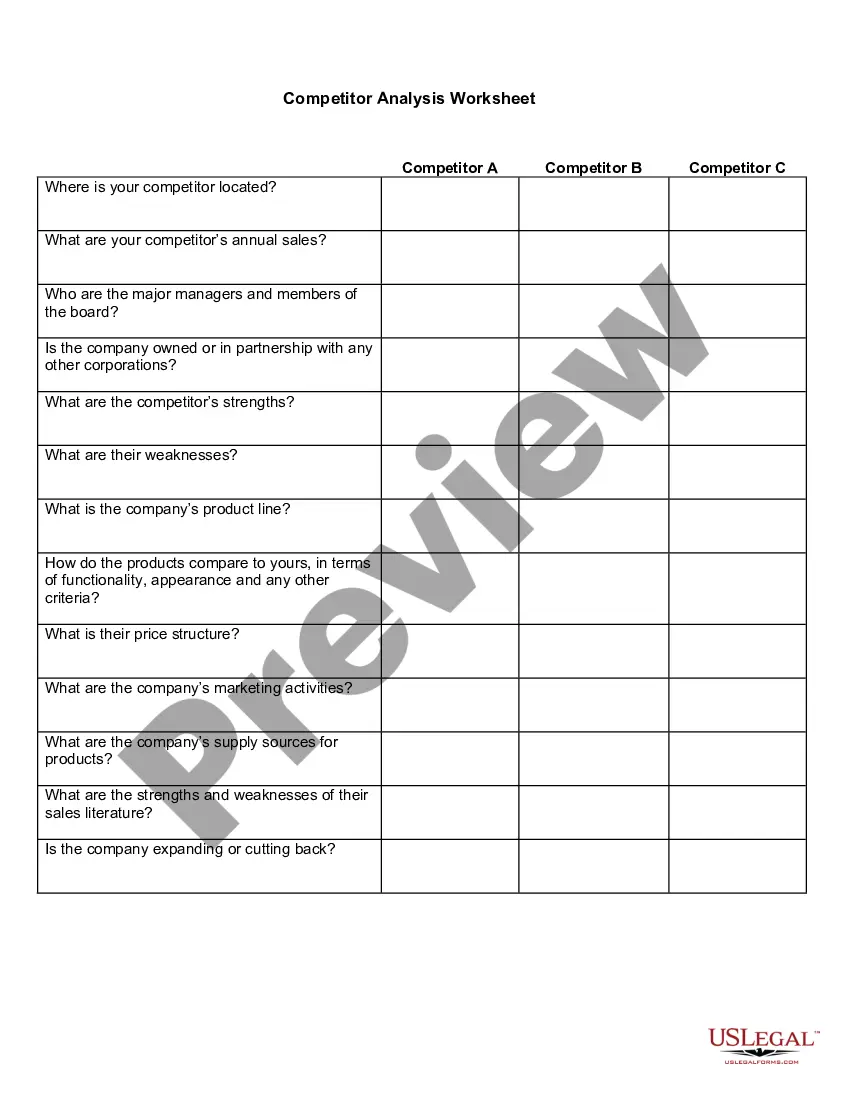
How to identify your target marketAnalyze your offerings. Ask yourself what problems your products and services solve, and, in turn, to whom they appeal.Conduct market research.Create customer profiles and market segments.Assess the competition.
For example, a children's toy may have boys ages 911 as the target market and the boys' parents as the target audience. It may also be defined as the consumer segment most likely to be influenced by an advertising campaign. The target market is also distinct from the buyer persona.
These include gender, age, income level, race, education, religion, marital status, and geographic location. Consumers with the same demographics tend to value the same products and services, which is why narrowing down the segments is one of the most important factors to determine target markets.
What is demographic segmentation? Definition: Demographic segmentation groups customers and potential customers together by focusing on certain traits such as age, gender, income, occupation & family status.
Demographic segmentation: age, gender, education, marital status, race, religion, etc. Psychographic segmentation: values, beliefs, interests, personality, lifestyle, etc. Behavioral segmentation: purchasing or spending habits, user status, brand interactions, etc.
A target market is a group of customers with shared demographics who have been identified as the most likely buyers of a company's product or service. Identifying the target market is important for any company in the development and implementation of a successful marketing plan.
For example, a children's toy may have boys ages 911 as the target market and the boys' parents as the target audience. It may also be defined as the consumer segment most likely to be influenced by an advertising campaign. The target market is also distinct from the buyer persona.
How to identify your target marketAnalyze your offerings. Ask yourself what problems your products and services solve, and, in turn, to whom they appeal.Conduct market research.Create customer profiles and market segments.Assess the competition.
Demographics are simply a particular section of a population. You can segment your target market using demographics such as age, location, gender, marital or family status, occupation, income level, education level, etc.