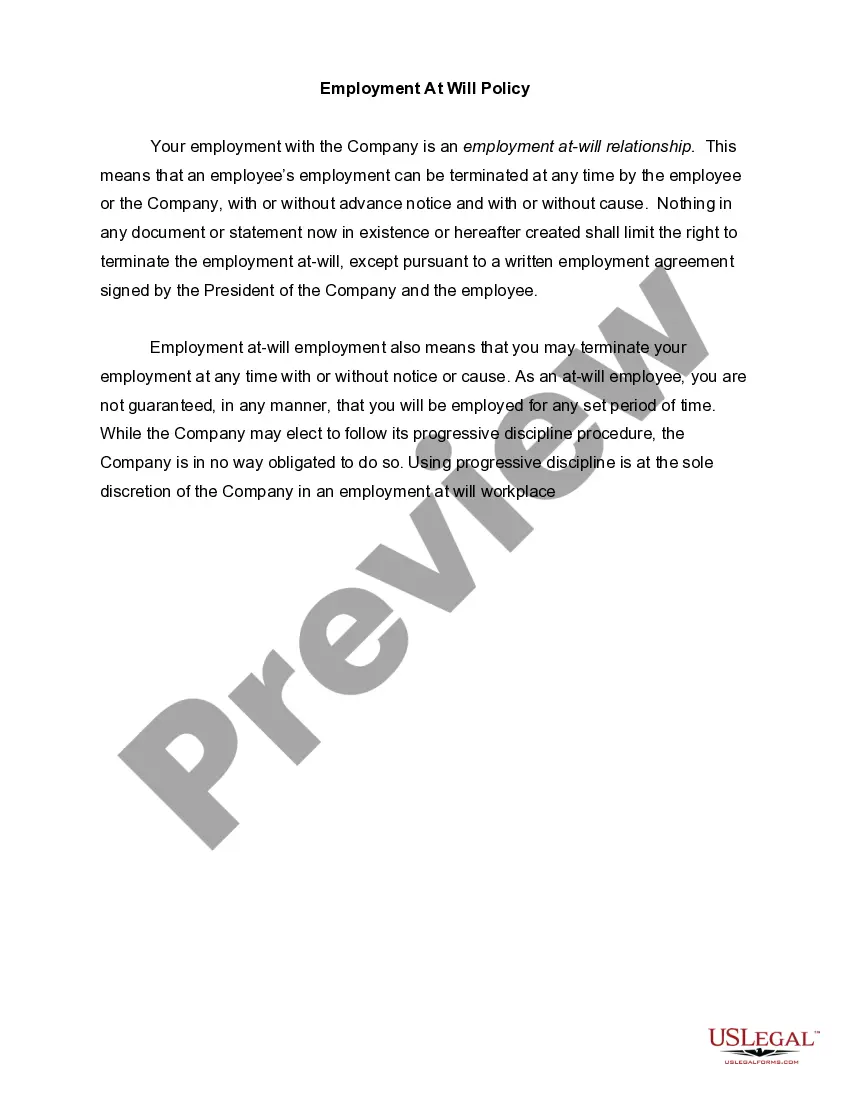
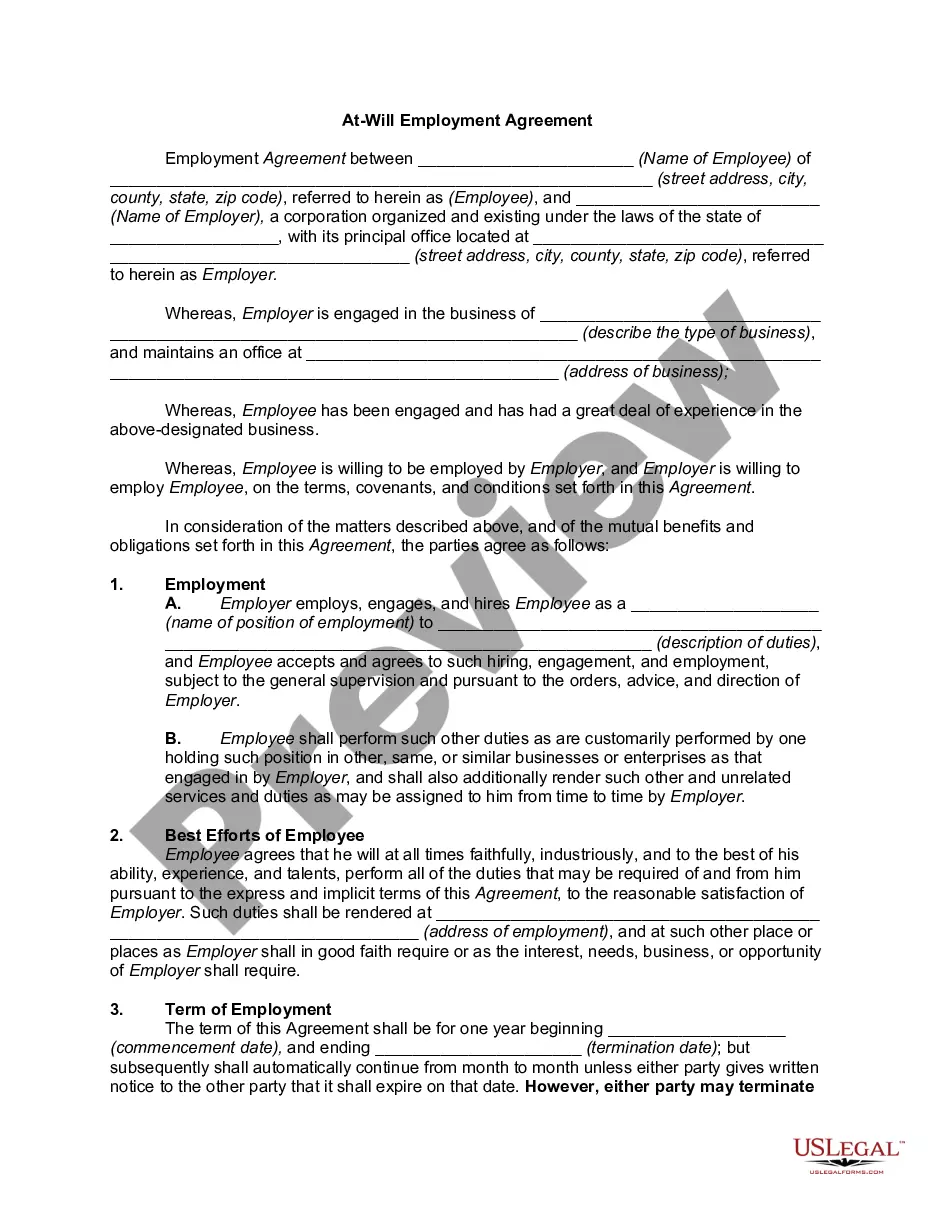
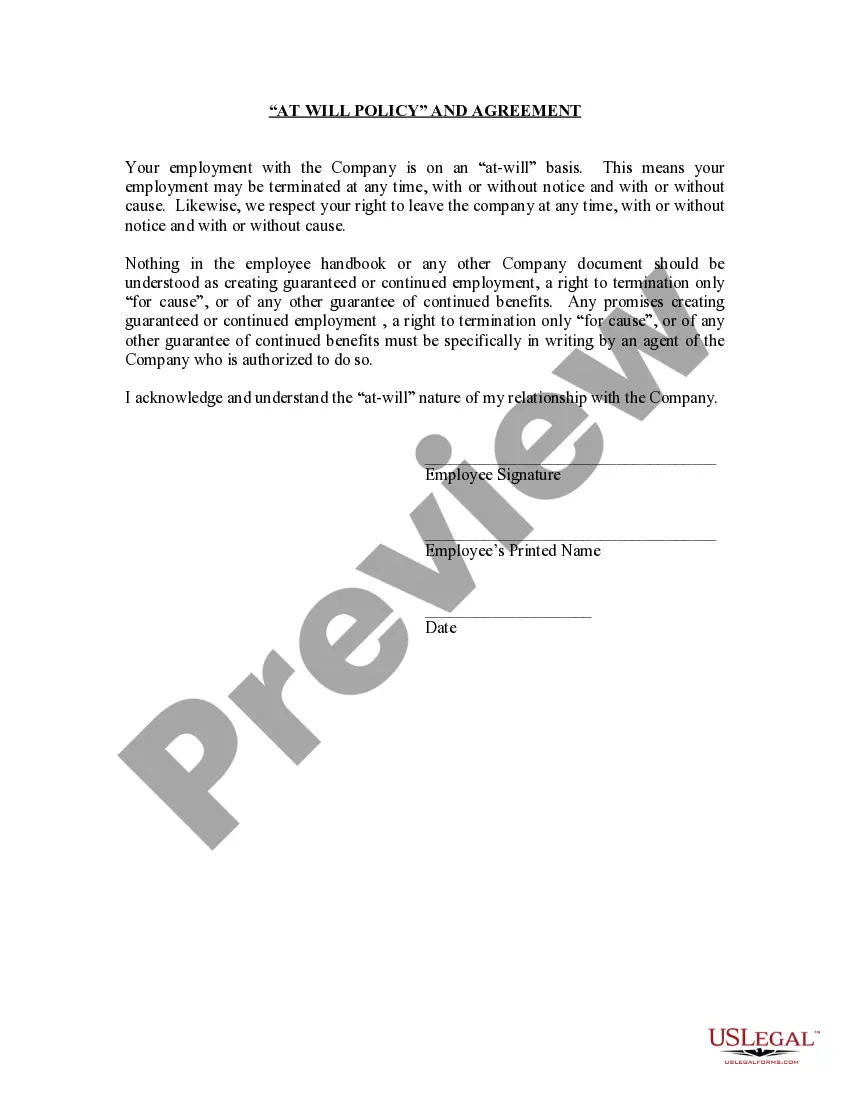
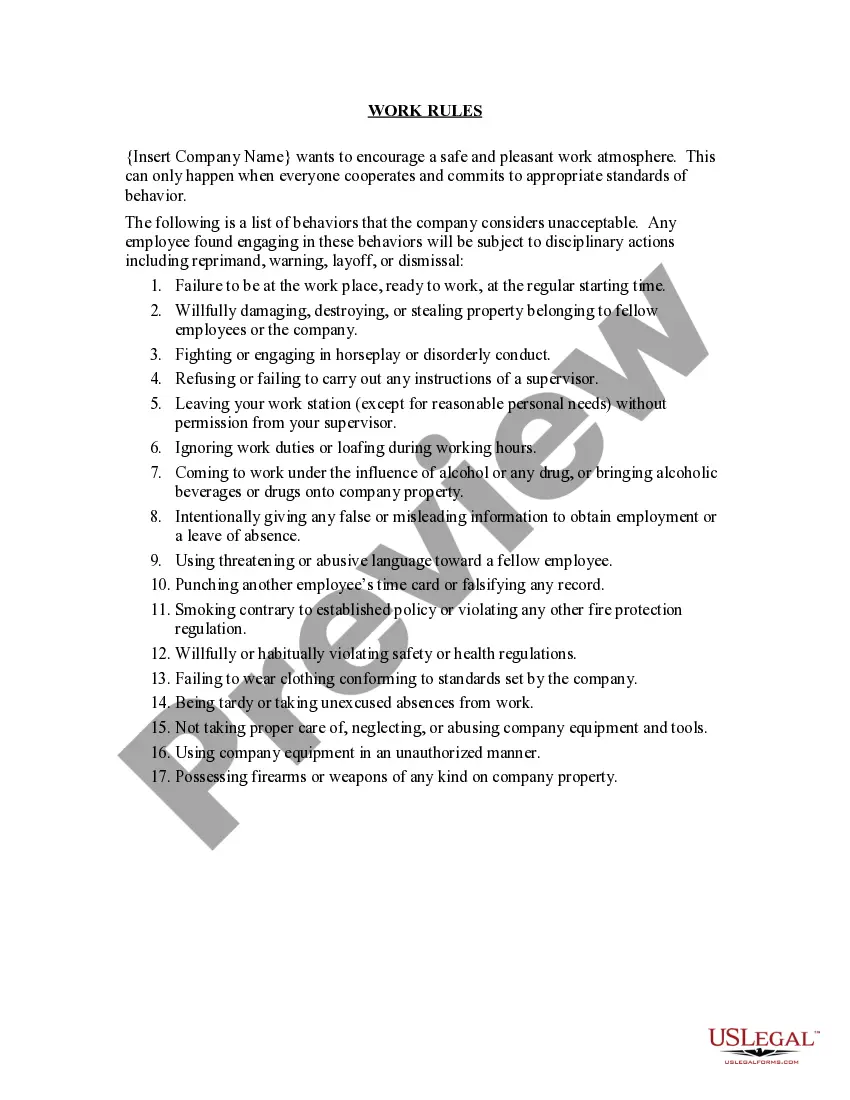
Illinois Employment At Will Policy
Description
Get your form ready online
Our built-in tools help you complete, sign, share, and store your documents in one place.
Make edits, fill in missing information, and update formatting in US Legal Forms—just like you would in MS Word.
Download a copy, print it, send it by email, or mail it via USPS—whatever works best for your next step.
Sign and collect signatures with our SignNow integration. Send to multiple recipients, set reminders, and more. Go Premium to unlock E-Sign.
If this form requires notarization, complete it online through a secure video call—no need to meet a notary in person or wait for an appointment.
We protect your documents and personal data by following strict security and privacy standards.

Make edits, fill in missing information, and update formatting in US Legal Forms—just like you would in MS Word.

Download a copy, print it, send it by email, or mail it via USPS—whatever works best for your next step.

Sign and collect signatures with our SignNow integration. Send to multiple recipients, set reminders, and more. Go Premium to unlock E-Sign.

If this form requires notarization, complete it online through a secure video call—no need to meet a notary in person or wait for an appointment.

We protect your documents and personal data by following strict security and privacy standards.
Looking for another form?
How to fill out Employment At Will Policy?
US Legal Forms - one of the largest collections of legal documents in the United States - provides a vast array of legal document templates that you can download or create.
By using the website, you can access thousands of forms for both business and personal purposes, organized by categories, states, or keywords.
You can obtain the latest versions of forms such as the Illinois Employment At Will Policy in just moments.
Click the Review button to examine the form's details. Read the form description to ensure you have chosen the right document.
If the form does not suit your needs, use the Search box at the top of the screen to find one that does.
- If you already have a monthly subscription, Log In to access the Illinois Employment At Will Policy from your US Legal Forms library.
- The Download button will be visible on every form you view.
- You can access all previously downloaded forms in the My documents section of your account.
- If you are using US Legal Forms for the first time, here are simple steps to help you get started.
- Make sure you have selected the correct form for your locality/region.
Form popularity
FAQ
Wrongful termination in Illinois occurs when an employee is fired for unlawful reasons, violating federal or state laws. These reasons include discrimination, retaliation for whistleblowing, or violation of public policy. Although the Illinois Employment At Will Policy allows for most terminations, it still respects employee rights regarding unlawful actions. If you suspect wrongful termination, US Legal Forms offers solutions to understand your rights and take necessary actions.
Under the Illinois Employment At Will Policy, an employer can terminate an employee without prior notice. This policy means that employers have the right to dismiss employees for almost any reason, as long as it is not illegal. However, it’s essential to understand that employees can also quit without notice, making this flexibility a two-way street. If you feel your termination was unjust, consider exploring legal options or consulting resources available at US Legal Forms.
One significant concept that serves as an exception to the employment-at-will doctrine is the implied contract theory. Under the Illinois Employment At Will Policy, this means that if an employer has made verbal or written representations about job security, employees may have grounds for claiming wrongful termination. Awareness of this concept helps both parties understand their rights and responsibilities in the employment relationship.
The exceptions to the employment-at-will doctrine in the US include federal anti-discrimination laws, whistleblower protections, and contractual agreements that establish specific conditions for termination. Under the Illinois Employment At Will Policy, recognizing these exceptions is crucial for employers to avoid legal repercussions. Employees should also be aware of their rights to ensure fair treatment in the workplace.
The exception to the employment-at-will doctrine typically includes wrongful termination claims based on discrimination, retaliation, or violations of public policy. In the context of Illinois Employment At Will Policy, these exceptions serve to protect employees from terminations that are deemed unfair or unlawful. Understanding these exceptions can provide clarity and guidance for both employers and employees navigating the workplace.
Yes, Illinois is an at-will state for employment, meaning that employers can terminate employees at any time, for virtually any reason. However, this flexibility is limited by statutory and common law exceptions, specifically under the Illinois Employment At Will Policy. It's important for both employees and employers in Illinois to understand these exceptions to ensure compliance and protect rights.
The common law exceptions to at-will employment mainly include public policy, implied contract, and the covenant of good faith and fair dealing. Under Illinois Employment At Will Policy, employers cannot terminate employees for reasons that violate public policy, such as refusing to engage in illegal acts. Additionally, if there are circumstances that imply a contract, such as employee handbooks or verbal promises, they can create exceptions to the at-will rule.
An at-will employment policy template outlines the conditions and terms under which an employee can be terminated without cause. This template provides clarity for both employers and employees, ensuring everyone understands their rights and responsibilities. Using a well-structured template can enhance your compliance with the Illinois Employment At Will Policy, and platforms like uslegalforms can offer useful resources for creating one.
In Illinois, there is no set limit on the longest shift an employee can work in a day. However, it is essential for employers to adhere to labor laws regarding breaks and total hours worked. Understanding these regulations is important for maintaining compliance under the Illinois Employment At Will Policy and keeping employees healthy and happy.
The new 7-day law in Illinois requires employers to provide a written notice of termination to employees at least seven days in advance before their job ends. This law is designed to give employees a chance to prepare for their transition. Staying updated with these regulations is important for compliance with the Illinois Employment At Will Policy.