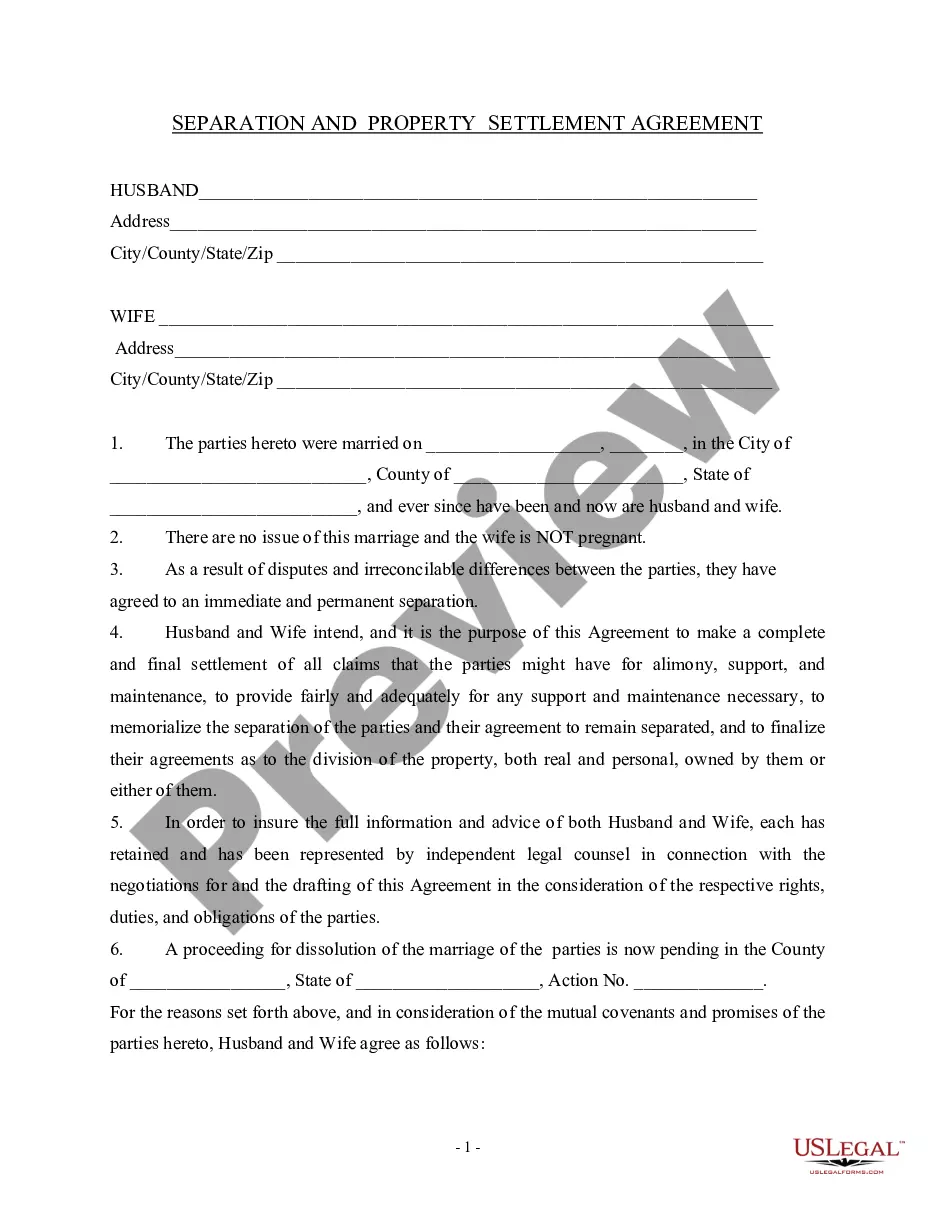
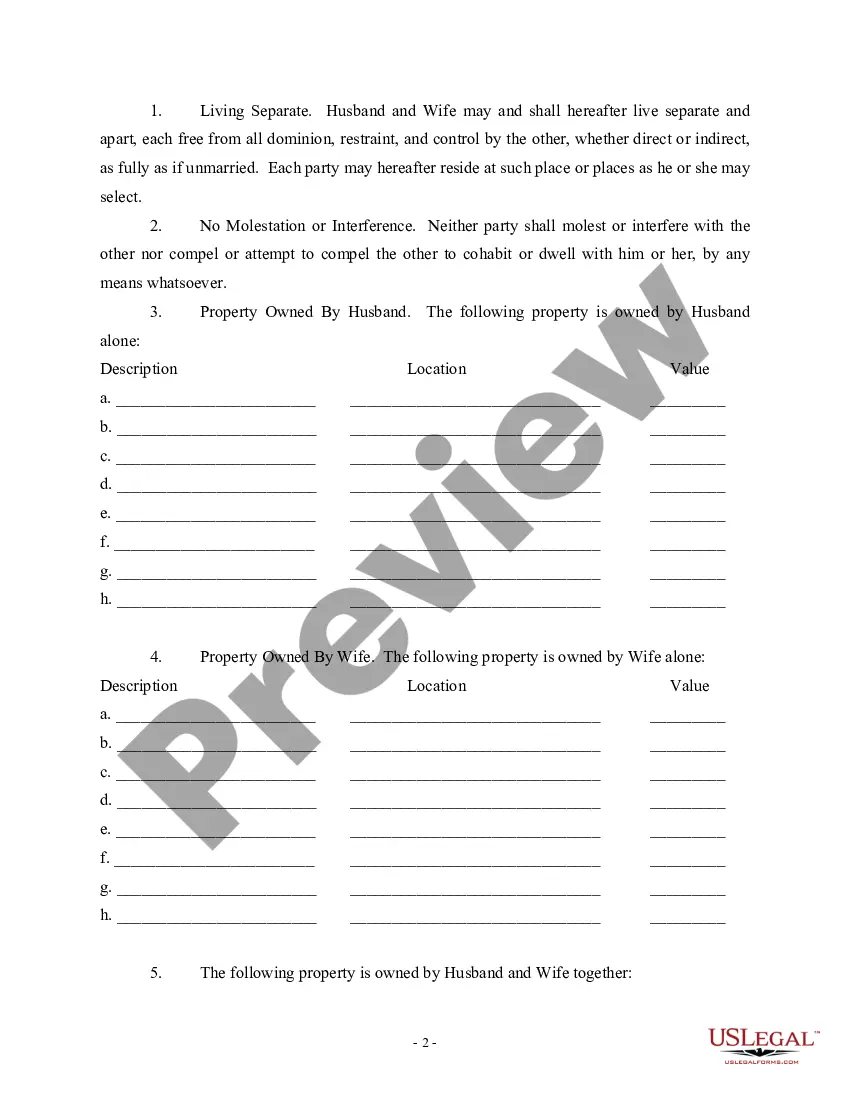
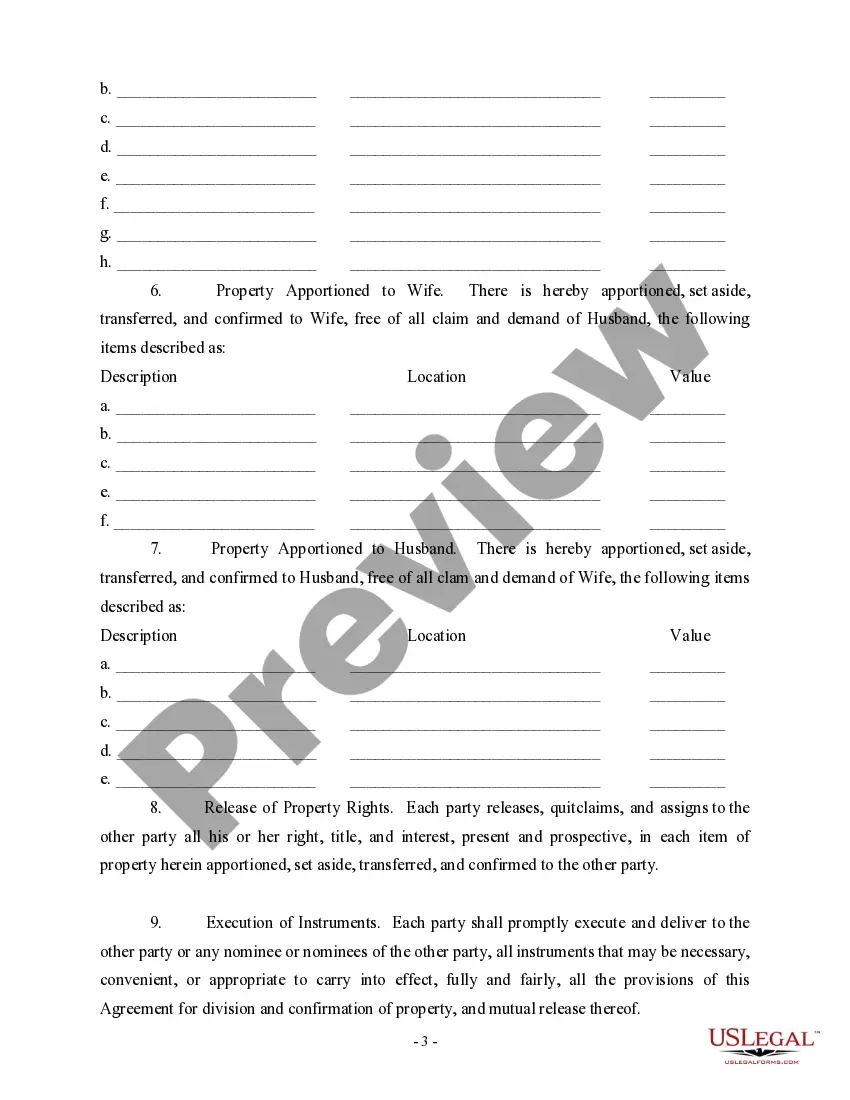
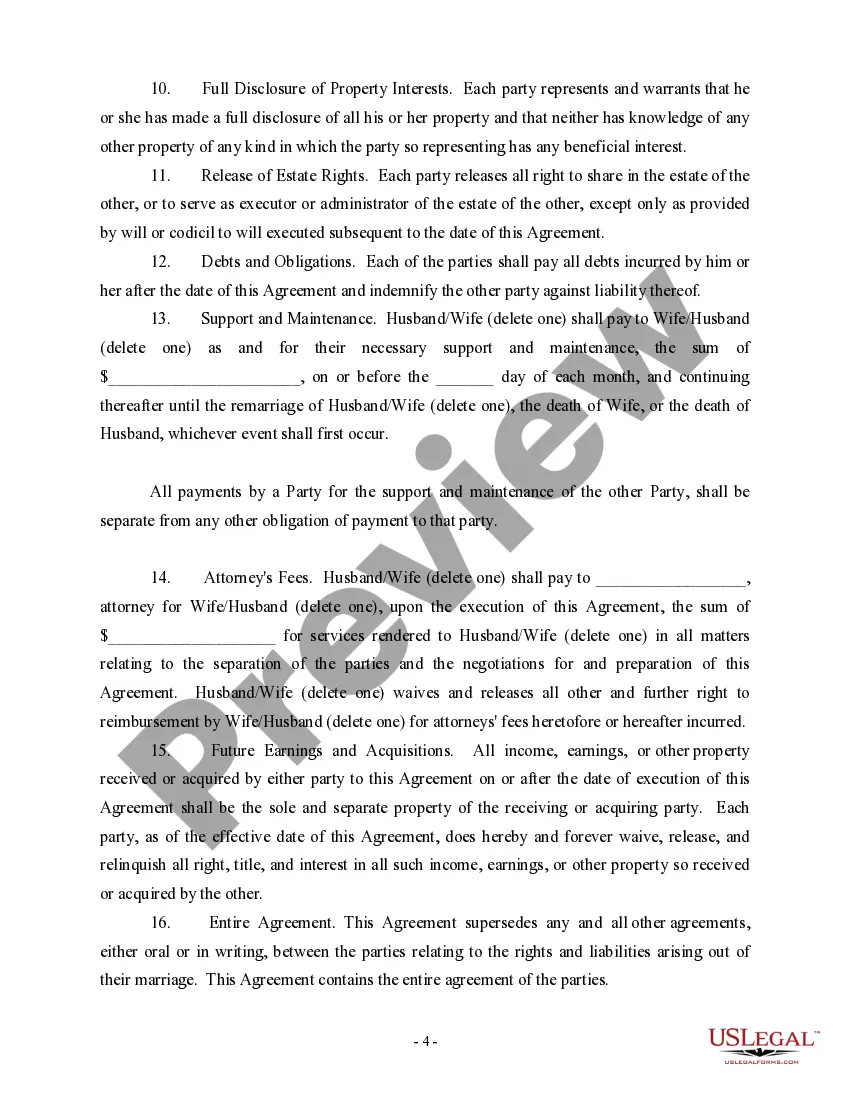
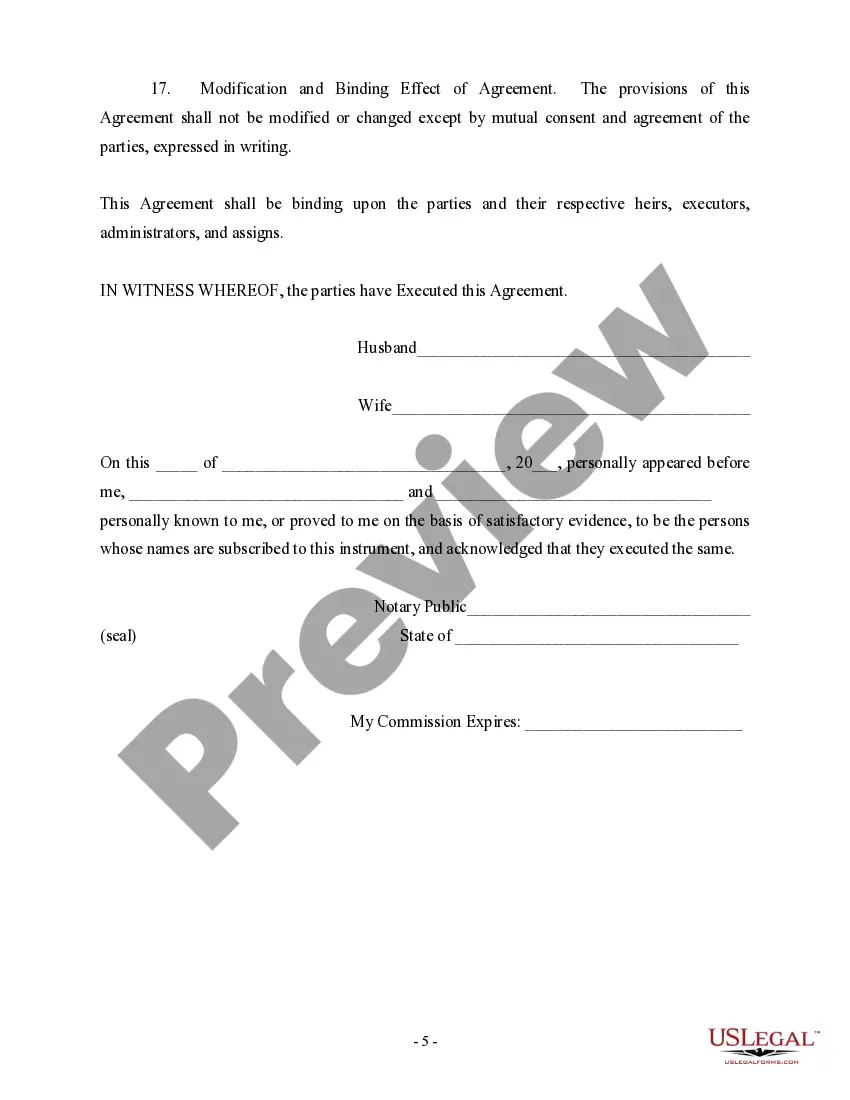
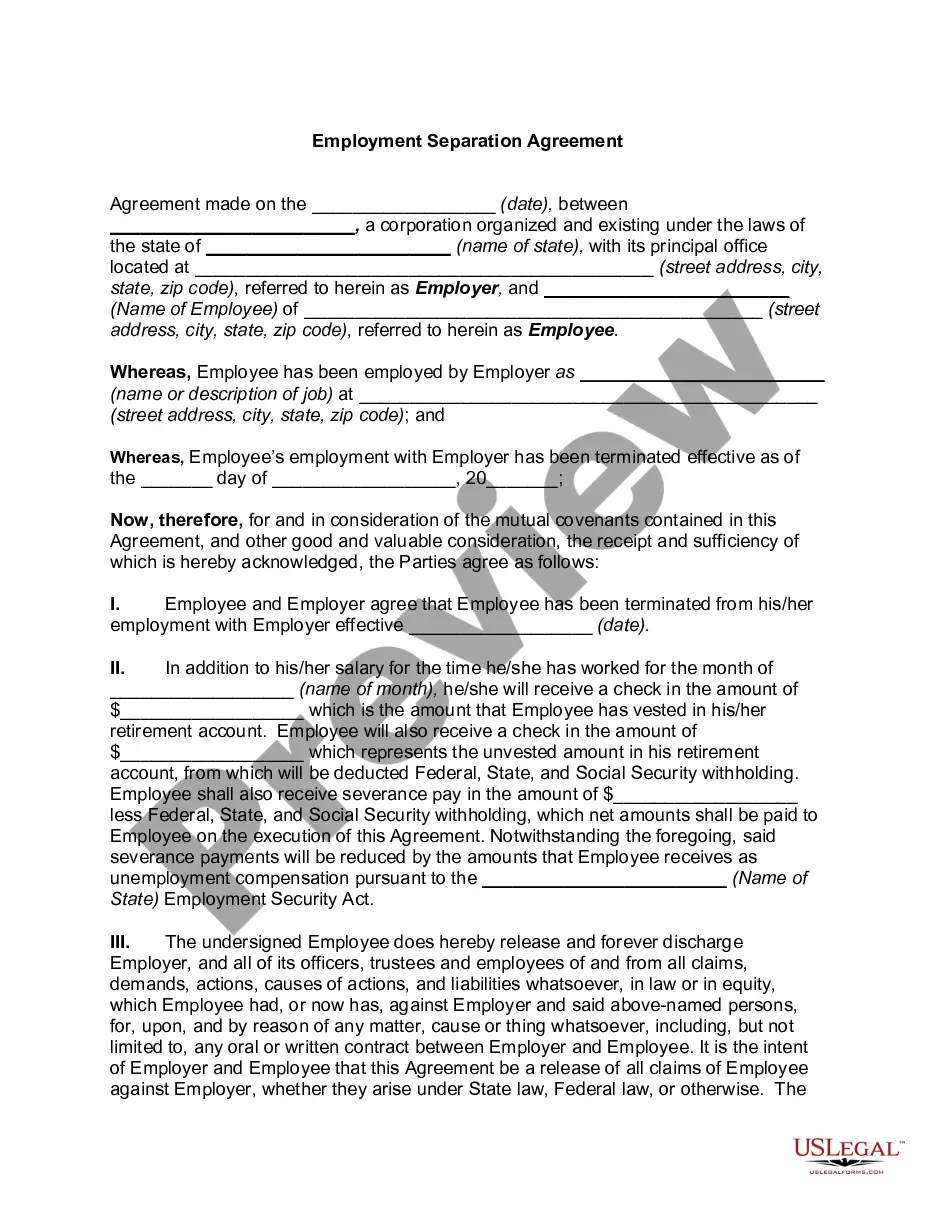
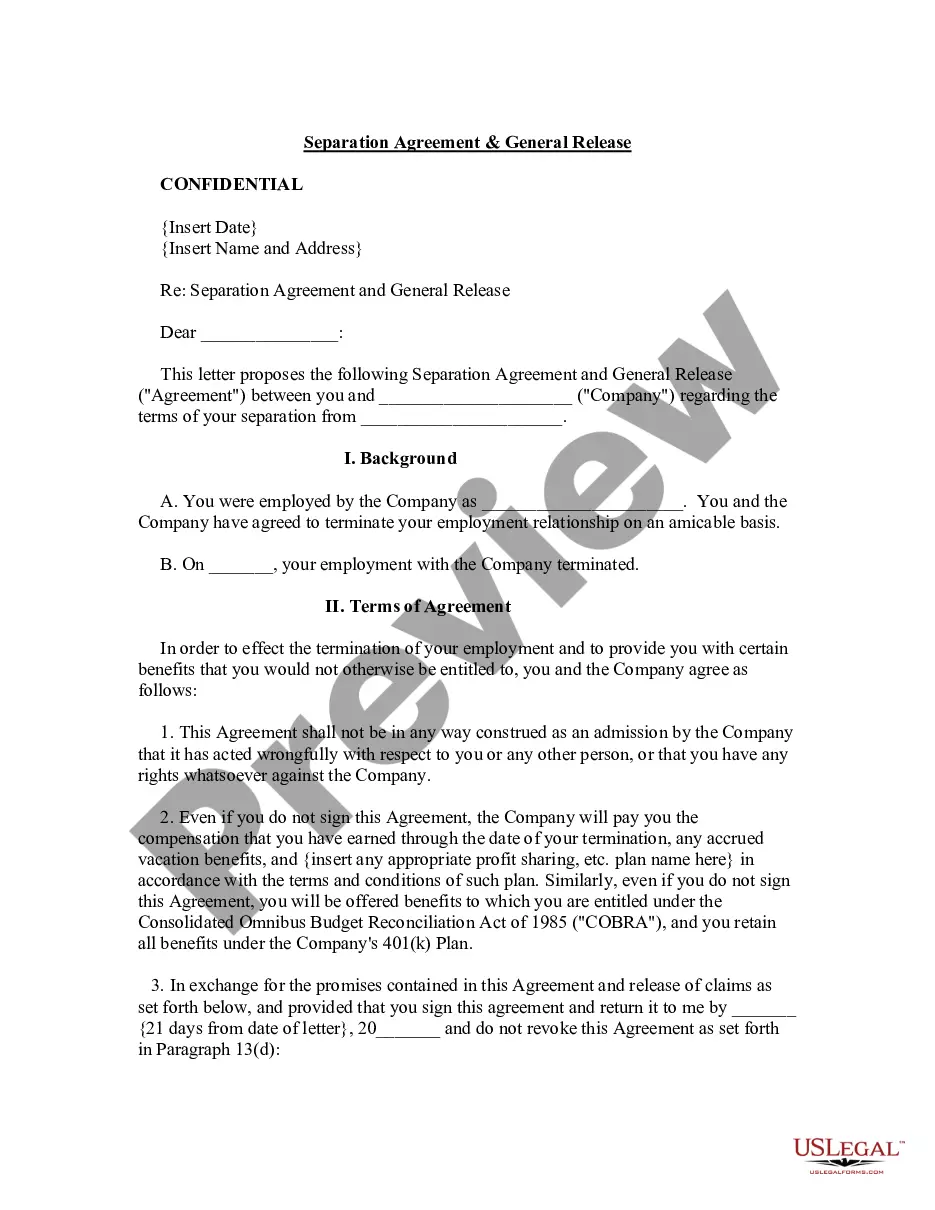
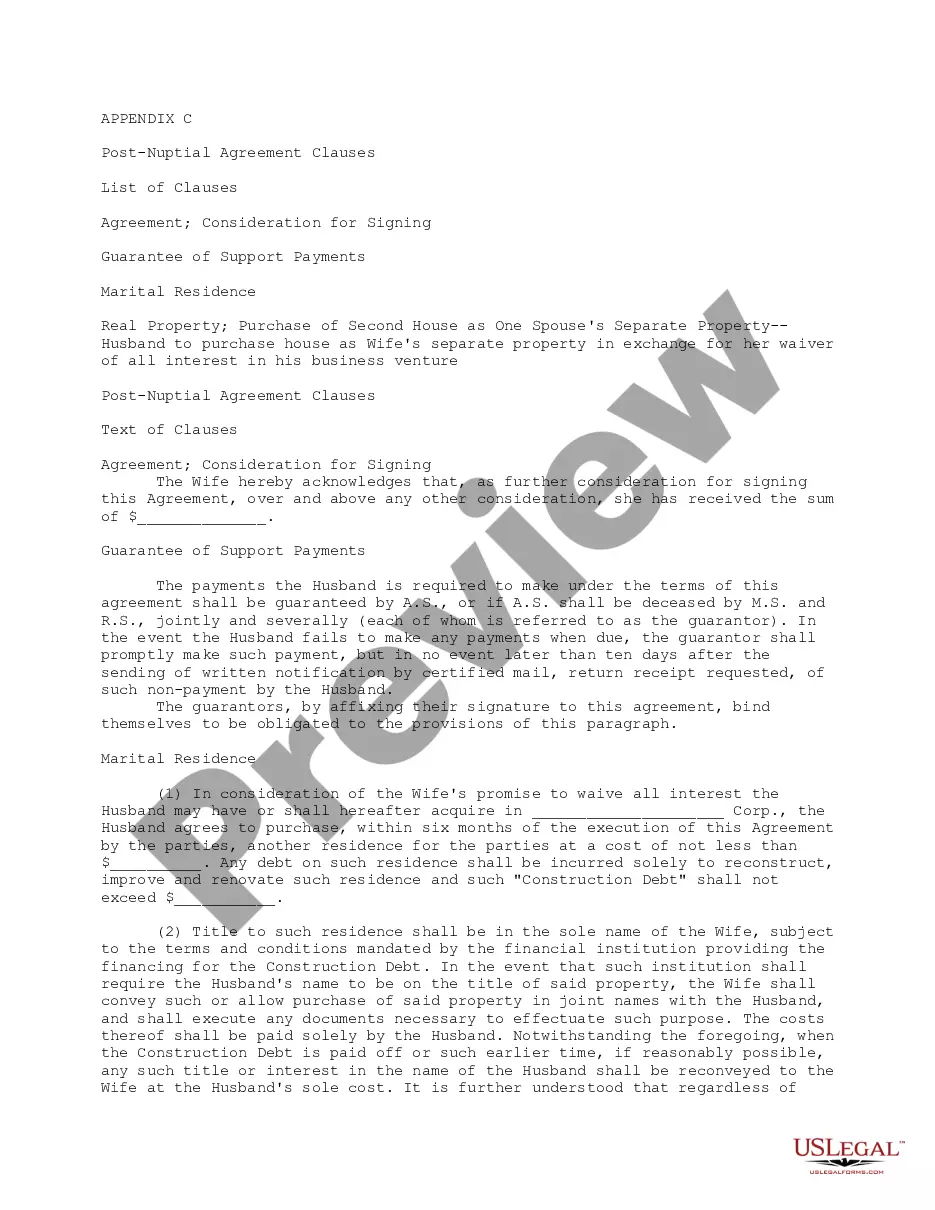
This form is a Separation and Property Settlement Agreement. The parties have agreed to a separation due to irreconcilable differences. The agreement also apportions certain property items between the parties. Each party agrees to release and quitclaim his/her right, title, and interest in each item that is apportioned to the other party.
Illinois Separation and Property Settlement Agreement
Category:
State:
Multi-State
Control #:
US-01714-2-AZ
Format:
Word;
Rich Text
Instant download
Description
Free preview
Get your form ready online
Our built-in tools help you complete, sign, share, and store your documents in one place.
Built-in online Word editor
Make edits, fill in missing information, and update formatting in US Legal Forms—just like you would in MS Word.
Export easily
Download a copy, print it, send it by email, or mail it via USPS—whatever works best for your next step.
E-sign your document
Sign and collect signatures with our SignNow integration. Send to multiple recipients, set reminders, and more. Go Premium to unlock E-Sign.
Notarize online 24/7
If this form requires notarization, complete it online through a secure video call—no need to meet a notary in person or wait for an appointment.
Store your document securely
We protect your documents and personal data by following strict security and privacy standards.

Make edits, fill in missing information, and update formatting in US Legal Forms—just like you would in MS Word.

Download a copy, print it, send it by email, or mail it via USPS—whatever works best for your next step.

Sign and collect signatures with our SignNow integration. Send to multiple recipients, set reminders, and more. Go Premium to unlock E-Sign.

If this form requires notarization, complete it online through a secure video call—no need to meet a notary in person or wait for an appointment.

We protect your documents and personal data by following strict security and privacy standards.
Looking for another form?
How to fill out Separation And Property Settlement Agreement?
It is feasible to spend hours online looking for the legal document template that meets the federal and state requirements you need.
US Legal Forms provides a vast array of legal forms that are vetted by professionals.
You can obtain or print the Illinois Separation and Property Settlement Agreement from their service.
If available, use the Preview button to view the document template as well.
- If you already have a US Legal Forms account, you can Log In and click on the Obtain button.
- After that, you can fill out, modify, print, or sign the Illinois Separation and Property Settlement Agreement.
- Every legal document template you acquire is yours permanently.
- To get another copy of the purchased form, go to the My documents tab and click on the corresponding button.
- If you are using the US Legal Forms website for the first time, follow the simple instructions below.
- First, ensure that you have selected the correct document template for the state/city of your choice.
- Check the form description to confirm you have chosen the right form.
Form popularity
FAQ
The cost of filing for legal separation in Illinois can vary depending on the county, but you can expect the court filing fees to be around $300. Additional costs may include service fees, attorney fees, and costs related to child custody evaluations or mediation, if applicable.
Under a legal separation in Illinois, you are still legally married to your spouse but living apart. Your separation agreement can dictate child support and custody if you have children.
Under the law of Illinois, generally, no one is required to leave the family home while the divorce is still underway. In Illinois, the family home is most likely marital property. Until the court makes a final decision about the division of the assets, each spouse has an equal right to live in the house.
In legal separation, parties physically separate but remain legally married. Legally separated couples get many of the financial benefits and other perks exclusive to married couples. But they still have to figure out maintenance, property division, child custody, and child support.
Legally separated couples get many of the financial benefits and other perks exclusive to married couples. But they still have to figure out maintenance, property division, child custody, and child support.
You Can't Remarry if You Are Legally Separated Another disadvantage of a legal separation is that it doesn't end your marriage. You can't remarry if you are legally separated. Therefore, you and your spouse must remain married on paper, even if you live apart and consider yourselves divorced.
During a divorce or legal separation, a settlement agreement dictates each party's legal and financial obligations to the other. They often involve substantial negotiation and may involve court approval, depending on the nature of the couple's separation.
A legal separation is more formal than just moving apart though. You would need to get a court to approve your decision and put together a legal separation agreement. This is an agreement that divides property, sets an arrangement for raising your children, and ends the financial connection you have to your spouse.