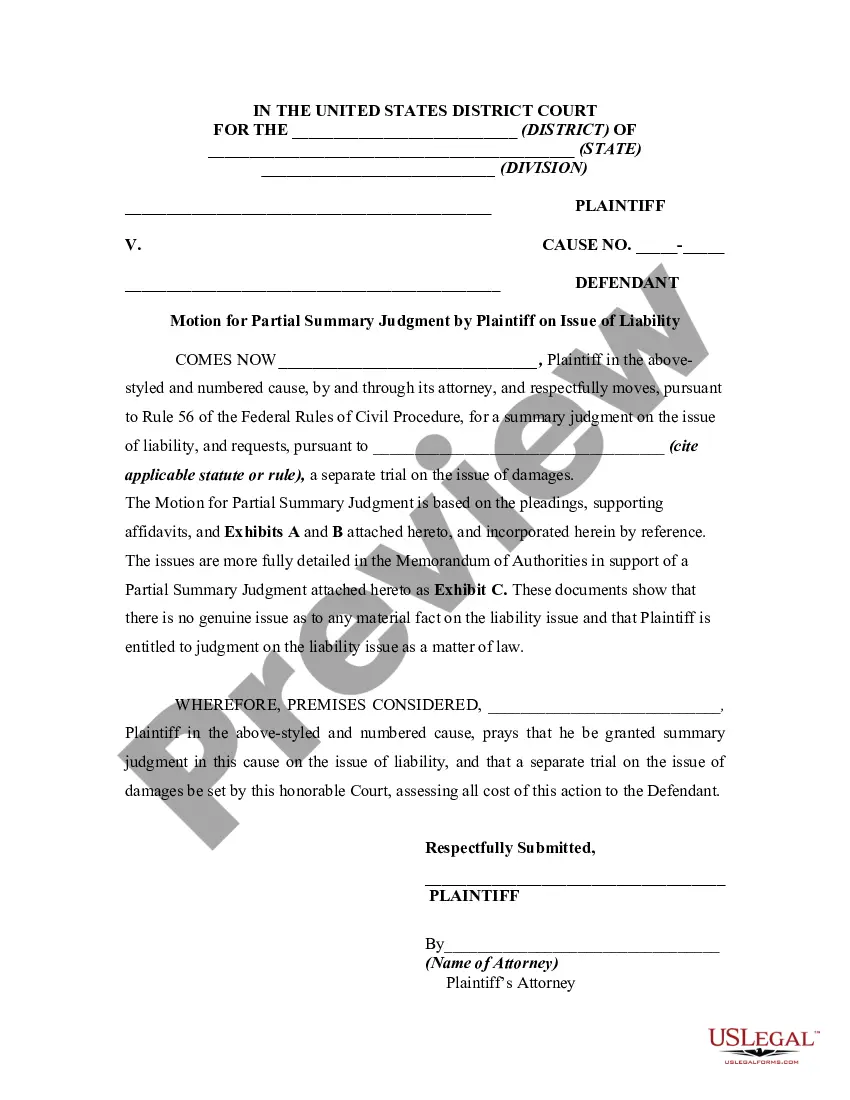
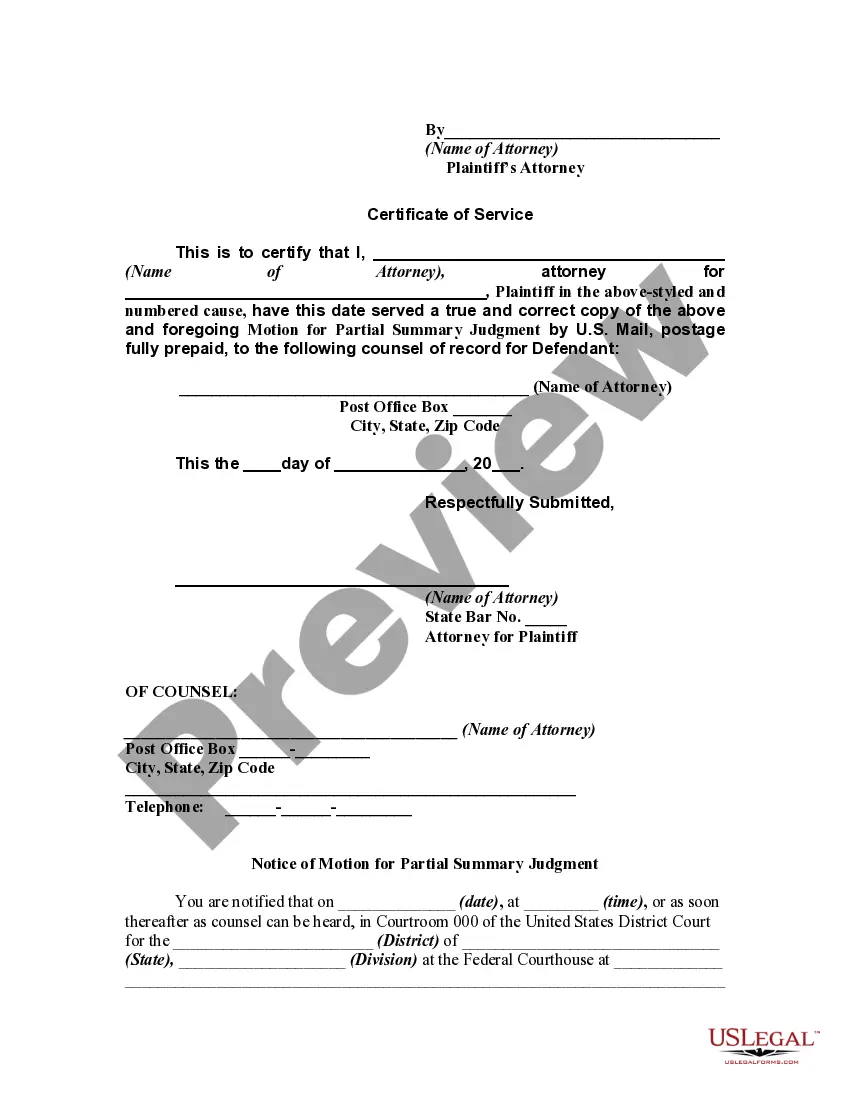
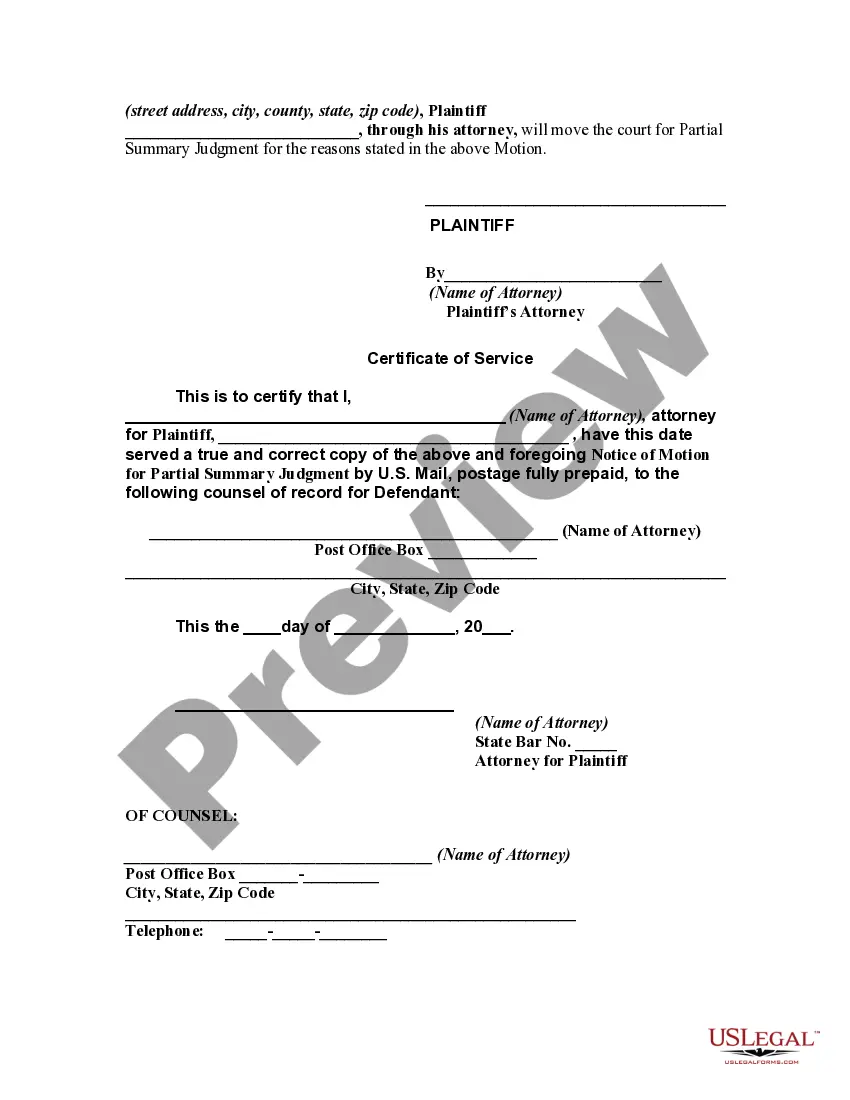
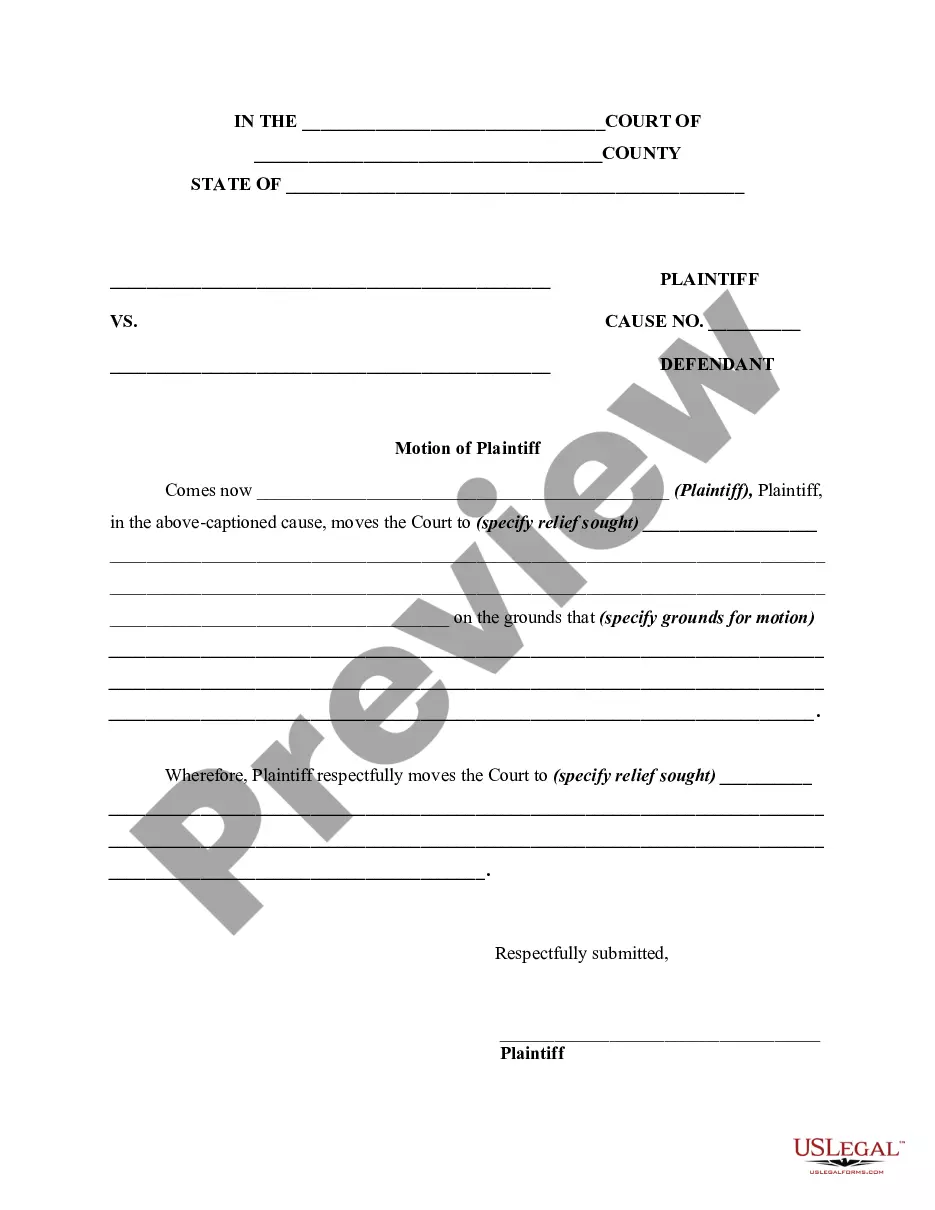
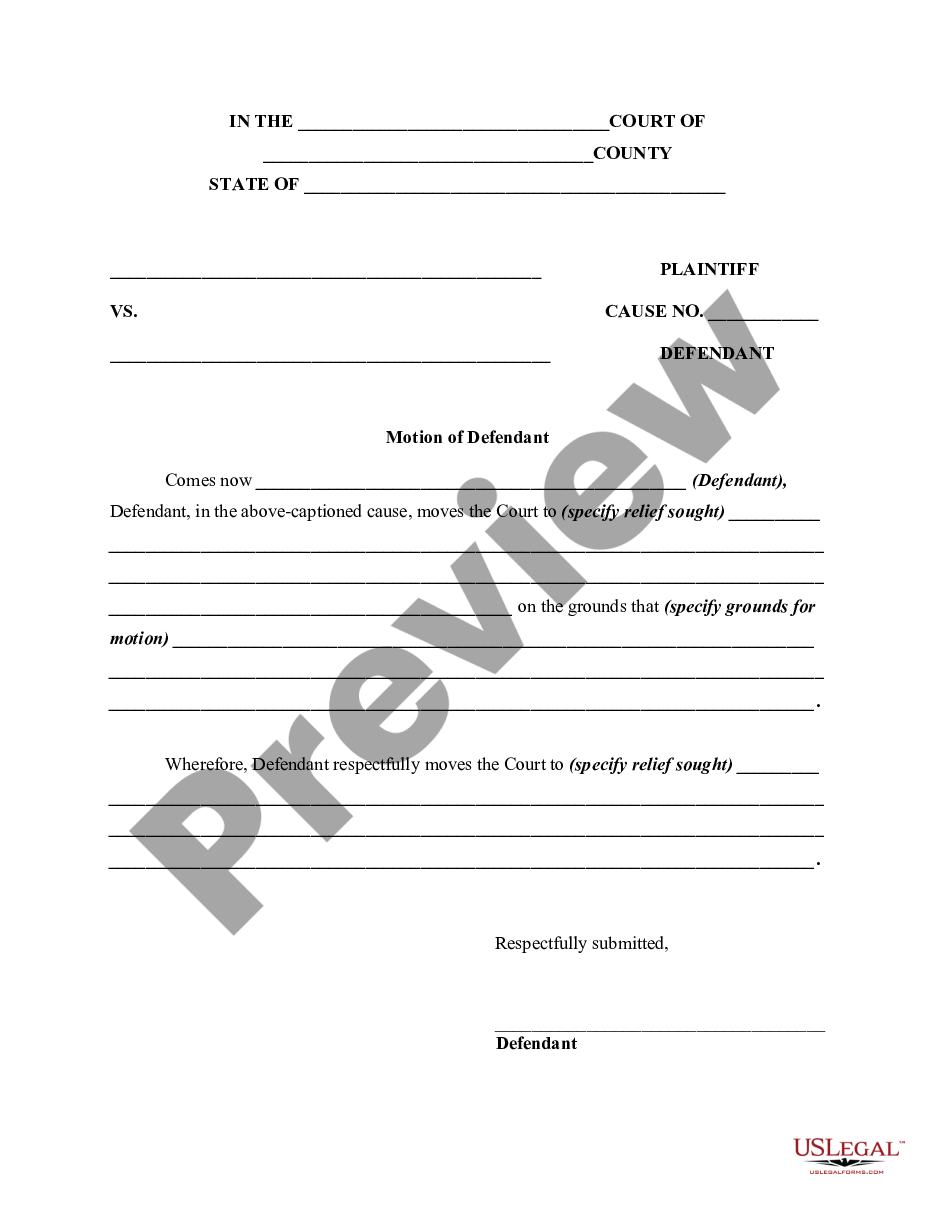
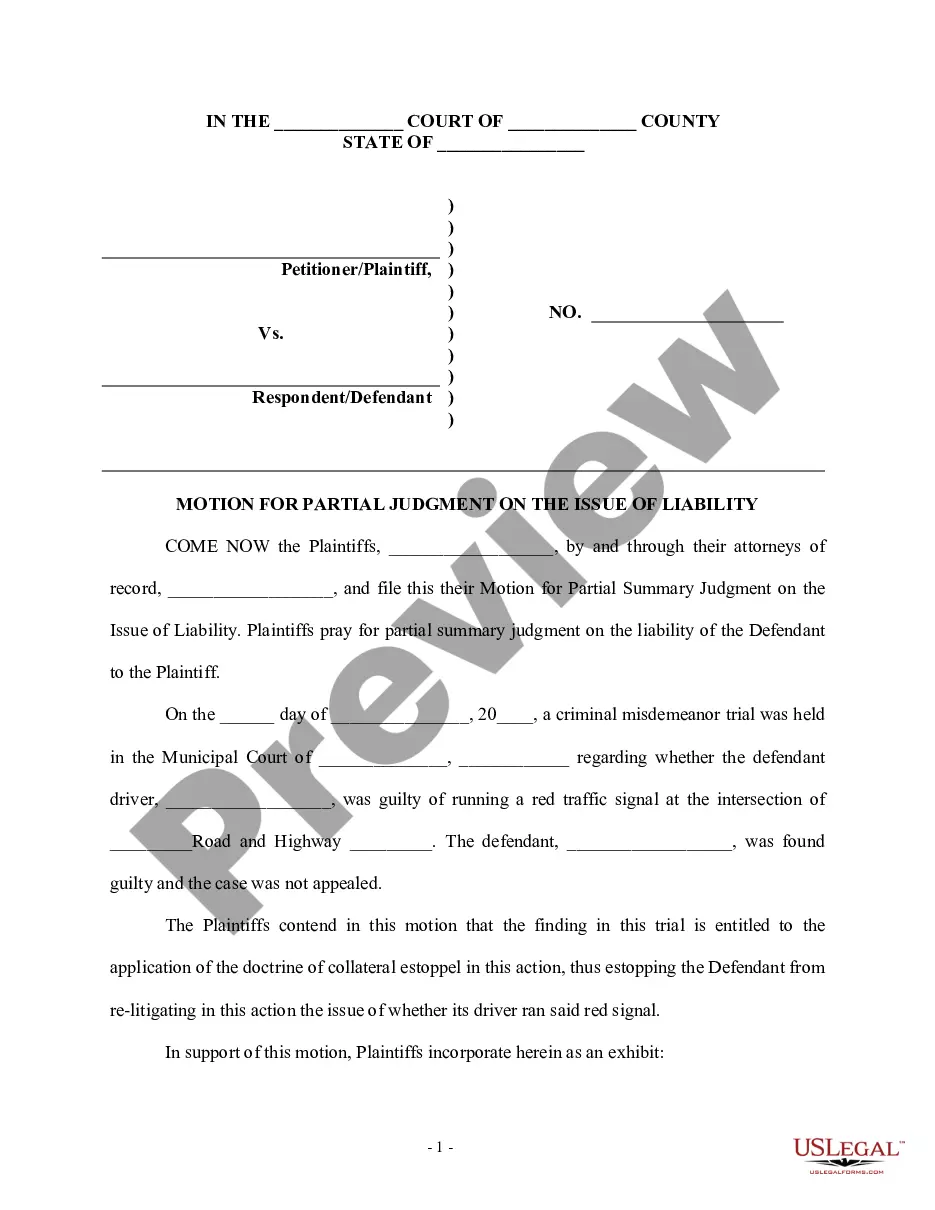
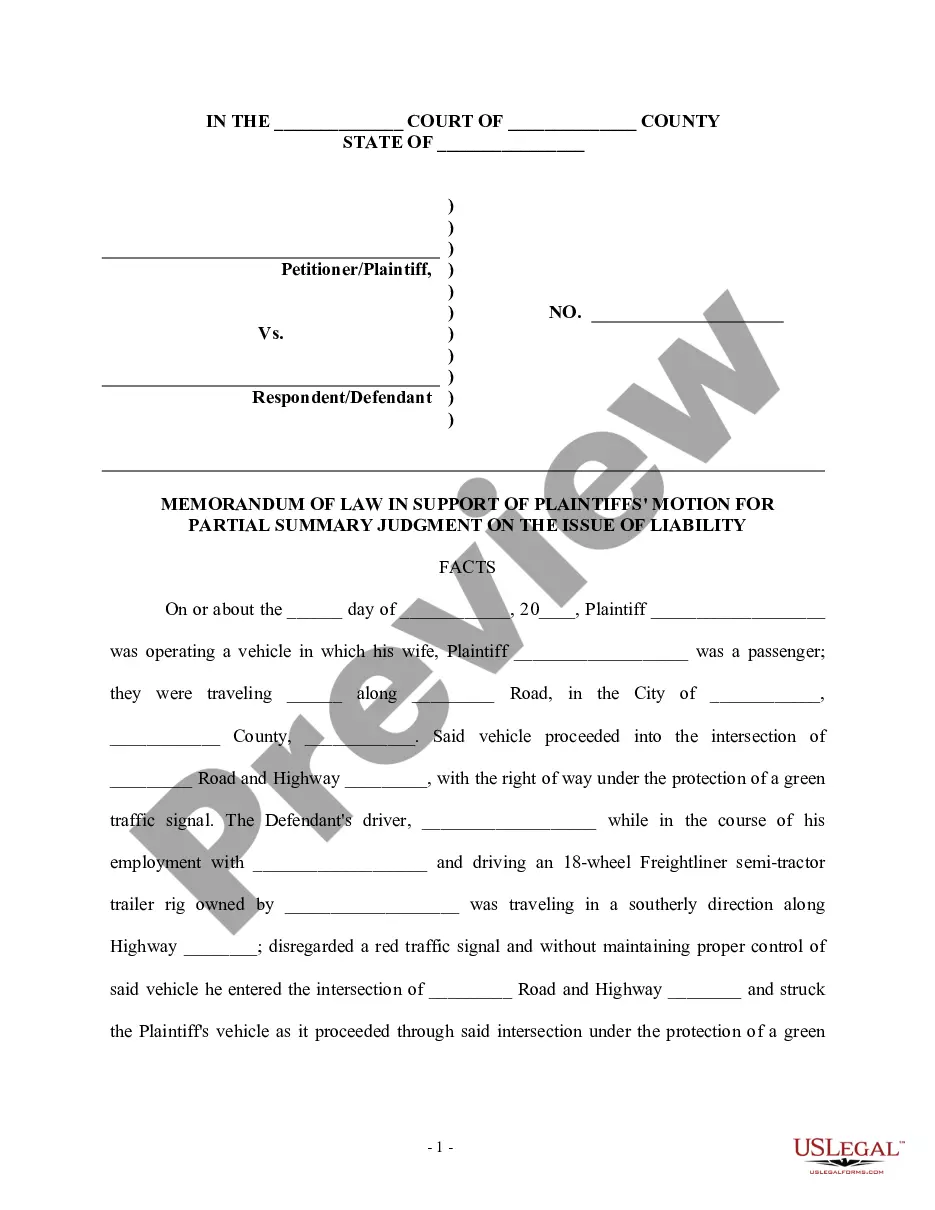
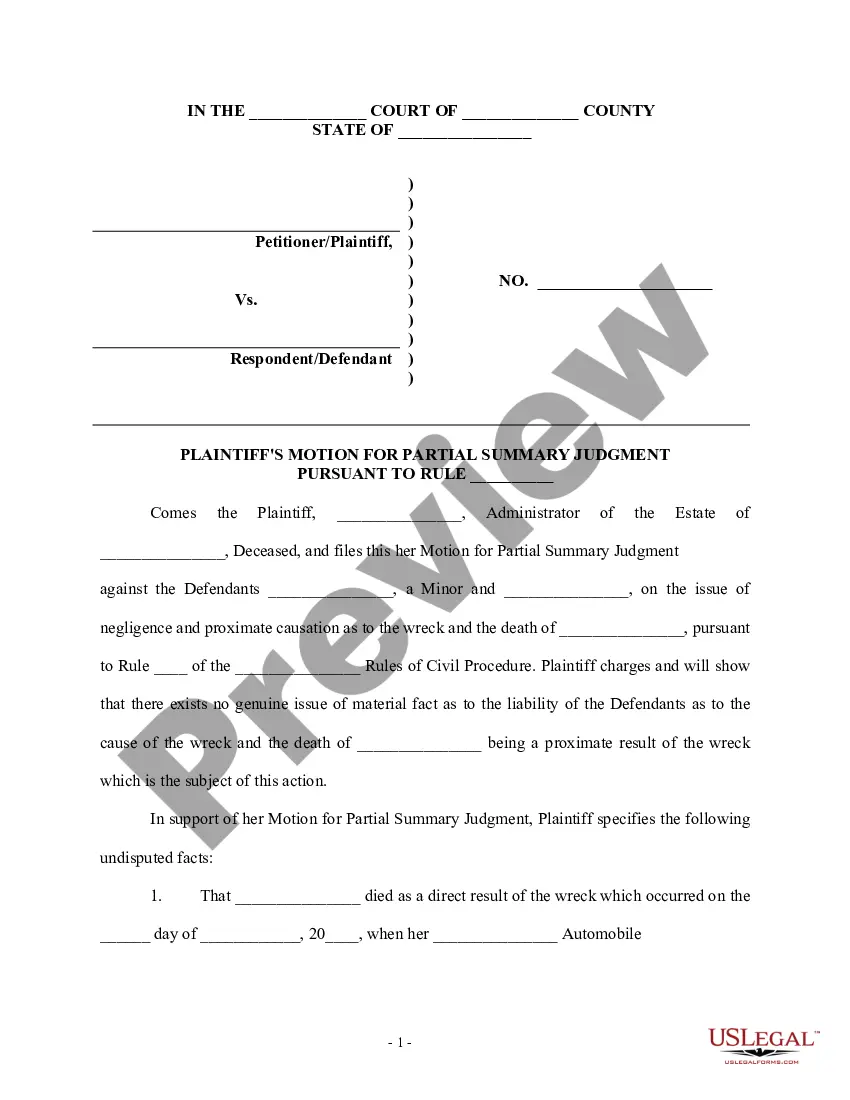
This form is a generic motion for partial summary judgment on the issue of liability. The motion adopts the "notice pleadings" format of the Federal Rules of Civil Procedure, which have been adopted by most states in one form or another.
Illinois General Form of Partial Motion for Summary Judgment by Plaintiff on Issue of Liability with Notice of Motion and with Request for Separate Trial on Issue of Damages
State:
Multi-State
Category:
Control #:
US-00918BG
Format:
Word;
Rich Text
121 downloads
Description
Free preview
Get your form ready online
Our built-in tools help you complete, sign, share, and store your documents in one place.
Built-in online Word editor
Make edits, fill in missing information, and update formatting in US Legal Forms—just like you would in MS Word.
Export easily
Download a copy, print it, send it by email, or mail it via USPS—whatever works best for your next step.
E-sign your document
Sign and collect signatures with our SignNow integration. Send to multiple recipients, set reminders, and more. Go Premium to unlock E-Sign.
Notarize online 24/7
If this form requires notarization, complete it online through a secure video call—no need to meet a notary in person or wait for an appointment.
Store your document securely
We protect your documents and personal data by following strict security and privacy standards.

Make edits, fill in missing information, and update formatting in US Legal Forms—just like you would in MS Word.

Download a copy, print it, send it by email, or mail it via USPS—whatever works best for your next step.

Sign and collect signatures with our SignNow integration. Send to multiple recipients, set reminders, and more. Go Premium to unlock E-Sign.

If this form requires notarization, complete it online through a secure video call—no need to meet a notary in person or wait for an appointment.

We protect your documents and personal data by following strict security and privacy standards.
Looking for another form?
How to fill out General Form Of Partial Motion For Summary Judgment By Plaintiff On Issue Of Liability With Notice Of Motion And With Request For Separate Trial On Issue Of Damages?
If you need to aggregate, download, or print authorized document templates, utilize US Legal Forms, the largest selection of legal forms available online. Employ the site's straightforward and convenient search to find the documents you require.
A range of templates for commercial and personal purposes are organized by categories and states, or keywords. Use US Legal Forms to locate the Illinois General Form of Partial Motion for Summary Judgment by Plaintiff on Issue of Liability with Notice of Motion and with Request for Separate Trial on Issue of Damages with just a few clicks.
If you are already a US Legal Forms user, Log In to your account and click the Get option to acquire the Illinois General Form of Partial Motion for Summary Judgment by Plaintiff on Issue of Liability with Notice of Motion and with Request for Separate Trial on Issue of Damages. You can also access forms you previously saved in the My documents tab of your account.
Every legal document template you purchase is yours indefinitely. You will have access to every form you saved in your account. Navigate to the My documents section and select a form to print or download again.
Be proactive and download, and print the Illinois General Form of Partial Motion for Summary Judgment by Plaintiff on Issue of Liability with Notice of Motion and with Request for Separate Trial on Issue of Damages using US Legal Forms. There are thousands of professional and state-specific forms available for your business or personal needs.
- Step 1. Ensure you have selected the form for your correct city/state.
- Step 2. Utilize the Preview feature to review the form's details. Remember to read through the summary.
- Step 3. If you are not satisfied with the form, use the Search field at the top of the screen to find other variations of your legal form template.
- Step 4. Once you have found the form you need, select the Get now option. Choose the pricing plan you prefer and provide your information to register for an account.
- Step 5. Complete the transaction. You can use your credit card or PayPal account to process the payment.
- Step 6. Choose the format of your legal form and download it to your device.
- Step 7. Complete, revise and print or sign the Illinois General Form of Partial Motion for Summary Judgment by Plaintiff on Issue of Liability with Notice of Motion and with Request for Separate Trial on Issue of Damages.
Form popularity
FAQ
As an initial matter, the Court reiterated the utility of expert witness declarations in summary judgment motions: "An expert witness declaration is admissible to support or defeat summary judgment if the expert's testimony would be admissible at trial in ance with Evidence Code section 720.
A party seeking summary judgment may refer to any evidence that would be admissible at trial, such as depositions (or deposition excerpts), party admissions, affidavits in support from witnesses, documents received during discovery (such as contracts, emails, letters, and certified government documents).
What Is a Summary Judgment Motion? A motion for summary judgment is when a litigant in a case, either the plaintiff or the defendant, asks the court to end the case without holding a trial.
3) Declaration in Support of Motion for Summary Judgment The Declaration is a sworn statement to the Court stating all of the declarant's facts supporting your Motion. These facts must come from the declarant's own personal knowledge of the events.
Rule 56(c)(4) provides that a formal affidavit or a written unsworn declaration that complies with 28 U.S.C. § 1746 can be used to support or oppose a motion for summary judgment.
It asserts that the plaintiff has raised no genuine issue to be tried and asks the judge to rule in favor of the defense. This motion is typically made before trial.
A motion for summary judgment "searches the record," meaning that the court reviews all of the evidence in the record, regardless of which side submitted it.
Parties file motions for summary judgment, requesting judgment in their favor without a trial, when either there is no dispute as to the material facts, or the other side cannot prove their claims or defenses.