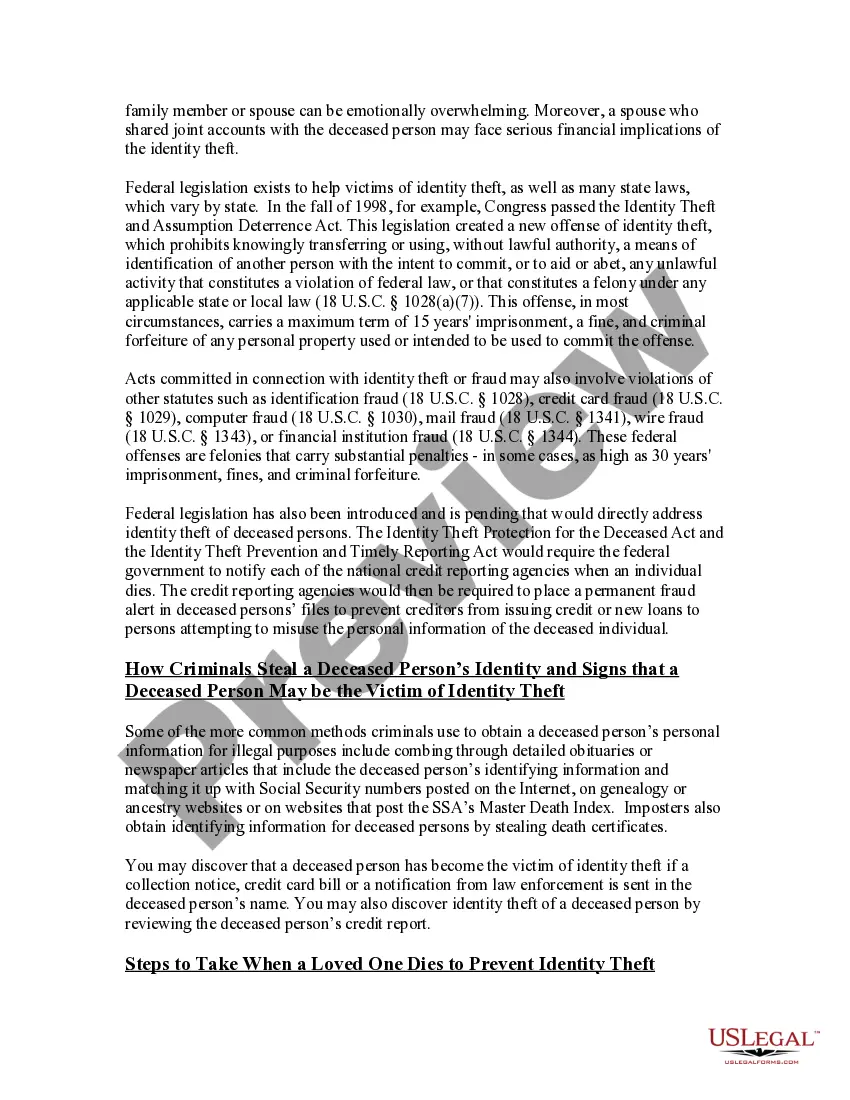
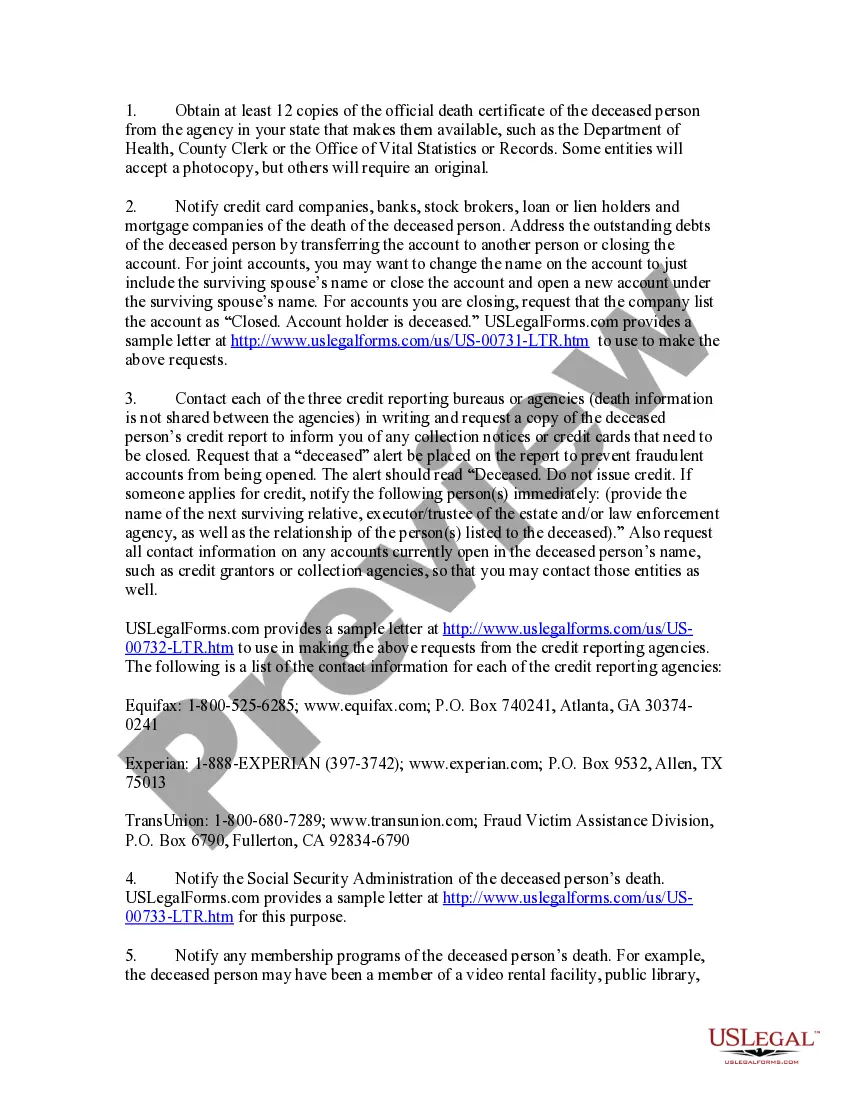
Illinois Guide for Protecting Deceased Persons from Identity Theft
Description
Get your form ready online
Our built-in tools help you complete, sign, share, and store your documents in one place.
Make edits, fill in missing information, and update formatting in US Legal Forms—just like you would in MS Word.
Download a copy, print it, send it by email, or mail it via USPS—whatever works best for your next step.
Sign and collect signatures with our SignNow integration. Send to multiple recipients, set reminders, and more. Go Premium to unlock E-Sign.
If this form requires notarization, complete it online through a secure video call—no need to meet a notary in person or wait for an appointment.
We protect your documents and personal data by following strict security and privacy standards.

Make edits, fill in missing information, and update formatting in US Legal Forms—just like you would in MS Word.

Download a copy, print it, send it by email, or mail it via USPS—whatever works best for your next step.

Sign and collect signatures with our SignNow integration. Send to multiple recipients, set reminders, and more. Go Premium to unlock E-Sign.

If this form requires notarization, complete it online through a secure video call—no need to meet a notary in person or wait for an appointment.

We protect your documents and personal data by following strict security and privacy standards.
Looking for another form?






How to fill out Guide For Protecting Deceased Persons From Identity Theft?
US Legal Forms - one of the largest collections of legal documents in the USA - offers a wide range of legal document templates that you can download or print.
By using the site, you can find thousands of forms for business and personal purposes, organized by categories, states, or keywords. You can find the latest versions of documents like the Illinois Guide for Protecting Deceased Persons from Identity Theft in just a few minutes.
If you already have a monthly subscription, Log In and download the Illinois Guide for Protecting Deceased Persons from Identity Theft from the US Legal Forms library. The Download button will appear on each form you view. You can access all previously downloaded forms in the My documents section of your account.
Next, select your preferred pricing plan and provide your information to register for an account. Process the payment. Use your Visa or Mastercard or PayPal account to complete the transaction. Choose the format and download the form to your device.
Make changes. Complete, edit, print, and sign the downloaded Illinois Guide for Protecting Deceased Persons from Identity Theft. Each template you added to your account has no expiration date and is yours permanently. Therefore, if you wish to download or print another copy, simply visit the My documents section and click on the form you need. Gain access to the Illinois Guide for Protecting Deceased Persons from Identity Theft with US Legal Forms, the most extensive collection of legal document templates. Utilize thousands of professional and state-specific templates that cater to your business or personal needs and requirements.
- If you want to use US Legal Forms for the first time, here are simple instructions to get started:
- Ensure you have chosen the correct form for your city/state.
- Click the Review button to examine the content of the form.
- Check the form details to confirm you have selected the right document.
- If the form does not meet your needs, use the Search field at the top of the screen to find one that does.
- Once you are satisfied with the form, confirm your selection by clicking the Acquire now button.
Form popularity
FAQ
(i) Identity theft of credit, money, goods, services, or other property not exceeding $300 in value is a Class 4 felony. A person who has been previously convicted of identity theft of less than $300 who is convicted of a second or subsequent offense of identity theft of less than $300 is guilty of a Class 3 felony.
Identity theft and identity fraud are terms used to refer to all types of crime in which someone wrongfully obtains and uses another person's personal data in some way that involves fraud or deception, typically for economic gain.
What does identity theft insurance not cover? It's important to note that these insurance policies typically don't cover stolen money or direct financial losses from fraudulent purchases and other unauthorized use of credit accounts. They typically reimburse you only for the costs of the reporting and recovery process.
It is the unlawful violation of an individual's right to the protection of his/her privacy. This illegitimate acquisition of your information can be performed in a variety of ways. Most commonly, identity theft includes stealing, misrepresenting or hijacking the identity of another person or business.
Submit the following with your information request as proof that you're authorized to receive deceased person's information: The full name of the deceased, their last address and Social Security Number. A copy of the death certificate. Either: A copy of Letters of Testamentary approved by the court or.
File a report with the Federal Trade Commission (FTC). If you report your identity theft to the FTC within two business days of discovering it, you will only be liable to pay $50 of any unauthorized use of your bank and credit accounts (under federal law).
Avoid listing birth date, maiden name, or other personal identifiers in obituaries as they could be useful to ID thieves. Report the death to the Social Security Administration by calling 800-772-1213. Order multiple certified copies of the death certificate with and without cause of death.
One form of medical identity theft, accounting for nearly half the victims, should begin to decline as the Patient Protection and Affordable Care Act takes effect.