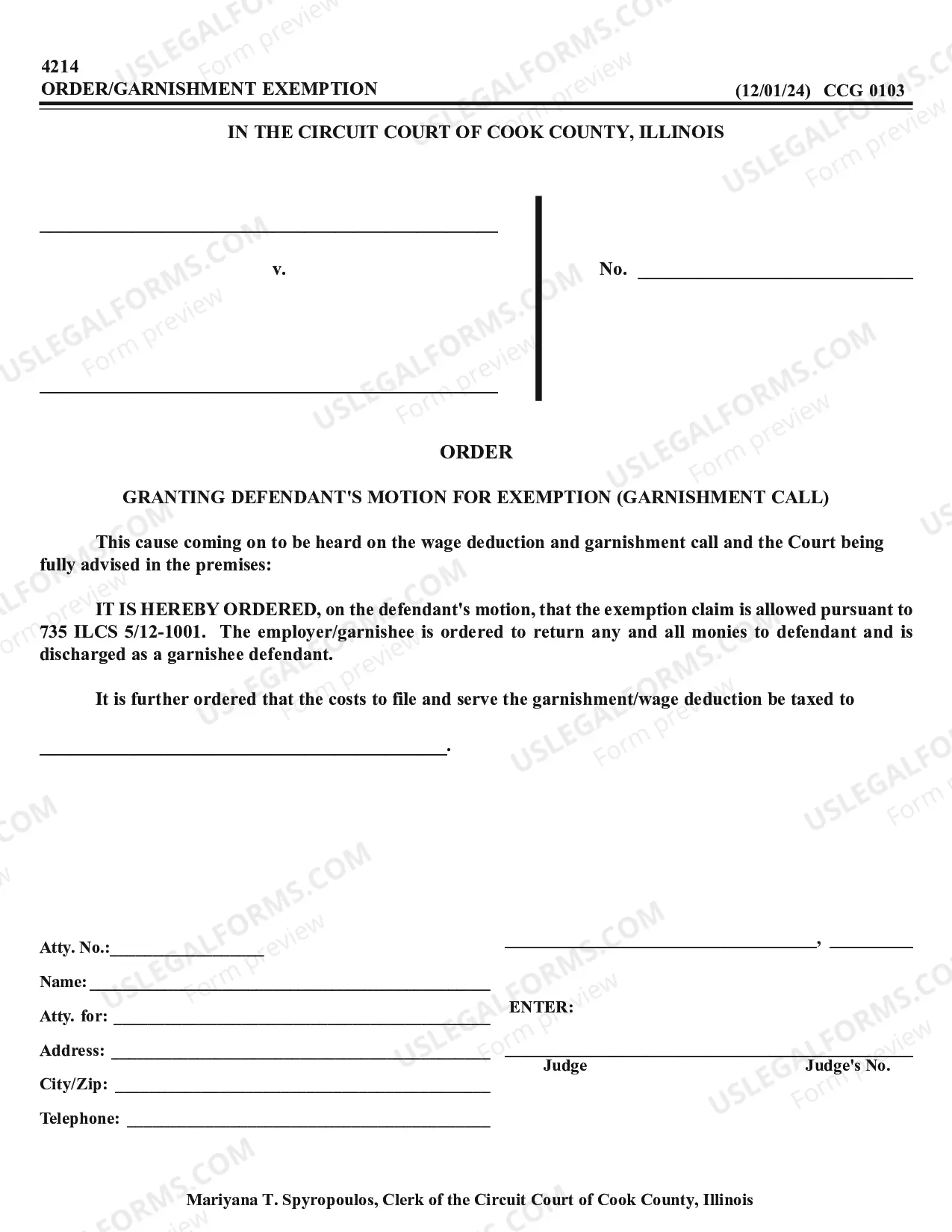
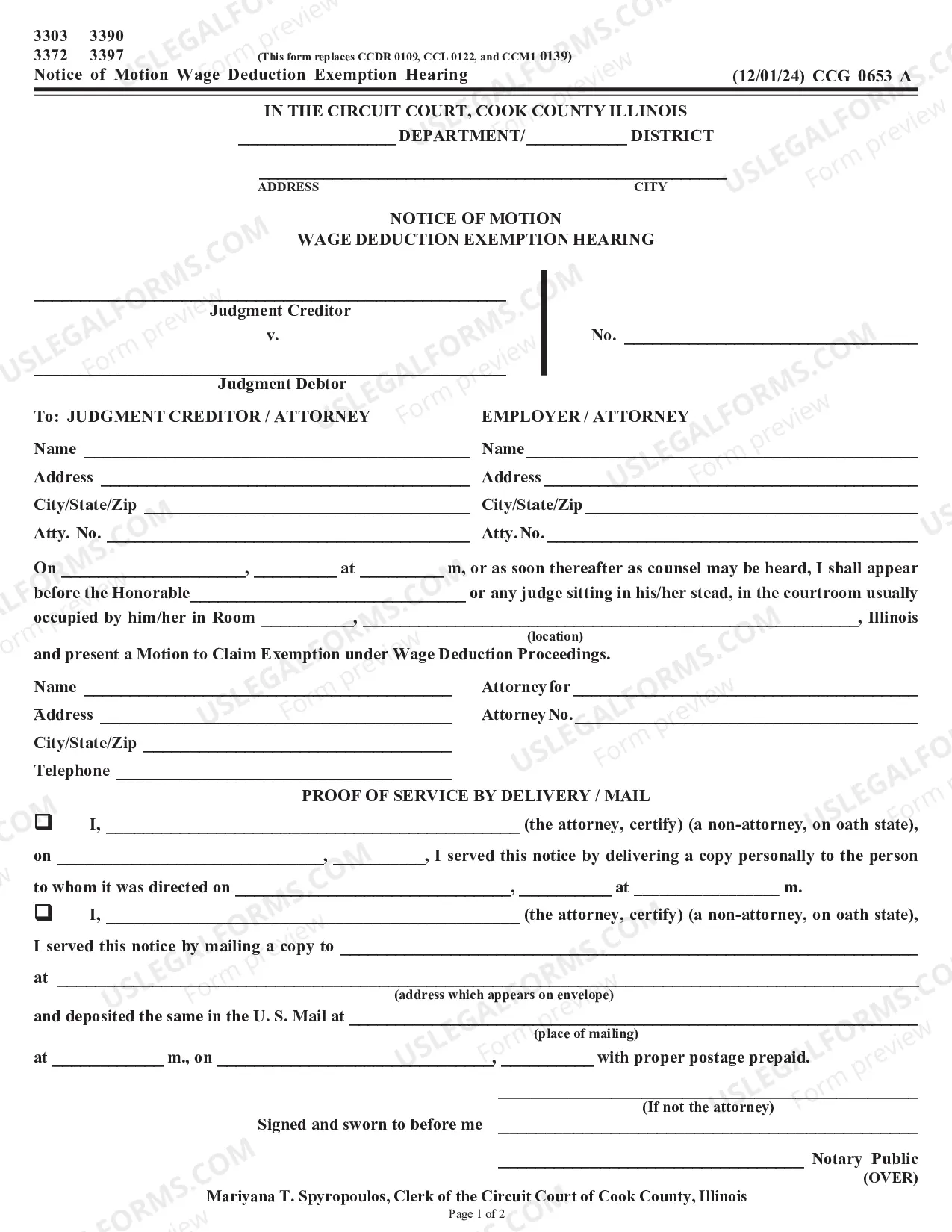
The Illinois Order-Garnishment Exemption is a law that protects certain types of wages and income from being garnished by creditors. The law states that an employee’s net earnings must be greater than 45 times the federal minimum wage before they can be garnished. This means that if a person’s income is less than or equal to 45 times the federal minimum wage, then they are exempt from wage garnishment. The types of Illinois Order-Garnishment Exemption include Social Security benefits, public assistance benefits, workers' compensation benefits, unemployment benefits, veterans' benefits, and public and private pensions. Additionally, the law states that no more than 25% of a person’s income can be garnished in any given week, and that the total amount of money that can be garnished from any single source is limited.
Illinois Order-Garnishment Exemption
Description
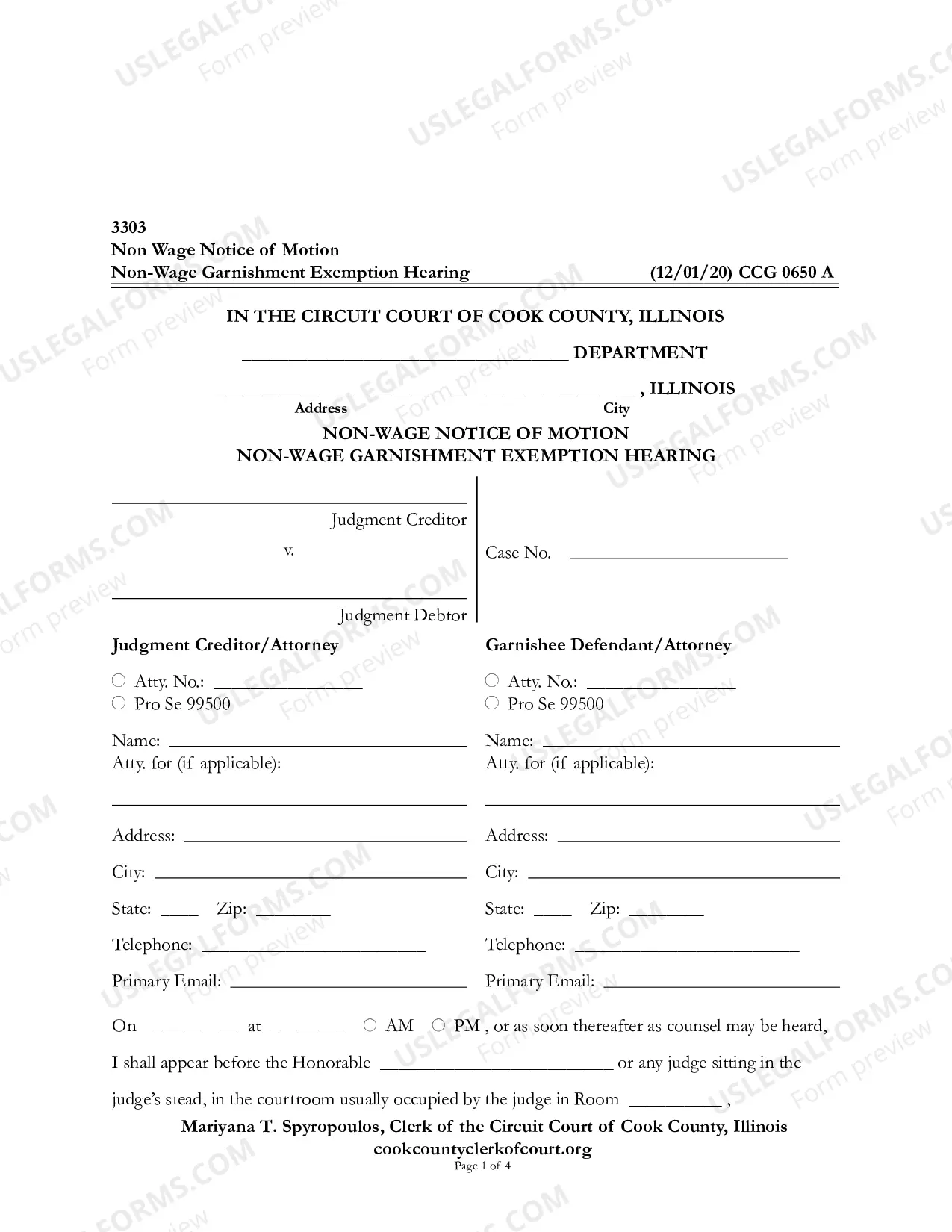
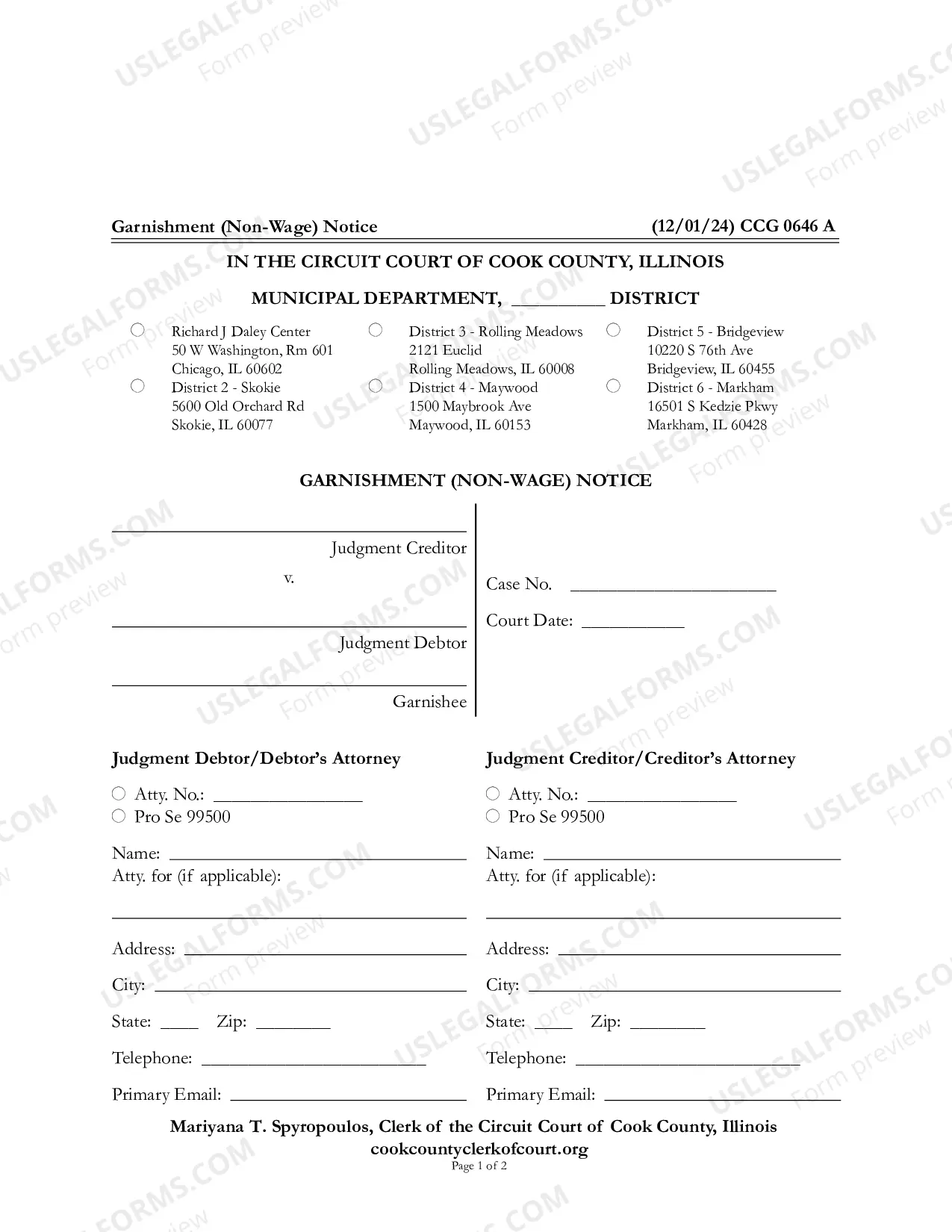
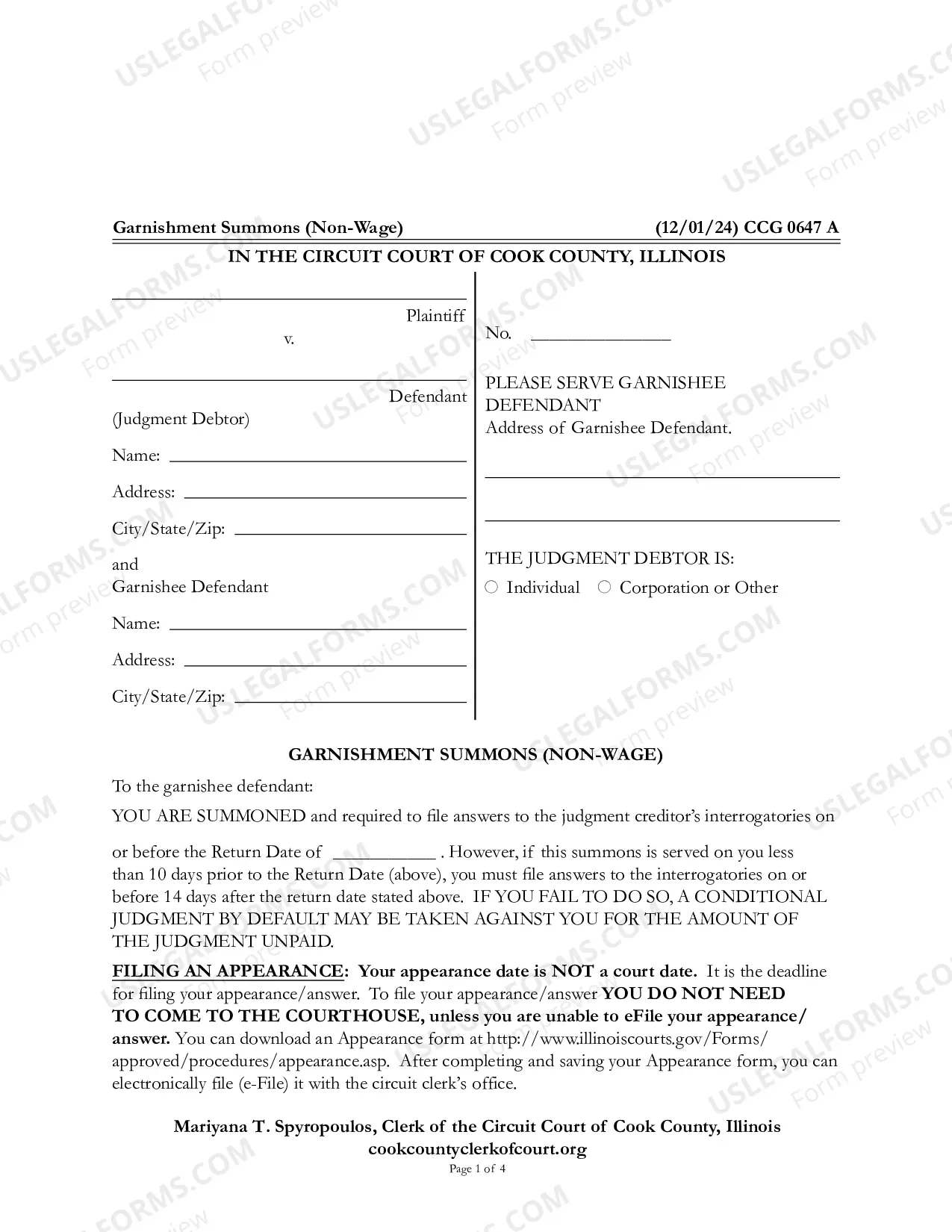
Get your form ready online
Our built-in tools help you complete, sign, share, and store your documents in one place.
Make edits, fill in missing information, and update formatting in US Legal Forms—just like you would in MS Word.
Download a copy, print it, send it by email, or mail it via USPS—whatever works best for your next step.
Sign and collect signatures with our SignNow integration. Send to multiple recipients, set reminders, and more. Go Premium to unlock E-Sign.
If this form requires notarization, complete it online through a secure video call—no need to meet a notary in person or wait for an appointment.
We protect your documents and personal data by following strict security and privacy standards.

Make edits, fill in missing information, and update formatting in US Legal Forms—just like you would in MS Word.

Download a copy, print it, send it by email, or mail it via USPS—whatever works best for your next step.

Sign and collect signatures with our SignNow integration. Send to multiple recipients, set reminders, and more. Go Premium to unlock E-Sign.

If this form requires notarization, complete it online through a secure video call—no need to meet a notary in person or wait for an appointment.

We protect your documents and personal data by following strict security and privacy standards.
Looking for another form?

How to fill out Illinois Order-Garnishment Exemption?
US Legal Forms is the easiest and most lucrative means to find suitable legal templates.
It is the most comprehensive online repository of business and personal legal documents created and validated by legal experts.
Here, you can discover printable and fillable templates that adhere to federal and local laws - similar to your Illinois Order-Garnishment Exemption.
Review the form description or view a preview of the document to ensure you’ve found the one that meets your needs, or search for another using the search tab above.
Click Buy now when you are confident in its compatibility with all criteria, and select your preferred subscription plan.
- Acquiring your template requires just a few straightforward steps.
- Users who already possess an account with a valid subscription merely need to Log In to the web service and download the document to their device.
- Subsequently, they can locate it in their profile in the My documents section.
- For first-time US Legal Forms users wanting to obtain a professionally drafted Illinois Order-Garnishment Exemption.
Form popularity
FAQ
In non-wage garnishments, 735 ILCS 5/12-701 requires the judgment creditor, or other person, to file an affidavit stating that the affiant believes the garnishee is indebted to the judgment debtor or has property of the judgment debtor. Failure to file such affidavit invalidates the garnishment.
Employment income is usually not exempt under Illinois law, but other kinds of income are exempt from wage deductions. Some examples of exempt income include Social Security and other income from the federal government, workers' compensation benefits, unemployment benefits, and government assistance, to name a few.
Wage Garnishment in Illinois In Illinois, if a creditor wins a court judgment against you, the maximum your employer can garnish from your weekly earnings is either 15 percent of your earnings or the amount left over after you deduct 45 hours' worth of Illinois' minimum wage.
It can be accomplished only by a court order directed to the employer, and no such court order can be issued without fair notice to the ¬debtor/wage earner. Other than the kinds of debts identified above, no other debt or legal obligation can give rise to wage attachment by the State of Illinois.
The Debt Collection Improvement Act authorizes federal agencies or collection agencies under contract with them to garnish up to 15% of disposable earnings to repay defaulted debts owed to the U.S. government.
Wage Garnishment in Illinois In Illinois, if a creditor wins a court judgment against you, the maximum your employer can garnish from your weekly earnings is either 15 percent of your earnings or the amount left over after you deduct 45 hours' worth of Illinois' minimum wage.
The most the employer can hold out for you is 15% of the debtor's gross income before taxes or deductions. However, the withholding can't leave the debtor with less than 45 times the state minimum wage as weekly take-home pay.