Illinois Trustee's Deed
Overview of this form
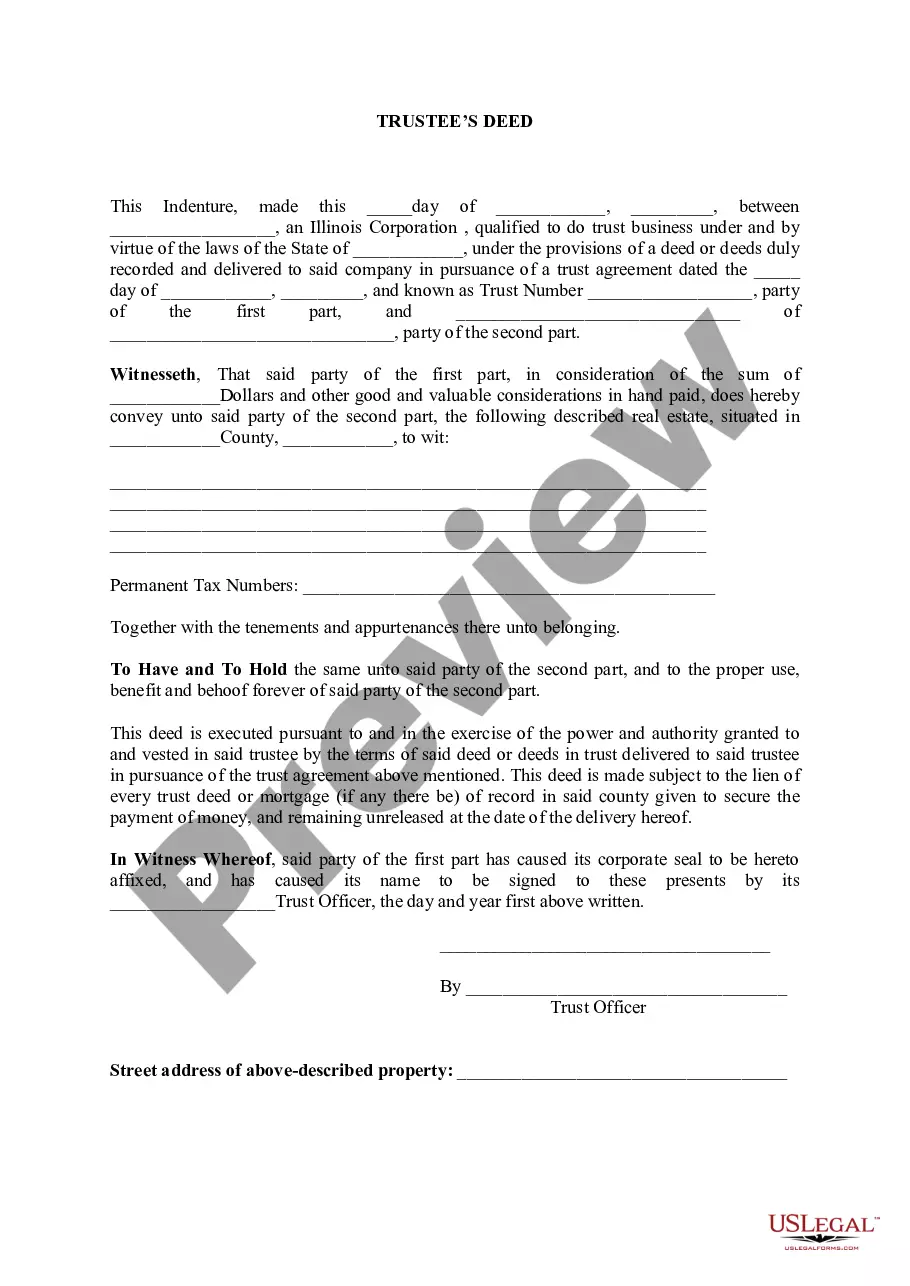
The Trustee's Deed is a legal document used in property transactions to transfer real estate from a trust to a beneficiary or other designated party. This deed outlines the terms of the transfer and differentiates itself from other deeds by specifically indicating the involvement of a trustee, who holds legal title to the property in trust for the benefit of others. This ensures that the property is managed and transferred according to the trust's provisions.
Main sections of this form
- Identification of the trustees and beneficiaries involved in the property transfer.
- Details of the real estate being conveyed, including a description and tax numbers.
- Consideration amount, establishing the value exchanged for the property.
- Legal assurances regarding existing liens or mortgages affecting the property.
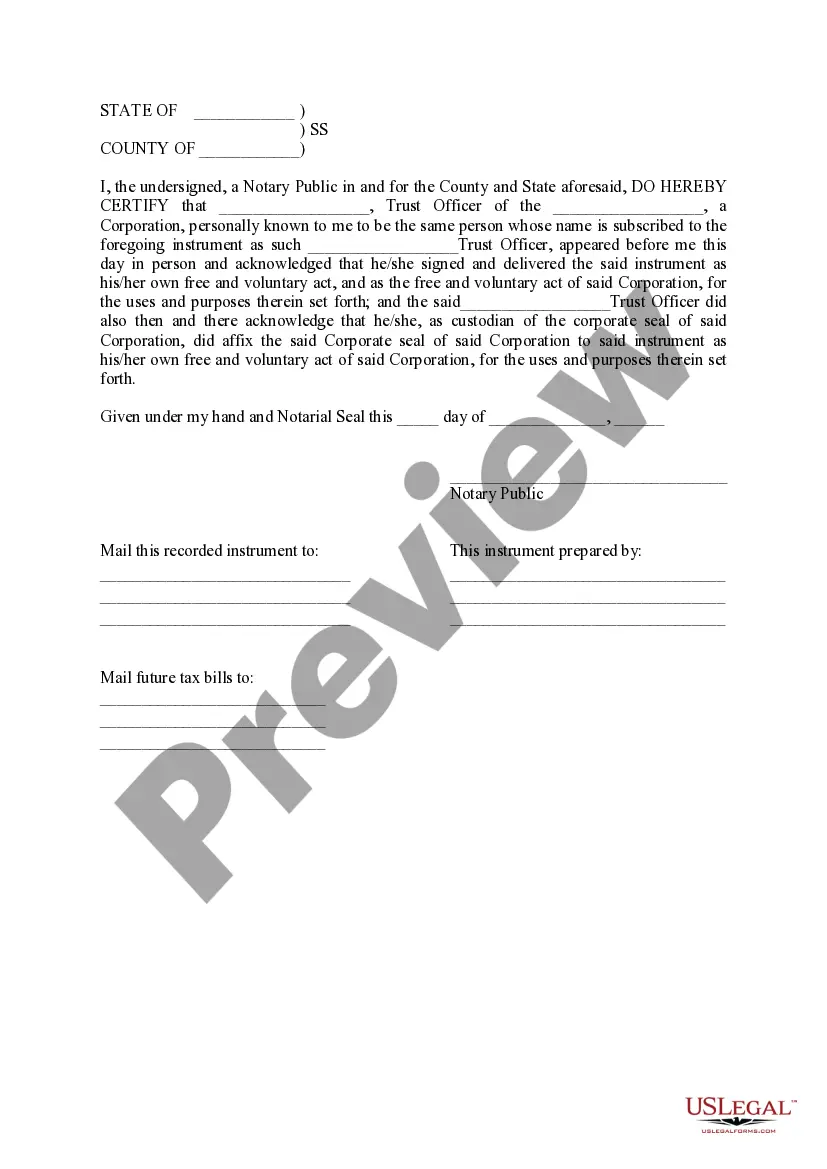
- Notary acknowledgment to confirm the signing partyâs identity and intention.


When to use this document
This form should be used when a trustee, under a trust agreement, is transferring property to another party. Common scenarios include the sale or gifting of real estate held in trust to beneficiaries, or when a trustee is fulfilling obligations related to the management of the trust's assets. It is ideal for situations where legal ownership needs to be formally changed while adhering to the terms outlined in the trust agreement.
Who should use this form
The following parties may use the Trustee's Deed:
- Trustees managing the assets of a trust.
- Beneficiaries receiving property from a trust.
- Real estate professionals handling transactions involving trust-held properties.
- Individuals seeking to clarify the transfer of property under a trust's terms.
How to prepare this document
- Identify the parties involved, including the trustee and beneficiary.
- Provide a legal description of the property, including the street address and permanent tax numbers.
- Enter the date of the agreement and the consideration amount being exchanged.
- Affix the trusteeâs corporate seal and include the signature of an authorized trust officer.
- Have the signing party acknowledged by a notary public to validate the document.
Is notarization required?
Yes, this form must be notarized to be legally valid. The notary public's acknowledgment confirms the identity of the signer and the willingness to execute the document. US Legal Forms offers integrated online notarization, available 24/7 through secure video calls, allowing for a convenient and legal signing process without the need for in-person meetings.
Get your form ready online
Our built-in tools help you complete, sign, share, and store your documents in one place.
Make edits, fill in missing information, and update formatting in US Legal Forms—just like you would in MS Word.
Download a copy, print it, send it by email, or mail it via USPS—whatever works best for your next step.
Sign and collect signatures with our SignNow integration. Send to multiple recipients, set reminders, and more. Go Premium to unlock E-Sign.
If this form requires notarization, complete it online through a secure video call—no need to meet a notary in person or wait for an appointment.
We protect your documents and personal data by following strict security and privacy standards.

Make edits, fill in missing information, and update formatting in US Legal Forms—just like you would in MS Word.

Download a copy, print it, send it by email, or mail it via USPS—whatever works best for your next step.

Sign and collect signatures with our SignNow integration. Send to multiple recipients, set reminders, and more. Go Premium to unlock E-Sign.

If this form requires notarization, complete it online through a secure video call—no need to meet a notary in person or wait for an appointment.

We protect your documents and personal data by following strict security and privacy standards.
Mistakes to watch out for
- Failing to accurately describe the property, which can lead to legal disputes.
- Not including the required signatures, leading to an incomplete deed.
- Omitting the notary acknowledgment, which may invalidate the deed.
- Using outdated forms that do not comply with current state requirements.
Benefits of using this form online
- Convenient access to a professionally drafted template reduces the need for extensive legal advice.
- Editable fields allow customization to individual needs without hassle.
- Instant download options means you can complete the form at your convenience.
- Access to reliable legal resources ensures compliance with state-specific regulations.
Looking for another form?
Form popularity
FAQ
The trustee is a neutral third-party who holds the legal title to a property until the borrower pays off the loan in full. They're called a trustee because they hold the property in trust for the lender.
A Trustee's Deed Upon Sale, also known as a Trustee's Deed Under Sale or a Trustee's Deed is a deed of foreclosure. This deed is prepared after a property's foreclosure sale and recorded in the county were the property is located.The property may be in default on taxes, have mechanic's liens and/or other encumbrances.
To preserve legal chain of title, real estate transfers in Illinois must be recorded with the appropriate county recorder of deeds office. Additionally, it is well-settled law that a transfer to a trust is valid without recording a deed if one later uses a pour-over will via probate.
Trustee's deeds convey real estate out of a trust.This type of conveyance is named for the person using the form the trustee who stands in for the beneficiary of the trust and holds title to the property.
Like all deeds, these two legal documents are both used to transfer titles from one owner to another. A warranty deed protects property owners from future claims that someone else actually owns a portion (or all) of their property, while trustee deeds protect lenders when borrowers default on their mortgage loans.
A warranty deed protects property owners from future claims that someone else actually owns a portion (or all) of their property, while trustee deeds protect lenders when borrowers default on their mortgage loans.
A trustee deedsometimes called a deed of trust or a trust deedis a legal document created when someone purchases real estate in a trust deed state, such as California (check your local laws to see what is required in your state). A trust deed is used in place of a mortgage.
In Illinois, a trustee's deed is used to transfer real property out of a trust.The trustee's deed establishes basic information about the trust, such as the name and date of the trust document. The trustee serves as the grantor in the deed, and transfers the title into the grantee's name.