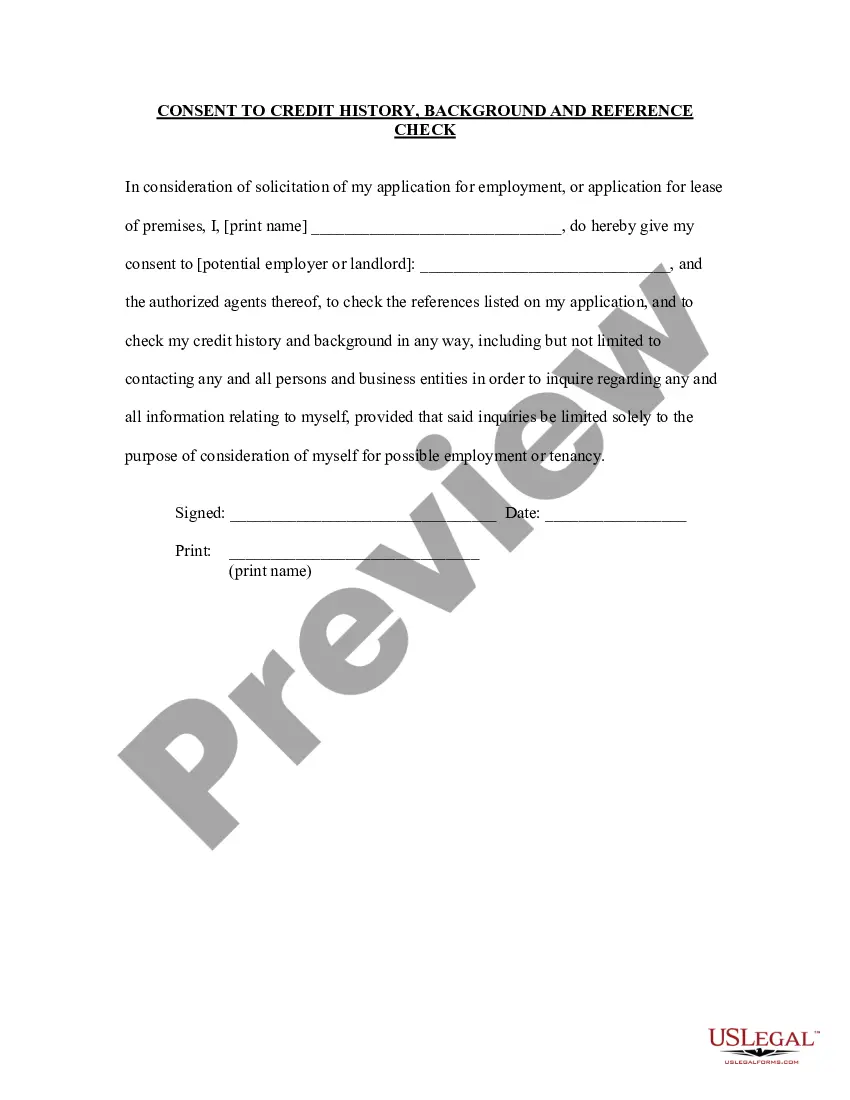
Illinois Quitclaim Deed from Corporation to Two Individuals
Understanding this form
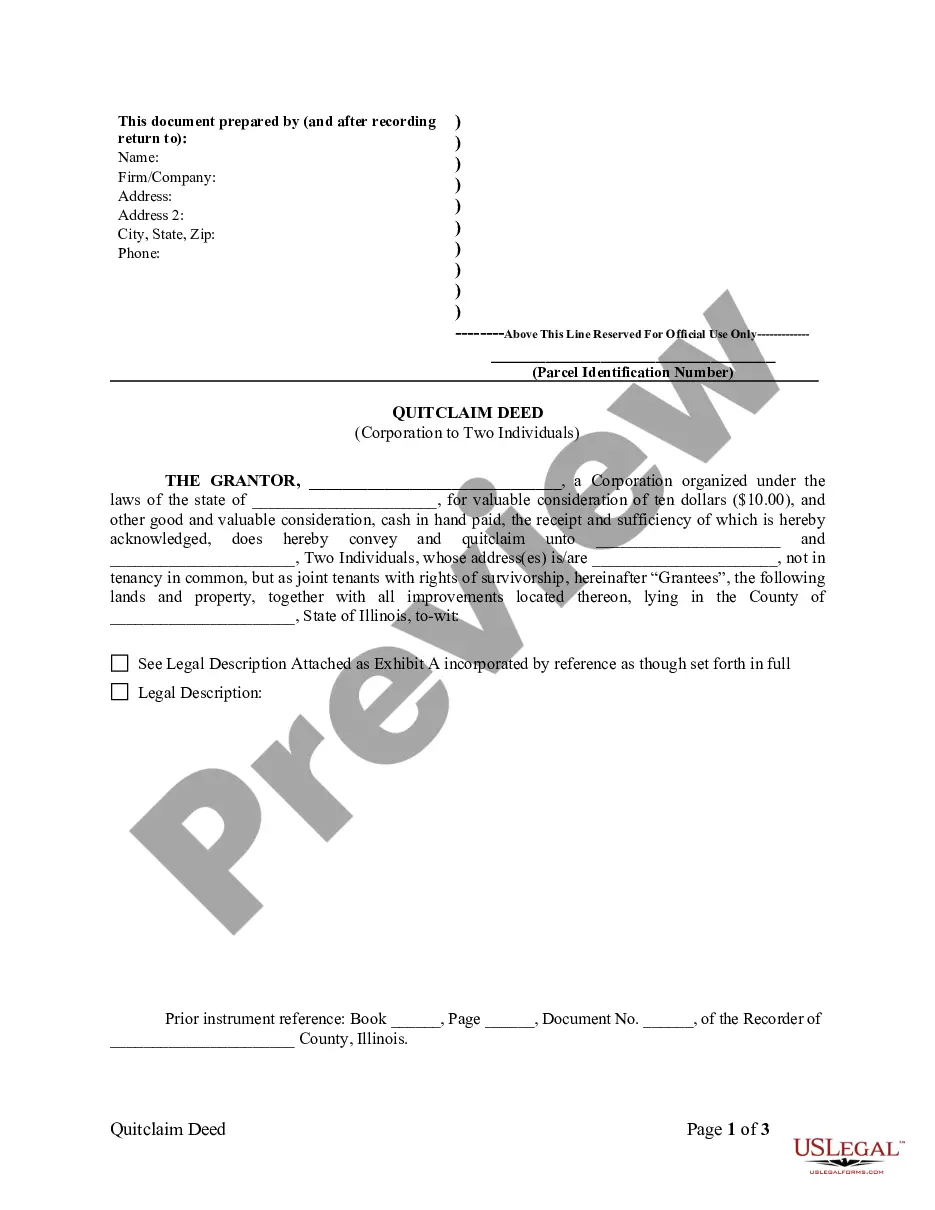
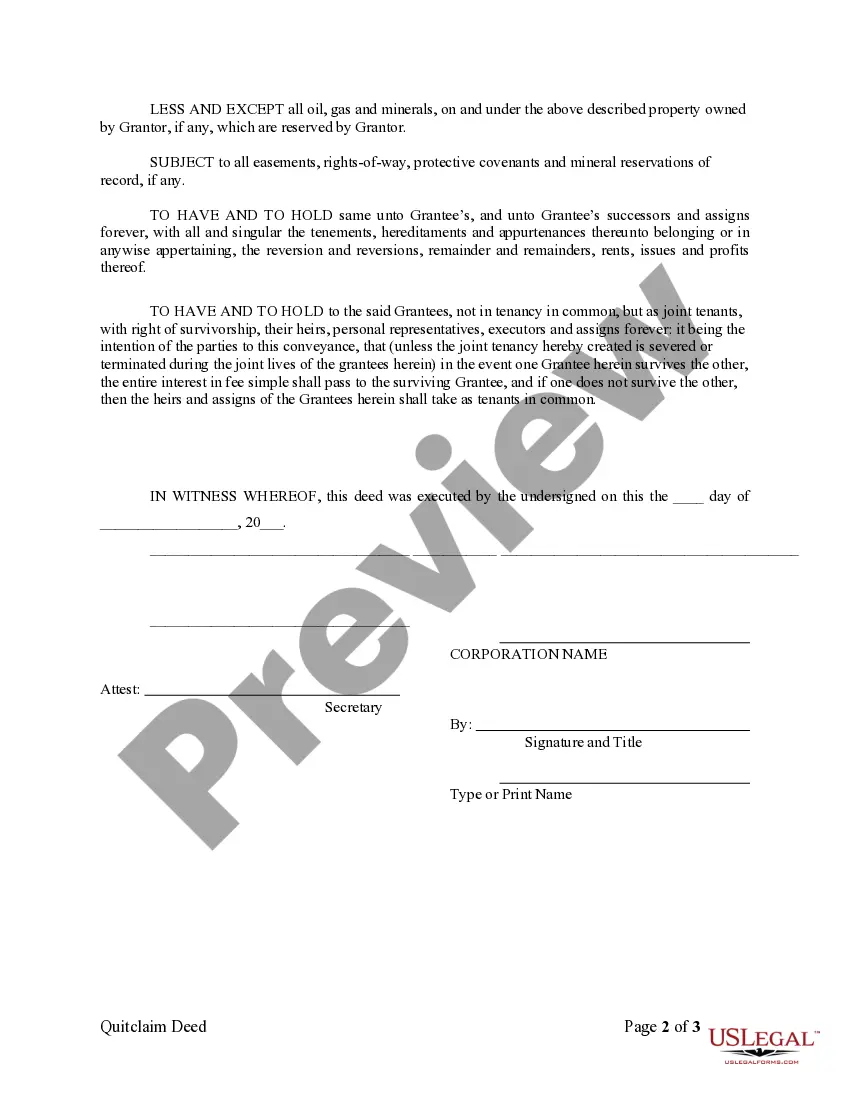
The Quitclaim Deed from Corporation to Two Individuals is a legal document that allows a corporation (the Grantor) to transfer property ownership to two individuals (the Grantees). This deed conveys property without any warranties about the title, meaning the Grantor simply relinquishes any claim to the property. It is important to note that this form excludes oil, gas, and mineral rights, which remain with the Grantor. This quitclaim deed differs from other deed types, like grant deeds, by providing no guarantees regarding the propertyâs ownership status.
Key parts of this document
- Partiesâ information: Names of the corporation and the two individuals receiving the property
- Property description: Detailed description of the property being transferred, usually included as an exhibit
- Joint tenancy clause: Specifies how Grantees hold the property and the right of survivorship
- Effective date: The date of execution for the deed
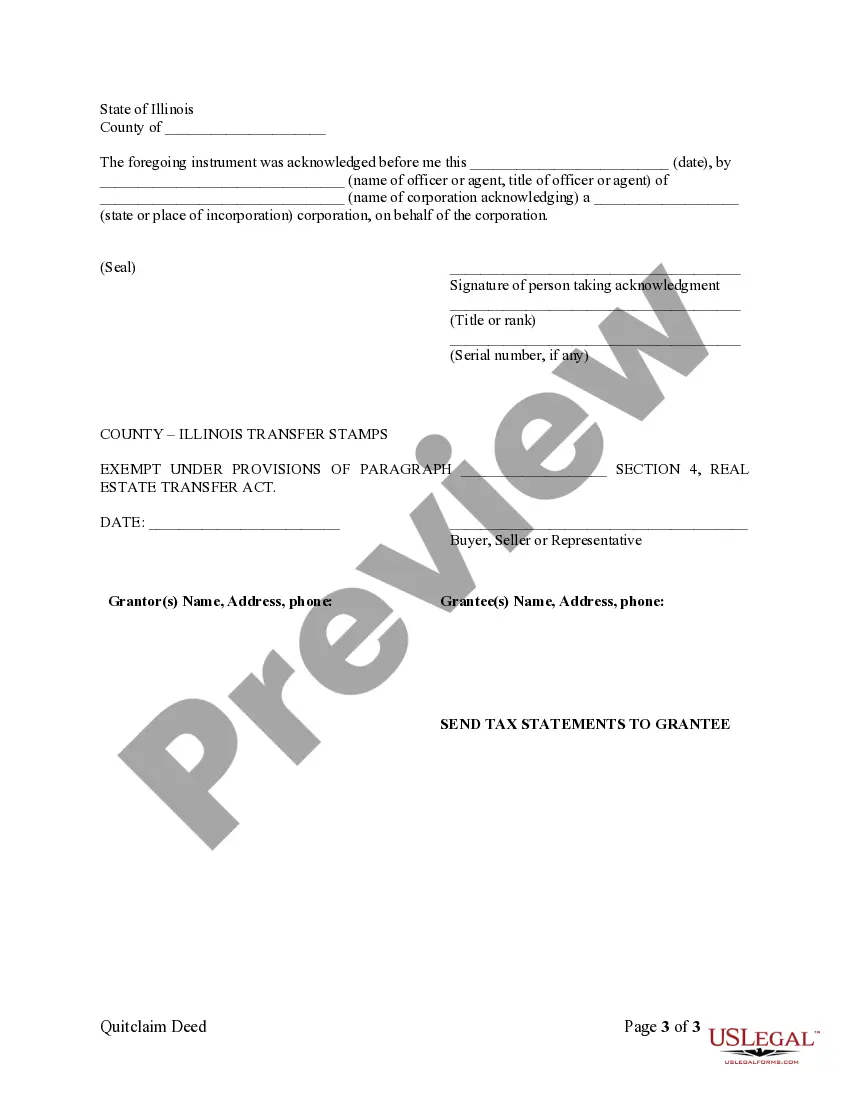
- Signature section: Area for acknowledgment and signature of the corporation's representative




Situations where this form applies
This form is commonly used when a corporation decides to transfer property to individuals without making any guarantees about the title. It is typically used in scenarios where the corporation is liquidating assets, simplifying estate transitions, or reallocating property among members. This deed may also be relevant in joint property arrangements where the individuals intend to hold the property jointly.
Intended users of this form
- Corporations looking to transfer real estate holdings to individuals.
- Individuals who want to receive property from a corporation without formal title guarantees.
- Real estate professionals assisting clients with property transfers between entities and individuals.
Instructions for completing this form
- Identify the parties: Clearly state the full legal names of the Grantor (corporation) and the Grantees (individuals).
- Specify the property: Provide a detailed legal description of the property being conveyed, usually attached as an exhibit.
- Enter joint tenancy details: Ensure the joint tenancy clause is included to define how the property will be held.
- Include the date: Fill in the date when the deed is executed.
- Obtain signatures: Ensure proper signatures from the authorized representative of the corporation, along with any required acknowledgments.
Notarization guidance
This form does not typically require notarization unless specified by local law. It is advisable to check your state's regulations to confirm. Some jurisdictions may require notarization for the deed to be considered legally valid.
Get your form ready online
Our built-in tools help you complete, sign, share, and store your documents in one place.
Make edits, fill in missing information, and update formatting in US Legal Forms—just like you would in MS Word.
Download a copy, print it, send it by email, or mail it via USPS—whatever works best for your next step.
Sign and collect signatures with our SignNow integration. Send to multiple recipients, set reminders, and more. Go Premium to unlock E-Sign.
If this form requires notarization, complete it online through a secure video call—no need to meet a notary in person or wait for an appointment.
We protect your documents and personal data by following strict security and privacy standards.

Make edits, fill in missing information, and update formatting in US Legal Forms—just like you would in MS Word.

Download a copy, print it, send it by email, or mail it via USPS—whatever works best for your next step.

Sign and collect signatures with our SignNow integration. Send to multiple recipients, set reminders, and more. Go Premium to unlock E-Sign.

If this form requires notarization, complete it online through a secure video call—no need to meet a notary in person or wait for an appointment.

We protect your documents and personal data by following strict security and privacy standards.
Common mistakes to avoid
- Not including a complete and accurate property description.
- Failure to sign the document or obtain proper acknowledgment.
- Misunderstanding the implications of joint tenancy and survivorship rights.
- Neglecting to file or record the deed with the appropriate county office.
Why use this form online
- Convenient access to legal forms that can be downloaded instantly.
- Editable templates ensure that users can customize the deed to fit their specific needs.
- Reliability, as templates are prepared by licensed attorneys to meet legal standards.
Summary of main points
- The Quitclaim Deed from Corporation to Two Individuals facilitates property transfer without warranty.
- It is useful in various informal and family-related property transactions.
- Complete the form carefully to avoid common mistakes that could invalidate the transaction.
Looking for another form?
Form popularity
FAQ
Only the party transferring the property, known as the grantor, must sign the quitclaim deed to make it valid. The parties receiving the deed, known as the grantees, do not have to sign but should acknowledge the deed for their records. This simplicity in process is one of the reasons people opt for an Illinois Quitclaim Deed from Corporation to Two Individuals.
While it is not always necessary for both parties to be present when signing a quitclaim deed, it is recommended for clarity and assurance. The grantor must sign the deed in front of a notary, but the grantees do not always have to be present. However, facilitating the process with both parties helps ensure a smooth transaction involving an Illinois Quitclaim Deed from Corporation to Two Individuals.
One of the most common ways property owners add spouses to real estate titles is by using quitclaim deeds. Once completed and filed, quitclaim deed forms effectually transfer a share of ownership from the owners, or grantors, to their spouses, or the grantees.
When you need to transfer ownership of a property quickly and relatively easily, filing a quit claim deed is one option. A quit claim deed transfers the legal ownership of the property from one party to another, and doesn't require attorneys or legal help, unless you choose to consult an attorney.
Quitclaim deeds are most often used to transfer property between family members. Examples include when an owner gets married and wants to add a spouse's name to the title or deed, or when the owners get divorced and one spouse's name is removed from the title or deed.
An unrecorded quit claim deed is still valid.Failure to record a deed could render transfer or mortgaging of the property impossible and create numerous legal difficulties. The purpose of the recording a quit claim deed is to give notice to the world that there has been a change in ownership.
A quitclaim deed in Illinois is often used to transfer property between close family members or trusted friends.A quitclaim deed requires trust on the part of the person receiving the deed, because the person transferring it, also known as the grantor, isn't guaranteeing they actually own the property.
Fill out the quit claim deed form, which can be obtained online, or write your own using the form as a guide. The person giving up the interest in the property is the grantor, and the person receiving the interest is the grantee.
The drawback, quite simply, is that quitclaim deeds offer the grantee/recipient no protection or guarantees whatsoever about the property or their ownership of it. Maybe the grantor did not own the property at all, or maybe they only had partial ownership.
Once a quitclaim is signed and recorded, can the deed be challenged in court? Yes, it can. Recording your deed only provides notice of your ownership claim to the public. It does not guarantee ownership.