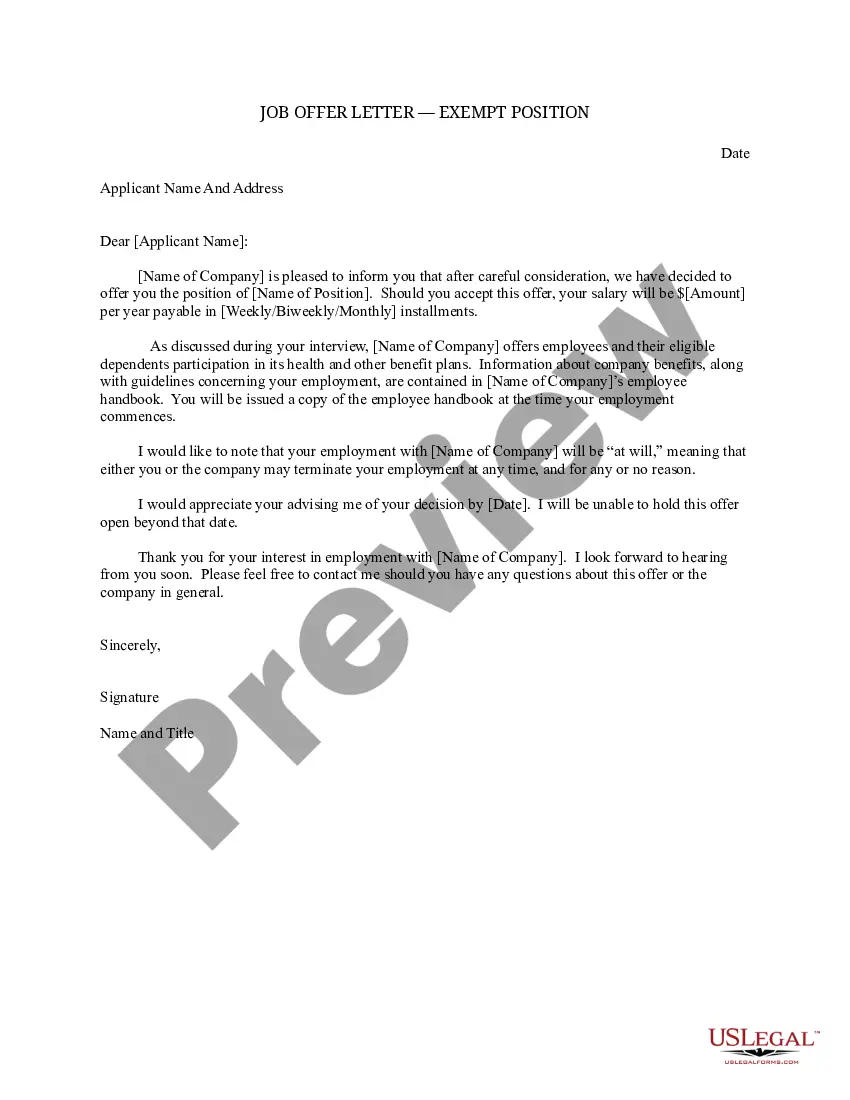
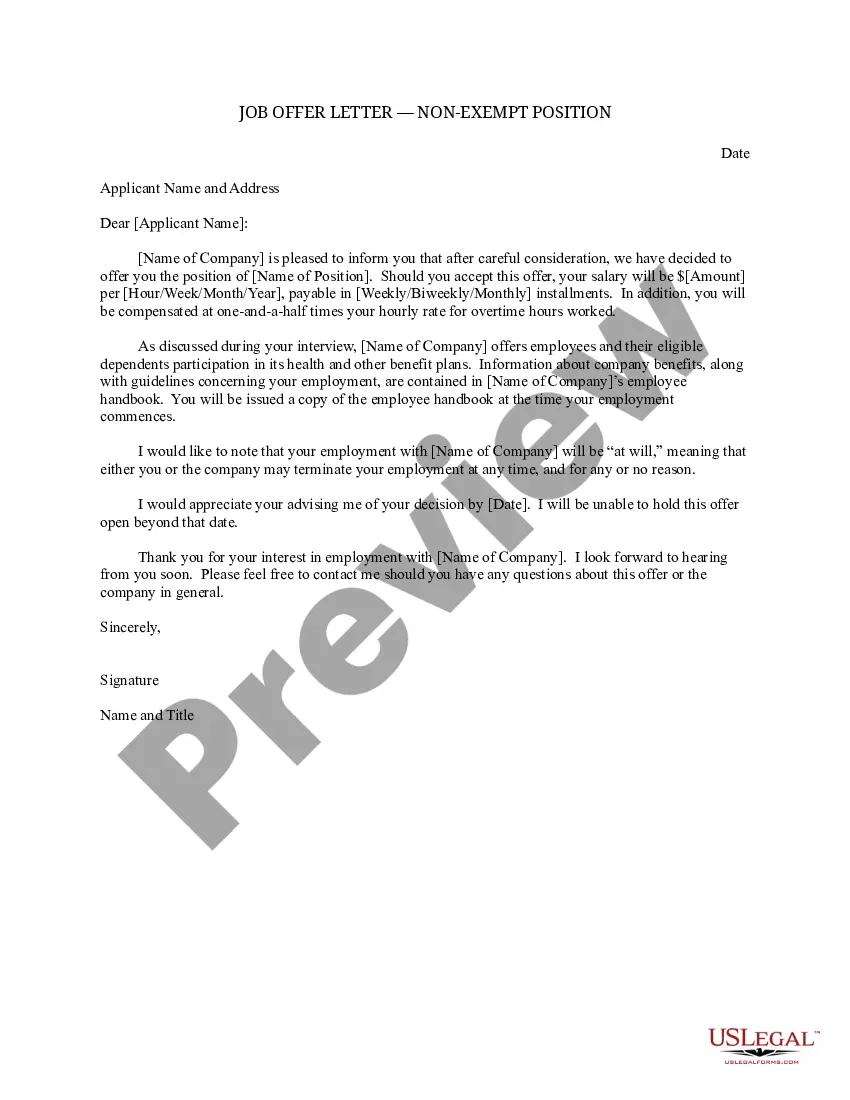
Idaho Employment Offer Letter Exempt or Non-Exempt
Description


Get your form ready online
Our built-in tools help you complete, sign, share, and store your documents in one place.
Make edits, fill in missing information, and update formatting in US Legal Forms—just like you would in MS Word.
Download a copy, print it, send it by email, or mail it via USPS—whatever works best for your next step.
Sign and collect signatures with our SignNow integration. Send to multiple recipients, set reminders, and more. Go Premium to unlock E-Sign.
If this form requires notarization, complete it online through a secure video call—no need to meet a notary in person or wait for an appointment.
We protect your documents and personal data by following strict security and privacy standards.

Make edits, fill in missing information, and update formatting in US Legal Forms—just like you would in MS Word.

Download a copy, print it, send it by email, or mail it via USPS—whatever works best for your next step.

Sign and collect signatures with our SignNow integration. Send to multiple recipients, set reminders, and more. Go Premium to unlock E-Sign.

If this form requires notarization, complete it online through a secure video call—no need to meet a notary in person or wait for an appointment.

We protect your documents and personal data by following strict security and privacy standards.
Looking for another form?

How to fill out Employment Offer Letter Exempt Or Non-Exempt?
Selecting the optimal legal document format can be somewhat challenging.
Undoubtedly, there is a multitude of templates accessible online, but how can you secure the legal form you need.
Utilize the US Legal Forms website. This service provides thousands of templates, such as the Idaho Employment Offer Letter Exempt or Non-Exempt, that can be used for both business and personal purposes.
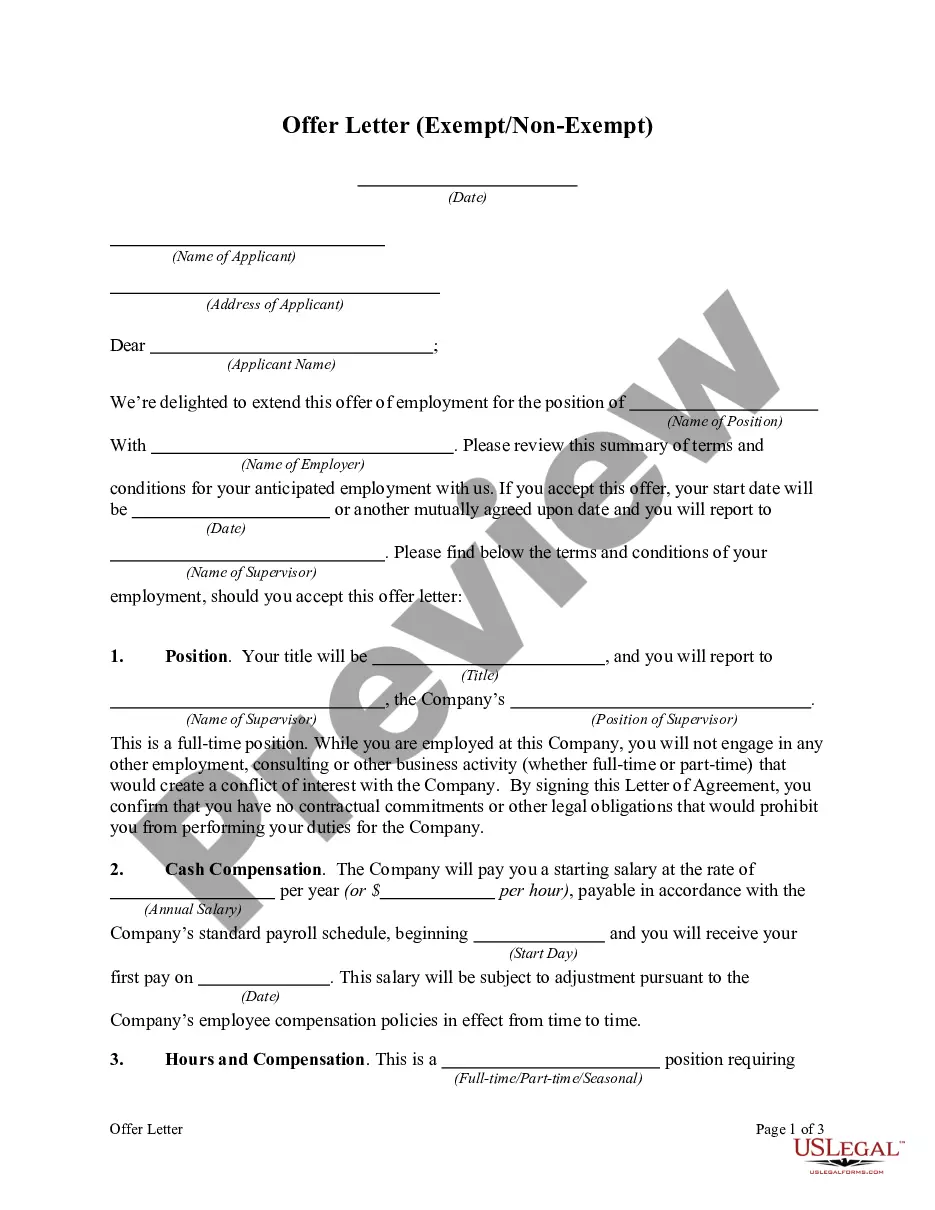
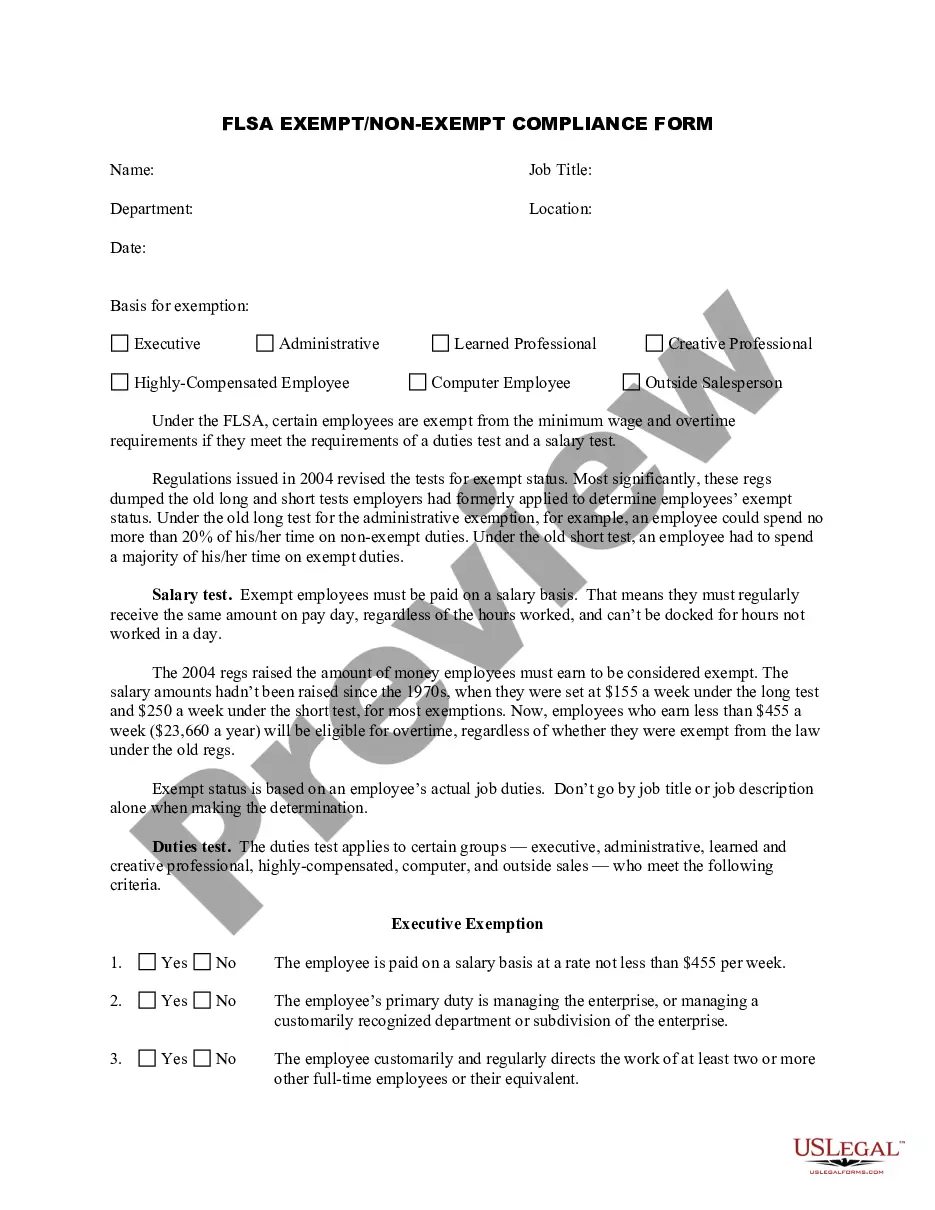
You can review the form using the Preview option and read the form description to verify it is suitable for you.
- All of the forms are reviewed by professionals and meet federal and state requirements.
- If you are already a registered user, Log In to your account and click the Download button to obtain the Idaho Employment Offer Letter Exempt or Non-Exempt.
- Use your account to search for the legal forms you have previously purchased.
- Navigate to the My documents section of your account and download another copy of the document you need.
- If you are a new user of US Legal Forms, here are simple instructions for you to follow.
- First, make sure you have selected the correct form for your city/state.
Form popularity
FAQ
Executives, administrators, and other professionals earning at least $455 per week do not have to be paid overtime under Section 13(a)(1) of the Fair Labor Standards Act. External salespeople (who often set their own hours) are also exempted from ID overtime requirements, as are some types of computer-related workers.
The current Idaho state minimum wage is $7.25 per hour. The minimum wage for a tipped employee is $3.35 per hour. The minimum wage for new hires under the age of 20 years old is $4.25 per hour but only for the first 90 consecutive calendar days of employment. See Idaho Code, Section 44-1502.
The standard salary level threshold for white-collar exempt employees will increase from $455 ($23,600 per year) to $684 per week ($35,568 per year). That means starting January 1, employers will need to pay overtime to employees who earn less than $684 per week ($35,568 per year).
At-Will Employment States:All states in the U.S., excluding Montana, are at-will. Most do have exceptions, but the states of Florida, Alabama, Louisiana, Georgia, Nebraska, Maine, New York, and Rhode Island do not allow any exceptions.
Idaho is a "work at will" state. This means there is no set length for an employment relationship and either the employer or the employee may end it at any time, with or without notice; with or without cause.
Employees may be considered exempt if they are paid a salary, earn at least $684 per week or $35,568 annually, and perform the job duties of one of the exempt professions (administrative, executive, etc.). Highly compensated employees who make $107,432 or more per year are also not required to be paid overtime.
Idaho Minimum Wage for 2021, 2022. Idaho's state minimum wage rate is $7.25 per hour. This is the same as the current Federal Minimum Wage rate.
Idaho is a Right-to-Work state. Employees cannot be forced to join a union or pay union dues, nor can union or non-union members be discriminated against in hiring, promotion or termination.
Generally, when you are employed in Idaho, it is at will. This means an employer can terminate a worker at any time for any reason, as long as that reason does not infringe upon the worker's rights or an employment contract.