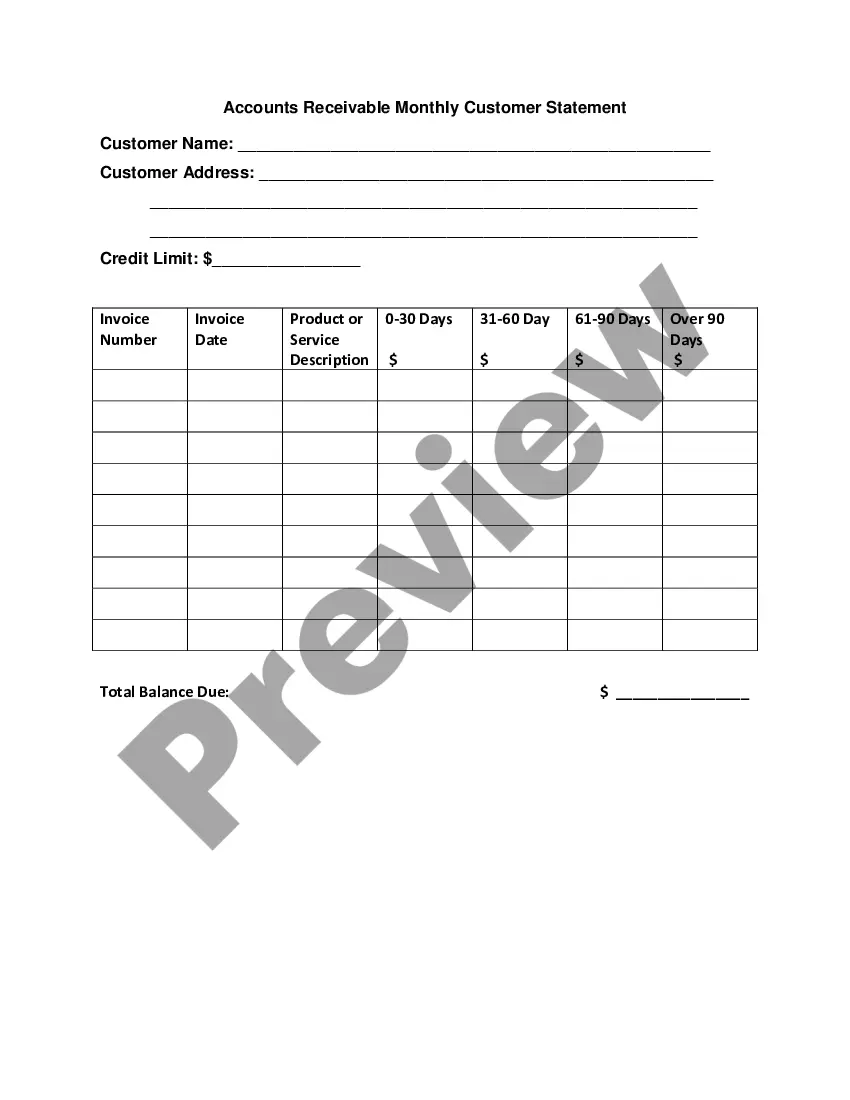
Idaho Accounts Receivable Monthly Customer Statement
Description


Get your form ready online
Our built-in tools help you complete, sign, share, and store your documents in one place.
Make edits, fill in missing information, and update formatting in US Legal Forms—just like you would in MS Word.
Download a copy, print it, send it by email, or mail it via USPS—whatever works best for your next step.
Sign and collect signatures with our SignNow integration. Send to multiple recipients, set reminders, and more. Go Premium to unlock E-Sign.
If this form requires notarization, complete it online through a secure video call—no need to meet a notary in person or wait for an appointment.
We protect your documents and personal data by following strict security and privacy standards.

Make edits, fill in missing information, and update formatting in US Legal Forms—just like you would in MS Word.

Download a copy, print it, send it by email, or mail it via USPS—whatever works best for your next step.

Sign and collect signatures with our SignNow integration. Send to multiple recipients, set reminders, and more. Go Premium to unlock E-Sign.

If this form requires notarization, complete it online through a secure video call—no need to meet a notary in person or wait for an appointment.

We protect your documents and personal data by following strict security and privacy standards.
Looking for another form?



How to fill out Accounts Receivable Monthly Customer Statement?
If you require to complete, acquire, or print authorized document templates, utilize US Legal Forms, the largest collection of legal forms available online.
Take advantage of the site's straightforward and convenient search to find the documents you need.
Numerous templates for business and personal uses are categorized by types and states, or keywords. Use US Legal Forms to obtain the Idaho Accounts Receivable Monthly Customer Statement with just a few clicks.
Every legal document template you acquire is yours forever. You have access to every form you downloaded in your account. Browse the My documents section and select a form to print or download again.
Complete and download, and print the Idaho Accounts Receivable Monthly Customer Statement with US Legal Forms. There are thousands of professional and state-specific forms you can use for your business or personal requirements.
- If you are already a US Legal Forms customer, Log In to your account and click on the Acquire button to get the Idaho Accounts Receivable Monthly Customer Statement.
- You can also access forms you previously downloaded from the My documents tab of your account.
- If you are using US Legal Forms for the first time, follow the instructions below.
- Step 1. Ensure you have selected the form for the correct area/state.
- Step 2. Use the Preview option to review the form's content. Remember to read the details.
- Step 3. If you are not satisfied with the form, use the Search field at the top of the screen to find other types of the legal form template.
- Step 4. Once you have found the form you want, click the Buy now button. Choose the pricing plan you prefer and add your details to register for an account.
- Step 5. Process the purchase. You can use your Visa or Mastercard or PayPal account to complete the transaction.
- Step 6. Select the format of your legal form and download it to your device.
- Step 7. Complete, modify, and print or sign the Idaho Accounts Receivable Monthly Customer Statement.
Form popularity
FAQ
Accounts receivable itself does not appear directly on the profit and loss statement; instead, it affects revenue recognition. When you record sales, they typically convert to accounts receivable until payment is received. Therefore, the Idaho Accounts Receivable Monthly Customer Statement plays a vital role in understanding how these transactions impact your overall profitability.
To prepare a monthly statement of account, start by gathering all relevant transactions for the month, including invoices and payments received. Next, compile the data into a clear format that highlights the customer's name, account number, and transaction details, leading to the total outstanding amount. Using tools like USLegalForms can simplify this process, ensuring your Idaho Accounts Receivable Monthly Customer Statement is accurate, professional, and easy to read.
The account statement for accounts receivable is a financial document that summarizes all transactions between a business and its customers over a specified period. This document, particularly the Idaho Accounts Receivable Monthly Customer Statement, helps businesses track what customers owe and ensures timely payments. It provides a clear overview of account activity, making it easier for both the business and the customer to understand their financial standing.
An Idaho Accounts Receivable Monthly Customer Statement must include essential details such as the customer's name, account number, transaction history, and the outstanding balance. Additionally, it should specify the payment due date and any applicable terms of payment. Including contact information for inquiries enhances communication and fosters a better relationship with your customers.
The balance sheet is the primary financial statement that displays accounts receivable. It summarizes your company's assets, liabilities, and equity. In addition, the Idaho Accounts Receivable Monthly Customer Statement gives you a comprehensive breakdown of receivables. This document is essential for understanding your company's financial health and managing customer payments.
Accounts receivable is usually listed on the balance sheet under current assets. This section provides a clear picture of what your customers owe your business at a given time. By using the Idaho Accounts Receivable Monthly Customer Statement, you can easily monitor these figures. This visibility helps you manage your finances more effectively.
The Accounts Receivables Statements are documents that itemize all invoices, payments, and credits created during a specific time period, and whose intention is to remind the account holder of their account status. Statements can be mailed, emailed, faxed, or previewed.
What is a Statement of Account? A statement of account is a detailed report of the contents of an account. An example is a statement sent to a customer, showing billings to and payments from the customer during a specific time period, resulting in an ending balance.
Accounts receivable statements are print, file, email, or fax reports showing amounts owed by AR account holders. They are typically prepared for billing purposes.
An account receivable is an asset recorded on the balance sheet as a result of an unpaid sales transaction, explains BDC Advisory Services Senior Business Advisor Nicolas Fontaine. ?More specifically, it is a monetary asset that will realize its value once it is paid and converts into cash.