Idaho Decree Vesting Estate in Surviving Spouse
About this form
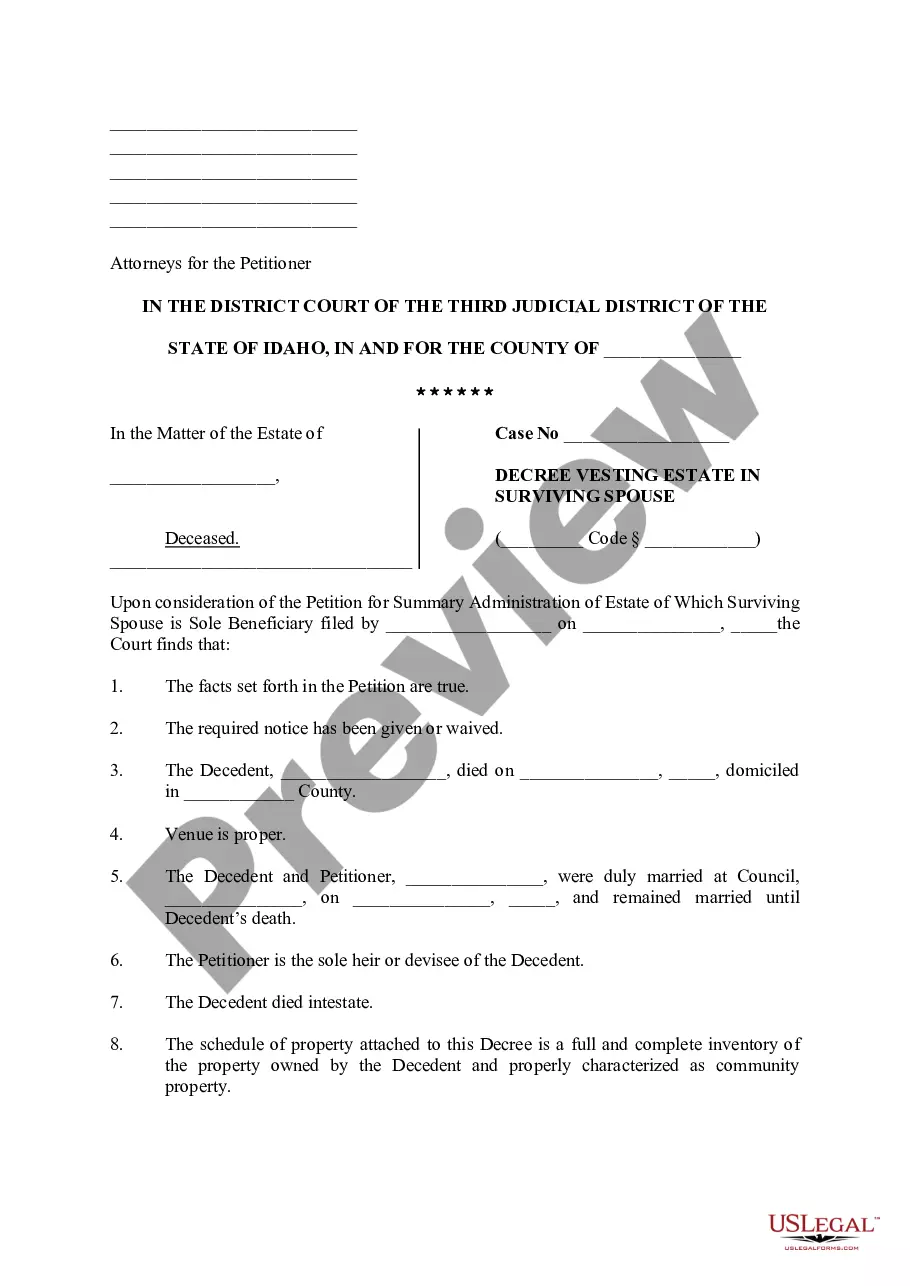
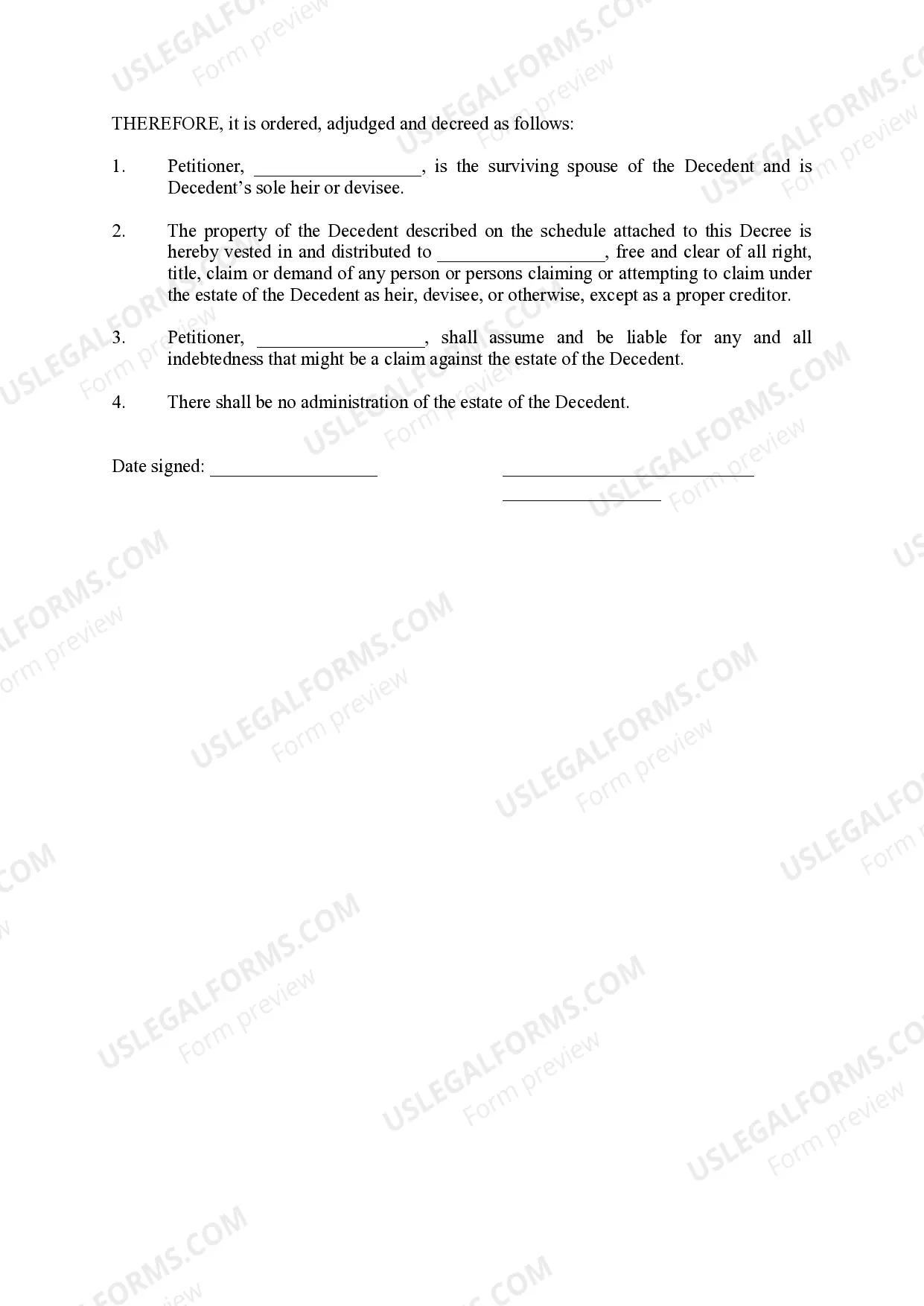
The Decree Vesting Estate in Surviving Spouse is a legal document that transfers the property of a deceased individual (the decedent) to their surviving spouse. This form differs from a will in that it is specifically for situations where the surviving spouse is the sole beneficiary and there is no need for probate proceedings. The document ensures that the spouse receives the property free from claims by other heirs or creditors, except for legitimate debts of the estate.
What’s included in this form
- Identification of the decedent, including name and date of death.
- Confirmation of the survivor's marital status and relationship to the decedent.
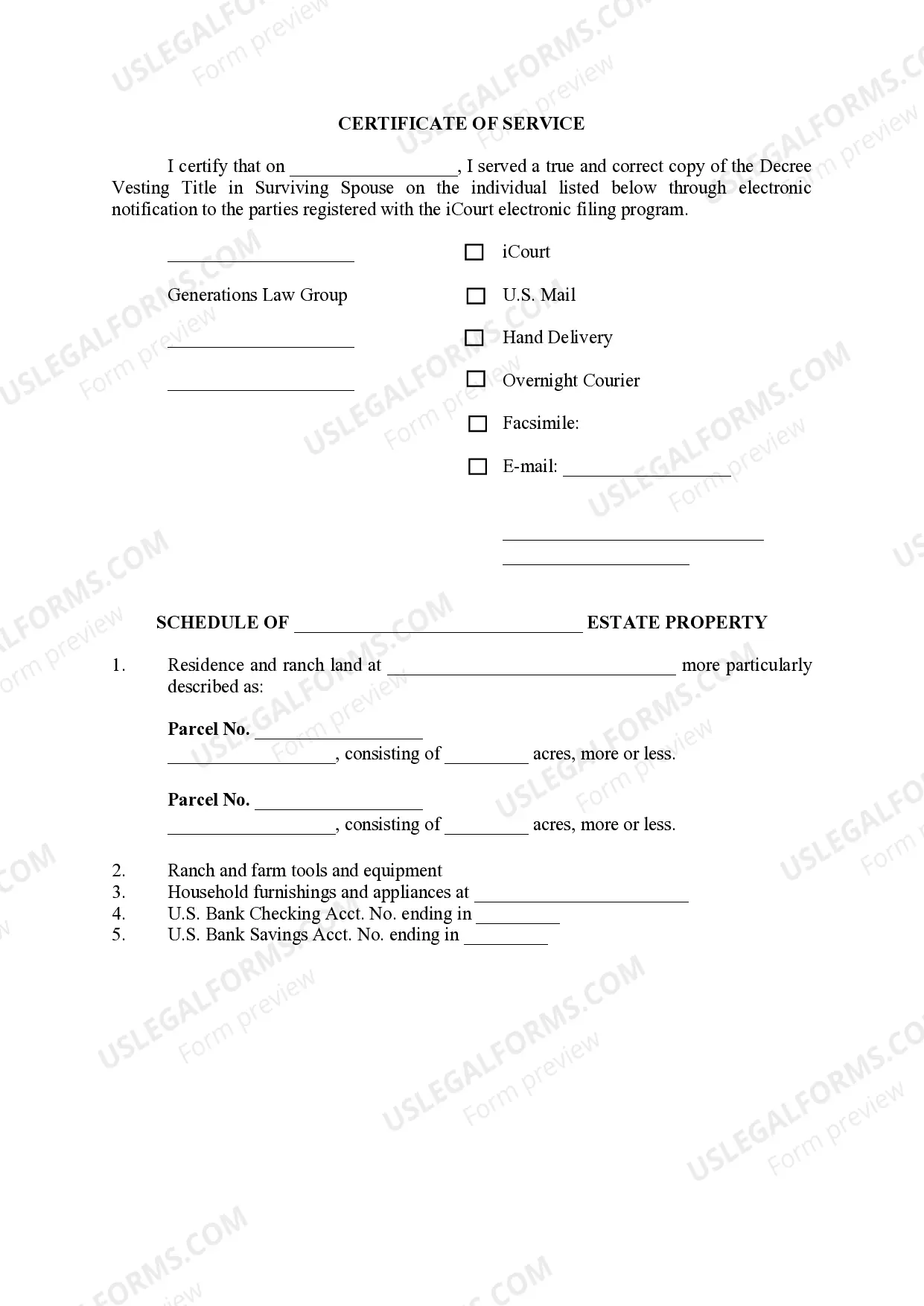
- A complete schedule of the decedentâs property being transferred.
- Legal language affirming the exclusivity of the surviving spouse's claim to the property.
- Certification of notice and procedural requirements met for the court.


Situations where this form applies
This form should be used when a person who has passed away leaves their property solely to their surviving spouse. It is especially relevant in cases where the decedent died intestate (without a will) and there are no other claims to the property. It helps streamline the transfer process, allowing the surviving spouse to take ownership without going through formal probate, provided no outstanding debts remain that might complicate the transfer.
Who this form is for
- Surviving spouses of decedents who died without a will.
- Heirs needing a straightforward declaration of property ownership.
- Individuals looking to clarify the ownership of community property after the death of a partner.
Completing this form step by step
- Provide the full names of the decedent and surviving spouse.
- Fill in the date of the decedent's death and the county where they were domiciled.
- Attach a detailed schedule of the property that is being vested.
- Check the required notifications and certifications have been fulfilled.
- Sign and date the document to finalize it.
Does this document require notarization?
This form does not typically require notarization unless specified by local law. It is advisable to check with local regulations or an attorney for specific requirements in your jurisdiction.
Get your form ready online
Our built-in tools help you complete, sign, share, and store your documents in one place.
Make edits, fill in missing information, and update formatting in US Legal Forms—just like you would in MS Word.
Download a copy, print it, send it by email, or mail it via USPS—whatever works best for your next step.
Sign and collect signatures with our SignNow integration. Send to multiple recipients, set reminders, and more. Go Premium to unlock E-Sign.
If this form requires notarization, complete it online through a secure video call—no need to meet a notary in person or wait for an appointment.
We protect your documents and personal data by following strict security and privacy standards.

Make edits, fill in missing information, and update formatting in US Legal Forms—just like you would in MS Word.

Download a copy, print it, send it by email, or mail it via USPS—whatever works best for your next step.

Sign and collect signatures with our SignNow integration. Send to multiple recipients, set reminders, and more. Go Premium to unlock E-Sign.

If this form requires notarization, complete it online through a secure video call—no need to meet a notary in person or wait for an appointment.

We protect your documents and personal data by following strict security and privacy standards.
Typical mistakes to avoid
- Failing to include a complete and accurate inventory of the property.
- Not providing the required signatures or dates on the document.
- Overlooking local filing requirements after the decree is signed.
Advantages of online completion
- Convenience of downloading the form at any time.
- Ability to edit and complete the form digitally.
- Access to forms created by licensed attorneys for accuracy and reliability.
Summary of main points
- The Decree Vesting Estate in Surviving Spouse allows a deceased individual's property to transfer directly to their spouse without probate.
- This form is suitable for intestate estates where the spouse is the sole beneficiary.
- Completing the form accurately and following local regulations ensures a smooth transfer process.
Looking for another form?
Form popularity
FAQ
The surviving spouse has the right to Family Exempt Property.The surviving spouse has the right to receive Letters of Administration, which means that ahead of all other family members, he/she has the right to serve as the Administrator when someone dies intestate.
The Spouse Is the Automatic Beneficiary for Married People A federal law, the Employee Retirement Income Security Act (ERISA), governs most pensions and retirement accounts.
If you die without a will or the person named in the will can't serve as executor, the probate court will choose an executor. State law dictates who has priority to serve. The surviving spouse usually has first priority, followed by children. If there is no spouse or children, then other family members may be chosen.
The surviving spouse has the right to Family Exempt Property.The surviving spouse has the right to receive Letters of Administration, which means that ahead of all other family members, he/she has the right to serve as the Administrator when someone dies intestate.
Non-UPC Elective Share RightsThe remaining 21 states only allow a disinherited spouse to take a portion of the deceased spouse's probate estate. As a result, in these 21 states, the deceased spouse can completely disinherit the surviving spouse by leaving no assets that require probate.
Many married couples own most of their assets jointly with the right of survivorship. When one spouse dies, the surviving spouse automatically receives complete ownership of the property. This distribution cannot be changed by Will.
This law states that no matter what your will says, your spouse has a right to inherit one-third or one-half (depending on the state and sometimes depending on the length of the marriage) of your total estate. To exercise this right, your spouse has to petition the probate court to enforce the law.
Most married couples own most of their assets jointly. Assets owned jointly between husband and wife pass automatically to the survivor.This requires the will to be probated and an executor to be appointed in order to secure the assets. There are exceptions to the probate requirement for estates of $50,000 or less.