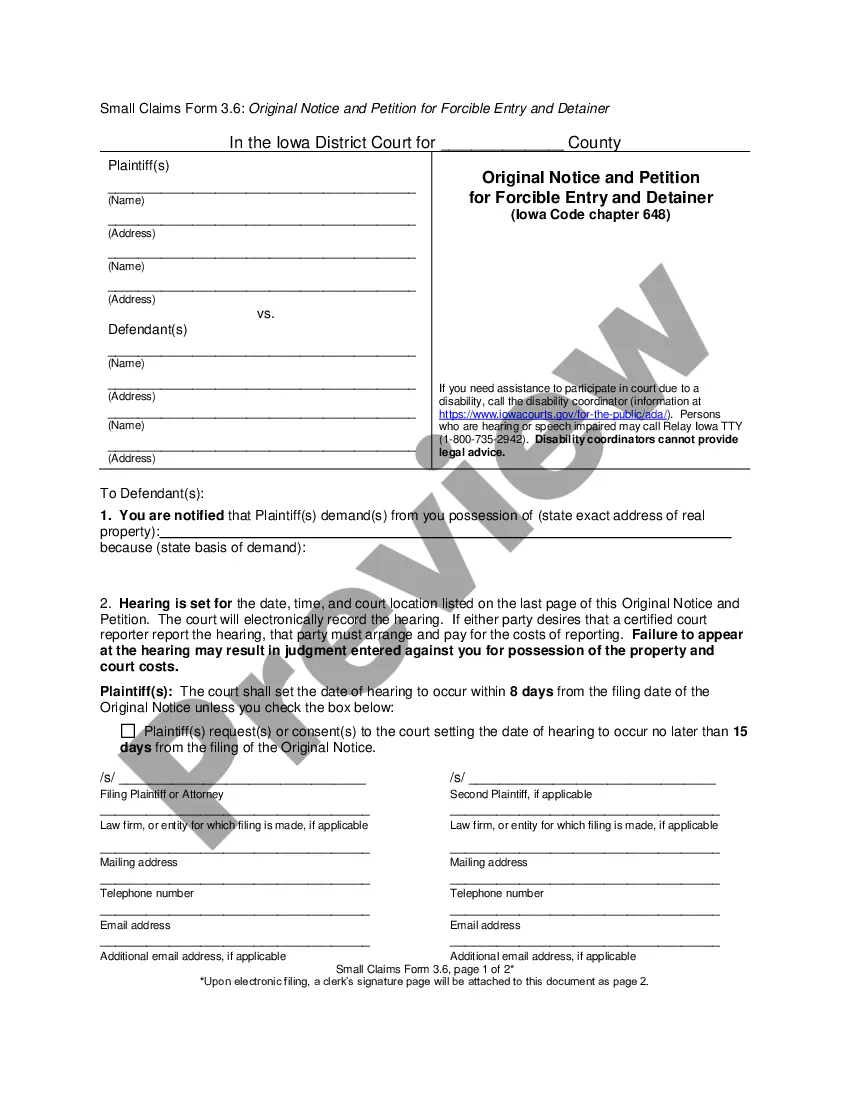
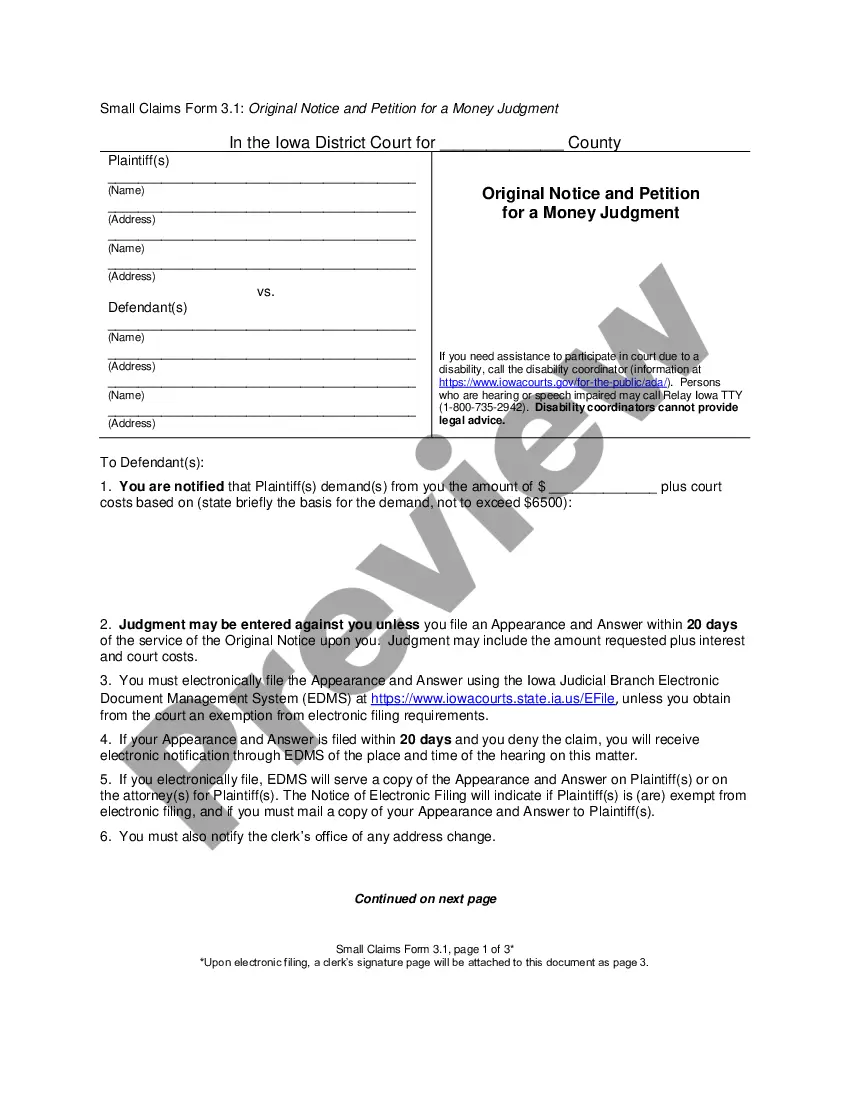
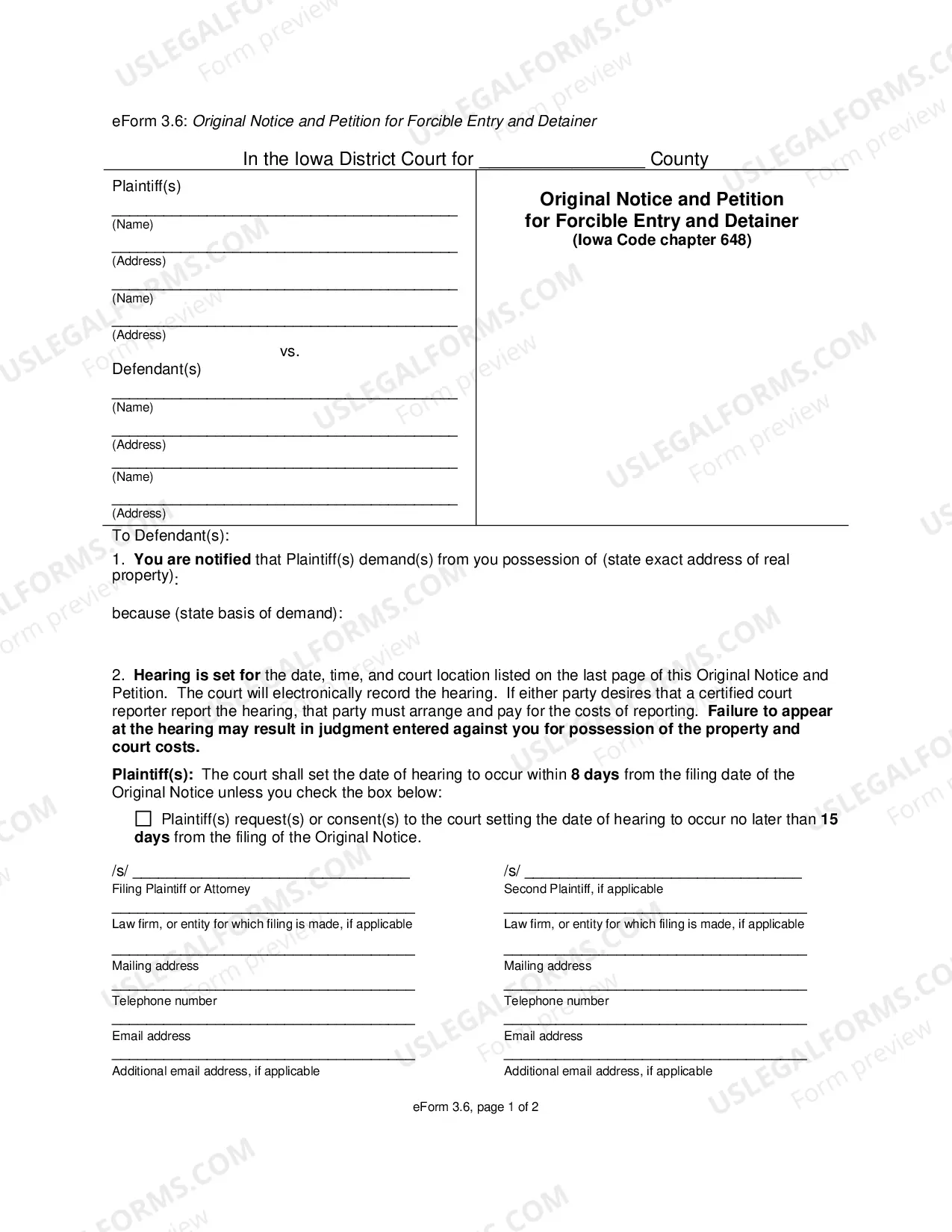
This Small Claims form is an official document from the Judicial Branch of Iowa, and it complies with all applicable state and Federal codes and statutes. USLF updates all state and Federal forms as is required by state and Federal statutes and law.
Iowa Original Notice - Action for Forcible Enter and Detainer
Instant download
This website is not affiliated with any governmental entity
Public form
Description
Get your form ready online
Our built-in tools help you complete, sign, share, and store your documents in one place.
Built-in online Word editor
Make edits, fill in missing information, and update formatting in US Legal Forms—just like you would in MS Word.
Export easily
Download a copy, print it, send it by email, or mail it via USPS—whatever works best for your next step.
E-sign your document
Sign and collect signatures with our SignNow integration. Send to multiple recipients, set reminders, and more. Go Premium to unlock E-Sign.
Notarize online 24/7
If this form requires notarization, complete it online through a secure video call—no need to meet a notary in person or wait for an appointment.
Store your document securely
We protect your documents and personal data by following strict security and privacy standards.

Make edits, fill in missing information, and update formatting in US Legal Forms—just like you would in MS Word.

Download a copy, print it, send it by email, or mail it via USPS—whatever works best for your next step.

Sign and collect signatures with our SignNow integration. Send to multiple recipients, set reminders, and more. Go Premium to unlock E-Sign.

If this form requires notarization, complete it online through a secure video call—no need to meet a notary in person or wait for an appointment.

We protect your documents and personal data by following strict security and privacy standards.
Looking for another form?
How to fill out Iowa Original Notice - Action For Forcible Enter And Detainer?
Access the most comprehensive collection of legal documents.
US Legal Forms is truly an option where you can discover any state-specific template in just a few clicks, including Iowa Original Notice - Action for Forcible Entry and Detainer forms.
There's no need to squander hours searching for a legally acceptable document. Our certified experts guarantee you receive updated versions consistently.
If all details are accurate, click on the Buy Now button. After selecting a pricing plan, register an account. Complete payment via card or PayPal. Save the document to your device by clicking Download. That's it! You should fill out the Iowa Original Notice - Action for Forcible Enter and Detainer template and review it. To confirm accuracy, consult your local legal advisor for help. Join and effortlessly browse approximately 85,000 valuable templates.
- To utilize the document repository, select a subscription and create your account.
- If you have already established it, simply Log In and then click Download.
- The Iowa Original Notice - Action for Forcible Enter and Detainer file will be swiftly saved in the My documents section (a section for every form you save on US Legal Forms).
- To set up a new account, adhere to the straightforward instructions provided below.
- If you intend to use a state-specific sample, make sure to specify the correct state.
- If possible, review the description to grasp all the subtleties of the document.
- Use the Preview option if it's available to examine the content of the document.
Form popularity
FAQ
Yes, the landlord can give you a hand-written notice to terminate your tenancy. There is no rule that it needs to be typed.
The landlord cannot file an eviction lawsuit until after the three days have gone by. If the landlord does file before waiting 3 days, the court should dismiss the lawsuit at the hearing. Tenants must get notice of any eviction hearing at least 3 days before it takes place.
To proceed with an eviction, notify the tenant no fewer than three days before the hearing date that the case will be taken to small claims court. The case will be postponed otherwise. The notice can be served by hand, certified mail, or by posting the notice to their door.
Personal service by a process server; hand delivery by the landlord if the tenant signs an acknowledgment of service; or. posting on the tenant's main entrance along with both regular and certified mail.
The notice must state that the tenant has three days to either pay rent or the lease will terminate. If the tenant does not pay rent within the three-day time period, the landlord can terminate the lease and begin eviction proceedings against the tenant (see Iowa Code Ann. § 562A.
Iowa Tenant's Right to Notice Before Landlord Entry In Iowa a landlord must usually give 24 hours' notice before entering a tenant's apartment. The landlord can only enter during reasonable hours, which would be normal business hours unless the landlord and tenant agreed on another time.
The most effective way to serve a notice of eviction is to send the notice via certified mail with a return receipt. After this is done, the notice of eviction is posted conspicuously on the property, such as the front door or garage.