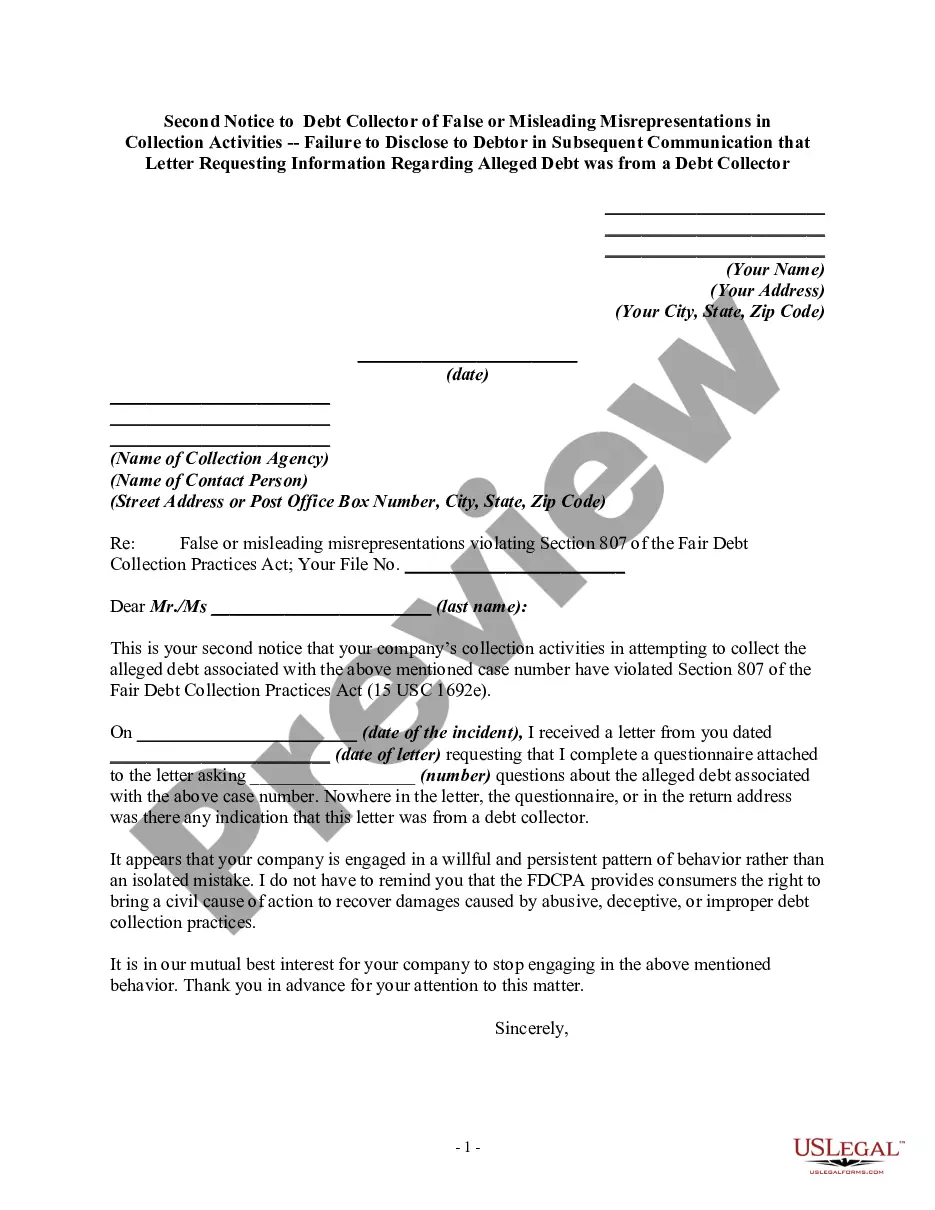
Hawaii Second Notice to Debt Collector of False or Misleading Misrepresentations in Collection Activities - Failure to Disclose to Debtor in Subsequent Communication that Letter Requesting Information Regarding Alleged Debt was from a Debt Collector

State:
Multi-State
Control #:
US-DCPA-19.2BG
Format:
Word; 
Rich Text
Instant download

Description

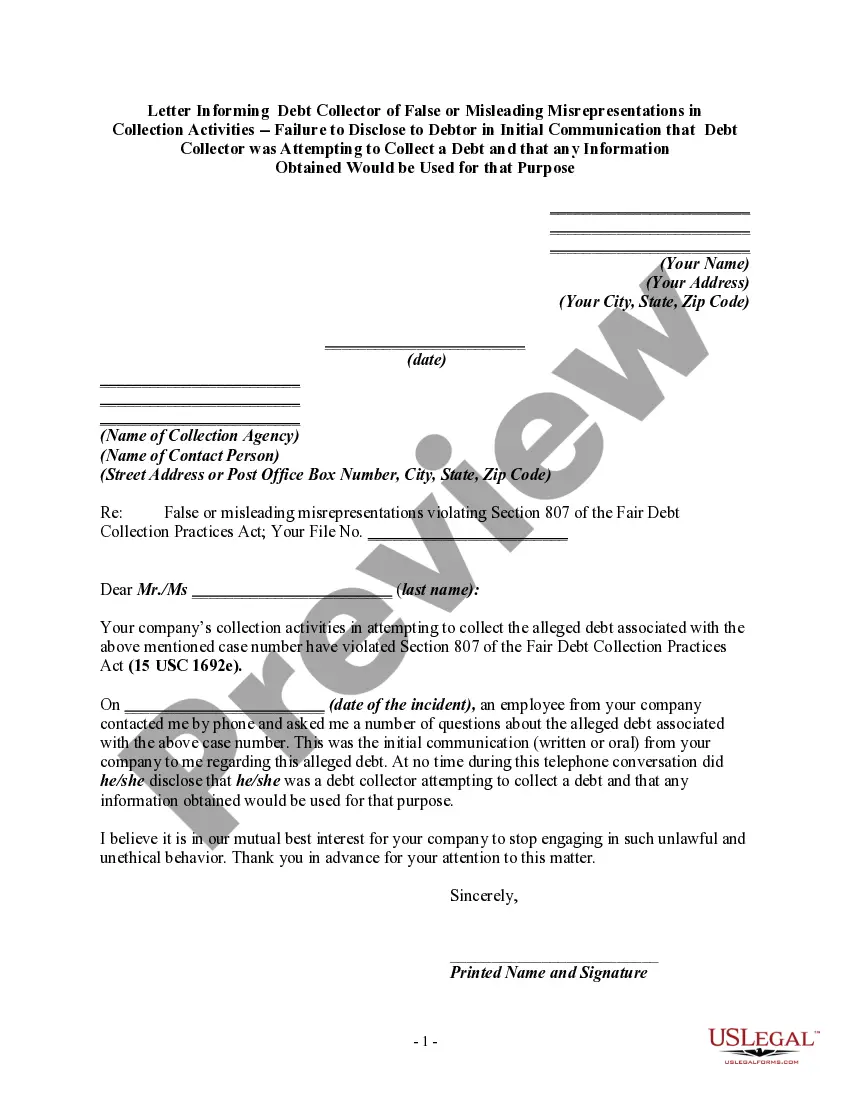
Section 807 of the Fair Debt Collection Practices Act, 15 U.S.C. Sec. 1692e, provides, in part, as follows:


A debt collector may not use any false, deceptive, or misleading representation or means in connection with the collection of any debt. Without limiting the general application of the foregoing, the following conduct is a violation of this section:


"11) The failure to disclose in the initial written communication with the consumer and, in addition, if the initial communication with the consumer is oral, in that initial oral communication, that the debt collector is attempting to collect a debt and that any information obtained will be used for that purpose, and the failure to disclose in subsequent communications that the communication is from a debt collector . . . ."
Free preview
  • Preview Second Notice to  Debt Collector of False or Misleading Misrepresentations in Collection Activities - Failure to Disclose to Debtor in Subsequent Communication that Letter Requesting Information Regarding Alleged Debt was from a Debt Collector
  • Preview Second Notice to  Debt Collector of False or Misleading Misrepresentations in Collection Activities - Failure to Disclose to Debtor in Subsequent Communication that Letter Requesting Information Regarding Alleged Debt was from a Debt Collector

Related forms

form-preview
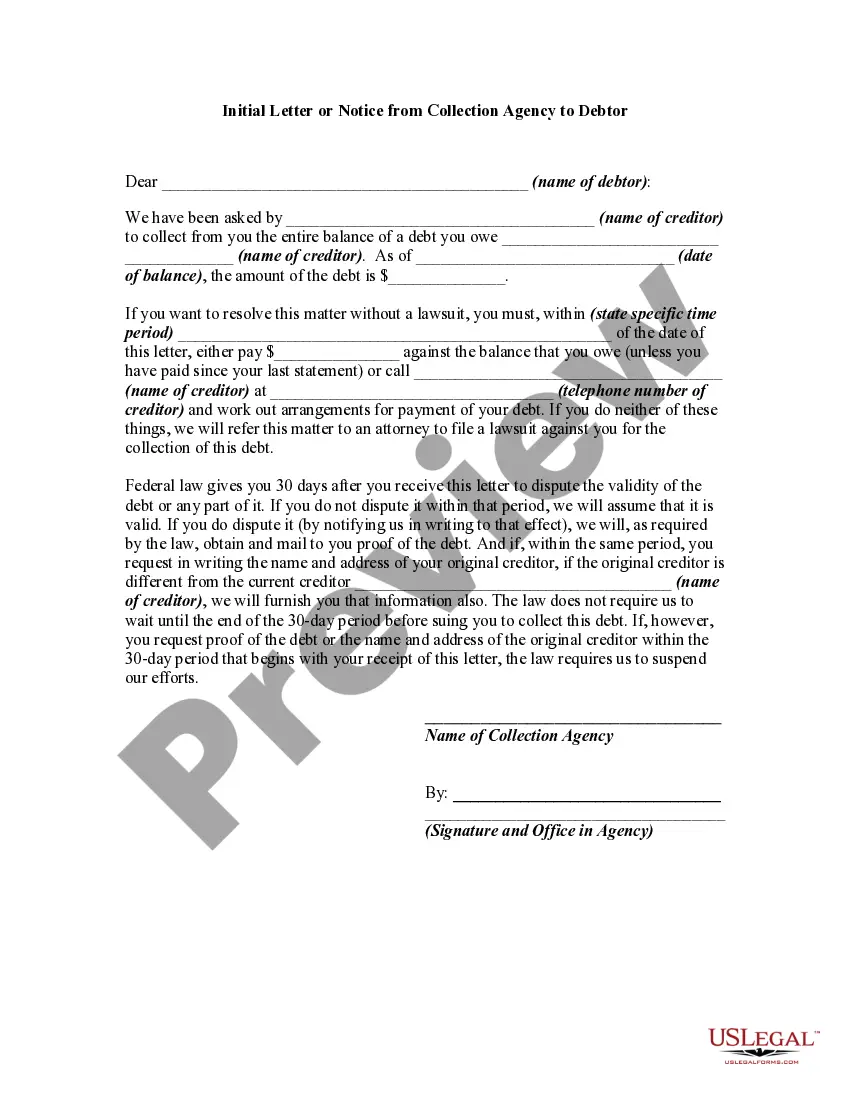
Hawaii Initial Letter or Notice from Collection Agency to Debtor

Hawaii Initial Letter or Notice from Collection Agency to Debtor

View this form
form-preview
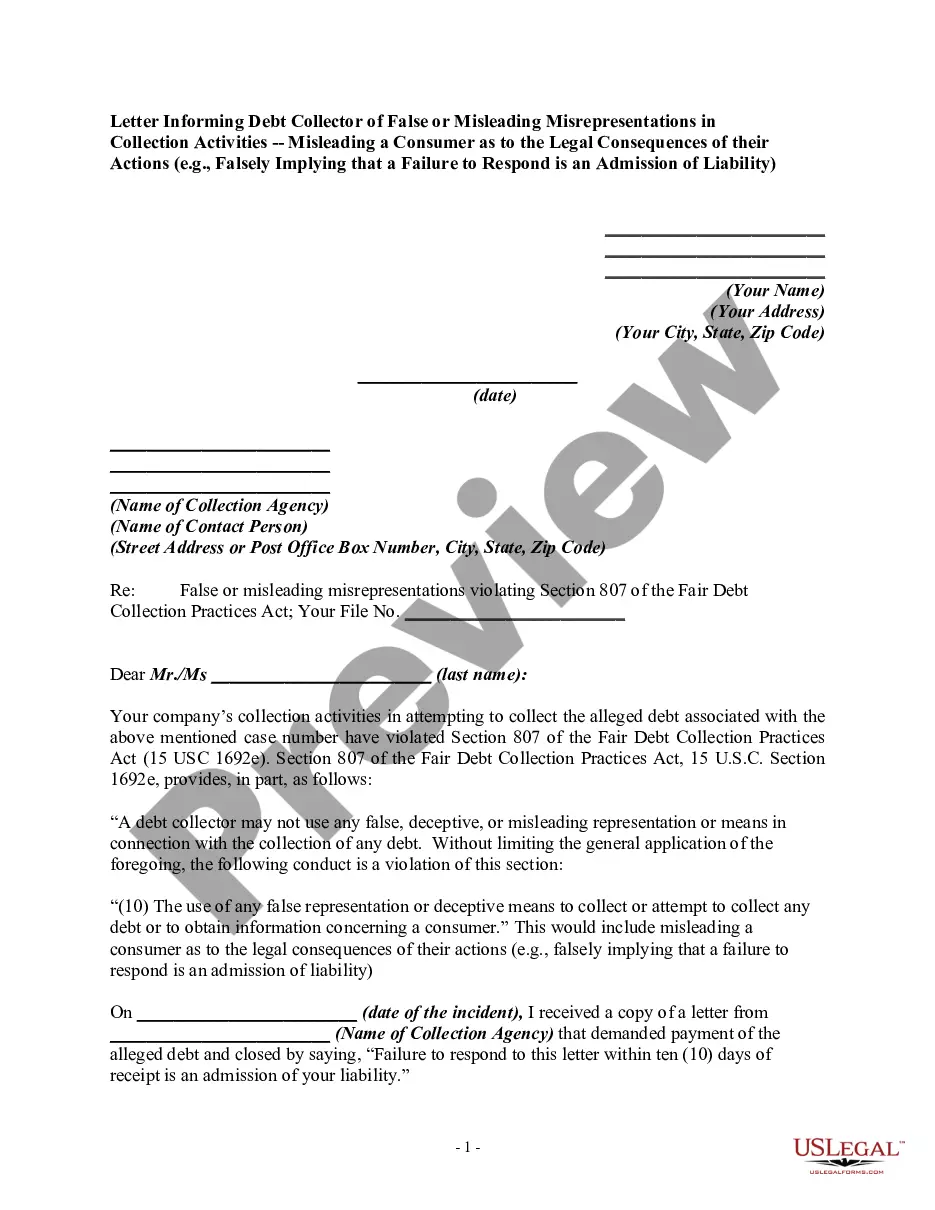
Hawaii Letter Informing Debt Collector of False or Misleading Misrepresentations in Collection Activities - Misleading a Consumer as to the Legal Consequences of their Actions - e.g., Falsely Implying that a Failure to Respond is an Admission of Liability

Hawaii Letter Informing Debt Collector of False or Misleading Misrepresentations in Collection Activities - Misleading a Consumer as to the Legal Consequences of their Actions - e.g., Falsely Implying that a Failure to Respond is an Admission of Liability

View this form
form-preview
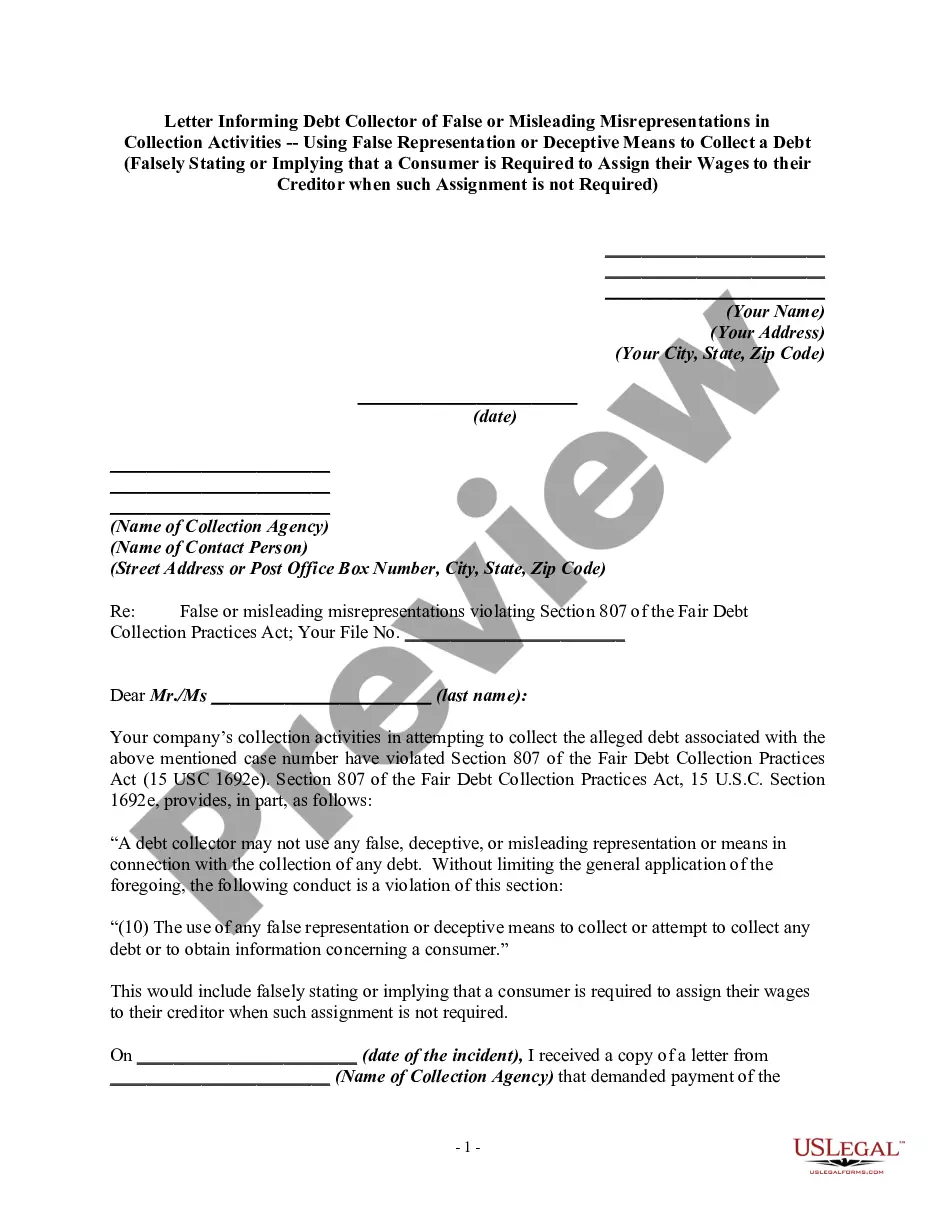
Hawaii Letter Informing Debt Collector of False or Misleading Misrepresentations in Collection Activities - Using False Representation or Deceptive Means to Collect a Debt

Hawaii Letter Informing Debt Collector of False or Misleading Misrepresentations in Collection Activities - Using False Representation or Deceptive Means to Collect a Debt

View this form
form-preview
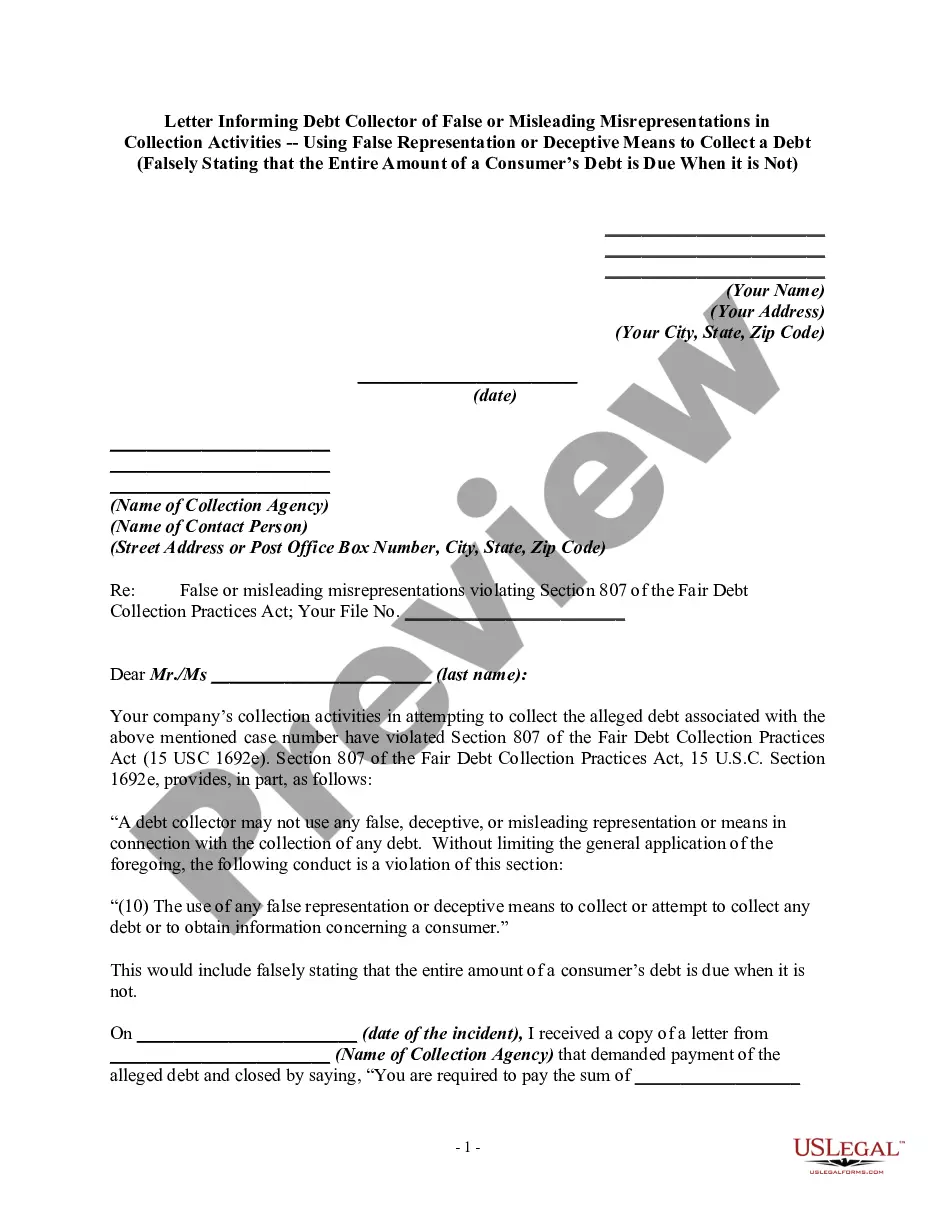
Hawaii Letter Informing Debt Collector of False or Misleading Misrepresentations in Collection Activities - Using False Representation or Deceptive Means to Collect a Debt - Falsely Stating that the Entire Amount of a Consumer's Debt is Due When it is Not

Hawaii Letter Informing Debt Collector of False or Misleading Misrepresentations in Collection Activities - Using False Representation or Deceptive Means to Collect a Debt - Falsely Stating that the Entire Amount of a Consumer's Debt is Due When it is Not

View this form
form-preview
Hawaii Letter Informing Debt Collector of False or Misleading Misrepresentations in Collection Activities - Failure to Disclose to Debtor in Initial Communication that Debt Collector was Attempting to Collect a Debt

Hawaii Letter Informing Debt Collector of False or Misleading Misrepresentations in Collection Activities - Failure to Disclose to Debtor in Initial Communication that Debt Collector was Attempting to Collect a Debt

View this form

How to fill out Second Notice To Debt Collector Of False Or Misleading Misrepresentations In Collection Activities - Failure To Disclose To Debtor In Subsequent Communication That Letter Requesting Information Regarding Alleged Debt Was From A Debt Collector?

Locating the appropriate legal document template can be a significant challenge.

It goes without saying that numerous templates are accessible online, but how can you find the legal document you require.

Utilize the US Legal Forms website. The service offers a vast array of templates, including the Hawaii Second Notice to Debt Collector of False or Misleading Misrepresentations in Collection Activities - Failure to Disclose to Debtor in Subsequent Communication that Letter Requesting Information Regarding Alleged Debt was from a Debt Collector, which can be utilized for both business and personal purposes.

If the form does not meet your needs, utilize the Search field to find the correct document. Once you are confident that the form is accurate, click the Buy now button to purchase the document. Select the payment plan you prefer and input the necessary information. Create your account and process the order using your PayPal account or credit card. Choose the file format and download the legal document format to your device. Finally, edit, print, and sign the obtained Hawaii Second Notice to Debt Collector of False or Misleading Misrepresentations in Collection Activities - Failure to Disclose to Debtor in Subsequent Communication that Letter Requesting Information Regarding Alleged Debt was from a Debt Collector. US Legal Forms is the largest collection of legal templates where you can find a variety of document formats. Take advantage of the service to obtain well-crafted papers that meet state requirements.

  1. All templates are reviewed by professionals and conform to state and federal regulations.
  2. If you are already registered, Log In to your account and click the Acquire button to download the Hawaii Second Notice to Debt Collector of False or Misleading Misrepresentations in Collection Activities - Failure to Disclose to Debtor in Subsequent Communication that Letter Requesting Information Regarding Alleged Debt was from a Debt Collector.
  3. Use your account to search for the legal templates you have previously requested.
  4. Go to the My documents tab of your account and retrieve another copy of the document you require.
  5. If you are a new user of US Legal Forms, here are simple steps you should follow.
  6. First, ensure you have selected the correct document for the city/county. You can preview the form using the Preview button and read the form description to ensure that it is the right one for you.

Form popularity

FAQ

Write a dispute letter and send it to each credit bureau. Include information about each of the disputed itemsaccount numbers, listed amounts and creditor names. Write a similar letter to each collection agency, asking them to remove the error from your credit reports.

If a debt collector fails to verify the debt but continues to go after you for payment, you have the right to sue that debt collector in federal or state court. You might be able to get $1,000 per lawsuit, plus actual damages, attorneys' fees, and court costs.

If the FDCPA is violated, the debtor can sue the debt collection company as well as the individual debt collector for damages and attorney fees.

Debt collectors are generally prohibited under federal law from using any false, deceptive, or misleading misrepresentation in collecting a debt. The federal law that prohibits this is called the Fair Debt Collection Practices Act (FDCPA).

Under the Fair Credit Reporting Act (FCRA) (15 U.S.C. § 1681 and following), you may sue a credit reporting agency for negligent or willful noncompliance with the law within two years after you discover the harmful behavior or within five years after the harmful behavior occurs, whichever is sooner.

You can sue a company for sending you to collections for a debt that you don't owe. If a debt collector starts calling you out of the blue, but you know perfectly well that you made the payment in question, the law gives you the right to file an action in court against the company.

Your dispute should be made in writing to ensure that the debt collector has to send you verification of the debt. If you're having trouble with debt collection, you can submit a complaint with the CFPB online or by calling (855) 411-CFPB (2372).

Write a dispute letter and send it to each credit bureau. Include information about each of the disputed itemsaccount numbers, listed amounts and creditor names. Write a similar letter to each collection agency, asking them to remove the error from your credit reports.

Yes, you may be able to sue a debt collector or a debt collection agency if it engages in abusive, deceptive, or unfair behavior. A debt collector is generally someone who buys a debt from a creditor who, for whatever reason, has been unable to collect from a consumer.

Trusted and secure by over 3 million people of the world’s leading companies

Hawaii Second Notice to Debt Collector of False or Misleading Misrepresentations in Collection Activities - Failure to Disclose to Debtor in Subsequent Communication that Letter Requesting Information Regarding Alleged Debt was from a Debt Collector