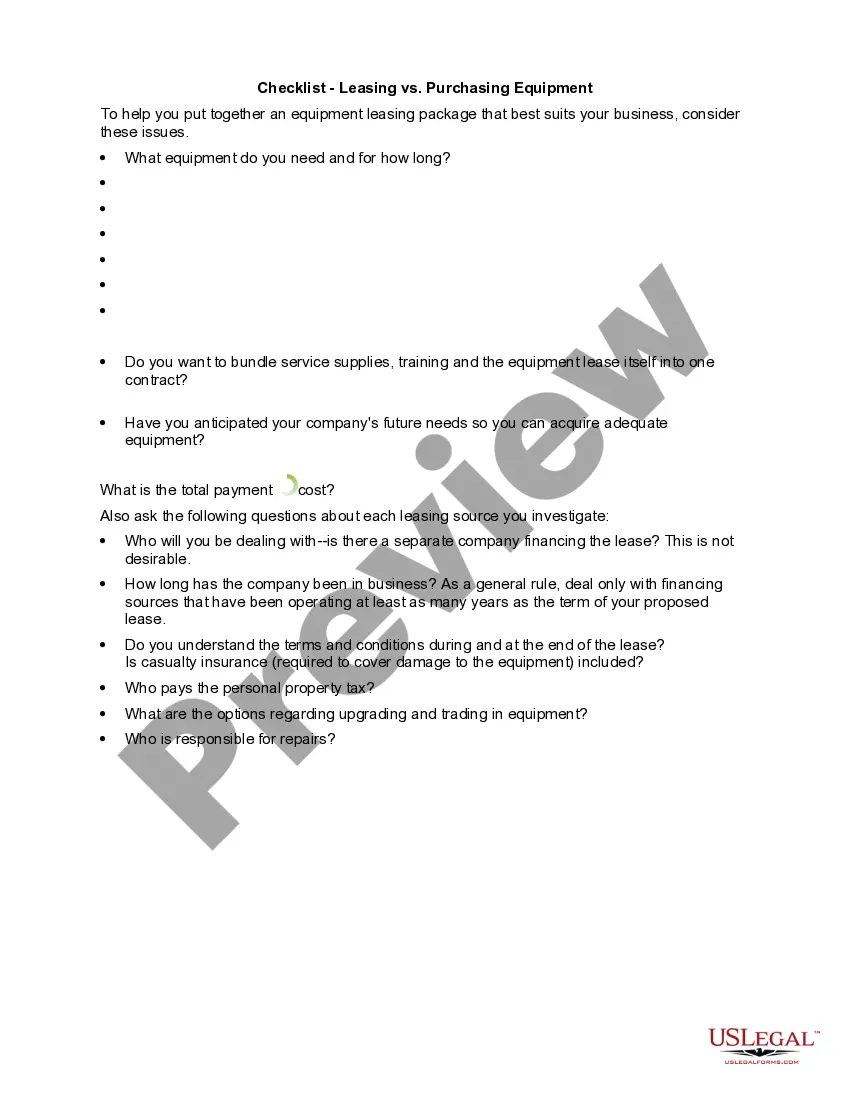
Leasing equipment can help your business stay up-to-date with the latest technology. Other benefits of leasing include making lower monthly payments than you would have with a loan, getting a fixed financing rate instead of a floating rate, benefiting from tax advantages, and conserving working capital by avoiding cash-devouring down payments. Leasing also has its downside, however: You may pay a higher price over the long term. You are also committed to retaining a piece of equipment for a certain time period, which can be problematic if your business is in flux.
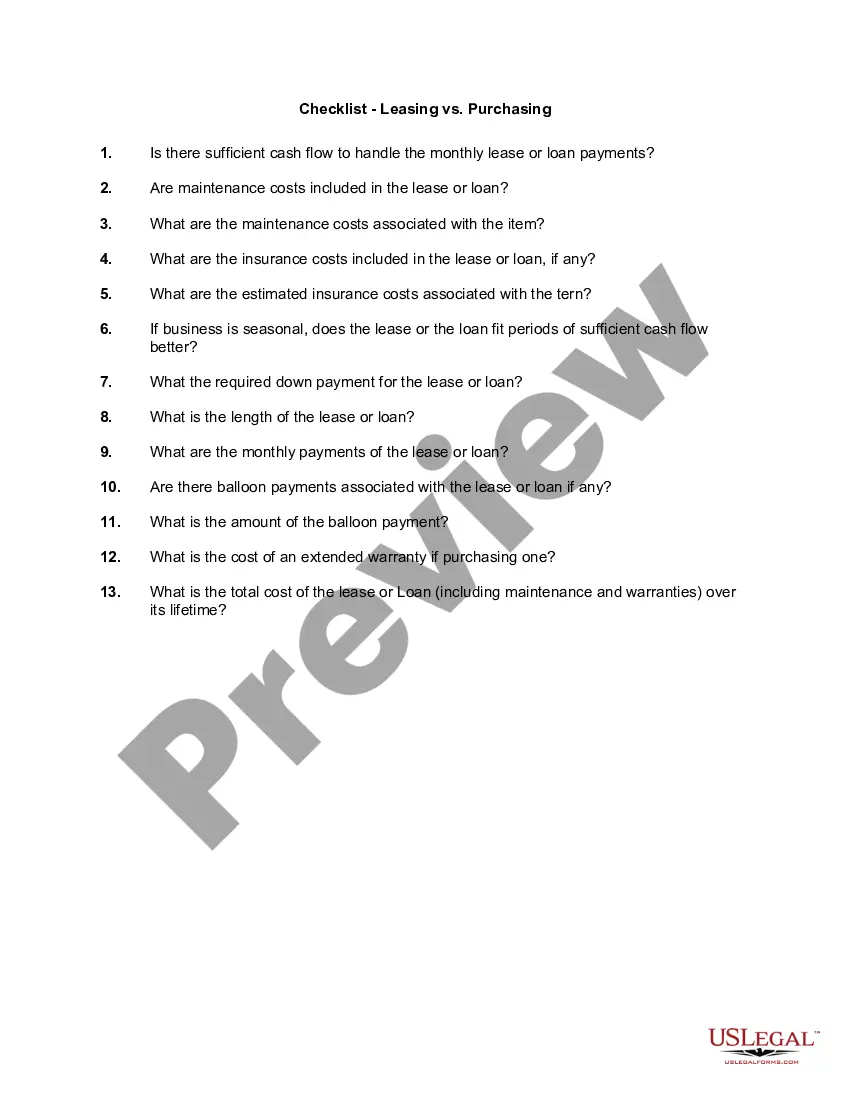
Every lease decision is unique so it's important to study the lease agreement carefully. When deciding to obtain equipment, you need to determine whether it is better to lease or purchase the equipment. You might use this checklist to compare the costs for each option.
Hawaii Checklist - Leasing vs. Purchasing Equipment
Category:
State:
Multi-State
Control #:
US-03082BG
Format:
Word;
Rich Text
Instant download
Description
Get your form ready online
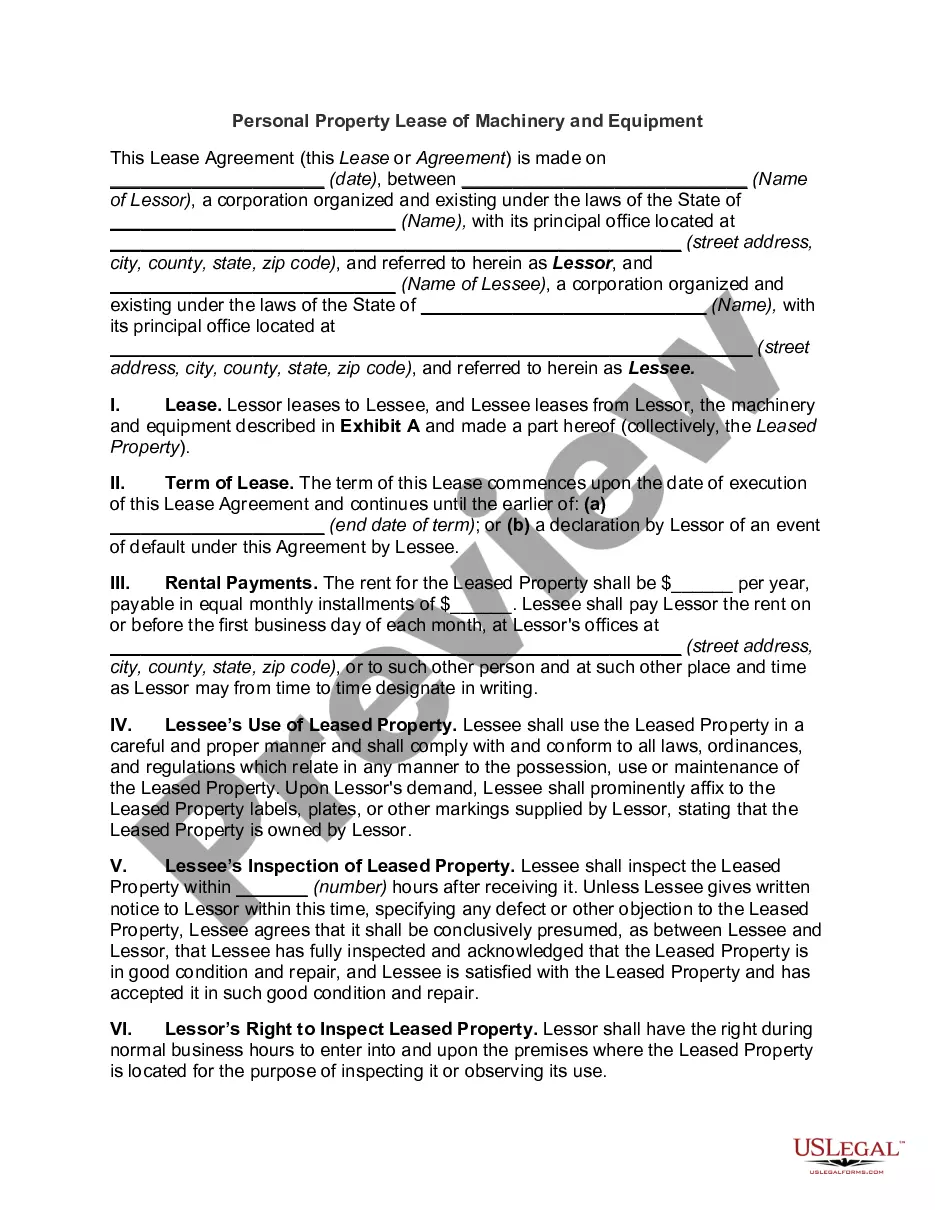
Our built-in tools help you complete, sign, share, and store your documents in one place.
Built-in online Word editor
Make edits, fill in missing information, and update formatting in US Legal Forms—just like you would in MS Word.
Export easily
Download a copy, print it, send it by email, or mail it via USPS—whatever works best for your next step.
E-sign your document
Sign and collect signatures with our SignNow integration. Send to multiple recipients, set reminders, and more. Go Premium to unlock E-Sign.
Notarize online 24/7
If this form requires notarization, complete it online through a secure video call—no need to meet a notary in person or wait for an appointment.
Store your document securely
We protect your documents and personal data by following strict security and privacy standards.

Make edits, fill in missing information, and update formatting in US Legal Forms—just like you would in MS Word.

Download a copy, print it, send it by email, or mail it via USPS—whatever works best for your next step.

Sign and collect signatures with our SignNow integration. Send to multiple recipients, set reminders, and more. Go Premium to unlock E-Sign.

If this form requires notarization, complete it online through a secure video call—no need to meet a notary in person or wait for an appointment.

We protect your documents and personal data by following strict security and privacy standards.
Looking for another form?


How to fill out Checklist - Leasing Vs. Purchasing Equipment?
If you wish to total, obtain, or print legal document templates, utilize US Legal Forms, the largest selection of legal forms available online.
Take advantage of the site's user-friendly and convenient search to find the documents you require. Various templates for business and personal use are organized by categories and states, or keywords.
Utilize US Legal Forms to access the Hawaii Checklist - Leasing vs. Purchasing Equipment with just a few clicks.
Every legal document template you purchase is yours for a long time. You have access to every form you've downloaded in your account. Click the My documents section and select a form to print or download again.
Stay competitive and obtain, and print the Hawaii Checklist - Leasing vs. Purchasing Equipment with US Legal Forms. There are thousands of professional and state-specific forms available for your personal or business needs.
- If you are already a US Legal Forms member, Log In to your account and click the Acquire button to locate the Hawaii Checklist - Leasing vs. Purchasing Equipment.
- You can also access forms you have previously downloaded in the My documents section of your account.
- If you are using US Legal Forms for the first time, follow the instructions below.
- Step 1. Ensure you have selected the form for your appropriate state/region.
- Step 2. Use the Preview feature to view the form’s content. Don't forget to read the description.
- Step 3. If you are not satisfied with the form, utilize the Search field at the top of the screen to find other forms in the legal form format.
- Step 4. Once you have found the form you need, click the Buy now button. Choose the payment plan you prefer and enter your details to register for the account.
- Step 5. Complete the payment process. You can use your credit card or PayPal account to finalize the transaction.
- Step 6. Select the format of the legal form and download it to your device.
- Step 7. Fill out, modify, and print or sign the Hawaii Checklist - Leasing vs. Purchasing Equipment.
Form popularity
FAQ
Deciding whether to buy or lease equipment depends on your business's unique needs and financial situation. Purchasing typically suits businesses looking for long-term investment and asset accumulation. Conversely, leasing can be ideal for those who prefer lower upfront costs and flexibility. To evaluate what works best for you, consider reviewing our Hawaii Checklist - Leasing vs. Purchasing Equipment and explore the benefits each option offers.
Leasing offers several advantages, including lower initial costs and flexibility in upgrading to newer models. It also frees up capital for other business investments, as you can allocate funds elsewhere. Utilizing the Hawaii Checklist - Leasing vs. Purchasing Equipment can help you weigh these benefits against your specific business objectives.
Setting up an equipment lease typically involves identifying your equipment needs and selecting a leasing company. Once you have chosen a provider, you will need to review and sign a lease agreement outlining the terms. Resources like the Hawaii Checklist - Leasing vs. Purchasing Equipment can guide you through the process to ensure you make informed decisions.
While leasing equipment has its perks, there are downsides to consider. You may end up paying more over time compared to purchasing, and you do not build equity in the equipment. Additionally, lease agreements can come with restrictions that limit how you use the equipment, which is why reviewing the Hawaii Checklist - Leasing vs. Purchasing Equipment is essential.
When it comes to tax implications, leasing can offer benefits, as lease payments are often fully deductible as business expenses. However, purchasing equipment allows you to claim depreciation over time, which can also provide tax advantages. Therefore, the decision hinges on your business's financial strategy; refer to the Hawaii Checklist - Leasing vs. Purchasing Equipment to evaluate which option aligns with your goals.
If your business leases equipment under a typical lease, you generally are entitled to currently deduct your rental payments as long as you are using the leased property in your business.
Advantages of Equipment LeasingEquipment Leasing.Advantages of Equipment Leasing. Risk of Obsolescence. Easy Source of Finance. Preferable to a Term Loan. Tax Benefits. Low Maintenance Cost.Disadvantages of Equipment Leasing. No Alteration in the Asset. Higher Cost. Restricted Usage of Asset. Penalties.
The main tax advantage to equipment leasing is the fact that you can write off the full amount of the equipment without paying the full amount. In this way, the amount you save in taxes may actually exceed the lease payments.
Buying or Leasing Business Equipment: Factors to considerOutright purchase. This option is when businesses decide to own the asset and make an outright purchase.Tax benefits.Ownership & Control.Leasing equipment.Frequent Equipment Upgrade.Limited upfront investment.Tax savings.Invest in Core Competencies.10-Mar-2021