A written agreement regarding child custody and support entered into by unmarried parents at time of their breakup is generally enforceable unless the parties abandon the agreement, or the agreement is unconscionable.
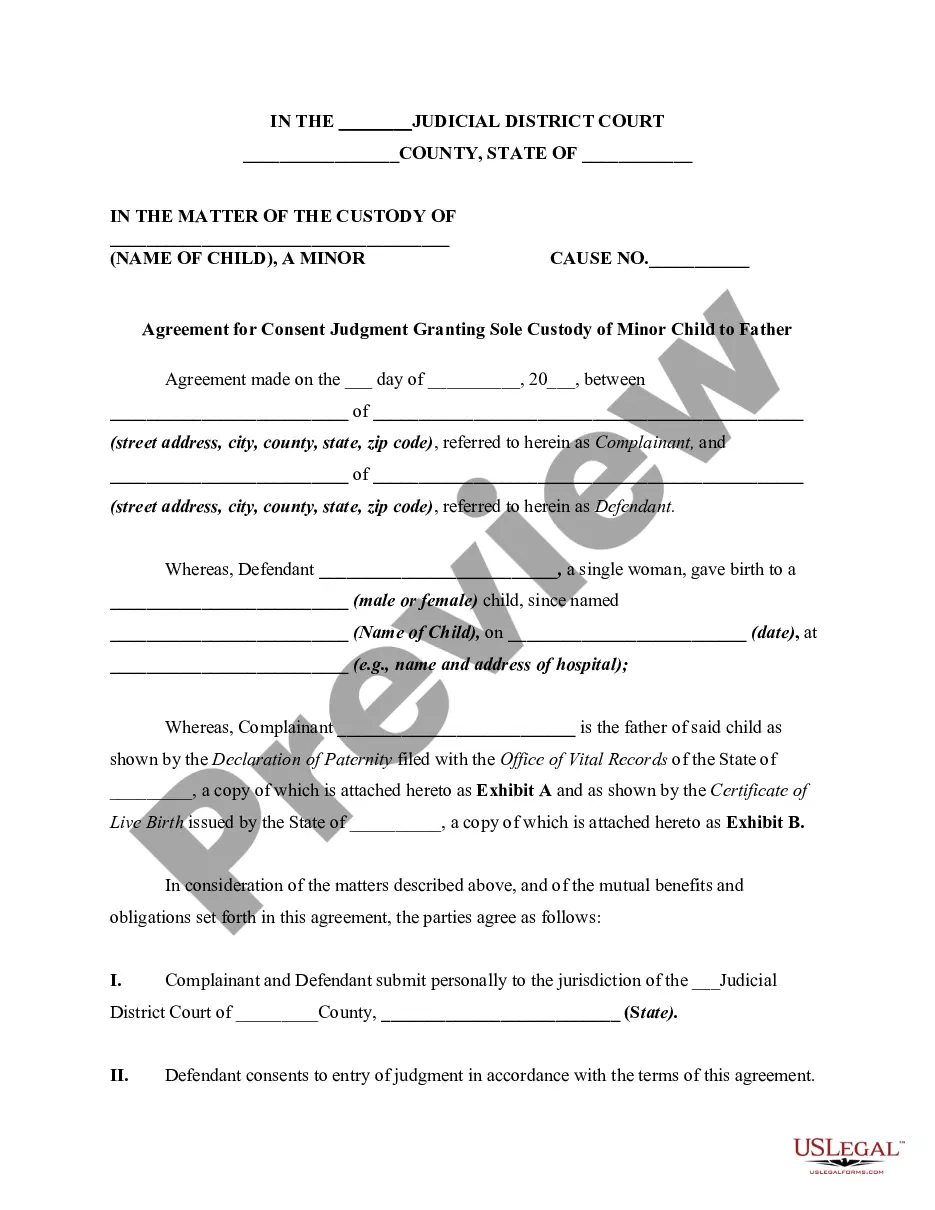
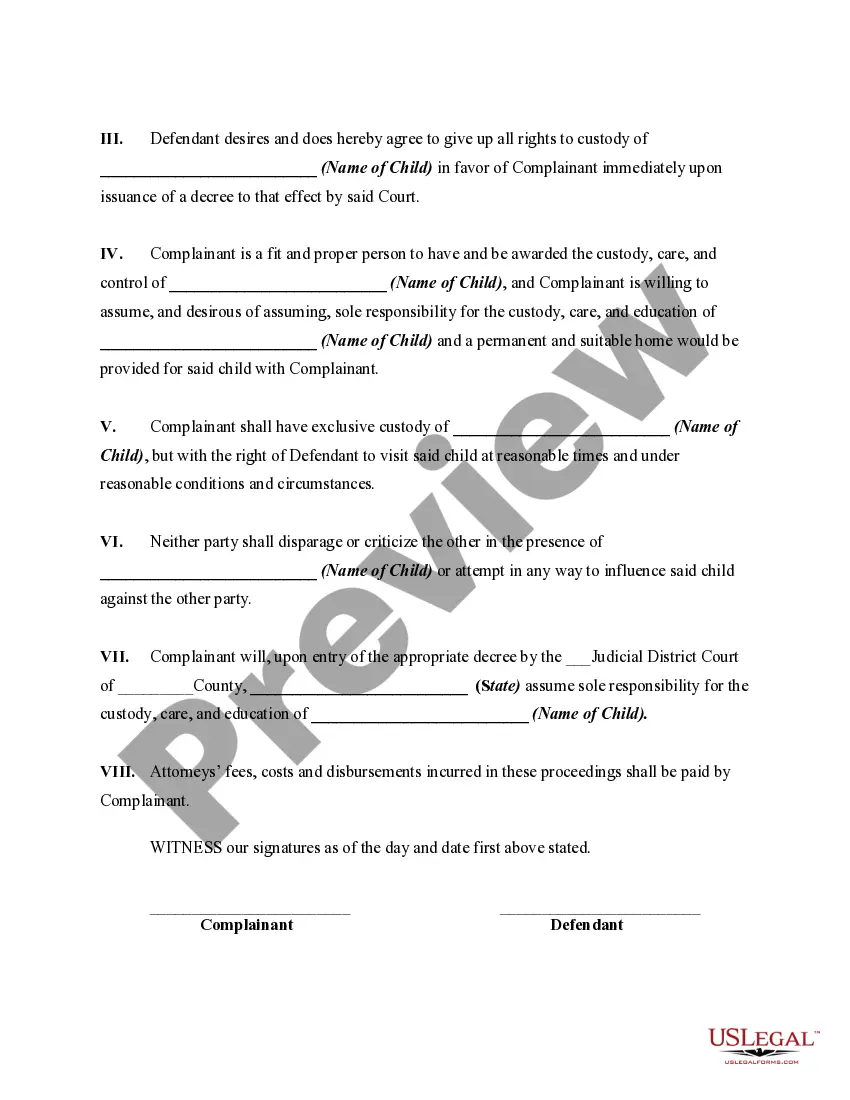
The following form is a sample of an agreement for a consent judgment granting sole custody of a minor child to the father.
Hawaii Agreement for Consent Judgment Granting Sole Custody of Minor Child to Father
State:
Multi-State
Control #:
US-00774BG
Format:
Word;
Rich Text
Instant download
Description
Free preview





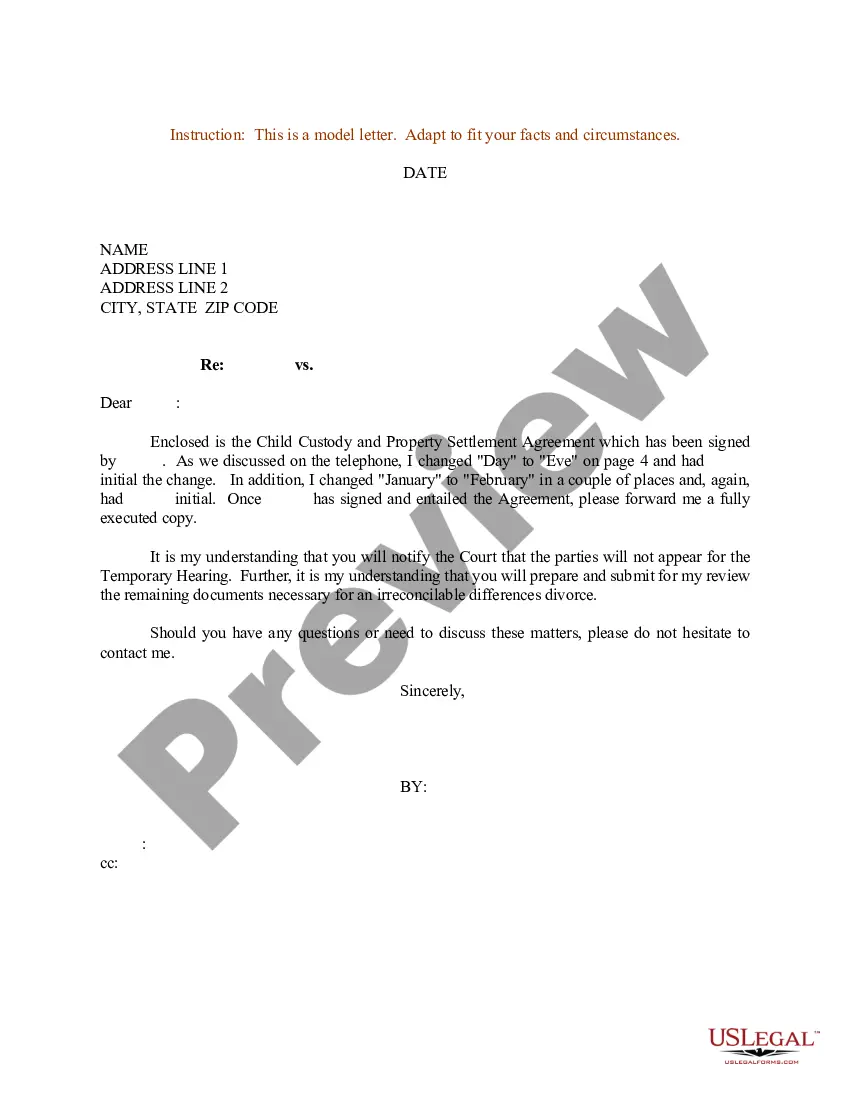
How to fill out Agreement For Consent Judgment Granting Sole Custody Of Minor Child To Father?
If you wish to be thorough, acquire, or create legal document templates, utilize US Legal Forms, the largest collection of legal forms, which is accessible online.
Take advantage of the site’s simple and user-friendly search to locate the documents you require.
Various templates for business and personal uses are organized by categories and states, or keywords.
Step 4. Once you have located the form you need, click on the Purchase now button. Choose the pricing plan you prefer and provide your information to create an account.
Step 5. Complete the transaction. You may use your credit card or PayPal account to finalize the payment.
- Use US Legal Forms to access the Hawaii Agreement for Consent Judgment Granting Sole Custody of Minor Child to Father with just a few clicks.
- If you are already a US Legal Forms customer, Log In to your account and select the Obtain option to find the Hawaii Agreement for Consent Judgment Granting Sole Custody of Minor Child to Father.
- You can also retrieve forms you have previously downloaded in the My documents section of your account.
- If you are using US Legal Forms for the first time, follow the steps below.
- Step 1. Ensure you have selected the form for the correct city/state.
- Step 2. Use the Preview feature to review the form’s content. Make sure to read the summary.
- Step 3. If you are not satisfied with the form, use the Search field at the top of the screen to find alternative forms in the legal type template.
Form popularity
FAQ
Short of that, there is no specific age under Hawaii law at which a child can choose his custodial parent. Hawaii statutes do provide that the ?preferences? of a child of ?suitable age and discretion? should be given ?due weight and deference? by the court.
The legal definition of an unfit parent is when the parent through their conduct fails to provide proper guidance, care, or support. Also, if there is abuse, neglect, or substance abuse issues, that parent will be deemed unfit.
Is Hawaii a Mother State? Hawaii, much like other states, follows the ?best interests of the child? standard when determining child custody, which means there is no legal preference for custody towards the mother or the father.
There are two types of child custody in Hawaii: physical and legal custody. "Physical custody" refers to where the child lives. A parent with physical custody lives in the same household as the child. If it serves a child's best interests, a judge may award parents shared physical, also called "joint physical custody".
This usually occurs when the child turns eighteen (18) years of age unless the child is attending high school or the child is under twenty-three (23) years of age and is presently enrolled as a full-time student or has been accepted into and plans to attend as a full-time student for the next semester a post-high ...
There are two types of child custody in Hawaii: physical and legal custody. "Physical custody" refers to where the child lives. A parent with physical custody lives in the same household as the child. If it serves a child's best interests, a judge may award parents shared physical, also called "joint physical custody".
Physical custody means who the child lives with. Physical custody can be joint (usually this means the child spends equal time with both parents) or sole (usually this means the child lives with one parent, and the other gets to visit).
If it is in the child's best interest, someone other than the child's mother or father can be given custody if that person: has been acting as the child's caretaker (has ?de facto custody?); is in a stable and wholesome home; and. is fit and proper.