Guam Guarantor - Consignor Notice Required by FTC on certain Transactions

State:
Multi-State
Control #:
US-GUARANTY
Format:
Word; 
Rich Text
Instant download

Description

The Rule applies to consumer credit contracts offered by finance companies, retailers (such as auto dealers and furniture and department stores), and credit unions for any personal purpose except to buy real estate.


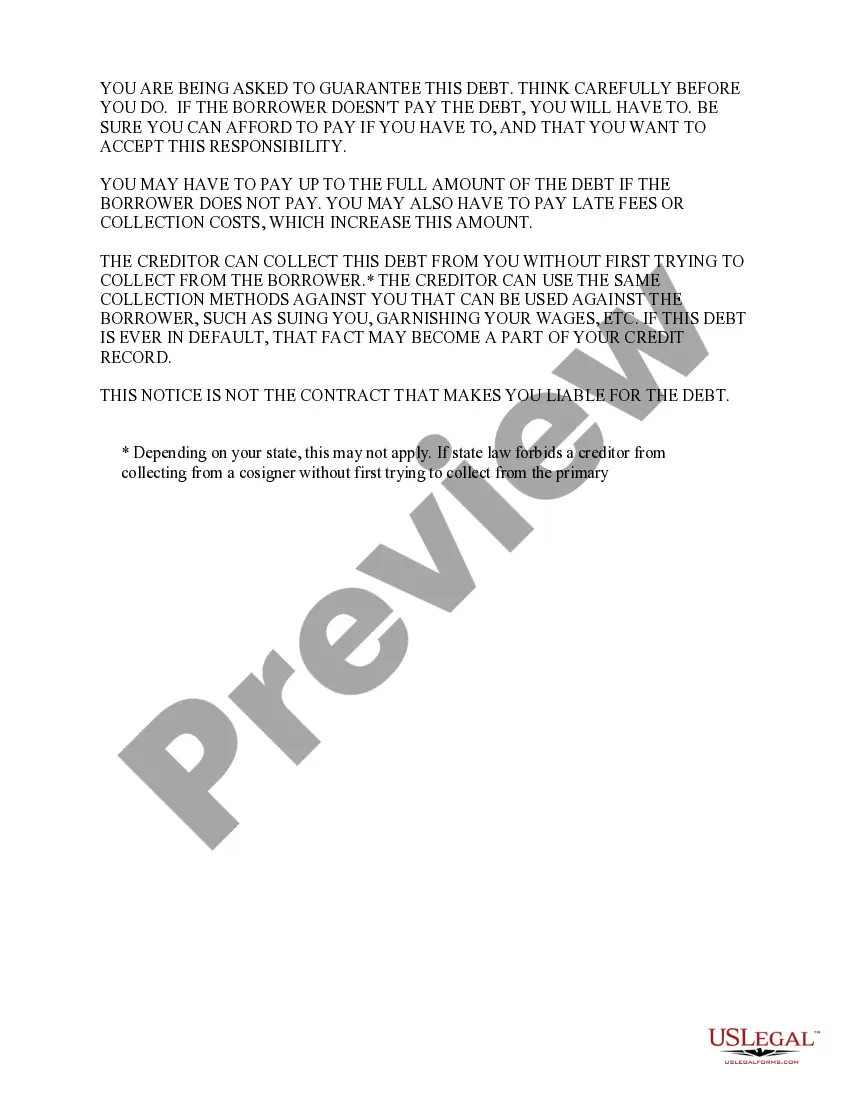
When you agree to be a cosigner for someone else's debt, you are guaranteeing to pay if that person fails to pay the debt. The Rule requires that you be given a notice that explains the responsibility you are undertaking. Under the Rule, the cosigner notice must say:


You are being asked to guarantee this debt. Think carefully before you do. If the borrower doesn't pay the debt, you will have to. Be sure you can afford to pay if you have to, and that you want to accept this responsibility.
You may have to pay up to the full amount of the debt if the borrower does not pay. You may also have to pay late fees or collection costs, which increase this amount.


The creditor can collect this debt from you without first trying to collect from the borrower.* The creditor can use the same collection methods against you that can be used against the borrower, such as suing you, garnishing your wages, etc. If this debt is ever in default, that fact may become a part of your credit record.


This notice is not the contract that makes you liable for the debt.


* Depending on your state, this may not apply. If state law forbids a creditor from collecting from a cosigner without first trying to collect from the primary debtor, this sentence may be crossed out or omitted on your cosigner notice.


This notice is not required when you receive benefits from the contract, such as when you buy goods, take out a loan, or open a joint credit-card account with another person. In these cases, you would be a co-buyer, co-borrower, or co-applicant (co-cardholder) rather than a cosigner. Therefore, the creditor would not be required to provide the notice.
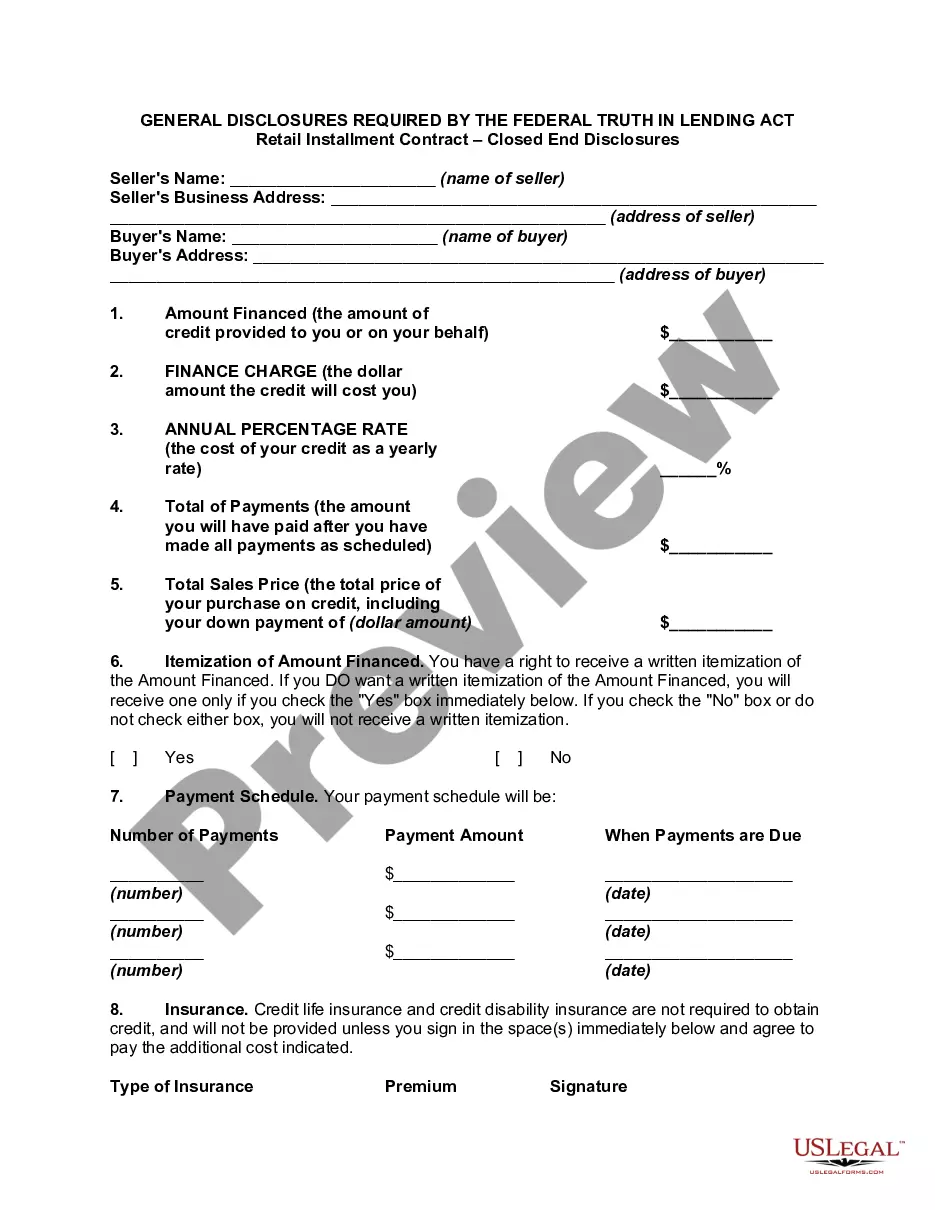
How to fill out Guarantor - Consignor Notice Required By FTC On Certain Transactions?

US Legal Forms - one of the largest collections of legal documents in the United States - provides a diverse selection of legal document templates that you can obtain or create.

By utilizing the website, you can access thousands of documents for business and personal purposes, organized by categories, states, or keywords. You can find the latest versions of documents such as the Guam Guarantor - Consignor Notice Required by FTC for specific Transactions within moments.

If you are a member, Log In to download the Guam Guarantor - Consignor Notice Required by FTC for specific Transactions from the US Legal Forms library. The Download button will appear on each document you view. You have access to all previously downloaded documents in the My documents section of your account.

Complete the transaction. Use your credit card or PayPal account to finalize the purchase.

Select the format and obtain the document onto your device. Edit. Complete, modify, print, and sign the downloaded Guam Guarantor - Consignor Notice Required by FTC for specific Transactions.

Each document you add to your account does not expire and is your property indefinitely. So, to obtain or create another copy, simply go to the My documents section and click on the document you need.

Gain access to the Guam Guarantor - Consignor Notice Required by FTC for specific Transactions with US Legal Forms, one of the most extensive libraries of legal document templates. Utilize thousands of professional and state-specific templates that fulfill your business or personal requirements and needs.

  1. Make sure you have selected the correct document for your locality/county.
  2. Use the Preview feature to examine the document content.
  3. Check the document details to verify that you have selected the appropriate document.
  4. If the document does not meet your needs, use the Search field at the top of the screen to find one that does.
  5. If you are happy with the document, confirm your selection by clicking on the Acquire now button.
  6. Then, choose your preferred pricing plan and provide your details to create an account.

Form popularity

FAQ

A premerger notification is a requirement for reporting certain transactions to federal authorities before the merger or acquisition occurs. This process ensures that significant transactions undergo review to maintain competitive markets. The Guam Guarantor - Consignor Notice Required by FTC on certain Transactions is an essential aspect of this notification. Using uslegalforms, you can easily manage your premerger notification needs.

Yes, HSR filings are publicly available, but access is restricted to certain information. The filings provide insights into significant transactions that require premerger notification. However, sensitive business information may be kept confidential. Understanding the implications of the Guam Guarantor - Consignor Notice Required by FTC on certain Transactions can help you navigate what public information you might want to share.

Submitting an HSR filing involves gathering necessary information and completing specific forms. After your forms are prepared, you’ll access the FTC’s online filing portal to submit your application. It’s essential to provide precise information that reflects your transactions, including adherence to the Guam Guarantor - Consignor Notice Required by FTC on certain Transactions. Our platform can guide you through each step to ensure compliance.

To submit an HSR filing, you must prepare the required forms and include relevant documentation. After filling out these forms, you will submit them electronically through the FTC’s filing system. It’s crucial to ensure all information is accurate and complete, aligning your transaction details with the Guam Guarantor - Consignor Notice Required by FTC on certain Transactions. Working with uslegalforms can simplify this process for you.

An HSR filing is triggered when certain transactions meet specified thresholds related to size and activity. Generally, if an acquisition exceeds these thresholds, it becomes necessary to file. The Guam Guarantor - Consignor Notice Required by FTC on certain Transactions is relevant here, as it outlines requirements for certain transactions. Understanding these thresholds will help you determine your filing obligations.

Examples of Federal Trade Commission Actions In 1996, the FTC implemented the Funeral Rule Offenders Program, which allows offending funeral homes to make a voluntary payment to the U.S. Treasury or an appropriate state fund in exchange for not having to go to court.

An opt out right gives a party to an agreement discretion over certain practices that, while legal, require firms to seek permission before acting. When the right exists, parties may give notice that they do not wish to abide by the terms covered by the right, and the counterparty must honor those terms.

The FTC Act prohibits unfair or deceptive advertising in any medium. That is, advertising must tell the truth and not mislead consumers. A claim can be misleading if relevant information is left out or if the claim implies something that's not true.

A financial institution must provide an annual notice at least once in any period of 12 consecutive months during the continuation of the customer relationship. Generally, new privacy notices are not required for each new product or service.

The FTC Act prohibits unfair or deceptive advertising in any medium. That is, advertising must tell the truth and not mislead consumers. A claim can be misleading if relevant information is left out or if the claim implies something that's not true.

Trusted and secure by over 3 million people of the world’s leading companies

Guam Guarantor - Consignor Notice Required by FTC on certain Transactions