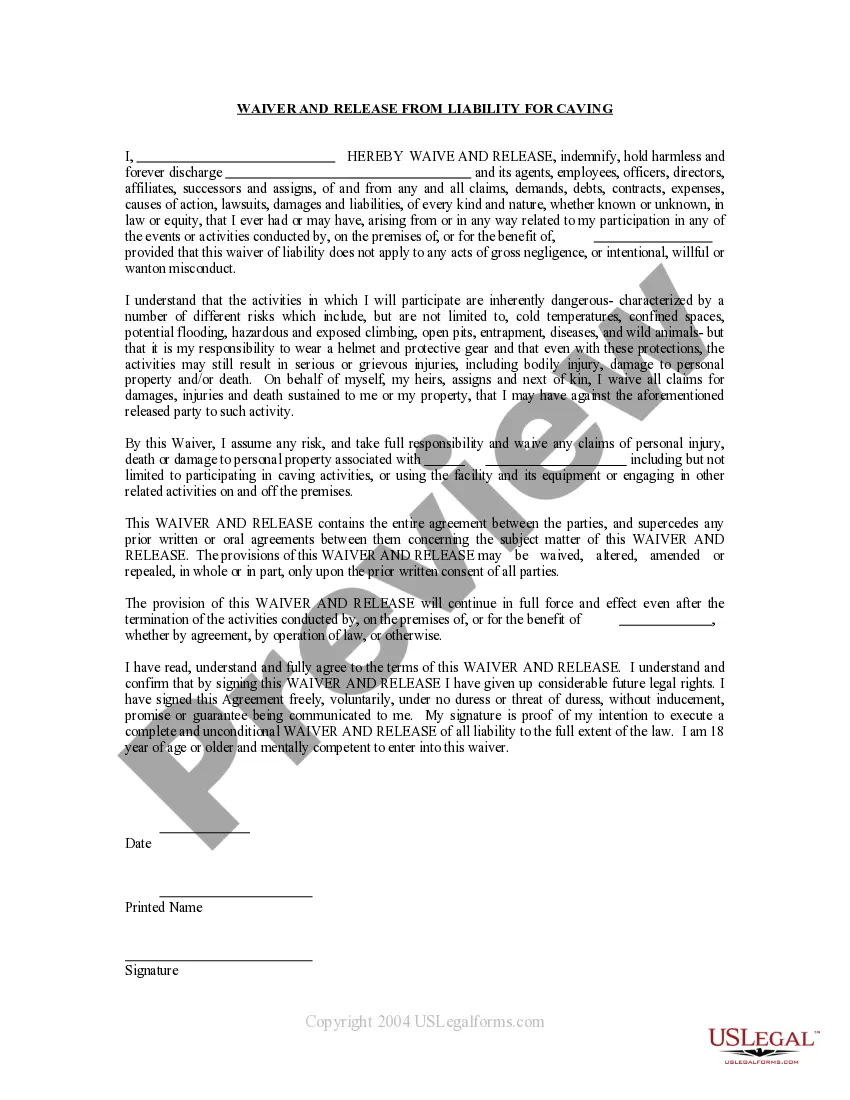
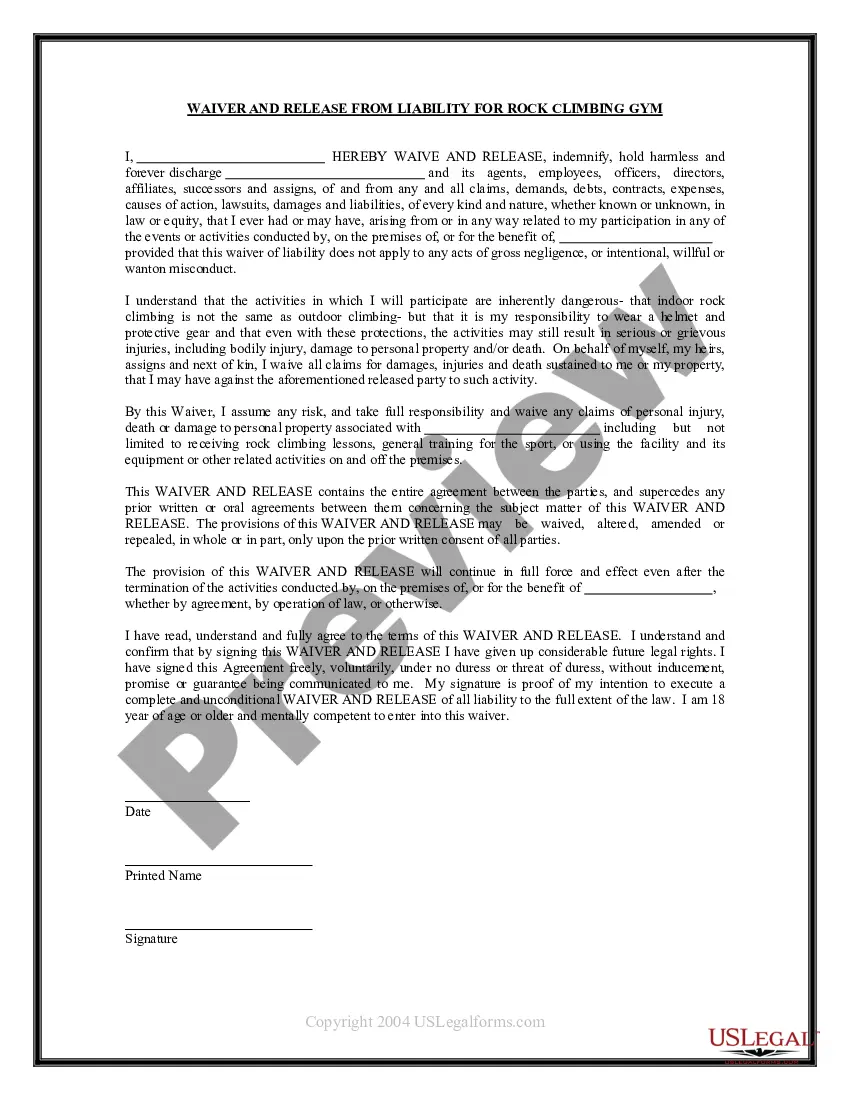
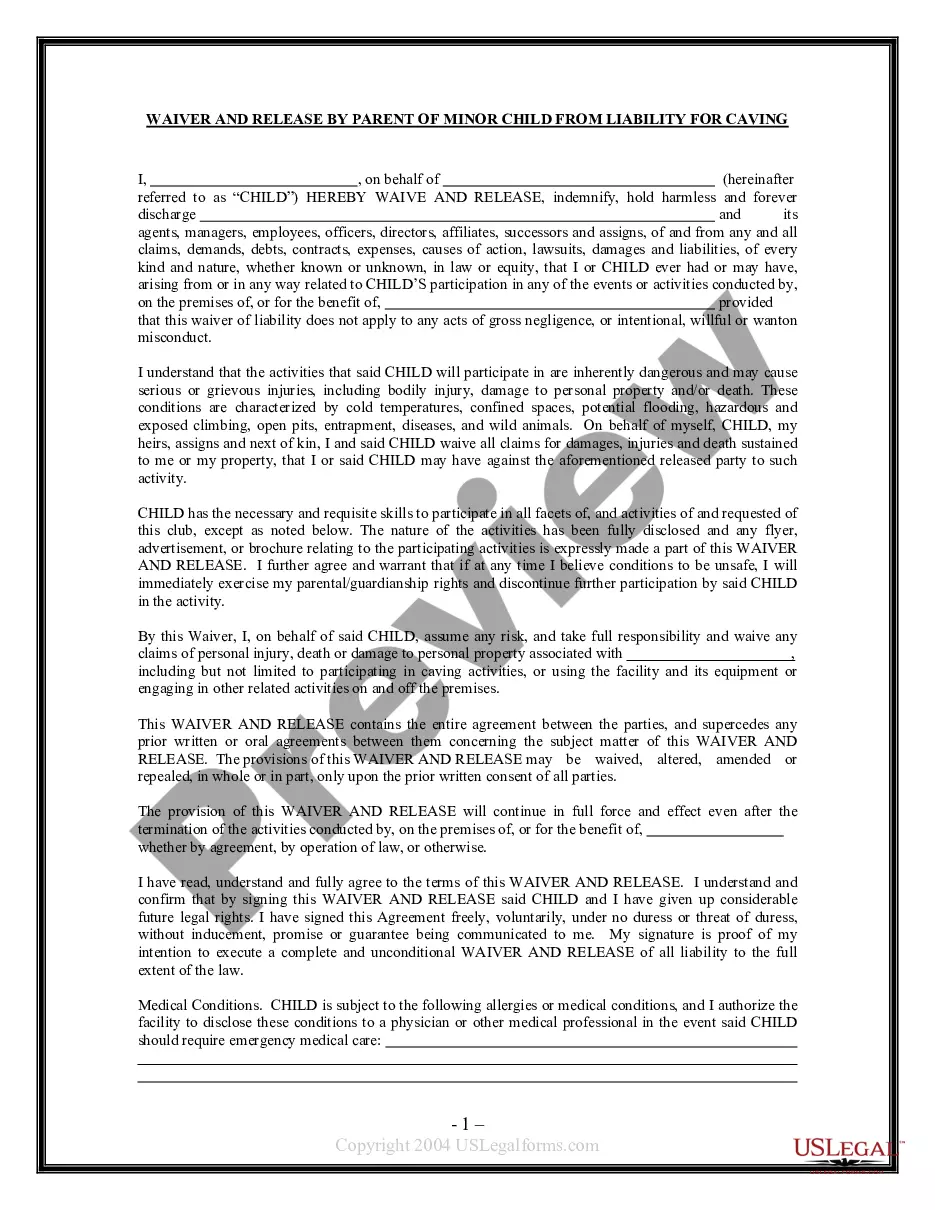
This form releases a property owner from liability for permitting an individual for caving on the owner's property.
Georgia Waiver and Release From Liability For Adult for Caving
Category:
State:
Multi-State
Control #:
US-WAV-67A
Format:
Word;
Rich Text
Instant download
Description
How to fill out Waiver And Release From Liability For Adult For Caving?
US Legal Forms - one of the largest collections of legitimate templates in the United States - offers an extensive selection of lawful document formats that you can download or print.
Through the website, you can access thousands of forms for both business and personal use, organized by categories, states, or keywords. You can obtain the latest versions of forms such as the Georgia Waiver and Release From Liability For Adult participating in Caving within moments.
If you already have an account, Log In and download the Georgia Waiver and Release From Liability For Adult participating in Caving from the US Legal Forms collection. The Download button will appear on every form you view. You can access all previously downloaded forms from the My documents tab of your account.
Complete the transaction. Use your credit card or PayPal account to finalize the purchase.
Select the format and download the form to your device. Make modifications. Fill out, edit, print, and sign the acquired Georgia Waiver and Release From Liability For Adult for Caving. Each template you add to your account does not expire and is yours indefinitely. Therefore, if you want to download or print another copy, just go to the My documents section and click on the form you need. Access the Georgia Waiver and Release From Liability For Adult for Caving with US Legal Forms, the most comprehensive collection of legal document formats. Utilize thousands of professional and state-specific templates to meet your business or personal needs.
- Make sure you have selected the correct form for your city/state.
- Click the Preview button to check the form's details.
- Review the form outline to ensure you have chosen the right document.
- If the form does not meet your requirements, use the Search field at the top of the screen to find one that does.
- If you are satisfied with the document, confirm your selection by clicking the Purchase now button.
- Then, choose your preferred payment plan and provide your credentials to register for an account.
Form popularity
FAQ
In California, waivers of liability are generally enforceable so long as they have been drafted correctly, are explicit as to the scope of coverage, are legible and use high-visibility text, and do not illegally waive unknown or unrelated claims.
Liability waivers are enforceable in California solely to the extent they shift to the customer the risk of ordinary negligence. Under California law, a liability waiver cannot excuse an injury caused by a defendant's gross negligence, recklessness or intentionally wrongful act.
A waiver is a demonstration, usually in written form, of a party's intent to relinquish a legal right or claim. The key point to note is that the relinquishment is voluntary, and can apply to a variety of legal situations. Essentially, a waiver removes a real or potential liability for the other party in the agreement.
In California, waivers of liability are generally enforceable so long as they have been drafted correctly, are explicit as to the scope of coverage, are legible and use high-visibility text, and do not illegally waive unknown or unrelated claims.
Georgia will enforce a well-written waiver for simple negligence as long as it is not void as against public policy.
In many cases, the courts will rule liability waivers unenforceable due to issues with the language of the contracts. For example, a liability waiver cannot violate public policy in Georgia. If the terms of the waiver could jeopardize public safety, it violates public policy and will be ruled invalid.
Although legal in their own right, waivers can't be used to completely shield event organisers from liability as a result of their negligence. Under the Unfair Contract Terms Act, activity providers can't exclude or restrict liability for injury or death caused as a result of their negligence.
Generally, liability waivers are enforceable in Georgia with one big exception: the waiver cannot relieve a person, entity, corporation, or premises owner of liability for acts that constitute gross negligence or reckless, willful, wanton or intentional conduct.
To sum it up, customers can still sue business owners even when they've signed a waiver to use the business.
So, if an accident happens and injury occurs, is a Waiver effective in protecting the institution from liability and preventing a lawsuit from the injured party? The answer is that, if properly worded and signed, the Waiver is likely valid and will preclude legal claims for injuries.