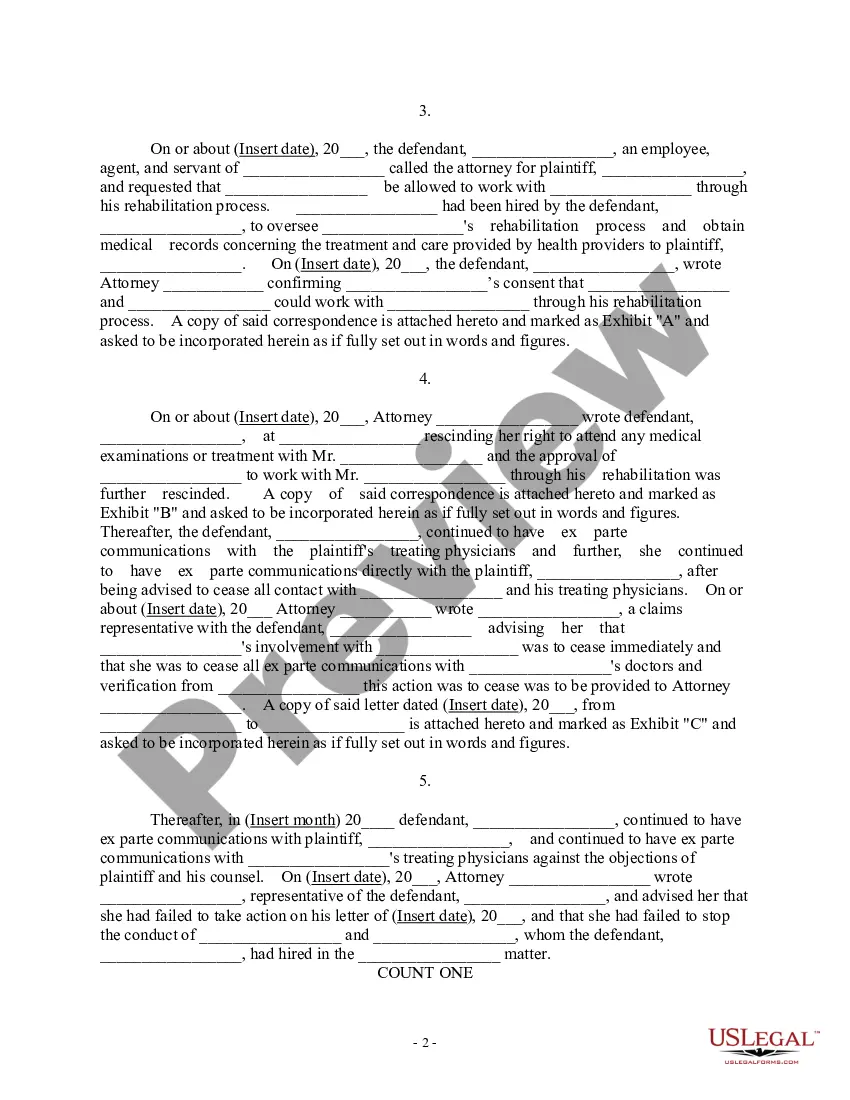
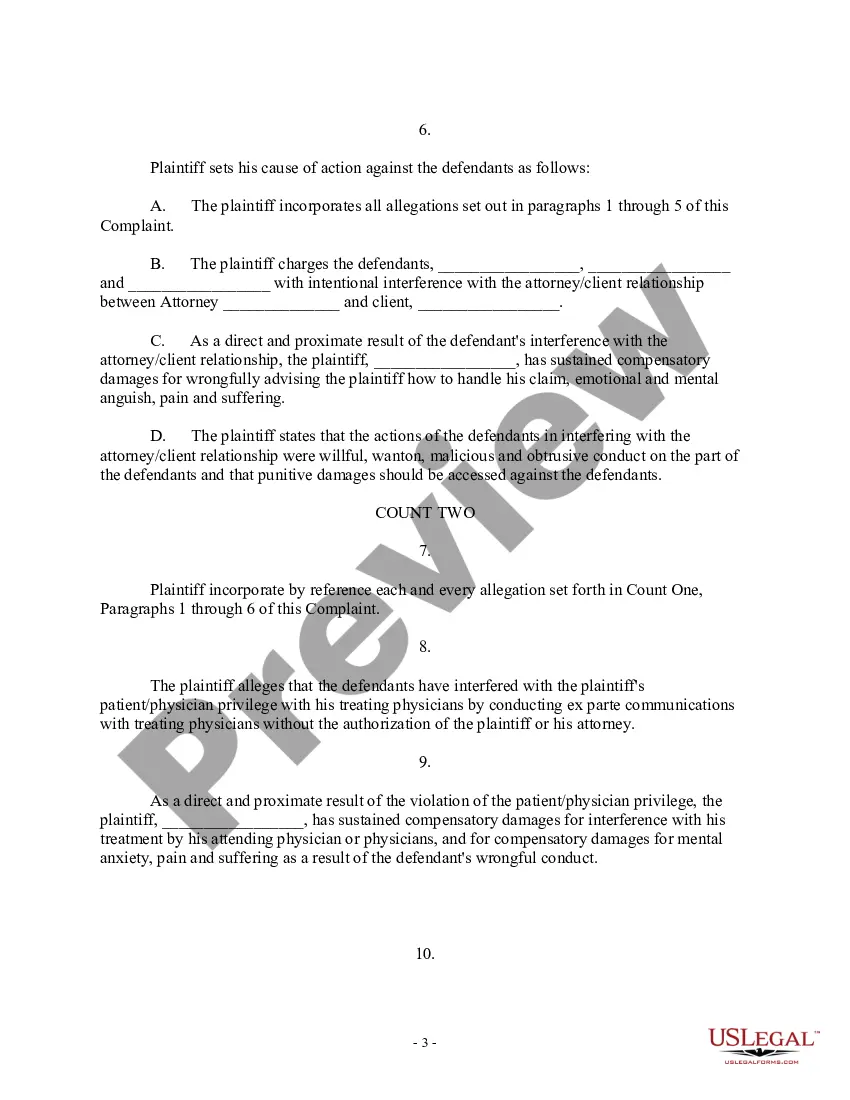
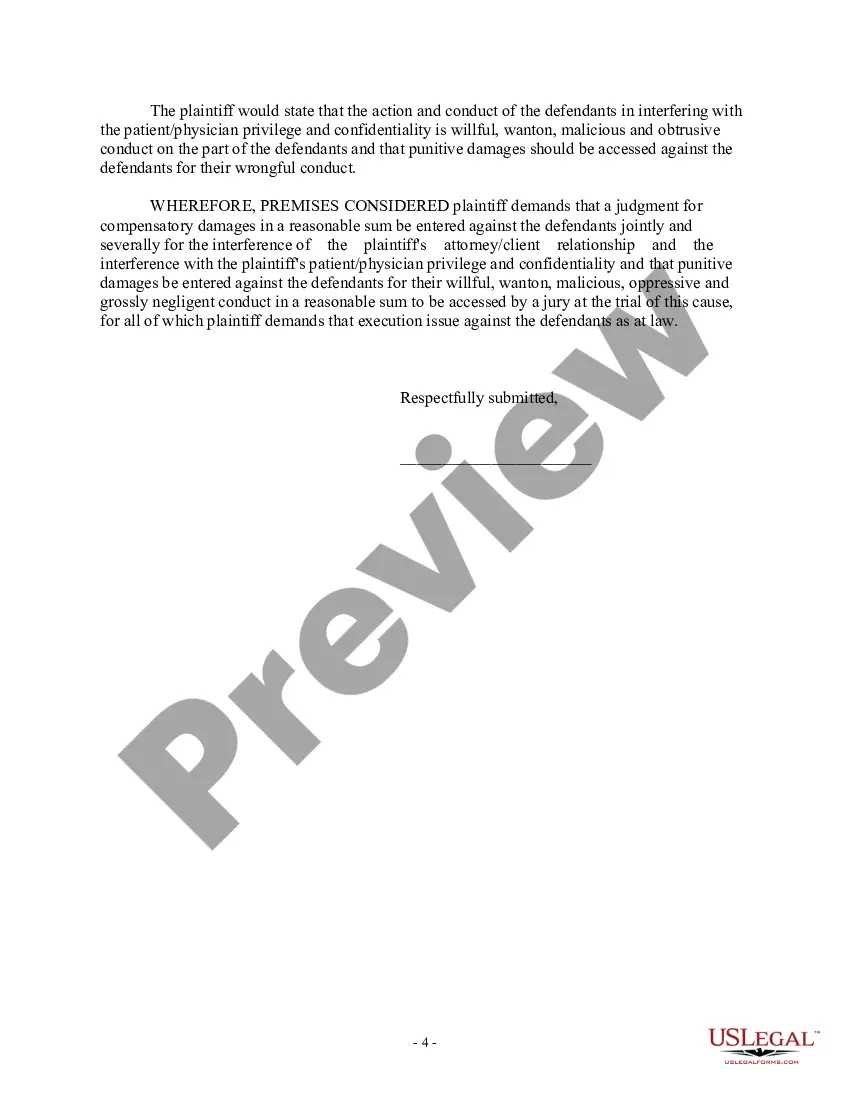
In this complaint, plaintiff charges defendants with intentional interference with the attorney/client relationship. The plaintiff states that the actions of the defendants in interfering with the attorney/client relationship were willful, wanton, malicious and obtrusive and that punitive damages should be accessed against the defendants.
Georgia Complaint For Intentional Interference With Attorney-Client Relationship
Category:
State:
Multi-State
Control #:
US-000295
Format:
Word;
Rich Text
Instant download
Description
Free preview




Get your form ready online
Our built-in tools help you complete, sign, share, and store your documents in one place.
Built-in online Word editor
Make edits, fill in missing information, and update formatting in US Legal Forms—just like you would in MS Word.
Export easily
Download a copy, print it, send it by email, or mail it via USPS—whatever works best for your next step.
E-sign your document
Sign and collect signatures with our SignNow integration. Send to multiple recipients, set reminders, and more. Go Premium to unlock E-Sign.
Notarize online 24/7
If this form requires notarization, complete it online through a secure video call—no need to meet a notary in person or wait for an appointment.
Store your document securely
We protect your documents and personal data by following strict security and privacy standards.

Make edits, fill in missing information, and update formatting in US Legal Forms—just like you would in MS Word.

Download a copy, print it, send it by email, or mail it via USPS—whatever works best for your next step.

Sign and collect signatures with our SignNow integration. Send to multiple recipients, set reminders, and more. Go Premium to unlock E-Sign.

If this form requires notarization, complete it online through a secure video call—no need to meet a notary in person or wait for an appointment.

We protect your documents and personal data by following strict security and privacy standards.
Looking for another form?


How to fill out Complaint For Intentional Interference With Attorney-Client Relationship?
You might invest several hours online attempting to locate the valid document template that meets the state and federal standards you require. US Legal Forms offers a vast array of valid forms that have been evaluated by experts.
It is easy to obtain or print the Georgia Complaint For Intentional Interference With Attorney-Client Relationship from my service.
If you already possess a US Legal Forms account, you can Log In and click on the Acquire button. After that, you can fill out, modify, print, or sign the Georgia Complaint For Intentional Interference With Attorney-Client Relationship. Each valid document template you purchase is yours indefinitely.
Complete the transaction. You can use your credit card or PayPal account to pay for the legal document. Choose the format of the file and download it to your device. Make modifications to your document if necessary. You can fill out, modify, sign, and print the Georgia Complaint For Intentional Interference With Attorney-Client Relationship. Obtain and print a multitude of document templates using the US Legal Forms website, which provides the largest collection of legal forms. Utilize professional and state-specific templates to address your business or personal needs.
- To get an additional copy of the purchased form, go to the My documents section and click on the appropriate button.
- If you are using the US Legal Forms website for the first time, follow the straightforward instructions below.
- First, ensure that you have selected the correct document template for your county/city of choice. Review the form summary to confirm you have chosen the right one.
- If available, use the Preview button to view the document template as well.
- If you wish to find another version of the form, use the Search box to locate the template that meets your needs and specifications.
- Once you have found the template you need, click Acquire now to proceed.
- Select the pricing plan you prefer, enter your details, and register for an account on US Legal Forms.
Form popularity
FAQ
Rule 1.5 of professional conduct in Georgia addresses the reasonableness of attorney fees and the necessity of communicating these fees to clients. This rule ensures that clients are fully aware of the costs associated with their legal representation. When drafting a Georgia Complaint For Intentional Interference With Attorney-Client Relationship, understanding this rule can provide significant insight into the financial aspects of legal ethics.
Unethical behavior of a lawyer can include actions such as dishonesty, conflicts of interest, or failure to communicate effectively with clients. These behaviors can severely compromise the attorney-client relationship and may lead to a Georgia Complaint For Intentional Interference With Attorney-Client Relationship. It is essential to recognize these unethical practices to ensure that your legal representation is held to high standards.
The stranger doctrine in Georgia relates to tortious interference, stating that a third party can be held liable for interfering with a contractual relationship. This is particularly relevant in cases involving a Georgia Complaint For Intentional Interference With Attorney-Client Relationship. Recognizing how this doctrine applies can help you understand your legal rights and the potential for claiming damages.
The professional responsibility under Rule 3.3 requires lawyers to uphold integrity in their dealings with the court. This includes not only avoiding deceitful conduct but also actively ensuring that the court is not misled. For those navigating a Georgia Complaint For Intentional Interference With Attorney-Client Relationship, familiarity with this rule can help clarify the expectations placed on legal professionals.
Rule 3.3 of the Rules of Professional Conduct in Georgia emphasizes a lawyer's duty to avoid making false statements to a tribunal. It outlines the obligation to disclose material facts and to correct any false evidence. When considering a Georgia Complaint For Intentional Interference With Attorney-Client Relationship, understanding this rule becomes crucial, as it highlights the importance of honesty in legal proceedings.
Rule 3.3 of the Georgia Rules of Professional Conduct addresses a lawyer's duty to avoid making false statements to a tribunal. It emphasizes the importance of honesty in legal proceedings and requires attorneys to correct any false statements made during the process. Understanding this rule is crucial for anyone considering a Georgia Complaint For Intentional Interference With Attorney-Client Relationship, as it underscores the ethical responsibilities of legal professionals.
A Rule 68 offer in Georgia refers to a formal settlement offer made by one party to another before a trial begins. If the receiving party does not accept the offer and then fails to obtain a more favorable judgment at trial, they may be responsible for the offering party’s legal costs incurred after the offer. This rule can have significant implications in cases involving a Georgia Complaint For Intentional Interference With Attorney-Client Relationship.
Yes, you can sue an attorney for tortious interference if they intentionally disrupted your attorney-client relationship. A Georgia Complaint For Intentional Interference With Attorney-Client Relationship can be filed if you can establish that the attorney acted outside the bounds of ethical conduct. This type of lawsuit can hold attorneys accountable for their actions that harm clients' legal interests.
To establish a Georgia Complaint For Intentional Interference With Attorney-Client Relationship, you must demonstrate that a valid contract existed, that the defendant had knowledge of this contract, and that the defendant intentionally interfered with it. Additionally, you need to show that this interference caused damages to you. Understanding these requirements helps in building a strong case.
To prove emotional distress in a Georgia Complaint For Intentional Interference With Attorney-Client Relationship, you need to present credible evidence of your emotional suffering. This can include medical records, psychological evaluations, and personal testimony detailing your experiences. Additionally, you should demonstrate how the interference caused significant emotional harm, affecting your daily life and well-being.