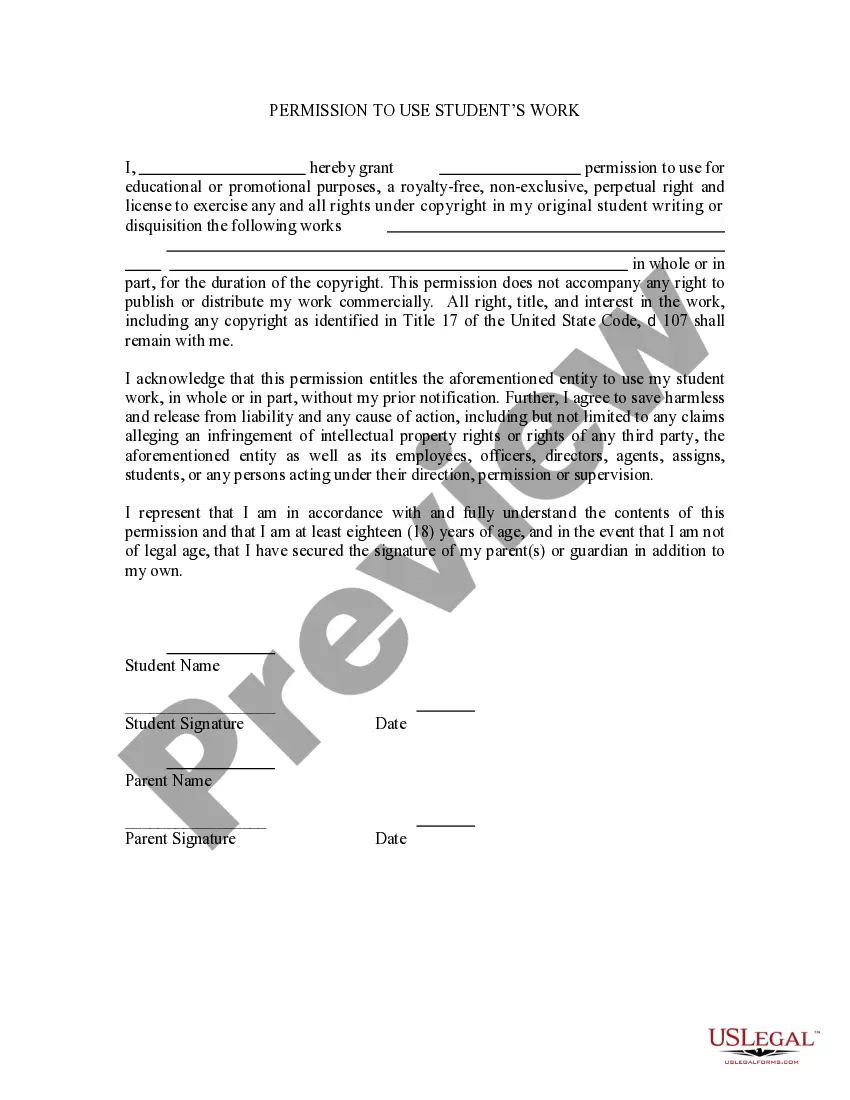
This is a permission form signed by a student or parents if student is under age permitting others to use his/her original work without any prior notification. This form also releases the entity using the work from any liability for such use.
Florida Permission to Use Student's Work
Category:
State:
Multi-State
Control #:
US-PRM-03
Format:
Word;
Rich Text
Instant download
Description
How to fill out Permission To Use Student's Work?
Are you currently in a situation where you require documents for either business or personal purposes almost every day.
There are numerous legal document templates available online, but finding ones you can rely on is challenging.
US Legal Forms provides thousands of form templates, such as the Florida Permission to Use Student's Work, which are designed to comply with federal and state regulations.
Utilize US Legal Forms, one of the largest collections of legal forms, to save time and avoid errors.
The service offers properly crafted legal document templates that you can use for various purposes. Create an account on US Legal Forms and start simplifying your life.
- If you are already familiar with the US Legal Forms website and have an account, simply Log In.
- After that, you can download the Florida Permission to Use Student's Work template.
- If you do not have an account and wish to start using US Legal Forms, follow these steps.
- Obtain the form you need and ensure it is for your correct area/region.
- Utilize the Review button to inspect the document.
- Check the summary to confirm that you have chosen the right form.
- If the form is not what you are looking for, use the Search field to find the form that meets your needs and requirements.
- Once you retrieve the correct form, click on Get now.
- Select the pricing plan you prefer, fill in the necessary information to create your account, and pay for the order using your PayPal or Visa or Mastercard.
- Choose a suitable document format and download your copy.
- Access all the document templates you have purchased in the My documents section. You can get another copy of Florida Permission to Use Student's Work anytime, if needed. Just click the desired form to download or print the document template.
Form popularity
FAQ
Fair use explicitly allows use of copyrighted materials for educational purposes such as criticism, comment, news reporting, teaching, scholarship, and research.
Under California Education Code Section 51512, it indeed is illegal for any person including a student to use an electronic device to record what is happening in the classroom without the consent of the teacher.
Fair use permits a party to use a copyrighted work without the copyright owner's permission for purposes such as criticism, comment, news reporting, teaching, scholarship, or research.
Section 107 of the Copyright Act gives examples of purposes that are favored by fair use: criticism, comment, news reporting, teaching (including multiple copies for classroom use), scholarship, and research. Use for one of these illustrative purposes is not automatically fair, and uses for other purposes can be
While Florida is a two-party consent state, courts don't apply the law to recordings made in a party's place of business. Therefore, even secret classroom recordings without a teacher's consent were found to not be illegal.
Copyright is an important form of protection that gives the student rights over reproduction, public display, public distribution, public performance, and creation of derivative works from their copyrighted works.
Generally, it's probably against your school policies to pull out an audio recording device to capture a lecture without the consent of the professor or university. Some institutions may be more relaxed in their policies, but ultimately may be at the discretion of the teacher.
Florida's recording law is a "two-party consent" law. This means that all individuals engaged in a private conversation must all consent to any audio recording of the conversation to be legal. For example, you are prohibited from recording a phone call without every person's consent.
Secretly recording another person in Florida is a felony, but many lawmakers were willing to carve out an exception in the state law if the person being secretly recorded was a professor at a public university. In the end, the bill was passed with the secrecy provision deleted.
Fair Use allows limited use of copyrighted works without requiring permission from the copyright holder for a number of educational purposes -- commentary, criticism, research, teaching, or scholarship.