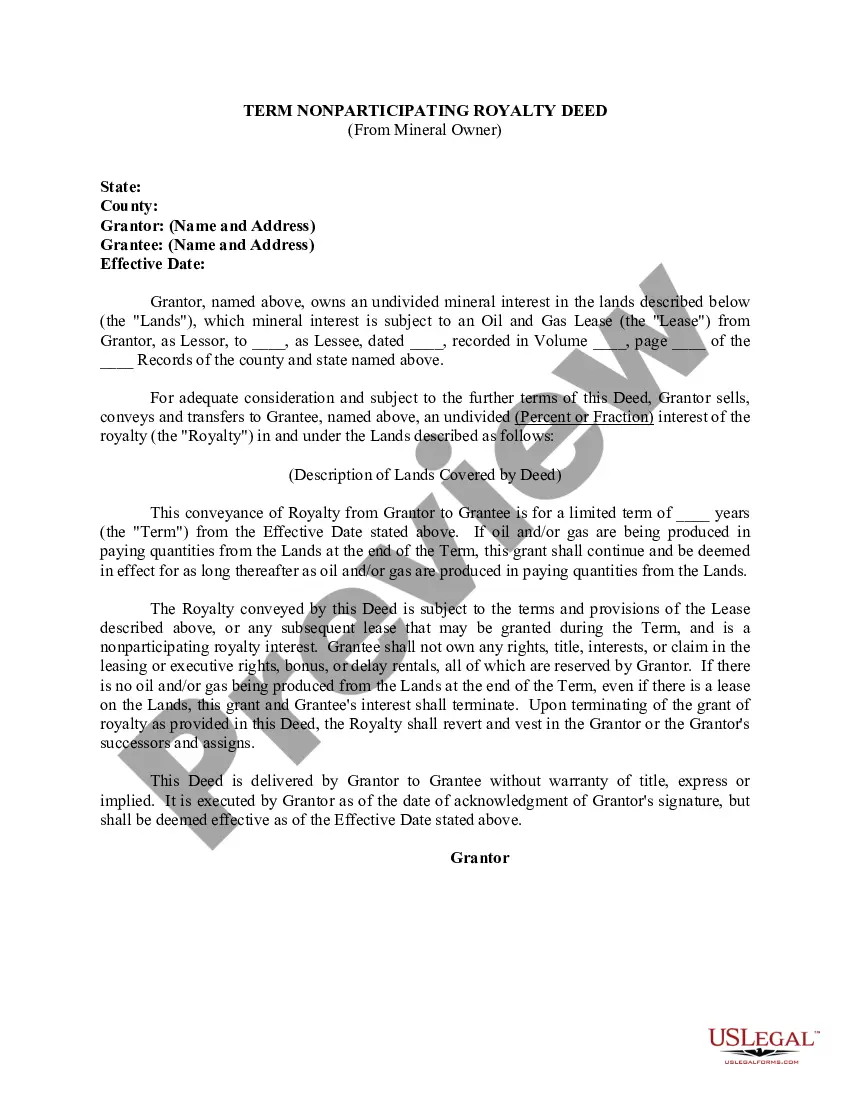
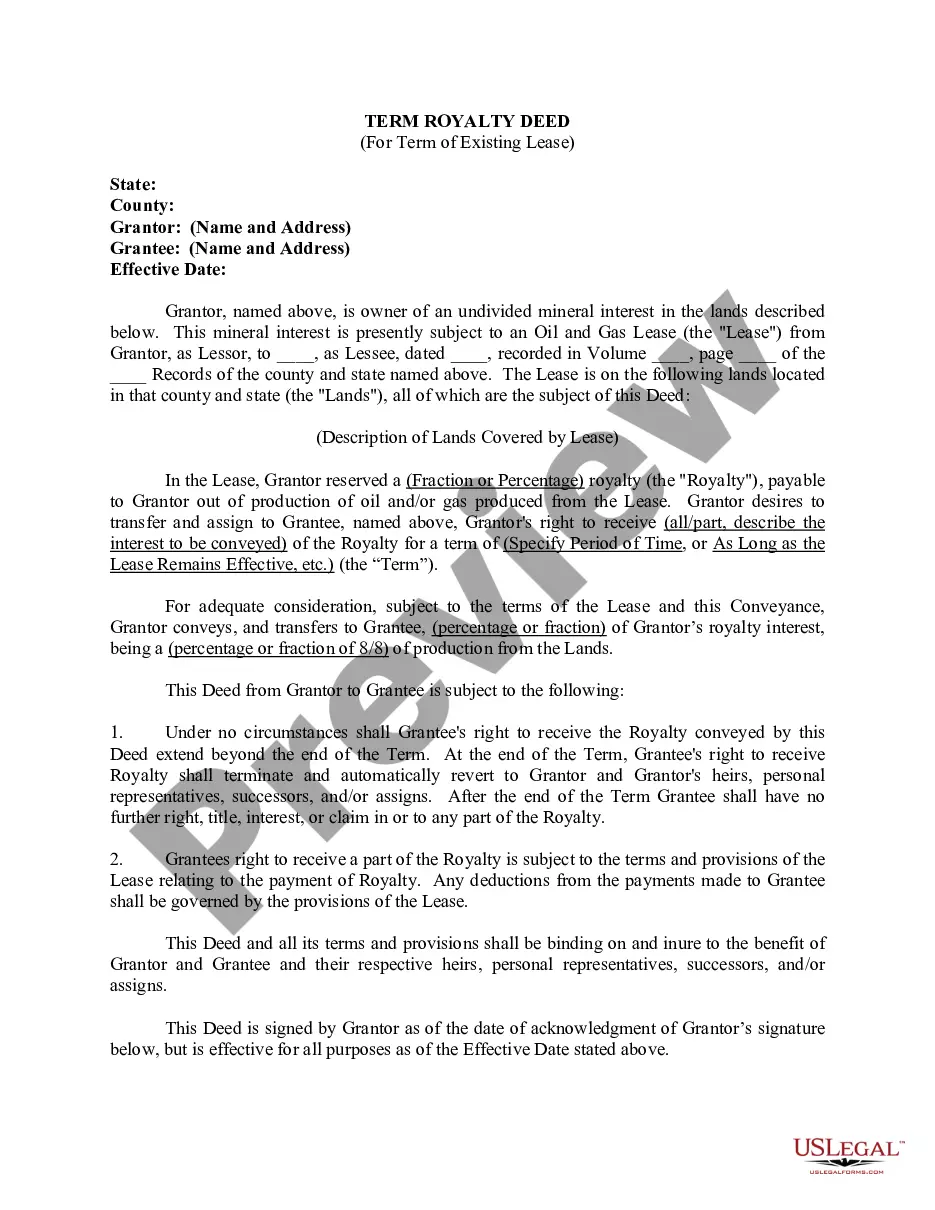
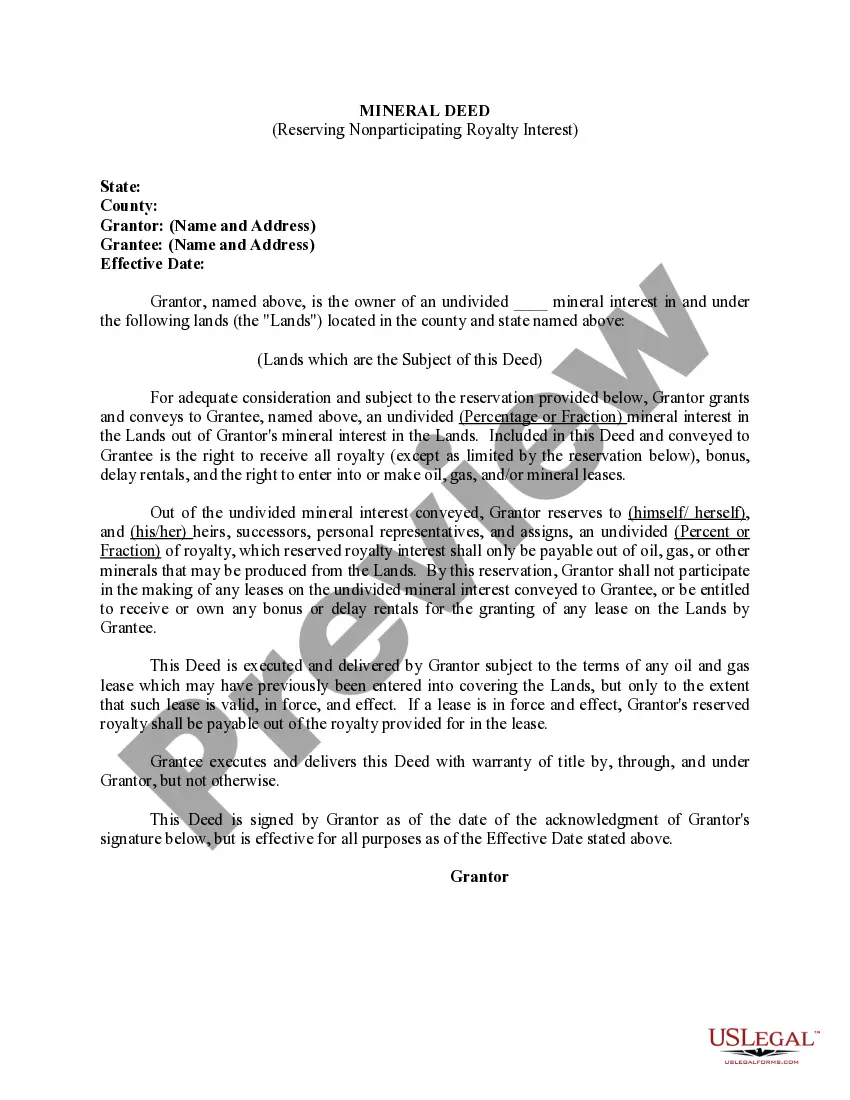
Florida Term Nonparticipating Royalty Deed from Mineral Owner
Description

Get your form ready online
Our built-in tools help you complete, sign, share, and store your documents in one place.
Make edits, fill in missing information, and update formatting in US Legal Forms—just like you would in MS Word.
Download a copy, print it, send it by email, or mail it via USPS—whatever works best for your next step.
Sign and collect signatures with our SignNow integration. Send to multiple recipients, set reminders, and more. Go Premium to unlock E-Sign.
If this form requires notarization, complete it online through a secure video call—no need to meet a notary in person or wait for an appointment.
We protect your documents and personal data by following strict security and privacy standards.

Make edits, fill in missing information, and update formatting in US Legal Forms—just like you would in MS Word.

Download a copy, print it, send it by email, or mail it via USPS—whatever works best for your next step.

Sign and collect signatures with our SignNow integration. Send to multiple recipients, set reminders, and more. Go Premium to unlock E-Sign.

If this form requires notarization, complete it online through a secure video call—no need to meet a notary in person or wait for an appointment.

We protect your documents and personal data by following strict security and privacy standards.
Looking for another form?

How to fill out Term Nonparticipating Royalty Deed From Mineral Owner?
Finding the right lawful record design can be quite a battle. Obviously, there are plenty of web templates available on the net, but how can you discover the lawful kind you want? Make use of the US Legal Forms internet site. The service provides a large number of web templates, like the Florida Term Nonparticipating Royalty Deed from Mineral Owner, which you can use for organization and private requirements. Every one of the types are checked by pros and meet up with federal and state requirements.
If you are already signed up, log in for your bank account and click on the Down load switch to get the Florida Term Nonparticipating Royalty Deed from Mineral Owner. Utilize your bank account to look from the lawful types you have ordered earlier. Proceed to the My Forms tab of your respective bank account and get one more backup from the record you want.
If you are a fresh user of US Legal Forms, listed below are easy guidelines that you can adhere to:
- Initially, ensure you have selected the appropriate kind for your personal area/area. You may look through the shape using the Review switch and look at the shape outline to make sure this is the right one for you.
- If the kind will not meet up with your requirements, take advantage of the Seach industry to discover the correct kind.
- When you are positive that the shape is acceptable, click the Acquire now switch to get the kind.
- Choose the rates plan you desire and enter the required information. Make your bank account and purchase an order utilizing your PayPal bank account or bank card.
- Choose the file formatting and down load the lawful record design for your product.
- Complete, change and print out and sign the received Florida Term Nonparticipating Royalty Deed from Mineral Owner.
US Legal Forms will be the greatest collection of lawful types where you can see various record web templates. Make use of the service to down load skillfully-created paperwork that adhere to condition requirements.
Form popularity
FAQ
The following are methods for establishing mineral rights ownership: Deed. A deed is used to transfer mineral rights ownership from one party to another. Lease. ... Severance. ... Adverse Possession. ... Surface Use Agreement. ... Royalties. ... Mineral Estate. ... Texas Railroad Commission.
Mineral rights deeds are not the same as royalty deeds. Royalty deeds do not allow for surface access, or for the initiation of the extraction and sale of minerals. A royalty owner will only benefit economically if the mineral owner decides to produce and sell the minerals.
After confirming your legal ownership with an attorney at law, you need to draw up a deed of transfer form in your name and register it with the county records office as the mineral owner. The land transaction, leasing transaction, and royalty compliance go through the county office.
The rising value of oil and minerals have increased the popularity of investing in the mineral rights but not the property rights. To research how to attain these rights, look at the county's courthouse. They typically have a deed record of mineral rights. From there you can contact the owners of the rights.
How to transfer mineral rights in Texas? Review The Current Title. Review the current title before transferring the mineral rights. Negotiate And Execute A Transfer Agreement. An agreement should be outlined in the terms of transfer. ... Record The Transfer. ... Pay Any Fees.
Royalty income from an oil and gas lease will be paid so long as a product is produced from the lease. Royalties are a proportionate part of the revenue received from the sale of oil, gas or other materials from a well or lease and paid to the royalty owners based on a lease agreement or other contract.
The mineral owner's interest in the spacing unit is calculated by dividing the number of acres owned by the mineral owner within the unit by the total number of acres in the unit (Acres Owned / Total Acres in Unit). This will result in a decimal.
Generally minerals are held in private ownership, and information on mineral rights, where available, is held by the Land Registry together with details of land surface ownership.