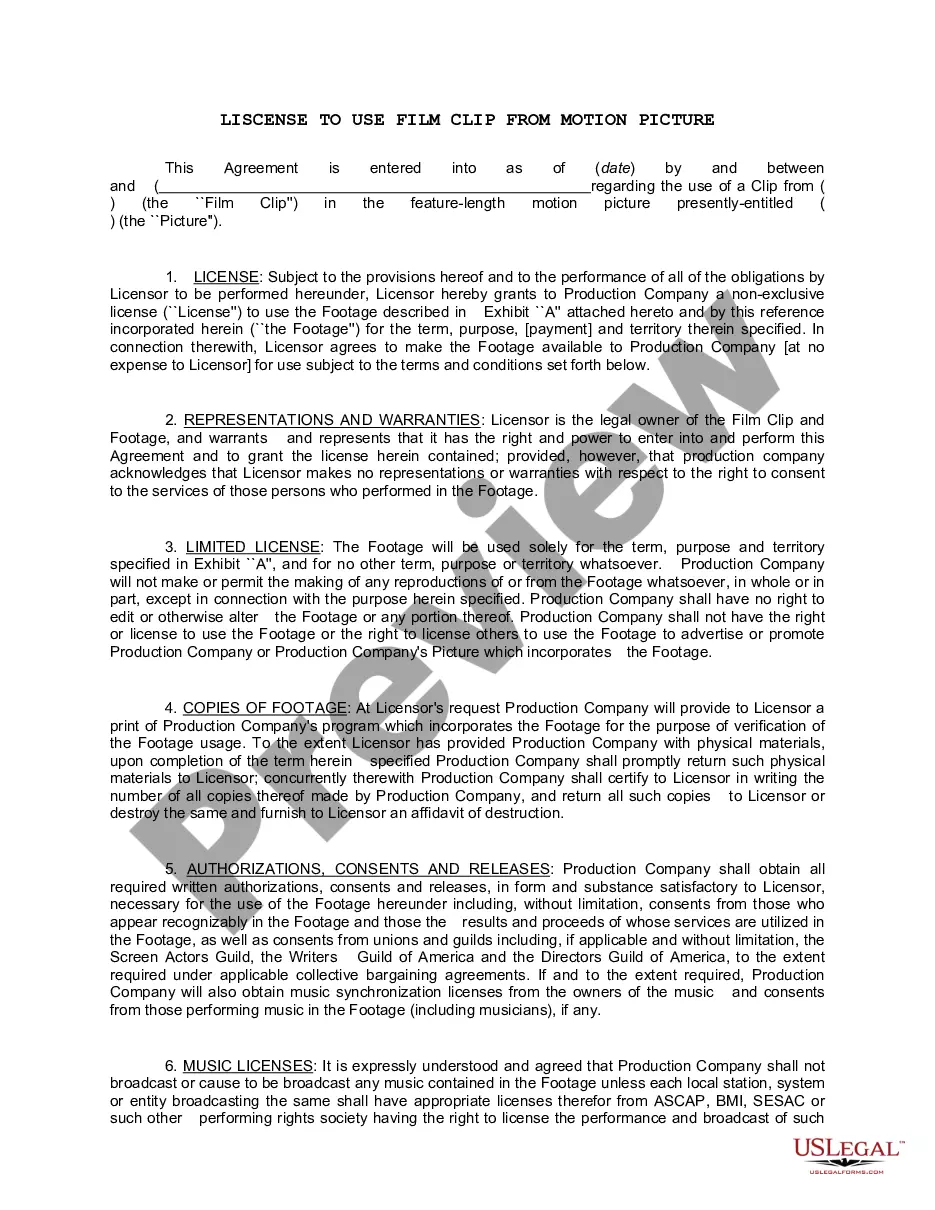
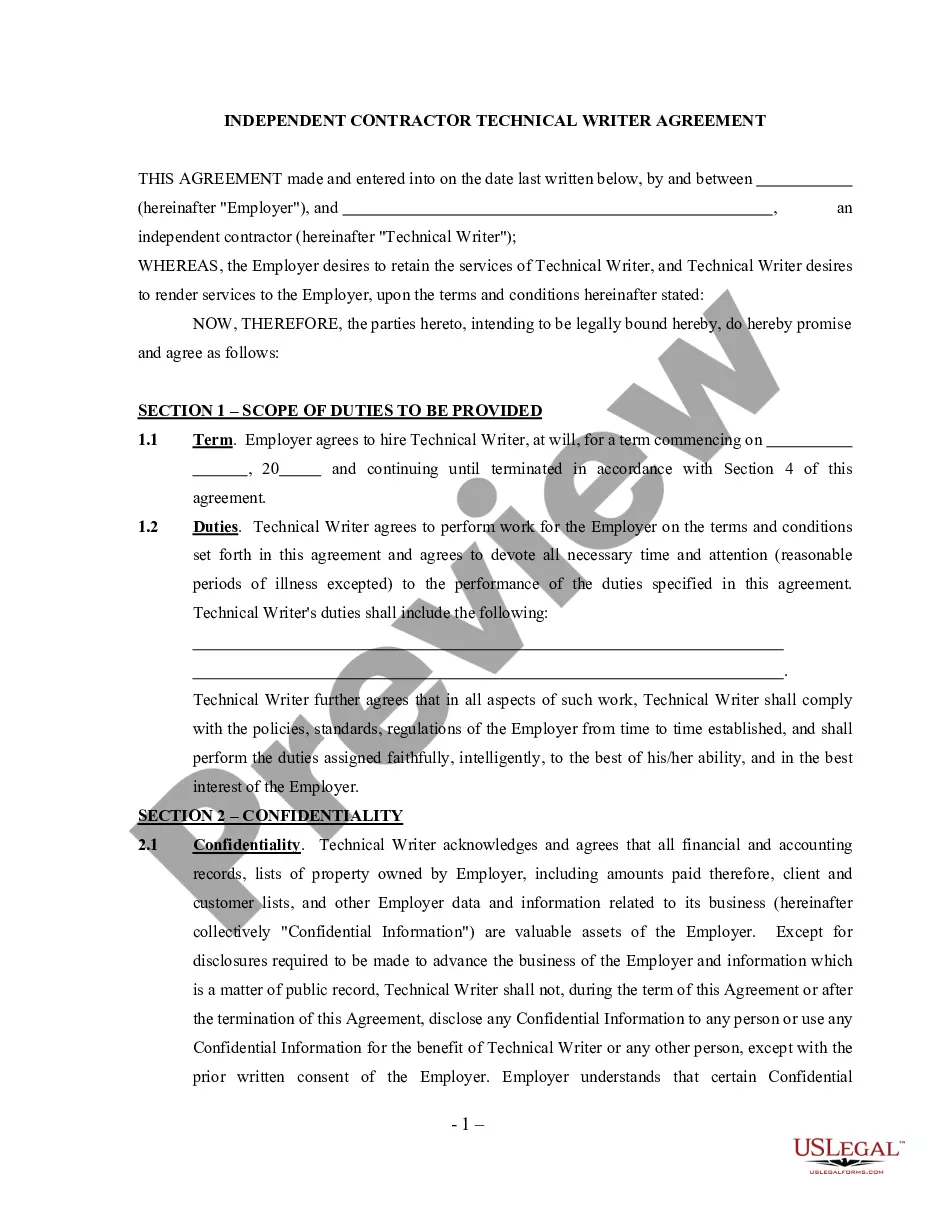
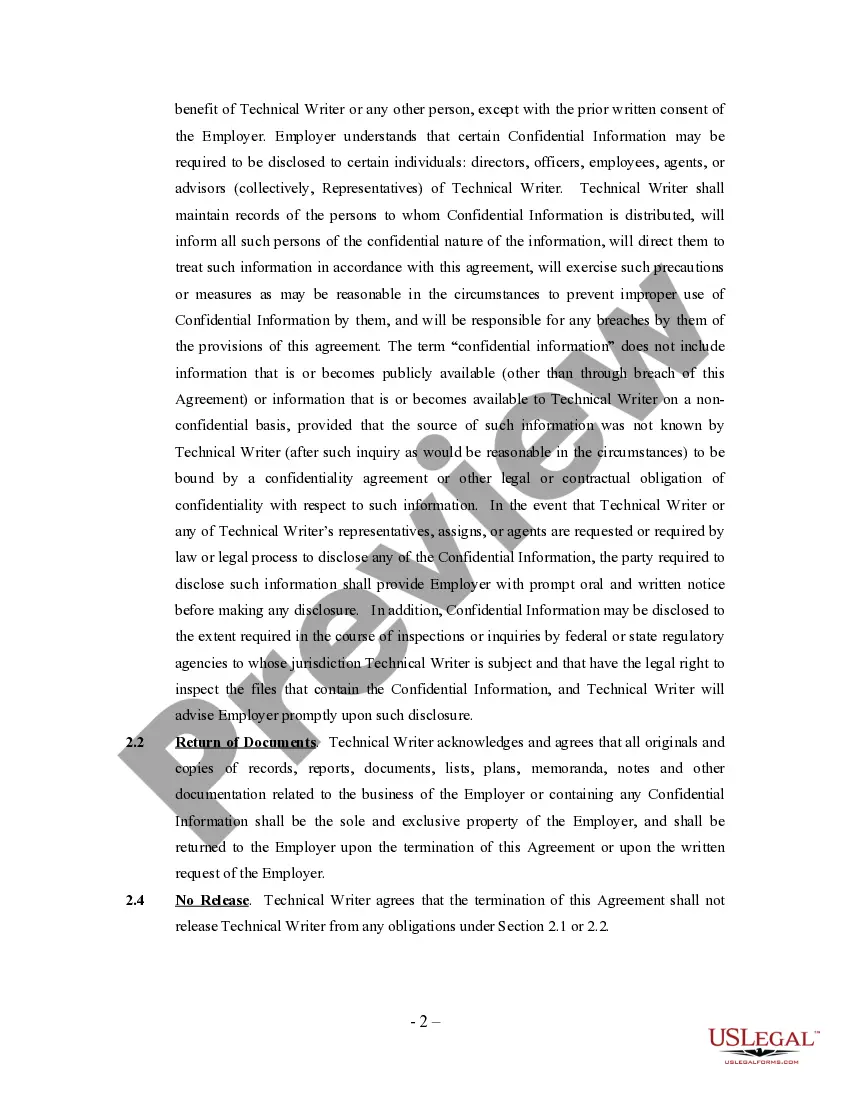
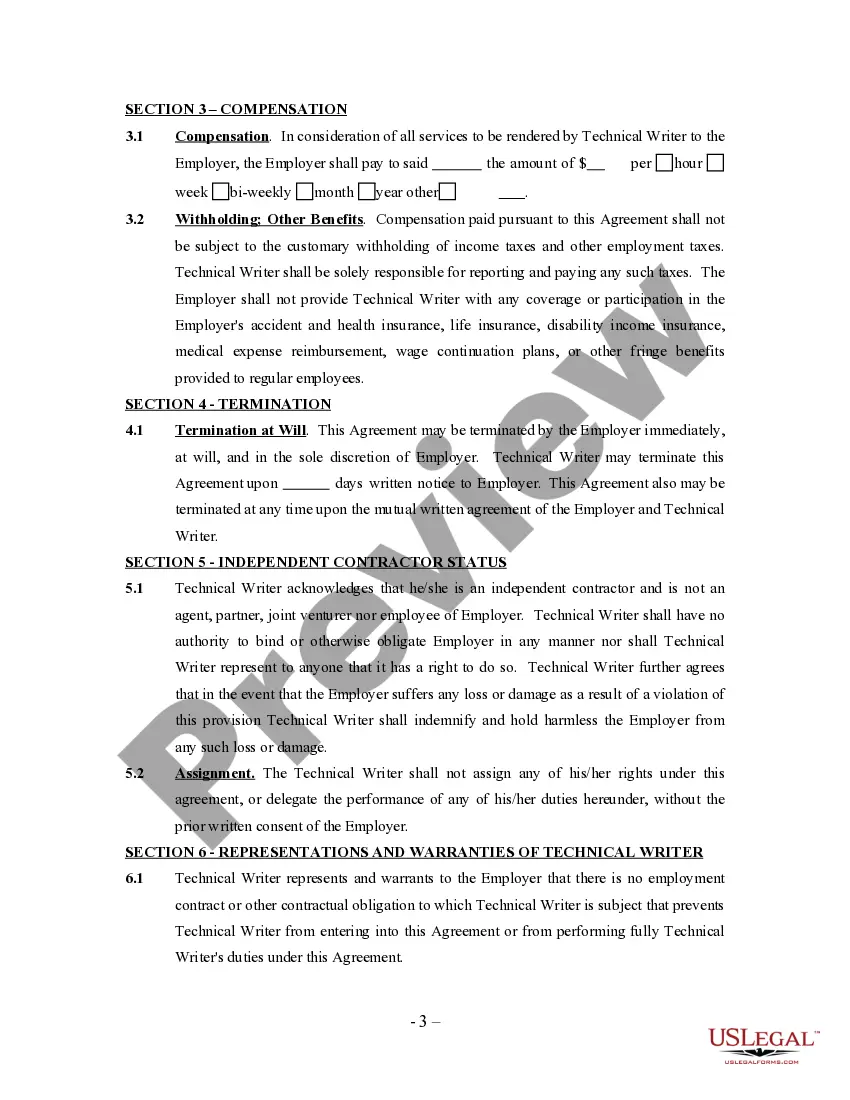
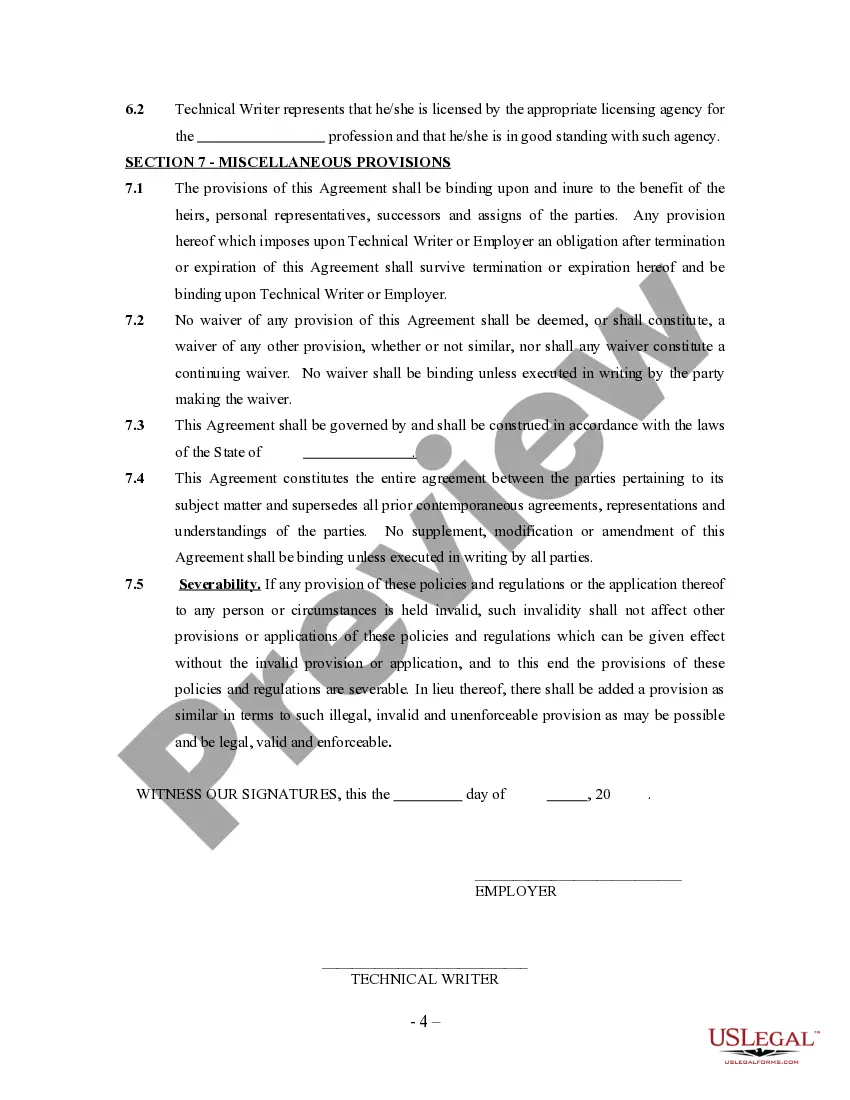
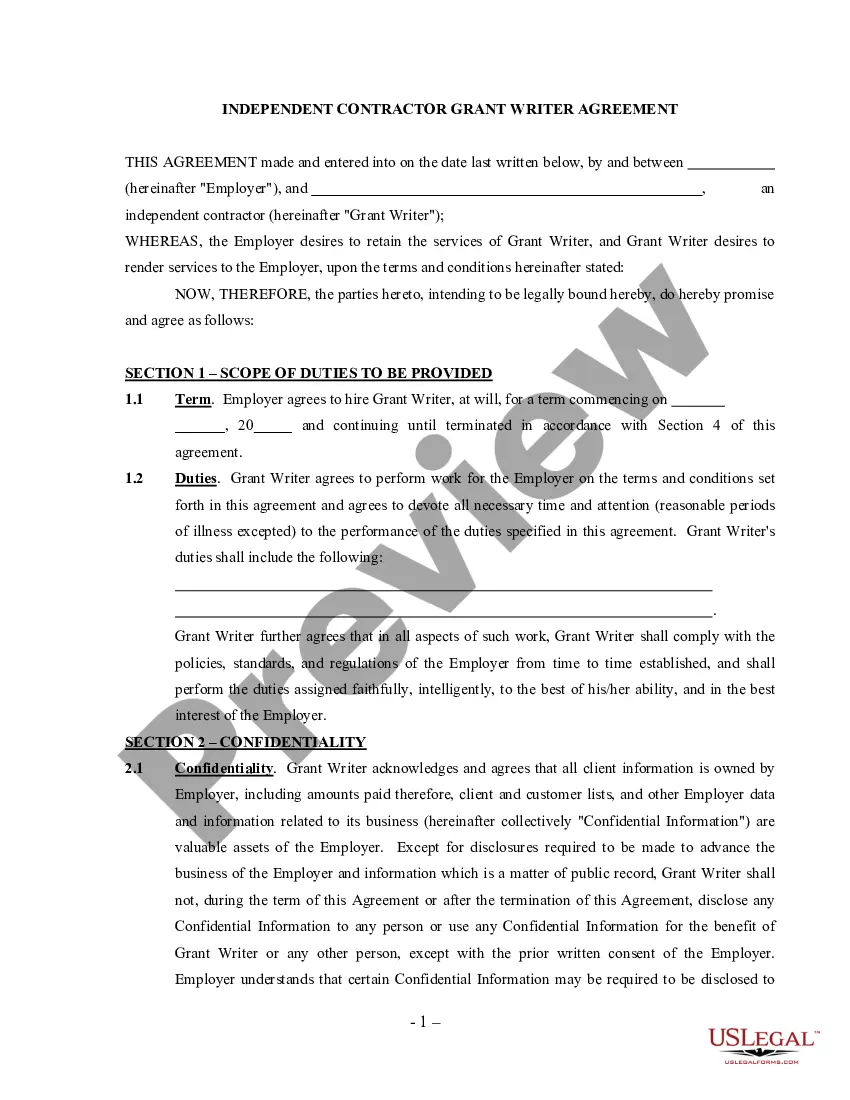
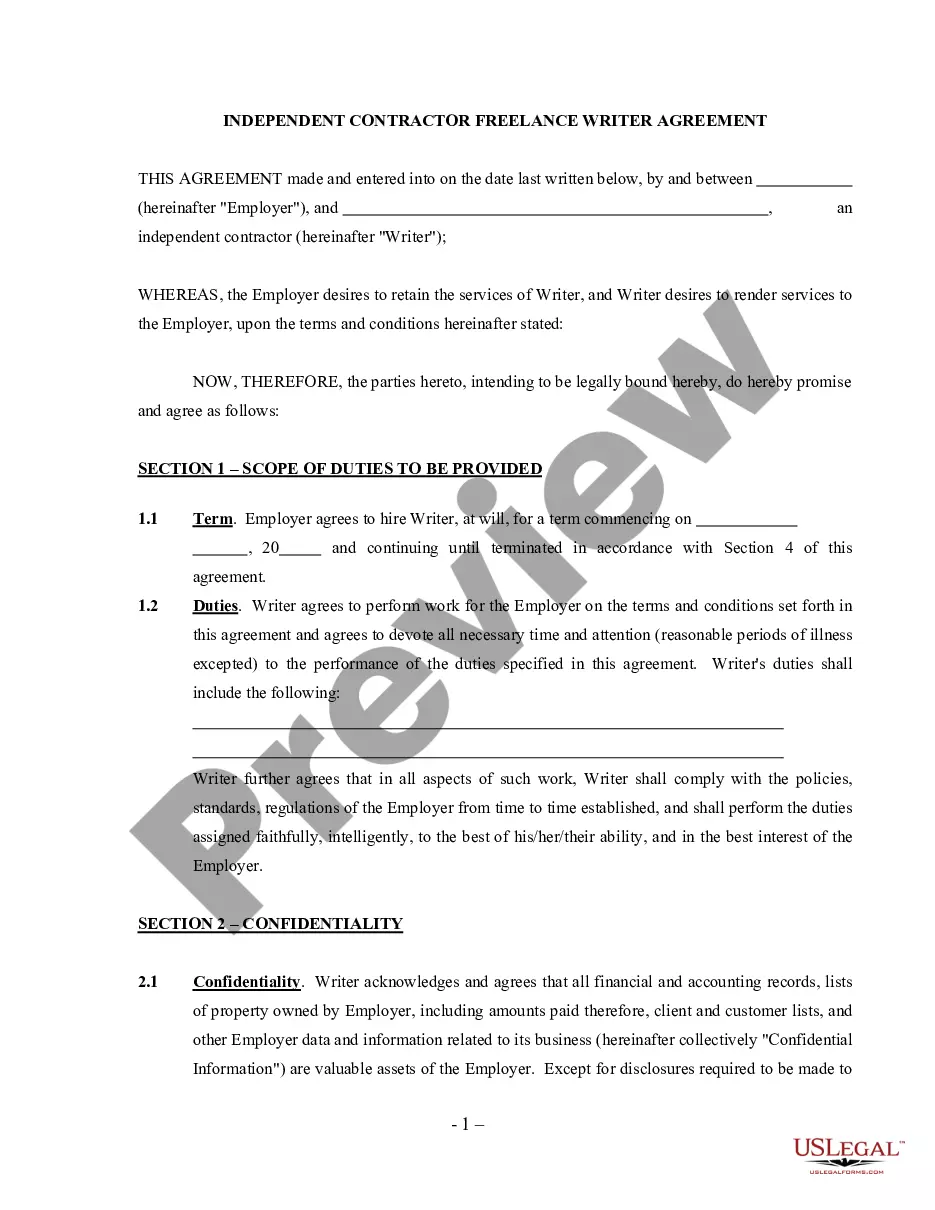
Employer hires a technical writer as an independent contractor as specified in the Agreement. Contract includes a confidentiality clause.
Florida Technical Writer Agreement - Self-Employed Independent Contractor
State:
Multi-State
Control #:
US-INDC-193
Format:
Word;
Rich Text
Instant download
Description
Free preview
Get your form ready online
Our built-in tools help you complete, sign, share, and store your documents in one place.
Built-in online Word editor
Make edits, fill in missing information, and update formatting in US Legal Forms—just like you would in MS Word.
Export easily
Download a copy, print it, send it by email, or mail it via USPS—whatever works best for your next step.
E-sign your document
Sign and collect signatures with our SignNow integration. Send to multiple recipients, set reminders, and more. Go Premium to unlock E-Sign.
Notarize online 24/7
If this form requires notarization, complete it online through a secure video call—no need to meet a notary in person or wait for an appointment.
Store your document securely
We protect your documents and personal data by following strict security and privacy standards.

Make edits, fill in missing information, and update formatting in US Legal Forms—just like you would in MS Word.

Download a copy, print it, send it by email, or mail it via USPS—whatever works best for your next step.

Sign and collect signatures with our SignNow integration. Send to multiple recipients, set reminders, and more. Go Premium to unlock E-Sign.

If this form requires notarization, complete it online through a secure video call—no need to meet a notary in person or wait for an appointment.

We protect your documents and personal data by following strict security and privacy standards.
Looking for another form?




How to fill out Technical Writer Agreement - Self-Employed Independent Contractor?
US Legal Forms - one of the largest collections of legal documents in the United States - offers a variety of legal form templates that you can download or print. By using the website, you can locate thousands of forms for business and personal purposes, categorized by types, states, or keywords.
You can obtain the most recent versions of forms such as the Florida Technical Writer Agreement - Self-Employed Independent Contractor in just minutes. If you have an account, Log In and download the Florida Technical Writer Agreement - Self-Employed Independent Contractor from the US Legal Forms library. The Download button will be visible on every form you view. You have access to all previously obtained forms from the My documents section of your account.
If you are using US Legal Forms for the first time, here are simple instructions to help you get started: Make sure to select the correct form for your city/county. Click the Preview button to review the form’s content. Read the form summary to ensure you have chosen the correct one. If the form doesn’t meet your requirements, utilize the Search field at the top of the page to find the one that does. If you are satisfied with the form, confirm your choice by clicking on the Buy now button. Then, select the payment plan you prefer and enter your details to register for the account. Complete the payment. Use your credit card or PayPal account to finalize the transaction. Choose the format and download the form to your device. Make edits. Complete, modify, print, and sign the acquired Florida Technical Writer Agreement - Self-Employed Independent Contractor.
- Each document you added to your account has no expiration date and is yours permanently.
- So, if you wish to download or print another copy, simply visit the My documents section and click on the form you want.
- Access the Florida Technical Writer Agreement - Self-Employed Independent Contractor with US Legal Forms, the most extensive collection of legal document templates.
- Utilize a multitude of professional and state-specific templates that fulfill your business or personal needs and requirements.
- Enjoy the convenience of having all your legal forms in one place, ready for you whenever you need them.
- Take advantage of the easy-to-navigate interface to streamline your form-filling process.
Form popularity
FAQ
The new independent contractor law in Florida aims to clarify the classification of workers, providing clearer guidelines on who qualifies as an independent contractor. It emphasizes factors like control, relationship duration, and financial investment. To navigate these changes seamlessly, consider employing a Florida Technical Writer Agreement - Self-Employed Independent Contractor to ensure compliance and uphold your rights.
In Florida, an independent contractor is an individual or business that provides services under a contract, enjoying control over how the work is completed. Key factors include autonomy in project execution and eligibility for self-employment tax. Utilizing a Florida Technical Writer Agreement - Self-Employed Independent Contractor can clarify your status and responsibilities as you work with clients.
An independent contractor must earn at least $600 from a single client during the tax year to receive a 1099 form. This form reports income earned as a self-employed individual, which is crucial for tax purposes. To keep track of your earnings, consider using a Florida Technical Writer Agreement - Self-Employed Independent Contractor that outlines payment arrangements and relevant details.
Yes, a freelance writer is typically considered an independent contractor. They operate independently, providing writing services without the continuous oversight or control of an employer. Engaging with a Florida Technical Writer Agreement - Self-Employed Independent Contractor is essential for defining the terms of this relationship, ensuring clarity and mutual understanding.
In Florida, an independent contractor agreement is a legal document that defines the relationship between a client and a contractor. It stipulates the rights and obligations of both parties, including details like payment terms and project completion dates. If you are a freelancer, a solid Florida Technical Writer Agreement - Self-Employed Independent Contractor can help you navigate this landscape confidently and safeguard your work.
The purpose of the independent contractor agreement is to outline the roles and responsibilities between the client and the independent contractor. This agreement clarifies payment terms, project scope, and expectations, ensuring both parties are on the same page. A well-crafted Florida Technical Writer Agreement - Self-Employed Independent Contractor will protect your interests and promote a successful working relationship.
Writing an independent contractor agreement starts with defining the work relationship. Include detailed descriptions of the services you will perform as a technical writer. Make sure to specify payment terms and any deadlines. For a comprehensive document, consider the Florida Technical Writer Agreement - Self-Employed Independent Contractor template on uSlegalforms, which provides a structured format tailored to your needs.
To fill out an independent contractor agreement, ensure you include essential elements like the scope of work, payment rates, and deadlines. Clearly outline your responsibilities and the client’s obligations to avoid misunderstandings later. It is important to specifically reference the Florida Technical Writer Agreement - Self-Employed Independent Contractor within the agreement for clarity. Using uSlegalforms can simplify this process, providing templates that meet state regulations.
Filling out an independent contractor form is straightforward. Begin by entering your personal details, such as your name and contact information. Include information about the services you provide as a technical writer and specify your business structure. For a Florida Technical Writer Agreement - Self-Employed Independent Contractor, make sure to clarify the payment terms and deadlines.
Whether freelance writers need an LLC depends on their specific business circumstances. Creating an LLC can provide personal liability protection and may offer tax benefits, making it a wise choice for many self-employed individuals. However, if you decide to operate as a solo proprietor, it's crucial to have a solid Florida Technical Writer Agreement - Self-Employed Independent Contractor in place to safeguard your work and clarify your business relationships.